

 Passport






Mangalitsa Hogs, Hops and Blue Corn!
11/15/18 | 26m 47s | Rating: NR
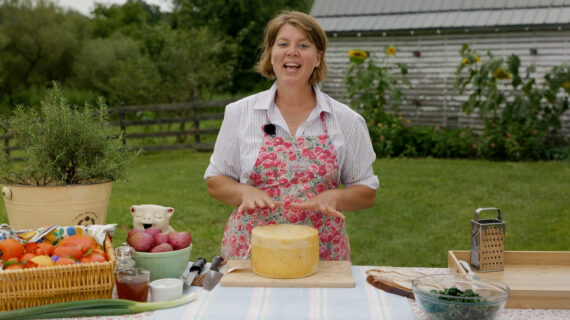
Inga welcomes a brand new calf to the farm and then travels to learn about Mangalitsa Hogs and discovers how to grow hops in Wisconsin. This week’s recipe Blue Corn Nachos for happy hour on the farm.


Copy and Paste the Following Code to Embed this Video:
Mangalitsa Hogs, Hops and Blue Corn!
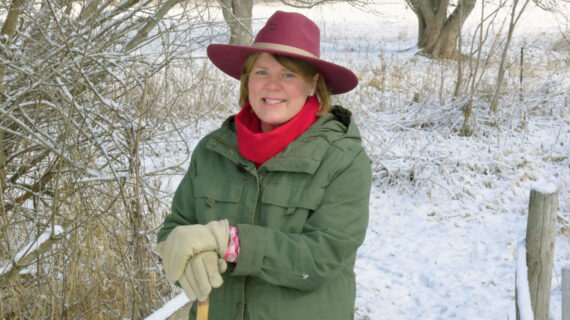
Welcome to the farm! Sharon here finally had her calf and it was a little heifer. I've invited some friends over to celebrate later on, with a little happy hour. For the ingredients, I went to Blue Farm Chips, and then it was off to Chickadee Hill, and finally, a stop at Saint Corey Hobbs. Gather with us, Around the Farm Table. I'm your host, Inga Witscher.
Sharon moos deeply
Muuurrr. Good morning, girls. I'm Inga and I love everything about farming. Midwestern farms are a bounty of good food made by good people. I love being able to travel to search out good ingredients. Cooking is all about what's seasonal, what's fresh. Every day can be filled with good food, good friends, and a beautiful herd of cows. Welcome to the farm!
affectionately to cow
Good girl! Around the Farm Table is funded in part by Wisconsin Farmers Union, United to grow family agriculture, Heartland Credit Union, and Friends of Wisconsin Public Television.
Sharon mooing deeply
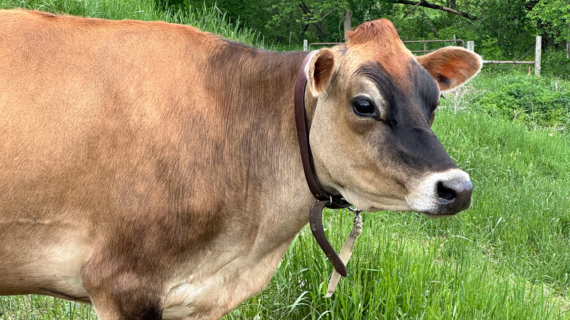
Muwwaaaaahhhh. When my cows get to calve on pasture. I really believe that sunlight is nature's disinfectant. So when the sun is hitting the ground, it's taking care of any germs and it's a nice, easy place for the cows to calve. I want to make sure after those cows calve that the calf gets up, it's nursing, which our little one is now, and most of all, that Sharon's taken care of and she's alert. I'm checking her ears
agitated "Mrrrrr!"
to make sure they're warm. You're okay, honey. And now, I'm going to go take her up to the barn and get her a nice drink of water and let her and her calf bond a little bit more. And then, I'll see you guys later for happy hour.
bright upbeat music
cornstalks crunching
I'm here in Janesville at Blue Farm, where Randy's growing some very special corn for his tortilla chips. Let's go say hello.
bright upbeat music
Hey, Randy. Hi, Inga! - Good to see you! How are you? - Good. Good to see you, too. Boy, I came down here to find about your tortilla chips, but now I want to know about this barn. It's gorgeous! - Well, thank you. If you'd like to see the inside, I can show it to 'ya. I would, thank you. - Let's check it out, yeah.
bright upbeat music
It's really fun being in this barn. It's beautiful. You guys have done a great job restoring it, but it must be fun for you to just see-- This is a part of your family's history. Yes, it was. I'm fifth generation to own this barn and it was built in 1901, I believe. So, it's well over a hundred years old and it was in disrepair, and we decided that we didn't want it to go down on our watch, this generation. So we started off with just what was going to be a repair. My daughter, Julianne, took it to the next step. And next thing you know, we put in a couple extra windows, put in a new floor, and some lighting, and a roof, and an air conditioner, and a few things. So now, it's a wonderful meeting spot. We've had some great gatherings here. So, why did you decide on blue corn chips? You've always been a corn farmer, right? That's correct, well, corn and beans. I had tasted blue corn before and it does have a better taste. It's just a more robust corn flavor that I really enjoy. It was unique. Not too many people were growing blue corn. It was hard to grow, so there wasn't going to be much of it around here. And so consequently, with it being unique and probably not going to have somebody else get into that market, we just decided to do that. And I love tortilla chips. I like Mexican food and it's all pretty tasty. So we just decided to take a unique product that we could grow ourselves and take it directly to market. And what are the ingredients in the chips? There's just three ingredients. It's just blue corn and sunflower oil and salt. That's all that's in there. Well, when you start with good ingredients, you don't need to put too much into it, right? Well, that's right, and it's all good stuff. It's all organic and we grow sunflowers, and we hope that we are going to be able to put the person that we sell our sunflowers to in touch with the people that are now making our chips. So we'll be doing the corn and the oil, just everything except the salt. Why did you choose organic? Was it something you always interested in, or is this another way to set yourself apart? Yeah, I think, that. We started in-- '91 was the first year I certified. So we started in '89, '88. And that was before people knew what organic was, really. That's true, that's true. When we would go out and sell the chips, you had to sell organics first and that was a tough sale when people didn't know what or why, or care. And so consequently, we ended up having to educate people about organics. Now, you don't have to do that. People understand organics and they seek it out and want it and it's easier to sell because it is organic. So, is local important to you, or do you want to distribute your chips nationwide? No, that's not what I want to do. I'm a local, local guy. Every state that touches Wisconsin is where we try to be in, in as big a way as we possibly can. We like to keep our food miles low. In Rock County, we have got single-digit food miles. The corn is here, the plant is five miles that way, and the stores are right here. So when you can a product to a place with single-digit food miles, that's a big deal. Well, this has been really fun. I'm excited to use these in my meal I'm making later on. Okay, well that'd be good, yes. Well, I'm going to grab some chips and then, I'll meet you on down the road.
mellow guitar music
pigs grunting
I'm here in Spooner at Chickadee Hill Farms. Sherry retired from the Air Force and now, she's raising hogs. Let's go say hi.
mellow guitar music
Hey, Sherry. - Hi, Inga! Nice to see you! - Nice to see you. Welcome to Chickadee Hills. - Thank you. I'm excited to come here. I know you've been farming here for a few years. I'm fascinated by your farm, but I'm also fascinated that your career before farming was in the Air Force! Yes, I was an in-flight re-fueler on a KC-135. That sounds scary.
Sherry and Inga chuckle
Well, never a dull moment, that's for sure. That's when you're literally in an airplane, filling up another airplane in the sky? In the sky, yes, that's right. I bet nothing on the farm, no pigs getting out, or anything like that can cause your blood pressure to rise after that kind of a career, I think. That's right, I don't get excited when the pigs get out.
Inga laughs
Well, I'd love to go take a look. Can I get a tour of the farm? - I would love to take you.
mellow guitar music
pigs snuffling and snorting
Well, I just want to thank you, again, for taking the time to show me this beautiful farm. How did you become a farmer? I'm really committed to farming and we moved here three years ago. When we move here, it was just a hayfield, so we've worked a lot at-- You've done a lot in three years! We've done a lot in three years, yeah. The house is new, the barn's new, all the fencing. So, we're always doing fencing, always seeding something. We did switch to no herbicides, pesticides, or synthetic fertilizers, as soon as we got the property. So I like to think that my soil's improving. We planted 50 apple trees for the pigs. I just recently planted mulberries, which is to feed chickens and then, the eggs are to feed the pigs. Yeah, we're just constantly trying to improve the land and the soil microbiology here. I think it's really important to the immune system for all of my animals to do that. And I love seeing the diversity of the animals. The chickens, the ducks, the guineas. It's nice to have a diverse ecosystem on your farm, isn't it? It really is. We kind of need a manure spreader, but I think that my guineas might be doing that for me. I like to think that they are. They're in the hayfield all the time. It does seem to all work together. Did you always know you wanted to really focus on hogs, or that just came naturally? Well, no, I don't think we wanted to focus on hogs. My first animal was a horse; I do love my horse. And I've always had chickens. The hog is so versatile, though, it's so versatile. And I know that I can raise a lot of things on this property that a hog can eat. For example? Well, the first season that we lived here, we planted 50 apple trees. They're not mature yet, but we do go to our friend's house and pick not a few apple trees, but a lot of apples. Pigs love apples. - They love apples! Also, there's a farm near here. They grow pumpkins so after Halloween, we go and get pumpkins by the tons and tons. Hazelnuts, we bring in for the pigs. We've also planted some plants here. We have some very nice mature ones on the farm, but we also planted some new ones. And we rotate them under the oak trees for acorns in the fall. I suppose the meat be so delicious and so different than say, just a regular pork steak that you get at the grocery store. It's not even close to a pork chop from the grocery store. And I do believe that feeding them influences the taste. I think the Mangalitsa's pretty tasty, almost whatever you do to it. But I think that we improve the flavor here by the way that we feed it our self. Where are they from? - They're from Hungary. They're like a natural national treasure in Hungary. They have Mangalitsa festivals. - Wow. Yeah, it's a really important pig in Hungary. And they do okay, here in the Midwest? They're wonderful for this environment. That is one of the main reasons that we chose them. It's really, really cold winters here and I didn't want to have to fight my environment, any more than necessary. So they have the nice big fat cap on them, and they have an undercoat, and they have a top wooly coat, and they really do exceptionally well in the winter. They don't love the summer, so we have nice, big wallows for them and a lot of water, but they really do exceptionally well in the winter. That's one thing people will often say, that pigs are dirty, but they're really not. They're just wallowing so they can get cooled off. Yes, that's absolutely right. They cool by evaporative cooling, so the mud stays on their bodies longer than just plain water. So if they have mud on there, it takes some time for that to dry out and as soon as it's not cooling them anymore, they go get back in the mud. I'm excited to see you're grazing here. I love grazing. One of the reasons why I wanted to become a dairy farmer is to graze the animals. And what you're planting in your pastures, it looks beautiful out there. What exactly are you planting out here? Well, we do a huge polyculture. When I plant, it's at least 12 different seeds, but often times, it's much more than that. For instance, I use a Brassica blend that's got almost that many seeds in it, alone. I always plant as many legumes as will germinate in this temperature. They all love red clover, so I'm heavy on the red clover, but I usually do sunflower, which they like a lot. - Interesting! Yes, hairy vetch, usually some Timothy, a lot of grasses, as well. Orchard grass, they love. Sometimes, some corn. They like a nice young corn plant. But it's really a wide variety of things that we plant here. That's really exciting. Well, I'm going to help Sherry take the pigs out to some new pasture and then, I'll see you on down the road.
easygoing guitar music
I'm here at St. Croix Valley Hops. I'm going to find out from Eric how he's growing one of the most important ingredients of our happy hour celebration today, hops, to make beer. Let's go say hi.
easygoing guitar music
Eric, thank you so much for having me out into your hops field. I think they're so beautiful, seeing them growing like this. Yeah, well thank you for coming. So what exactly are hops? Well, the hop plant is a herbaceous perennial, so it dies back to the ground every year. It grows off a rhizome, similar to say, a peony plant out in your garden. But it's growing for the flower, which is the cone, which you can see here. And that is what's actually used in making beer. Are there different varieties that have a different flavor? Well, there's probably hundreds of varieties of hops. Probably two main veins of hops. There's American lineage, which would be your citrus flavors or European varieties, which would be peppery, more earthy. Were hops something that has always been grown in Wisconsin? Yeah, as soon as immigrants started showing up, the hops would have been grown if they were brewing beer. It seems to me like there's a lot of breweries popping up here in Wisconsin. With the last influx of brewing, we have seen a need for local hops and interest in what local product can do to a local beer so that coupled with education on the horticultural side, we can handle the disease pressures. We know what's going on with the plant, which we didn't know a hundred years ago, so we're able to grow the crop here in Wisconsin again. So how does it grow? 'Cause it looks like it takes a lot of effort to get from the ground. How high is it? So I'm on a 16-foot Trellis. Usually, commercially, it's 16 to maybe 20 foot of Trellis. They'll grow taller, up to 30 feet a year. Wow. And so you just cut 'em down in the fall and harvest them? So they're cut down in the fall, at harvest. All the hops are cut and taken to a machine to be picked, basically, picked and cleaned. You strip everything off the vine and then, the machine sorts out leaf material, stem material from the hop cone. And then, it just grows back up the next spring. It starts in the spring. We start mid-April pruning for a training date. And around mid-May, depending on variety, we train it to the string and by mid-July, it's at the top of the wire. That's fast growing. It grows really fast, it hits the top of the wire, sends out side-arms and then from there, it sends cones. Is this a good crop for somebody looking to diversify their farm, maybe, to add some value to their land? You make it sound like it's easy to grow. It's very hard to grow and it could be a good fit. It's very time-consuming, especially in that spring training period and in the fall at harvest time. I've got three acres of hops we'll be harvesting, this fall. And we'll work for a month straight, harvesting those three acres. - Wow, wow. Yeah, it's very labor-intensive, along with capital-intensive. Yeah, oh well, for sure, yeah. And how many years can you grow in the same spot? Theoretically, up to 20 years, probably, or longer if your plants are in good health. Realistically, hops are changing varieties. Our brewer's interest and the public's interest is changing very quick right now. So realistically, you're probably five years, six years, depending on the variety. There's some old standards that you'll keep growing, but a grower has to be ready and willing to change. I just think they're so beautiful to look at. I'd love to have some 'cause I'm growing up my barn. I used some, actually, in my wedding bouquet. And I just think, ornamentally they're just gorgeous.
Eric laughs
Well, our background is in the cut flower industry, so that's how we jumped into the market. We had wholesale florists looking for hot vines for wedding work. And, actually, right now, the garlands and long streams are something that is very hot in the industry. So hops just fall right in there. They can either be used for a garland, the whole vine or just taking and making boutonnieres or adding, you know, just enough plant material into a bouquet. Well, I'm looking forward to enjoying some of these hops, down in Bobtown, at the brewery there. So thank you for spending time with me! Well, enjoy yourself there.
twangy bluegrass music
Katie, thank you so much for taking the time to teach me a little bit about beer. I like drinking beer, but I really don't know a whole lot about it and you're the brewer here at Bobtown. So, tell me a little bit about why you wanted to start brewing beer. I started brewing beer out of college 'cause I liked good craft-beer and I wanted to be able to have, maybe, better access to it. I really fell in love with the process, though, almost as much as the end product. So, that was how it started and then I've been a professional brewer here for about three years. Congratulations! That's exciting! - Thanks. So I was just up learning about hops and now, I wanted to just taste it. And these are all different colors, they're all going to taste a little bit different. Mm-hmm, all beer needs hops. If you didn't have hops in beer, and this is our lightest beer, probably our least hoppy beer. - Tastes smooth. But there's still a little bit of hops in there to balance out the sweetness that the malts put in beer and create in beer. And you can mix-match the flavor, depending on the amount of hops? Yep, so your lighter beers, they have just a little bit of hops. But you have those hoppy beers that people talk about. Like a IPA or something. - Yeah. Yep, those have a lot more hops in it. That's, like, the one fancy beer name I know. Yeah, IPA?
Inga and Katie laugh
Mm, so when I was up at the hop farm, we were smelling the different hops, we were crushing them in our hands, and just getting that aroma. And it was amazing how each was just a little bit different and somehow, that citrusy flavor. Do you use a lot of different hops just to get the flavors that you want? Yep, I use probably I'd say about 10 or 15 different varieties of hops, so this beer that you just had, that has a hop that has a good amount-- kinda of a black tea character. So it doesn't necessarily even have to have that citrus. A lot of them do. The first beer you tried, I'm looking for more of a lemon character in that. Just a subtle, you know. Some people will have a lighter beer and they'll put a lemon in it and I wanted that effect, without having to add that lemon. Right! - And then, of course, our hoppier beers will have grapefruit peel or some hops even maybe you get a little bit of blueberry or mango or papaya aroma to it or flavor. Interesting. If that's what you're looking for. How important is it for you to find local hops? For us, it's very important. We're a small enough brewery that we can really, kind of, use those boutique local hops. They're sort of a fresh ingredient and they have a shelf-life. And it's important to me that I can get an ingredient that I add in my beer that's just-- Right up the road. - Right up the road, yeah. Interesting, so what's the process, when you're making the beer? It's the grain, it's the hops, and water, basically? Yup. The grain, I steep the grain. Crush and steep the grain in hot water for about an hour or so and that creates that sugar water, basically. It's colored at this point. So the different colors depends on the malts I use. And then, during the boil process, where you're actually just evaporating some of the water out of that liquid, that's when you add the hops, at different times. The first hop addition would be the bittering addition and that's where you get the bitterness, in your beer. And then later on in the boil, right towards the end, when you turn off that heat, you get more of the aroma. So how long will these stay in, what is it called, the? Fermentor?
Inga
Fermentor, yeah. From the time I crush the grains until they're on tap, it's about three weeks. So I usually have them in the fermentor 10 to 14 days. Well, thank you so much for the opportunity to learn so much and congratulations on some great beer! Thank you. - Cheers.
warm country music
Inga
For happy hour, I decided to take the girls a little south of the border by making them some pork carnitas nachos. So for the pork carnitas, what I did is I put a pork shoulder roast in a Crock-Pot last night. And then, I added some onions, fresh squeeze of orange, a lime, and a little garlic and then, I added some beautiful spices and let that all simmer in a lot of beer for about eight hours. And that's what's going to make the pork nice and tender.
warm country music
Inga
Once I took it out of the Crock-Pot, then it was this beautiful, beautiful pork that's seasoned perfectly, but I wanted to add a little bit more zest to it, and that's what I'm going to do now. So I'm going to add a little bit of olive oil to my pan, and then, some fresh garlic. This came right out of my garlic patch and since it's so fresh, I'm only adding a few cloves. Eating garlic fresh is a whole different experience than when it's stored over the winter months. And that's why I'm just using a few. Usually, I use about 45 cloves in everything. Get that beautiful garlic smell going. And now, I'm just going to put the pork carnitas right inside. Here.
pan sizzling
Inga
Smelling good. Give those a stir around. And then, I'm going to use a little bit of chili seasoning. If you'd like, you could use taco seasoning, or our own personal seasoning works fine, too. Just stirring the seasoning enough to get the flavors cooked in. It's a nice hot day outside, but we got the AC rollin' in here and I think that these nice, spicy flavors are going to go perfect on a hot day. Okay, I saved some of my cooking liquid from the Crock-Pot. I'm going to add a little bit of that to it for a little extra flavoring and that's going to make it nice and moist, too. That looks good.
pan sizzling
Inga
Cook that down for a few minutes until some of that moisture has evaporated. It's smelling delicious inside this kitchen! And then, I'm just going to add a fresh squeeze of lime for some brightness. And now, I can assemble my nachos! So when I'm building the nachos, I like to build them in lots of layers because the best part is a lot of cheese. And I love it that we're using these beautiful, blue corn chips because it's visually pleasing, and it's exciting, and they're coming from right here, in Wisconsin, along with the pork. I'm going to use my tongs so I don't burn my fingers. So I'm going to sprinkle a little bit of the carnitas here. The ladies that are coming out today are all somehow related to the food industry. So we have another farmer coming out. We have some ladies who have a food space, a community kitchen that they have people come cook at. And we have a chef and a wonderful artist. And it's important to have good friends to get together with so you can blow off some steam and talk about things that you're all interested in, like good food and farming. So I'm excited to be able to tell them all about the ingredients that we picked up today 'cause I think they'll love to hear about what we have in Wisconsin. I'm going to do plenty of cheese. Lots of cheese on top of that. And then, more chips. I'm kind of tired of eating dainty little foods. I need something really greasy and really delicious to serve, today, to my friends. Put some more blue chips here. And some more of the pork carnitas. I think this is a fun way to use up the pork shoulder roast, too. I've just been mostly Crock-Potting them with some apples and different fall flavors, but this is a fun summer recipe, or you could have it in the fall, as well. I suppose it'd be great when you're sitting in front of the football game, having some pork carnitas with some delicious blue corn chips and nachos. Load these up. And have plenty of napkins on hand 'cause it's going to get messy. Dun dun dun da-dun dun da-dah And you can add anything. We grew up vegetarian, so we never got to have loads of meat on our nachos. It was just black beans or tofu or something. So, use whatever you have available, whatever style of eating you have. Now, I've got freezers full of meat that I raise here on the farm. So I'm always trying to figure out different ways to use it up, which is a good problem to have. My parents won't come over for dinner 'cause they're still vegetarian, but that's alright. And then I'm just going to load that up with more cheese. And I just have a blend of cheese, here. Just some Monterey Jack and some beautiful cheddar. And that's how easy making nachos is. I love cooking in Crock-Pots, too, because then it's so easy to do the dishes. I can throw everything in the Crock-Pot before I got out and milk cows. And everybody's happy. It's a win, win, win, win, win. I'm going to put these in the oven and then, when we get to the table, we'll fill 'em up with all of our favorite nacho fixin's.
bright folksy music
Inga
Serve your pork carnita nachos with peach and tomato Pico de Gallo and homemade guacamole. Bacon-wrapped jalapeno poppers are delicious on the side. Watermelon, with a spritz of lime, is so refreshing. Fresh tomato juice, beer, and some south of the border spices give this michelada a perfect kick.
women laughing
Inga
Well, I hope this has inspired you to have a little happy hour on your farm, and I hope you'll gather with us next time,
Everyone
Around the Farm Table! I'm your host, Inga Witscher. Thanks for coming, ladies. - Cheers.
Cheers. - Guest
Cheers.
women laughing, glasses clinking
Cheers. - Guest
Around the Farm Table is funded in part by Wisconsin Farmers Union, United to grow family agriculture, Heartland Credit Union, and Friends of Wisconsin Public Television.
Search Episodes
Related Stories from PBS Wisconsin's Blog



Donate to sign up. Activate and sign in to Passport. It's that easy to help PBS Wisconsin serve your community through media that educates, inspires, and entertains.
Make your membership gift today
Only for new users: Activate Passport using your code or email address
Already a member?
Look up my account
Need some help? Go to FAQ or visit PBS Passport Help
Need help accessing PBS Wisconsin anywhere?

Online Access | Platform & Device Access | Cable or Satellite Access | Over-The-Air Access
Visit Access Guide
Need help accessing PBS Wisconsin anywhere?
Visit Our
Live TV Access Guide
Online AccessPlatform & Device Access
Cable or Satellite Access
Over-The-Air Access
Visit Access Guide




Follow Us