

 Passport





Local Food with Local Friends
10/31/19 | 26m 47s | Rating: NR
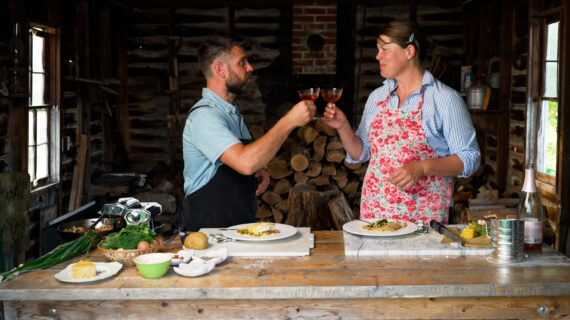
Inga cooks a meal made entirely of ingredients produced by local friends. She learns about urban beekeeping from a beekeeper whose hives are all located in yards and gardens in the city of Eau Claire. She then picks up some grass-fed beef from a farming family in Neillsville, and pays a visit to a friend who is growing garlic near Fairchild. She hosts a barbecue for her friends at the farm


Copy and Paste the Following Code to Embed this Video:
Local Food with Local Friends
Narrator
The following program is a PBS Wisconsin Original Production.
upbeat folksy music
Narrator
Welcome to the farm. Summer's here, the weather's warm, and the cows are out grazing, and that means it's time to celebrate with some local farms and some local friends. Today, I've invited some folks out for supper here at the farm. For ingredients, I'm heading into Eau Claire to get some honey from my friend Drew, and then it's out to Haly's for some Murray Grey beef, and finally I'll be ending up with my friend Nick to pick up some green garlic, and then I'll invite them all back here for a delicious supper.
Gather with us Around the Farm Table. I'm your host, Inga Witscher. Come on, girls. Good morning, girls!
I'm Inga, and I love everything about farming.
upbeat folksy music
Narrator
Midwestern farms are a bounty of good food made by good people. I love being able to travel to search out good ingredients. Cooking is all about what's seasonal, what's fresh. Every day can be filled with good food, good friends, and a beautiful herd of cows.
Welcome to the farm.
Inga to cow
Good girl!
Announcer
Around the Farm Table is funded in part by
Wisconsin Farmers Union
United to Grow Family Agriculture, Heartland Credit Union, a gift in memory of Wendy Bladorn, Focus Fund for Wisconsin Programming, and Friends of Wisconsin Public Television.
upbeat folksy music
Wisconsin Farmers Union
I'm proud to be a fourth- generation dairy farmer and a fourth-generation grazer. I grew up on my dad's dairy farm out in Washington state, and we grew up grazing cows, and that's still one of my favorite things about farming now and also, that I get to farm with my dad here on the farm. Thank you so much, Ingaborg. - You're welcome.
Well, thank you for coming out and being my free labor. Right.
laughing
Wisconsin Farmers Union
One thing you taught me about grazing is just the benefits to the land and the economics of it. The economics is a big deal, but the milk production surpasses anything I did in confinement.
Inga
And it's cheap feed.
Ricky
It's inexpensive feed in a way, but it's the best feed, because you can harvest it right when you need to harvest it. You're not harvesting it so it fits into your plan for equipment, like if you're making silage, you could chop it really fine so it goes through the system. That's not good for the cows; they--
Inga
They need the roughage. Also, one thing I find this spring, we've had such a wet year here, and now I'm almost all the way through my rotation, so I don't have to worry about those muddy spots in the pasture because these guys, they've got more horsepower than some of those tractors when it comes to getting around. 'Cause this is your second crop already when corn's not even being able to plant it. And I like doing this too because I love being out here with the birds.
This is a great habitat for the birds and the bees, and all those things that we need in our ecosystem. They're all alive; the soil is alive below us here. Well Dad, I'm gonna let you watch the cows and I'm gonna pick up some ingredients for our supper later on. I can't wait.
cheerful folksy music
Inga
Backyards across the city of Eau Claire are buzzing with activity, thanks to my friend Drew, who's been working with local residents to promote the practice of urban beekeeping. I visited Drew while he was tending to one of his hives to find out why backyards are ideal places to produce honey. Hey Drew! Oh hey, Inga, how's it going?
Good, how are you doing? - Good. I'm gonna stay back from the bees. Yeah, no problem.
I'm just finishing up, so they should be going back into their colony pretty good now. If I get stung by a bee, I swell like crazy and I don't need to swell any more. Yeah, you know I haven't swelled up much. One time I got stung by about 40 bees and it was fine.
- Jiminy, lucky. Yeah, some people get lucky. So this is the first time that I've been in a backyard, in Eau Claire, in a neighborhood, and seen bees being kept. I usually see 'em way out in the fields.
Absolutely, yeah. We do both. The reality of it is, is that we've seen that bees do a little bit better in the city actually. - Really?
Why is that? Well, there's a lot of reasons. There's a bit more diversity in the types of flowers blooming. Bees need constant food, and so any time that there isn't something flowering in their immediate area, they're having to tap into their reserves and so in the city, there's people's gardens, there's dandelions, there's trees blossoming and all kinds of stuff, and so that coupled with, I think that people who have beehives in their backyard tend to do a little bit more watching of the beehive than maybe if it's out in a pasture and kind of sitting.
Right.
upbeat folksy music
Inga
So what made you passionate about doing this? 'Cause you passed the bill in Eau Claire to be able to do backyard beekeeping. Right, so funny enough, I came to it through a couple of different means. But I was doing art in around 2010, where I was making collages out of beeswax, and my now-wife was working on a project with some geography professors at UW-Eau Claire, learning about bee mortality and she slowly, we won't say conned, but she convinced me to get a little bit more involved, and as we started going through the process of keeping bees there, we learned that keeping bees in the city of Eau Claire was technically illegal, so we ran a petition drive, gathered about 5 or 600 signatures from residents, and then over the course of about two years, I sat down with the sustainability commission and then inevitably with the city council, passed a resolution to be able to keep bees in backyards.
Why are you passionate about that? It offers me a chance to interact with the world on an environmental level, on an agricultural level. It might not sound relaxing, but there's something really relaxing about being in a cloud of thousands of bees. That does not sound relaxing.
Yeah, you know you have to learn to let go of some anxiety and move slowly and consciously. I tend to be very fast-paced with a lot of my life, and so when I go to the bees, I really have to push most of that aside and say, "I'm gonna take the time to do it right." And as long as I'm not in a rush, then the bees really don't mind me being there. That is so interesting. I know there's a lot of different kinds of honey, and we always see a wildflower honey or things like this.
What is the difference there? Sure, honey is really localized. Honey bees forage somewhere between three and five miles around their colony. Oh, that's not a lot really.
No, it's a pretty tight area. So in Eau Claire, we have hives on the north, south, and east side of town, so you get really different flavors. Depending upon what they're foraging on, it's gonna change the color of the honey, it's gonna change the viscosity, the flavor is really gonna change. We know that there's problems with bees and we need bees, obviously.
What are some ways that we can, even in our backyard in town, what are some ways that we can help support the bees? Sure. I always say, leave the dandelions first of all. I hate mowing my lawn, so I've got you covered there.
You know, I think there's a couple of things you can do. Obviously, planting gardens and having flowers available is really important. Being conscientious about how you use pesticides. Pesticides are a really big problem with not only bees, but birds and a lot of other species that go up the food chain.
And then beyond that, just supporting local producers. Whether it's the local beekeeper or the local dairy farmer. People who are growing in your area are doing it for the benefit of your community, and supporting them helps support the bees. Well I would love to get some of your honey, Drew.
Absolutely, let's go down to my favorite place to get it. Awesome. - Yeah.
cheerful folksy music
Inga
Hey, how's it going Wes? Good to see you. Could I get two jars of honey please? Awesome.
Thank you. Well this is fantastic. There is nothing more Wisconsin than getting your local honey at your local bar.
Drew
We think so too. Would you guys like to come out for supper later on? You and your wife? - Yeah, that'd be great.
We'd love to join. - Great. Well, I'd love to stick around here and have a beer, but it's time for us to head out and learn about some Murray Grey beef cattle.
cheerful folksy music
Drew
Hey boss, come on big girls!
Inga
Just outside of Neillsville, Haly and Joe are raising a family and a herd of Murray Grey cattle on the rolling hills of their family farm. I came to meet Haly out in the pasture to learn more about this unique beef breed and to pick up some steaks for our cookout. Hi Haly! - Hi Inga!
Nice to see you guys. Nice to see you, I'm glad you're at the farm today. Thank you, and you have a little one with you today. Yes, this is Eden.
He's just about a year old. You know, I started out farming when I was this age. I was on my dad's back, that's how I learned how to do pasture, so he's already learning probably. Yes, he is.
He takes in everything Mom does. Hopefully it's all good. - Good! This is nice to be out here, seeing your family, working with the cows in this beautiful valley.
This is how I want to spend my days. This is why I farm. Yes, you've picked a great spot and a great day to be out here to see our Murrays. These are beautiful cows.
This is the first farm I've been to with Murray Greys. Can you tell me a little bit about them? Sure, so Murray Greys came from Australia, probably in the early 1900s. It was a cross between Angus and a Blue Roan Shorthorn.
They kept having the similar types of calves that came out of it, so that family kept breeding for that same look. And here we are, however many years later, and the Murray Grey's a recognized breed; it's a breed that's known to do really well on pasture. They look in good condition. Yeah, they're coming out of winter well.
I think sometimes people think, "If I just have grass-fed cows, "they're gonna be a little bit under-conditioned." People will tell me all the time, "Your cows are too skinny," but no, they're just grazing cows. They're just not carrying any of that extra weight. Yes, and they're so much healthier for it. I mean, better feet and legs, better overall body condition when it comes to calving.
All those things are great. Why did you choose grazing?
Haly
So we really wanted to do grazing because it's just the lifestyle that we want to live. We want to be outside in the pastures; we're not interested in being in the barn all day, and so that's the type of job that we want to have and so we kept trying to work our way towards being able to do those daily tasks. So how did you find yourself becoming a farmer? Well I did not grow up on a farm.
I grew up in northern Wisconsin, where there really wasn't much farming at all, but after high school, when people are thinking about what do they want to do with their lives, I put the things together that I really like to do, which is I like to work with animals and I love to be outside. And so I started pursuing agriculture, the farming aspect, and it lent myself to going to River Falls for animal science, and I took a lot of internships out West, in Wisconsin, on different types of cattle operations and lo and behold, I met my husband, whose family had a farm in central Wisconsin, and we got married, and now we both get to work on the farm together and raise our kids on the farm. That's wonderful. It's always great to hear about people who didn't grow up farming that become farmers, it's a wonderful story.
Yes. I'm a big advocate of people trying things for the first time, especially when it comes to agriculture. I don't think that people should be afraid to jump into those things if they would like to have animals of their own. I think it's something that anyone benefits from knowing where their food comes from.
Sure, sure. I've been really thinking a lot just how important our local food systems are, and you're direct marketing your beef. You're able to provide this area with locally raised beef. Why is that important to you, to be able to do that?
I think it's important for me to have customers that I can partner with that look at what we're doing on the land and find value in it. - Right. So if they're looking at the soil that we're building, the land that we've taken out of row crop farming to make into permanent pasture, and to still produce a really tasty, well-marbled steak off of that, those are the folks that I'm really working with well to help us continue. 'Cause Inga, we'll probably never be a large farm.
We just don't have the land base, so we had to decide, do we either get big and go commercial farming, or do we try to do something unique and direct market and try and earn a living that way. Sure, yeah. I love seeing these smaller family farms around Wisconsin. I love that you can bring your kids out here to farm with you.
Have you ever tried farmers' markets at all? What are your thoughts? I haven't tried farmers' markets because I have three young kids and so, when I have three young kids, it's hard enough for me to just get out of the house, much less pack them up for a day at the farmers' market.
Inga
For sure. Yeah, so I really want to spend my time outside with the cattle doing what we love, doing what we do best. I don't really think of myself as someone that's probably a great marketer even though I value our product and how we do that. But yeah, the time to take for farmers' markets is just not something I'm looking for.
I'm looking more for folks to come to us, looking more to sell directly off the farm and directly to the producers through our processor. I think something that folks, if they're not farming, they forget that when they go to the farmers' market on a Saturday and they're strolling through, that a lot of those folks have been up since two, three o'clock in the morning, packing everything up to get to the farmers' market. And I can imagine with young kids, it's pretty difficult to be able to do that. Right, and for us, we're in central Wisconsin where we don't have any big metropolis nearby.
We'd be packing up to go probably at least an hour away to get to the closest farmers' market that would have a lot of customers. Right, right, so now it's just gonna be word of mouth. Yeah, exactly. - Well that's great.
I think it's an interesting breed. I think that's a great selling point too, and I love anything that's out here on grass. That's how I grew up farming, and I'm gonna continue to farm that way and hopefully your kids will be able to continue farming that way as well. Hopefully.
We're the fifth generation on the farm, and Eden and our other kids would be the sixth. I think he just agreed that he's gonna be a farmer, huh? I think so, I think so. He's got a lot to say some days.
both laughing
Inga
Well this is a great experience. Thank you for sharing your beautiful farm and your family with me today. Perfect, thank you for coming. Well I'm gonna grab some steaks, and then let's head on down the road to get some green garlic.
peaceful folksy music
tractor roaring
Inga
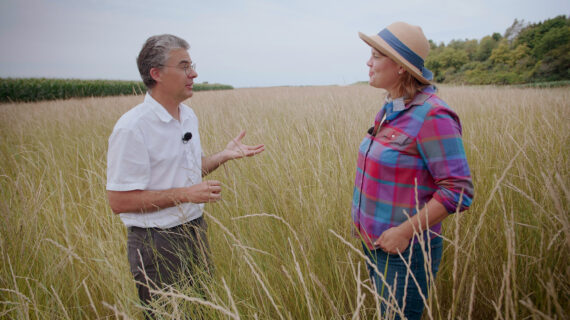
For my last local ingredient, I went to see my friend Nick. Nick was one of the first friends I made when I moved to Wisconsin. We bonded over our common careers as dairy farmers. Now, Nick is trying something different by cultivating garlic on a patch of land near his family farm.
I came out to get some green garlic and talk with him about our passion for growing local foods. Hey, Nick! - Hi, Inga. Boy, the garlic's looking good.
Thank you. I like your little tractor and cultivator. I do too. It's been a real game changer.
I met you when you started your first farm when you were 19 years old; you started out on your own. That's a pretty big deal to do. It was a little crazy, yeah. -
laughing
Inga
And you've dairy farmed your whole life, and now you're expanding with garlic. I know a few years ago we were talking about how to-- we're always talking about how to make money farming.
Nick
Yeah, how to diversify a little bit.
Inga
Yeah, do you like this?
Nick
I do. I've learned a lot doing it. I mean, not just about the garlic but just other crops in general at all. Everything works together and expands your knowledge, you know?
I know. You know, that's one thing I like about farming is you can always learn something. Yeah. - Yeah.
What is it that draws you to the farm? 'Cause I know you started with dairy farming, took some time off for college, now you're back farming. Well, my whole life it's what I've basically done and my family's all been farmers. My grandpa came over from France with my dad and their whole family to farm here, and it's something we've always done.
And you still have relatives farming in France. Still have relatives in Normandy and in Belgium, farming over there. So why is it important to you to eat local food, to grow local food, what is that? It's important, I think, to feed your community, people around you.
I think if you look historically, that's the way things always were up until post-World War II. Everything was pretty local, and when all that stuff and the consolidation of these businesses and things started, it dried up a lot of markets for smaller producers of things. Do you think we can ever go back to that way? I know sometimes you and I talk about, there should be a small creamery on every corner and butcher shop, like there is in Europe.
I don't know that it would happen. I think that we could get more of those things, for sure. Yeah. More artisanal cheese makers and butcher shops and things, and I think it would be good.
More variety for people. And the food tastes good too. Yeah, well like in Europe, part of their local food is their identity of the place too. Well I'm gonna do up a little local foods supper tonight, and I stopped by 'cause I'm hoping to pick up some green garlic from you, and I'm also wondering if you and Amy could bring the kids over and have supper with us?
Yeah, we'd like that. Okay, well give me about an hour to get some cooking done and you get back to it here, and then why don't we harvest some green garlic and get back over to my farm? We'll see you soon. - Yep.
upbeat folksy music
Nick
So I'm having some folks out for supper tonight, and I thought since the weather is so hot and it's summertime and it's wonderful, there is nothing better than lemonade, nice, cold lemonade. I had some strawberries in the garden so I thought, why not make it a strawberry lemonade?
gentle folksy music
Nick
So I'm gonna juice four lemons. And that smells amazing. Okay, so once you've got the lemons there, I'm just gonna use the back of my spoon and push on some of the lemon zest or the meat of the lemon, and just push all that through so I can get all of the liquid out of the solid, and put this right into your Cuisinart. Into here, I'm gonna add my honey first, and this is the honey we picked up in Eau Claire.
And I'm using honey instead of sugar because I have great local honey. Let me pulse this up. Whoa! If you didn't want to do it in a food processor, you could just heat up some water, about two, four cups of water, and then dissolve the honey into it, but I find it's just as easy to do it in a mixer.
Next, I'm gonna do my strawberries. I've probably got about one and a half pounds. And this year I got to 'em before the bunnies and the birds, so I'm very excited. Alrighty.
That looks like it's enough, and I'm gonna keep some of these just to eat. And two cups of water is gonna go in here, and I hope it doesn't leak all over the table. Maybe I'll just add that much for now.
food processor whirring
Nick
And now it's leaking all over the table, so I'm gonna get it in here. Nobody said that cooking, you can't get messy. All right, I'm gonna let that sit in the fridge and chill, and meld the flavors together, and then I'll pour it in a big old serving bowl for the kids today and add lots of ice, and dilute it down with some water. I'm gonna clean up this mess that I made and then we're gonna make some chimichurri for our steaks.
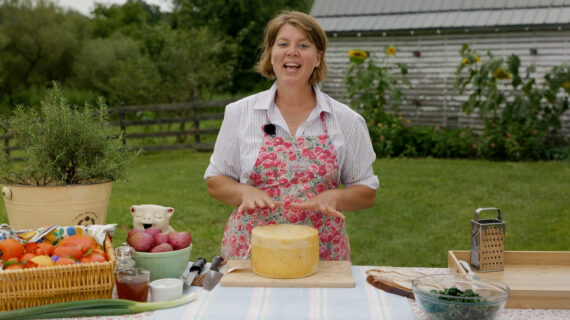
Chance and I love to have folks out to the farm in the summertime, so what I'm gonna do is I'm gonna turn all of my herbs from my garden and Nick's green garlic into a chimichurri. A chimichurri is kind of like a pesto, but with a pesto, like if you're doing a basil pesto, you pulverize that. You want it to be more of a sauce, so you're pulverizing the basil and the garlic, and the olive oil, and the cheese, and everything that comes together with a pesto. This I wanted to be more of a texture, so I'm just gonna chop all those herbs fine, or give them a rough chop, throw 'em together, and that's gonna top over my steak.
So I'm just using the herbs that I had in my garden. I've got some parsley, some Italian parsley here, little bit of oregano, some chives, and then I have Nick's green garlic. If you're not familiar with green garlic, it's the garlic that comes up in the spring. They're gonna smell like garlic, they're gonna taste like garlic, but they just don't have that bulb.
I'm actually gonna save some of these and have Chance grill 'em up so we can taste to see how they taste when they're grilled, but I'm gonna use three stalks of the green garlic in my recipe for my chimichurrui. I'll slice these up, and it already smells like garlic in here, which I love. And into my bowl. And now next, I'm gonna do some of these chives.
And a little dab will do you with this chimichurri, because it is very strong. And now for some parsley. Right in there. And it smells so fresh.
I'm taking the oregano leaves off of the stems. The stems aren't gonna add much to our recipe, but the leaves will be perfect. I think that's good. A little salt and pepper.
This chimichurri recipe can change throughout your season in your garden. You can change swapping different herbs that you have, you could even put in some fresh mint to add a brightness to it. That would be really delicious. A little bit of salt.
I'm putting in a little bit of, a lotta bit of red pepper; I love spice. And then some red wine vinegar for my acid. And then I'll just stir in some of my olive oil. I suppose you could do this in a mixer, Cuisinart, if you want it to be chopped a little bit finer, but I like the crunchiness of the herbs the way it is.
I'm gonna stick this in the fridge and let the flavors come together. I like to make this an hour ahead of time, half an hour if you've got time, and let all those flavors marry together, and then it'll be a great topping for our steaks. I'm gonna go get the table ready for the party, and I'll see you out there.
upbeat folksy music
people chatting
Nick
At the peak of summer, there's nothing better than the bright taste of a fresh chimichurri, served with grilled steaks. The kid in all of us will love the sweetness of the strawberry, honey lemonade. Potato salad and coleslaw are classic sides for any backyard barbecue. Well I hope this has inspired you to invite some local friends out for some local food, and I hope you'll gather with us next time,
In unison
Around the Farm Table! I'm your host, Inga Witscher. Great job guys, thanks for coming over.
people chatting
In unison
Thank you!
Nick
You're welcome, Inga.
upbeat folksy music
Announcer
Around the Farm Table is funded in part by
Wisconsin Farmers Union
United to Grow Family Agriculture, Heartland Credit Union, a gift in memory of Wendy Bladorn, Focus Fund for Wisconsin Programming, and Friends of Wisconsin Public Television.
Search Episodes
Related Stories from PBS Wisconsin's Blog

Donate to sign up. Activate and sign in to Passport. It's that easy to help PBS Wisconsin serve your community through media that educates, inspires, and entertains.
Make your membership gift today
Only for new users: Activate Passport using your code or email address
Already a member?
Look up my account
Need some help? Go to FAQ or visit PBS Passport Help
Need help accessing PBS Wisconsin anywhere?

Online Access | Platform & Device Access | Cable or Satellite Access | Over-The-Air Access
Visit Access Guide
Need help accessing PBS Wisconsin anywhere?
Visit Our
Live TV Access Guide
Online AccessPlatform & Device Access
Cable or Satellite Access
Over-The-Air Access
Visit Access Guide




Follow Us