[bright music] - Announcer: The following program is a PBS Wisconsin original production.
[birds chirping] - Inga Witscher: Come on, Buzzy.
Let's go, girls.
As the sun rises over the hills, come on, girls, another day begins on the farm.
Let's go, babies.
Most mornings on the farm start the same way.
Hey, girls, let's get up.
I'm gonna move you to a different pasture.
When the sun rises, I start calling the cows in.
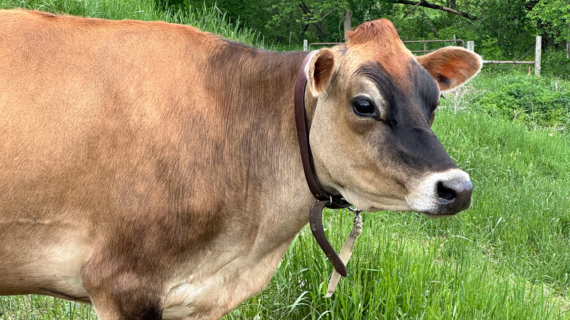
Let's go, my sweet Starlet.
I call them in the same way that my father did.
KA-BOSS, KA-BOSS, KA-BOSS, KA-BOSS!
The same way that his father did and his father before him.
KA-BOSS, KA-BOSS, KA-BOSS, KA-BOSS!
My family's been calling the cows in the same way for four different generations.
KA-BOSS, KA-BOSS, KA-BOSS!
Once the cows are up, we take the long way home, going past all the different wildflowers and the goldenrods, letting 'em stretch out and just kind of enjoy the morning.
Come on, sweet girls, let's go.
[serene music] You're okay, sweet princess, you're okay.
We follow the trail home towards the barn to begin the morning milking.
Welcome to St. Isidore's Dairy.
I'm excited to have you spend the day with me right here on my farm.
First, we're gonna milk the cows.
Then we'll put 'em back out to pasture, and I'm gonna invite you into our creamery to see how we make our cheese.
Gather with us, Around the Farm Table .
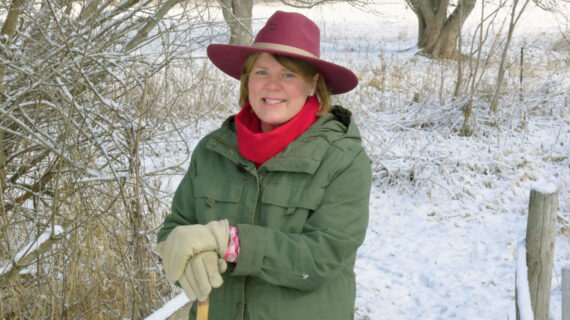
I'm your host, Inga Witscher.
Hey!
I'm Inga, a fourth-generation dairy farmer, milking cows and making cheese on my small farm in Wisconsin.
I'm passionate about exploring new places, meeting new people, and finding the best local ingredients that I can turn into delicious meals.
I would like to invite you along on this food and farming adventure.
[group laughing] - Announcer: Support for Around the Farm Table is provided by: Wisconsin Farmers Union, a gift in memory of Wendy Bladorn, Focus Fund for Wisconsin Programs, and Friends of PBS Wisconsin.
- Hey, girls, all right, let's go.
[bright music] Come on, Toots, let's go.
The morning milking always turns into kind of a meditation for me.
It's the time of day when I can just sort of really be present and connect with my own thoughts and with the cows too.
You guys are really pretty today.
Yes, you are.
We start off by giving 'em a scoop of grain with some added vitamins and minerals in it.
This keeps 'em really happy while they're in the barn, and it also keeps them healthy.
[broom rustling] After grazing the clover in the old hayfield, their udders are full of this milk that we're gonna use to make our cheese.
[bucket clanking] Carrying out the daily ritual of milking cows reminds me that I'm doing the same things here on my farm that generations of my family have done before me.
The things that I'm doing here every day, milking the cows, making the cheese, are things I'm doing to build my future, but they're a constant reminder of my connection to the past.
[vacuum pump whooshing] As soon as that vacuum pump goes on in the morning and I hear that clunk, clunk, clunk, clunk, that sound of the pulsation, [vacuum pump clunking] it takes me right back to being a kid, milking cows on my parents' dairy farm.
Hey!
[laughing] [gentle acoustic guitar music] Here on the farm, we're still a little old fashioned.
We milk using bucket milkers.
We do this because we wanna treat the milk gently.
Instead of pumping the milk through a traditional pipeline system, I wanna keep the integrity and the butterfat of the milk whole.
By milking into a bucket and then pouring that milk out by hand, we keep all that fat and that flavor in the milk, which then ends up in our cheese.
Thank you, girls, [clapping] let's go, thank you.
Let's move it, Toots, let's go.
Come on, Tootsie.
Let's go, Tootsie, come on.
[clapping] Good girls, good girls, come on, Toots.
Come on, Tootsie.
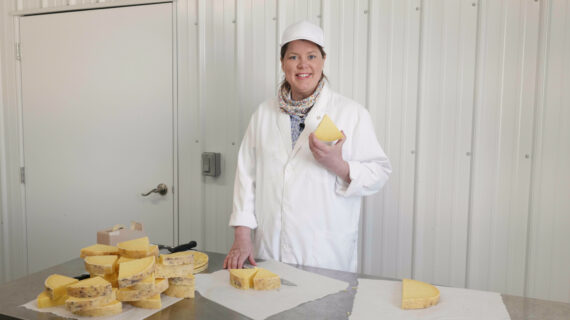
After the morning milking, I transfer the milk from the bulk tank into the creamery where my dad, who's a licensed Wisconsin cheesemaker, is waiting to receive that milk.
[bright music] [milk splashing] Once it's in the vat, he starts heating that milk up to 88 degrees.
And then we add in our starter cultures.
The starter culture is a beneficial bacteria that's responsible for creating the textures and the flavors of our cheese.
[bright music] Throughout the process of cheesemaking, we're always monitoring the temperature and the pH of the cheese.
After adding the starter culture, it takes about an hour for everything to cure together and to get the pH where we need it before the next step.
So we like to take our midmorning break then and have a little cup of tea and just catch up on other activities we're gonna do throughout the day.
[upbeat acoustic guitar music] [cups clinking] [upbeat acoustic guitar music] I never thought I was gonna be a dairy farmer, and now I can't believe I've been here for 15 years on this farm, milking cows.
– Rick: Oh, my gosh.
- What do you think of, that we're now finally realizing our goal of having a farmstead creamery?
- I love seeing that you're carrying on the tradition of our family and it's kind of an amazing accomplishment.
And you're doing it in a positive way.
And there's a future here.
I think of my grandfather, Charlie, he had, him and his brother, Hubert, had a creamery and they would love to see this.
- And they did bottled milk, right?
- They bottled milk, buttermilk, milk, butter.
And their motto was, "You can whip our cream, but you can't beat our milk."
[Inga laughs] - It's so interesting to see how dairy farming has evolved over the generation, over time, and with you guys milking, what were you milking, about 80 cows?
- Yeah, we milked 80 cows.
It started off with my father; he was milking 40 cows.
And then we built a new farm and we milked about 80 cows.
- And now I'm milking eight.
- And now you're milking eight.
And my grandmother, this is my grandmother, she shipped milk and she milked eight cows by hand.
- Oh, I don't think I could do it by hand.
That's a lot, I mean, that's, now I know why all the women, 'cause it was really the women that milked cows, a lot of women still do milk cows, but that's where they, my grandmother would always say, "I've got this arthritis in my hands from milking cows by hand."
And I always thought it couldn't be that hard.
And then I had to milk cows by hand, and I realized it's really hard.
- You know, I love the micro creamery that you've built here, because this is kind of a renaissance.
- For me, I find that it was, I had all these cows, I had to figure out a way to keep dairy farming, to keep being able to do something with the milk and make it financially sustainable as well as sustaining the environment.
And that's where I came to say, "Okay, I'm gonna go less cows and I'm gonna make a product."
So it's kind of, I'm glad that I have this outlet to let me continue milking cows.
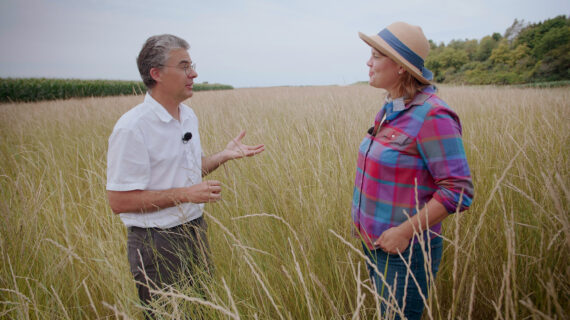
[chuckles] - It's kind of a bright spot in agriculture, this small scale, it's micro, it's small, but it might be a window for other farmers to say, "Okay, I can't do this on the large scale, maybe I can do it on this smaller scale."
But what's so nice about what you're doing here is it's a farmstead cheese.
The cows graze here on the farm, they're milked here, and the cheese is made right on this specific farm.
- Right, and it's just, it's a nice outlet for milk.
And then I get to take that milk, pump it over into the creamery where you're at, and then we get to start making this beautiful cheese that we're a part of from the very start.
- Well, I love that each cheese has the name of the pasture, has the name of the cows, and it has the date it was made, and each one is different.
- And that's what makes it exciting.
That's what makes farmstead so exciting, is that little bit of difference.
And I think what we're doing with making the cheese here on the farm, we're kind of bottling up summer.
- Oh, I like that.
- We're bottling up the pastures of summer, and we're bottling up that moment in time into a 20-pound truckle of cheese.
- And it's pretty amazing to say, okay, in this get big or get out kind of atmosphere on farming, to scale down and become, make it successful and cost-effective, that's kind of cool.
- And fingers crossed, it's gonna all work out.
- Yeah, right.
[both laugh] Okay, well, it's time to get back into the creamery.
- I know, it's just so nice to sit out here, but I suppose you're right, let's go.
[bright piano music] After our tea break, and once the pH has reached a certain level, we add our rennet.
Pour it slow.
The rennet is an enzyme which is gonna help the milk coagulate.
Now, you might remember this from Mrs. Muffet, that's where we get our curds and our whey.
Over the course of the next 15 minutes, we'll be checking on that cheese vat regularly.
What we're looking for is a certain consistency in the vat.
What do you think?
- I think a little longer.
- So we're hoping that the milk is gonna come together and be kind of the consistency of like a crme brle or a panna cotta.
Once it reaches that consistency, we take our cheese harps and we cut it into curds.
[bright acoustic guitar music] Now that it's into the curd formation, we're gonna heat up that whole vat to about 101 degrees.
And this is called cooking the curd.
We're cooking the curd to release more of the whey and to get the small curds to the right consistency.
As we bring it up in temperature, we're actually trying to cook out any of the whey.
We're expelling as much whey from those little curds as possible, while at the same time creating a nice environment for the curds to get a little bit firmer around the outsides.
That process usually takes about an hour.
Our whole goal now is to get as much whey out of the curds as we can throughout the rest of this process.
And once the curds have reached the consistency that we're looking for, then we can drain off the whey.
[serene piano music] So what I do here on the farm is called intensive grazing.
During the grazing season, I move the cows twice a day, every 12 hours, after their morning milking and after their evening milking.
I put them in a nice, beautiful paddock and that way they can harvest their own feed.
And what they're doing is they're sort of revitalizing the soil out here.
This is my poorest pasture.
This pasture was kind of always farmed with crops, soybeans, corn, soybeans, corn, and it needed some extra inputs to make it fertile again.
The cows have actually done that on their own.
Through grazing, they're grazing down those taller species of grasses so that the clovers can come out, and this field is full of beautiful clovers.
And they're also fertilizing the ground, so that we're getting some really good organic matter into the ground, because healthy cows start with healthy soil.
Healthy soil is really the foundation for all healthy foods.
And I find that grazing is a great way to accomplish that.
The other thing I really love about grazing is that when we're out here in the pastures, we're actually also creating habitat for all kinds of different species, for birds, for bees, for insects.
[bee buzzing] These pastures are just alive with different buzzings of noises and sounds, and it's so exciting, like, there's such a great relationship that the cows have with the land and the land has with all of these different pollinators.
[cows chewing] We can't have healthy people without healthy soil.
The soil is really where it all begins.
And by having the cows out here grazing that soil, we're building that foundation.
[bright music] [milk splashing] As the whey drains off the curd, I use my hands to pull the curd into two different sections.
We call these our slabs.
Then we cut those slabs into tinier pieces.
[knife scraping] Over the course of the next few hours, we stack those pieces one on top of each other.
And I continue doing this until I can stack them four to five stacks high.
What it does is it gets as much moisture out of that cheese as we can.
The weight of the cheese actually will push the whey out of that slab, so it becomes a little bit drier.
And that's really what we're looking for.
This is called the cheddaring process.
Once our slabs have reached the correct pH, it's time for milling.
[upbeat music] We use a traditional British-style peg mill.
The peg mill's a little bit different.
When we process through our slabs, they come out a little bit shaggier than your traditional Wisconsin cheese curds.
But these curds are perfect for the clothbound cheddar that we do here on the farm.
Once our slabs are all put through the mill, it's time for salting.
We add the salt in three different applications, allowing enough time in between to have the salt really absorb into those curds, and having any excess whey also expel from the rest of the curds.
As I'm salting the curds, my father begins to dress the molds with cheesecloth to get them prepared for me to fill them.
The final step in our cheesemaking is putting the curds into the molds.
We call our molds truckles because they're in a cylinder shape.
Once I put the lids on the molds, then it's time for the truckles to go into the press where they'll stay under high pressure for 24 hours.
[press hissing] When the truckles are under pressure, it's gonna expel even more of the liquid from those curds.
And in this process, the curds, they're gonna knit together and become one wheel of cheese.
[upbeat folk music] Something I learn year after year is just to let nature take its course.
One thing I've discovered a few years ago when our barn burned down, we didn't have a place to house the cows and the calves, so we let the cows be with the calves.
[upbeat folk music] Traditionally on dairy farms, the cows and the calves are separated a few hours after birth.
It makes it easier for the dairy farmer to milk the cows.
They can keep track of the growth of the calf.
But what I found is, by just letting the cows raise the calves, there're so many benefits to it, and it works really well here on this size of a farm.
So now I just let the calves stay with their moms.
This way, they can nurse all day long and they grow so fast and so healthy.
There's something just so beautiful about seeing that connection, hearing them sort of communicate with each other and find each other.
[calf bleating] [cow mooing] The calves are outside in this environment, getting fresh air, getting exercise, and just being able to be a part of that herd.
All these things we're doing because we really wanna try to make the best milk that we can make.
Back in the creamery, it's time to take the cheeses out of the molds.
[groovy country music] Over the course of that last 24 hours, the individual curds have knitted together to become one individual block of cheese.
Once I take the cheese out of the molds, it's time to do a second dressing of cheesecloth.
[groovy country music] First, I trim any edges of the cheese, making sure that it's nice and smooth and uniform.
Now I can snip off any extra bits of the original cheesecloth and adhere that right to the cheese using butter.
Then I take my second cheesecloth and I just soak that in melted butter.
This is gonna be my glue so to speak, in getting the cheesecloth to adhere to the wheel of cheese.
Once the cheesecloth is on the cheese and everything's smoothed and perfect, I have to label the cheese.
We label every wheel of cheese with the date it was made, the pasture that the cows were grazing in, and the cheesemakers.
And now it's time to put the cheeses to bed in the aging room for them to start developing the characteristics of the cheddar that we're looking for.
[bright music] The thing about artisan cheese is it's all a little bit different, depending on the pasture that the cows were in, depending on the weather, depending on the season that that cheese was made.
And also depending on how long the cheese was aged for.
As I place the wheel of cheese into the aging room, the process of making a farmstead cheddar is nearly complete.
We've taken the flavors from the pastures.
We've handled our cows and their milk with love and care.
And now the last ingredient is time, as the cheeses develop their flavors and their characteristics over the next year.
[footsteps receding] [acoustic guitar chord] [upbeat country music] [background conversation] [metallic ringing] Morning.
- Hi, guys.
- Hi, there you go.
Gonna come out and see the cows and kinda see, you know, where the cheese is.
Interested in some cheese today?
– Woman: I'll take this one.
- Well, thank you, guys, thank you.
- Thank you, guys, have a great day.
Have a good day.
- Hope you have more sales.
– Inga: Thank you, [laughs] bye.
Well, I hope you've enjoyed learning more about our farm and I hope you'll gather with us next time.
- [In unison]: Around the Farm Table !
- I'm your host, Inga Witscher.
Hi there, how're you doing?
[bright music] - Announcer: Support for Around the Farm Table is provided by: Wisconsin Farmers Union, a gift in memory of Wendy Bladorn, Focus Fund for Wisconsin Programs, and Friends of PBS Wisconsin.


 Passport














Follow Us