

 Passport



Goats in Wisconsin
09/30/19 | 26m 47s | Rating: NR
Inga meets with Wisconsin farmers who've found different ways to earn a living with goats. She travels to Cross Plains to meet a dairy goat farmer who makes artisanal cheese, then up to Mondovi to meet with a friend who makes goat milk soap. Finally, she takes a hike to meet ecologists who use grazing goats to manage natural wildlife areas. She makes a goat cheese frosting cake for friends.


Copy and Paste the Following Code to Embed this Video:
Goats in Wisconsin
Inga Witscher
Let's go boss, good boss. Come on, girls. Go boss, go boss, go boss, go boss, go boss. Come on, girls.
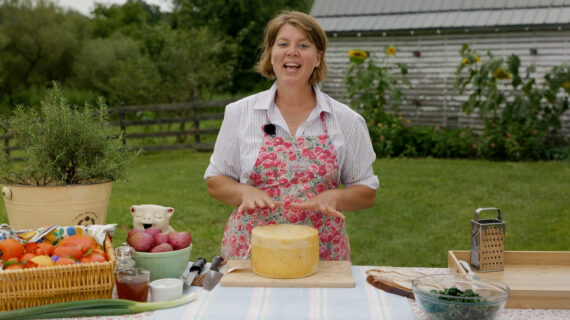
Welcome to the farm! You know I love my dairy cows. I've been farming my whole life and I just love cows. But I wanted to explore some different animals so today, I've decided to visit with some goat farms.
First, I'm gonna be heading out to a farmstead goat creamery to learn about goat milk cheese and then, I'm gonna see how goats can restore native prairie and finally, I'm gonna learn about goat milk soap. Gather with us, Around the Farm Table. I'm your host, Inga Witscher. Good morning, girls.
I'm Inga and I love everything about farming. Midwestern farms are a bounty of good food made by good people. I love being able to travel to search out good ingredients. Cooking is all about what's seasonal, what's fresh.
Every day can be filled with good food, good friends, and a beautiful herd of cows. Welcome to the farm!
affectionately to cow
Inga Witscher
Good girl! Around the Farm Table is funded in part by Wisconsin Farmers Union, united to grow family agriculture, Heartland Credit Union, Focus Funds for Wisconsin Programming, and Friends of Wisconsin Public Television.
birds chirping, peaceful music
Inga Witscher
When I start to put the cows back out on pasture after a long winter, I know it's time to start harvesting nettles. Nettles are an amazing wild food. They're so abundant here on my farm, and I'm sure probably in your own backyard too. They're delicious to eat and they're extremely healthy for you.
So, nettles, you might also know them as "burning weed." I think that's what people call them in the Midwest. They're a stinging nettle, so they will sting you if you just grab them without any gloves on. You might be saying, "Well, why in the heck "would you want to eat these weeds?" Because they're delicious, they're full of iron, they're full of minerals. They're really, really good for you and it's one of the first nice greens of the year.
So, we use them in everything. We use them in soups, we use them in egg dishes, sauts. Today, I'm gonna be making a nettle cake, and before you think that is the craziest idea, just wait. It tastes delicious.
So, when I'm harvesting my nettles, I harvest the top leaves. Those are the tastiest, the most tender leaves. As the summer progresses, the nettles will get a little bit hairier and more fibrous and then I stop using them because I'm kind of nettled out by that time. Nettles, to me, are like tomatoes, I wanna eat enough tomatoes in August and September that I'm so sick of eating fresh tomatoes, I don't wanna eat them again 'til the following summer when they're delicious again.
But I really encourage you to eat them because, well heck, they're free, they're everywhere, they're abundant, and it's kind of fun. When we get this bag to the kitchen, I'm just gonna do a nice... I'll throw these either in boiling water or just rinse them with hot water and that takes the sting out of them. Well, I'm gonna put these back in the kitchen and then we're gonna go on a little goat adventure.
folksy music
Inga Witscher
For my first stop, I traveled to Cross Plains to the Dreamfarm to meet with Diana, a goat farmer and cheese maker. Hi, Diana. - Hi, Inga. Nice to see you.
- Good to see you. Welcome to Dreamfarm. - Thank you. I'd love to check out the goats.
Diana
They'd love to greet you.
Inga
Dreamfarm is nestled on 25 acres of rolling hills which provide perfect pastures for a herd of playful dairy goats. Oooh, hi, hi. Diana milks her goats daily, and she uses that milk to produce a variety of artisanal hand-crafted goat cheeses and she sells those cheeses to local stores and restaurants. This is so fun to be out here with the goats and just to be on the farm here.
They're so sweet. Goats have great personalities, they love people. They really do, and as I was walking up, I saw them kind of just playing together and you can't help but smile being around these.
Diana
Most times, they make you smile. How did you find yourself getting into the cheese business and getting into being a goat farmer? Well, it's a long story but the short of the story is, we were living in a rural setting and we got some goats for our kids and bred the goats, had milk, and had extra milk so decided to make cheese, and I was sharing it with the farm where I was working at, at the time, that had a CSA they asked me if I'd be interested in providing cheese along with their vegetable selections and I thought, that'd be a great opportunity. Can you explain what farmstead cheese is for people that don't know?
Farmstead cheese is made from the milk produced only on your farm. We don't purchase any outside milk.
Inga
So, you're doing the milking, you're doing the feeding, the taking care of the goats and you're also doing the cheese making too?
Diana
Right. I like that system because I think it allows you to be a little bit more intimate with that cheese and the cheese is gonna be a little bit different each time, right? Depending on what the goats are eating? And the seasons, and the stage of lactation that they're in.
Okay, goats have a little bit more butterfat, is that right? Than dairy cows? It depends on the breed. Oh, okay, just like cows.
- Just like cow breeds. The Jersey has higher butterfat versus Holsteins, the Nubians have more butterfat than the Alpines so that's why I choose to do a mix of Alpine and Nubians. Okay, what is it about farming and cheese making that really just, that inspires you, keeps you going? I think to wake up every morning and just step outside into the beautiful environment that you have to work with and then being greeted by these animals.
I can't imagine a morning not being shared with the animals.
Inga
For sure. And then, just having that opportunity to provide food for other people is really a humbling experience. That's really beautiful. Well, I am so excited to see your creamery if that's possible and just spend a little bit more time here with these beautiful goats.
I'd love to show you.
light peaceful music
Inga
There's so many different varieties of cheeses that you can make. Can you explain to me what this variety is and how you make it? What's the process? This is called a fresh chvre, or a fresh goat cheese.
So, it actually started yesterday, we brought the milk up from the milk house in our boat cooler, brought it up in buckets, dumped it into this facility, which is a vat pasteurizer. Okay. So, because it's a fresh cheese it has to be pasteurized. We got through the pasteurization and then we add a little bit of starter culture to get some good bacteria breaking down that lactic acid in the milk.
And then add a little bit of rennet, and then it's set in here overnight. And this morning, lift up the lid and you've got this nice vat of soft curd. And I take that curd and scoop it out with this ladle into these cloth lined baskets and it'll drain here until tomorrow morning. Then we'll take it out of the cheese cloths.
It'll have a consistency of like a cream cheese texture. We'll put it into bowls, add salt, add herbs and then package it into individual containers, ready for sale. This has been so inspiring to learn about all this and to be here and to see that it can actually happen for me to have a small creamery as well, so thank you for spending the time with me. You're welcome, thank you for your interest.
Well let's head on down the road and check out some more goats.
light peaceful music
Inga
After meeting with Diana and her dairy goats, I took a ride up a steep ridge with Jesse. Jesse and Jay are a husband and wife team of ecologists who manage several herds of goats. Come on goats, let's see some goats. They put their goats to work, clearing brush and controlling invasive species as they preserve and rehabilitate natural areas.
goat bleats
Inga
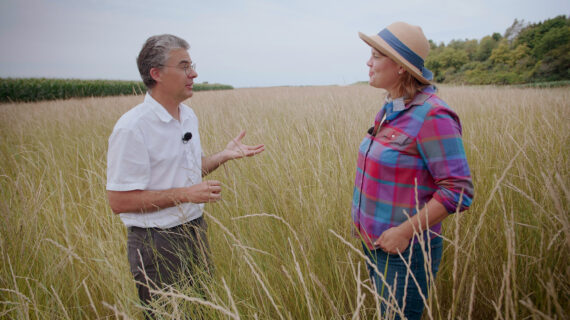
This is so spectacular to see these views and be up on this ridge. Can you tell folks where exactly we are? Yeah, this the Hogback State Natural Area. We're in Central Crawford County which is the heart of the Driftless Area.
We're actually on a ridge which used to be part of the Kickapoo River Valley but tens of thousands of years ago, the river cut through the bluff about a mile to the south of us and left this part of the river valley dry so we have this spectacular view of this huge river valley with no river in it. The Hogback itself is one of the finest examples of dry prairie left in the state.
Ingrid
So, what I'm looking at here, this is all native to Wisconsin? All these plants. It's a mixture of the native prairie plants that have been here for millennia and then things that have been brought in since Euro-settlement, so we have all of the common invasive species. One of the main reasons the goats are here in all this shrubbery behind us, is exotic bush honeysuckle.
It was brought in as an ornamental. 'Til a few years ago, you could buy it at every garden store and the birds poop it out, then it's everywhere and become a very, very serious issue. Prior to using goats, we used chainsaws and herbicide, and fire. Many of the sites are too rugged to use machinery and so, really, your only option is hand labor.
This site, for instance, prescribed fire just won't carry through this brush layer. We're using grazers as a surrogate for fire. This area would've burned nearly annually so once a year, there would have been a great disturbance. Wildfire, they came through and it top-killed all of the brush and let the prairie flourish and because this site has a federally endangered butterfly, there's some apprehension to burning too much.
What is that butterfly?
Jesse
The regal fritillary.
Inga
That's a mouthful.
Jesse
Yeah, it's only known from just a few places on earth.
Inga
Really?
Jesse
Very rare, federally endangered butterfly. Goaty goats! T-1000. Can I pet you?
Will you let me pet you? Some scratches up here. Come here, sweetie, look at this. So, do you consider yourself to be a farmer?
Yeah, absolutely. When we first got goats, we bought a dozen to see if we could use them to manage natural area because that's what our business had done for over a decade but now that we have hundreds of goats, I'm very much a farmer. So, do you like goats, do you like working with them? I've always had cows which I think are the most docile, easiest things to work with.
Over the last 20 years, we had employees for most of this time and goats are, to some degree, easier to manage.
laughing
Jesse
I wish I could teach them how to milk cows.
laughing
Jesse
My whole dairy farm career, people have been saying, "You should get goats instead of cows, "because they're so much easier to work with." And I think, boy, if my cows are out of their fences all the time, I don't think I could manage fencing for goats 'cause they're climbing everywhere and everything. We have cows on our own farm, and I would have to say that raising cattle's easier than raising goats. Yeah, but the goats are so much friendly, or they have this appeal that is just so lovely. They have a personality, they seem to think quicker, and they seem to be more social.
They're more like a dog.
goats bleating
Jesse
My cows will come up to me in the pasture as long as I have a little treat for 'em, and then they'll make me scratch 'em forever. But if I'm out of treats, they're just like "Forget it." Yeah, we have goats that you can call individually, and some of my best friends are goats.
laughing
Jesse
Well, thank you so much! This was just such an inspiration. Thanks for coming out. Well now it's time for me to get off this ridge and on to our next stop.
From the hills of southeastern Wisconsin, I traveled to a farmstead in the North Woods where Julie takes loving care of her small herd of goats. When she realized they were producing more milk than her family could drink, Julie found a new way to get value out of her dairy goats.
light melodic music
door opens and closes
Jesse
Hello, Julie. - Hi, Inga. May I have a seat? - Absolutely.
Nice to see you. - You too. I see I've come just in time for milking. You have, you have.
So, I've just been really feeling intrigued by goats lately and I've been trying to visit as many as I can, so immediately I thought, I need to come out and see Julie. Thank you. Goat milking is a little different than cow milking. Less than half the work.
My cows will typically milk about 25 pounds a day when they get on good pasture, it goes way up. But how much do goats do? Well, right now I'm probably getting about a pound a half a day but that's because the kids are with her and they're drinking a lot of milk. This year, I'm experimenting with having my calves with the cows which I know a lot of people do and boy, are they healthy.
Yes, they are. I don't mind sacrificing that little bit of milk, I'm sure you don't either. Not at all, not at all. - Yeah, for healthy babies.
That's right. So, how did you get into goat milking and goat farming? Well, I grew up in Appleton, which is not exactly farming country, but my great grandparents had a farm just outside of Berlin, Wisconsin and it was my favorite place in the whole wide world. My great grandma Lucy was there as I was growing up, and she had tons of animals and I decided then and there, that that's what I wanted for my life when I could.
There is something amazing, isn't there, about being on a farm? There certainly is. I was lucky enough to grow up on a farm and I find a lot of people will say to me, "Well, and then you decided to be a farmer?" Well, I decided to be a hairdresser, but I failed out of beauty school, so I became a farmer.
laughing
Jesse
But now I find that I have that need for those animals. I need to be around it, and I enjoy milking. I do too, I do too. How did you decide on goats?
Julie
Well, I had a neighbor who had baby goats and as you know, there's nothing cuter than a baby goat.
Inga
Oh, I know, I know. And that was the start of us getting two goats which has turned into many more over the years. I don't blame you. I've been spending a little bit more time with goats, and I have Jersey cows which have these big personalities, but the goats are so friendly.
They certainly are, yes. It's just such a nice feeling that they're-- I feel needed.
laughing
Julie
It's like having a bigger Golden Retriever.
laughing
Julie
So how did you decide on soap making? Well, we had started to do farming back in the early 2000s and were wondering about how to make things profitable. At that time, we had a gentleman come up from the department of Ag, Trade, and Consumer Protection to help us with our financials and when he found out we had goats, he told my husband he could just take his wallet out of his pocket, shake all the money out on the table, 'cause he'd never see it again.
laughing
Julie
And a few months later, I was in Eau Claire at the Value Added Farming Conference and met Tony and Della Ens from down near Brodhead. They had a grant to teach several other farm families how to make goat milk soap and I thought that sounded really interesting, so I went down and spent time with them and their farm and learned how to make soap and I've been doing it ever since. And really turned it into a business. Yes, I did.
That is so, for me, we went through this barn fire thing and the creamery burning down, and now I'm sort of having to just stay strong emotionally, and meeting with ladies like you, hearing your story and seeing the success that you've had, I can't even tell you how much it's helped me and really said to me, "Hey, it's gonna happen. It can happen." Because there's no way I'm gonna give up my cows, and I might be having some goats soon, too. I'm not gonna give those up. So, I have to keep figuring out a way-- Well, we can help you with that.
That must have been nice raising a family, too, and having that flexibility. It was very nice. Our kids were in grade school at the time and when I first started making soap, I made it in our regular kitchen. My concern at the time was, in order to make soap, you have to use lye and I was concerned about having my kids around that.
'Cause lye is, like, a chemical, right? Yes, a very caustic chemical so I wear gloves and I'm very careful when I do that part of the process. And I was doing it in our own kitchen, but I would only do it during the hours my kids were in school and would have to clean everything up real good by the time they got home. And a number of years ago, we built a dedicated soap kitchen off the back of our garage which has a door that locks so I can leave my mess behind,
laughing
Julie
keep it safe. This is wonderful. I would love to see where you make the soap, if that's okay? Oh, I'd be delighted to share that with you.
light guitar music
Julie
So, these soaps look amazing, they're so fun and beautiful. It looks like it's an easy thing to do. When I think of soap making, I think "Oh, you can just throw it together." What's the process? Well it actually takes at least four to six weeks from start to finish.
That's crazy. - I know.
Inga laughs
Julie
So, I start by making just a big plain bar and to do that, I have to use frozen goat milk and combine that with lye. If I didn't use the milk frozen, the lye would heat up so hot that there would be a burnt orange chemical reaction to it. So, I have those in the sink and then on the stove, I'm melting all my oils and bringing them to temperature. And when those two products are ready to be combined, I put them together in a large pot.
I use a electric drill with a paint stirrer on the end for about 10 minutes, then pour all that into a big Tupperware container. The Tupperware container sits for 24 hours so that the soap will harden and there's a chemical process called saponification where the lye no longer is caustic. That comes out of the Tupperware and sits on the shelf to dry for about four to six weeks. At the end of that time, I bring the soap up to the soap kitchen, I cut the bar into big slices, put it through the food processor and grate it, put it back on the stove for a second melt and if you've ever heard of French milled soaps, it means they've been melted more than once and the reason for that is so the soaps last longer and hold their scents longer.
Inga
Oh, interesting, so these are really artisan products. What is the difference, can you tell folks, between your basic bar of soap and something that's homemade with care? To actually be considered soap, you have to use lye. And if you look at some of the things that you think of as soap in the grocery store, they aren't labeled as soaps.
They might be labeled as moisturizing bars, or something to that effect and are full of a lot of different chemicals. They're like the margarine instead of butter. Yes, yes, that's an excellent analogy. And with goat milk soap, the goat milk in and of itself is a moisturizer and when you make homemade soap, all the natural glycerin is retained in the soap.
Glycerin is a humectant, which draws moisture to your skin so you're actually getting moisturizing benefits both from the soap itself and the goat milk. Well, I'm excited to share some of it. It smells delicious in here with all the different essential oils. This is heaven.
It is, it is. But I need to get back to the kitchen. I'm so excited that the ladies are gonna be showing up soon and I hope that you'll join them for a little goat yoga. Thank you, I would love to.
Well let's head back into the kitchen and frost our cake.
folksy guitar music
Inga
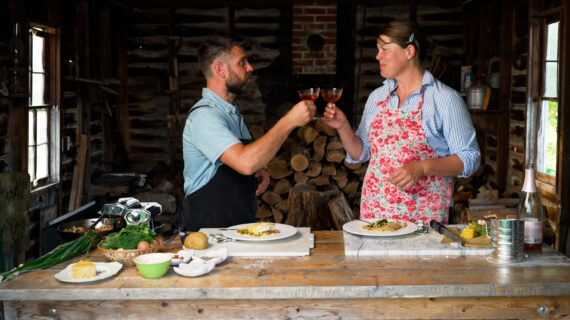
Having a farm definitely has its challenges and that's why I surround myself with wonderful people and some of those wonderful people happen to be mothers, especially my mother who comes down and she helps me here all the time, whether she's helping me weed the garden, chase cows around, or help me in the kitchen. And today, I wanted to celebrate those mothers in my life with a little bit of a nettle moss cake, I like to call it. It's a cake made out of nettles and I know you might be thinking, "That sounds terrible." It's gonna taste amazing. And it's gonna look beautiful.
So, I've already baked my cakes, and what I did for that was that I just creamed the butter and the sugar together, I added six eggs, I let all that come together. Put in two tablespoons of vanilla, four teaspoons of lemon juice, the zest of two lemons, and then I slowly added two cups of pureed nettles. Finally, I added four cups of flour, four teaspoons of baking powder, and a half a teaspoon of salt. Once that came together, I put them in three different pans and baked them in the oven.
I baked them at 325 for about 25 minutes. I bake them low and slow so that I don't lose the color of the nettles. And now, we're ready to make our goat cheese frosting. So, the first thing I'm gonna do is, I'm gonna take some of that wonderful goat cheese that I got from Diana, add it to my mixer.
Now I've got some cream cheese, a little bit of vanilla. And I'm gonna whip this up. And now, when it's on low, I'm gonna add my powdered sugar. Give that a swirl, it's looking good.
I gotta taste it here. That's gonna be delicious. All right, now we're ready to get our frosting going here. My first layer here, I'm just gonna whip that right on out.
Taste everything as you go. If you like your frosting a little bit sweeter, then put in a little bit more sugar, powdered sugar. Now I'm ready for that next layer.
light guitar music
Inga
I'm not interested in really making this cake look beautiful with the frosting because we have a trick that we're gonna use for making it look like moss. My mother made this cake for me a few years ago and when I first saw it, I thought, "Well, why would she put moss on a cake? "That doesn't make any sense." And then I realized it wasn't moss at all. All right, that looks good.
So, the trick to her moss frosting was actually that extra cake that we made, and you can just crumble it on top. This is so cute. This is another fun recipe you can make with kids. When my nephews are here, our activities are either doing something on the farm or doing something in the kitchen and so this is a fun recipe to make with those little kids 'cause you get to squish up cake.
How fun is that?
light guitar music
Inga
All right, so that was pretty easy, and it looks really kind of amazing, I think it looks amazing and really fun. Now I'm just gonna decorate with a few flowers on top. If you have some fun little fairy statues or something that you want to play with or anything else that makes it look really fun, you can have a really good time with this cake. And I think that looks beautiful and now I'm ready to take it to the ladies.
light upbeat music
Inga
You'll be delighted by the taste of this sweet nettle cake. Combined with the creaminess of a goat cheese frosting, served with a hot herbal tea and enjoy it with friends. Well, I hope this has inspired you to gather the important ladies in your life and take a little time out for cake and tea. And I hope you'll gather with us next time...
All
Around the Farm Table. I'm your host, Inga Witscher.
cheerful folksy music
Narrator
Around the Farm Table is funded in part by Wisconsin Farmers Union, united to grow family agriculture, Heartland Credit Union, Focus Funds for Wisconsin Programming and Friends of Wisconsin Public Television.
Search Episodes
Related Stories from PBS Wisconsin's Blog

Donate to sign up. Activate and sign in to Passport. It's that easy to help PBS Wisconsin serve your community through media that educates, inspires, and entertains.
Make your membership gift today
Only for new users: Activate Passport using your code or email address
Already a member?
Look up my account
Need some help? Go to FAQ or visit PBS Passport Help
Need help accessing PBS Wisconsin anywhere?

Online Access | Platform & Device Access | Cable or Satellite Access | Over-The-Air Access
Visit Access Guide
Need help accessing PBS Wisconsin anywhere?
Visit Our
Live TV Access Guide
Online AccessPlatform & Device Access
Cable or Satellite Access
Over-The-Air Access
Visit Access Guide




Follow Us