

 Passport







Friendsgiving
folksy music
Welcome to Friendsgiving. I've decided to invite some friends and neighbors over for a Friendsgiving celebration before they celebrate Thanksgiving with their families. I'll be cooking up a delicious pumpkin pie with ingredients from King's Hill Farm. And then, it's off to Brix Cider for ingredients for my delicious gravy.
We're going to top things off with an organic cranberry cocktail. Gather with us Around the Farm Table. I'm your host, Inga Witscher. Good morning, girls.
I'm Inga and I love everything about farming. Midwestern farms are a bounty of good food made by good people. I love being able to travel to search out good ingredients. Cooking is all about what's seasonal, what's fresh.
Every day can be filled with good food, good friends, and a beautiful herd of cows. Welcome to the farm!
affectionately to cow
Good girl! Around the Farm Table is funded in part by Wisconsin Farmers Union, united to grow family agriculture, Heartland Credit Union, and Friends of Wisconsin Public Television. Over 80% of farmers have to have some sort of an off-farm income and I'm one of those farmers. This holiday season, I'm so grateful to Erica and her family to hire me to come up and help with milkings and the daily chores.
And it's a great place to work. I've been really learning from her about how to manage a bigger group of cows. I'm going to finish up with chores now. And then, let's head out to get our organic cranberries near Wisconsin Rapids.
folksy music
Hey, Brian. - Oh, hi, Inga. Nice to see you. - Good to see you.
Inga
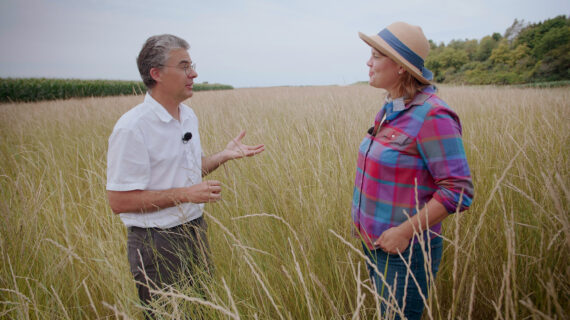
Oh, it's nice being out here in the bogs. Yes, wonderful, glad you could make it. Why is it frozen? It's that time of year where we have to start protecting the vines and the buds for next year's crop.
So we flood the beds and that protects those buds so that we'll have a crop again next year. So it's kind of like mulching your garden. Like I mulch my garlic in the fall so that I'm not affected by the freezing and thawing and things. Right, right exactly.
So it's just a matter of protecting the vines that we're doing right now. So this flood will stay on right through March. Tell me a little bit about your Century Farm. Okay, well, actually our great-grandparents bought it in 1879 so very shortly it will be 140 years in our family name.
Wow. - I'm fourth generation. And so we're excited about growing organic cranberries on it. Have you guys been doing cranberries the whole time?
Oh, actually about 25 years. - Okay. In fact, we were the first organic cranberry grower in the state. One time, this was a dairy farm like so many of the others in the area.
No kidding?
Brian
Yeah.
Inga
Oh, well great. Well, I'd love to look at some cranberry production.
Brian
Absolutely, let's go.
bumping and bouncing sounds
Brian
Thanks for letting me be a part of the cranberry process. This is so nice to just sit here. Glad to have you, glad to have you. Tell me about the process, what we're doing now.
Well, we're kind of looking for color. If there's any white-colored berries. Or if there's any berries that have... Like a little dent?
They're dented, yeah, dented berries like that. Or if they look like they're overripe. Maybe a bad color to 'em or that type of thing. They all look beautiful to me.
Well, there's a lot of good ones, but every now and then you run across some bad ones that need to be taken out. Tell me a little bit about this machine. It looks so cool. It has to be vintage.
I know that. Oh it's, these were all built in Cape Cod. Hayden Manufacturing in Cape Cod. And they were built back, a lot of these were built back in the 1930s, 1940s, even some as early as the '20s.
Oh, wow. And they're still in operation in a lot of areas of the country. And the technology and the thought behind them is very impressive. So they just operate on the premise that a good berry is going to bounce and a bad one won't.
So there's a series of boards in there that when the berry bounces over that board, they consider it a good berry. So the majority of the berries that come on to the sorting area are good but there's a few that it doesn't get and that's why we're here to take those out. I really enjoy that a lot of this is just done by hand. Yeah, yeah.
I can't imagine you can see too many of these pieces of equipment in too many cranberry sheds. No, absolutely not. The machine works beautifully even after over 100 years. It's a perfectly engineered piece of equipment.
I like these vintage pieces. They're less maintenance, I think. I think you're right, yeah, absolutely. Now, you guys are certified organic.
We are. Is that unique for the cranberry industry? Well, we were the first certified-organic cranberry marsh in the state of Wisconsin. And slowly over the years, there's been more cranberry marshes that have become certified.
Probably six or seven now in the state. So, I know the process that I have to do on my dairy farm to be organic and just with, you know, how I can deal with the health issues on cows or feed. What is organic look like in a cranberry field? Well, you know, obviously we're limited in the type of fertilizers that we can use.
Also limited in the pest control-type products that we can use. - So, how do you deal with that? Well, we flood the beds in early June to take care of the blackheaded fireworm. And then, there's some organic sprays that we can use to take care of what they call the fruitworm in July.
Their effectiveness is nothing like, of course, a conventional grower's, but they aren't too bad. It's so interesting to be on a cranberry farm. This is the first time I've ever seen anything like this. And I just love learning about these new kinds of agriculture.
How do you harvest? We actually use a dry harvester. That's very different than the wet harvest that you normally see on the television programs. It's just we go out on the beds and they're very dry in the afternoon and then rake the cranberries from there.
Now, where's your market for these berries? Well, there's really a nationwide market for cranberries. Terrific healthy food. We mainly distribute it in the Southern Wisconsin, Minneapolis, Indianapolis markets.
Oh, okay. And we're looking to expand beyond that, of course. So, it's been a probably 150 years almost since they started the actual cranberry industry here in Central Wisconsin. And now we're number one in the nation.
Grower in the world. - In the world, wow. Yeah, absolutely. - Go, Wisconsin.
Yeah, in fact, this county, Wood County, is the largest grower in the world right here in Central Wisconsin. It used to be the East Coast in Massachusetts, but now Wisconsin produces about nine million barrels of cranberries each year. I hope that they're not all having to be hand-sorted like this.
laughing
Brian
Well, this is a little bit, somewhat old-fashioned in comparison with the new technology that they use to be able to process that many millions of pounds of cranberries. I like old-fashioned. This works for us, this works for us 'cause we're small and I think we can do a better job, actually, than even the best machinery on the market today. Because we're looking over every berry that we see, pulling them out.
Inga
But,
it's worth it. - Brian
It is, absolutely. Well, Thanksgiving is a busy time of the year and I'm going to let these farmers get back to making sure we have cranberries on our Thanksgiving table. And I'm going to get ready for our Friendsgiving. It's a busy time to try to be cooking and gathering and everything.
So, I did a little shopping beforehand, as you'll see, down in Mineral Point.
folksy music
it's worth it. - Brian
I made it to King's Hill Farm where Steven and Elisabeth are growing 10 acres of vegetables. I'm here to talk to them about their winter CSA today. And I think it's the perfect day to talk about it 'cause it's certainly feeling like winter. How's everything going today?
Going very well, thanks for coming out. Yeah, it's chilly. - It is, yes. So, for those folks that don't know what a CSA is, can you explain it to them what it is?
Yeah, it's a-- CSA is short for Community Supported Agriculture. Essentially, as a farm, we reach out to the community and find people that are interested in investing in our farming operation. In exchange for their investment per season, they get a season's worth of produce. We do a summer share that's 20 weeks, and then, we do a winter share that's every other week in November and December.
Wow, and it seems like winter shares are a little bit more unique that farmers are offering now. Yeah just keeping people eating locally longer into the winter is better for the local food economy. We have the ability with some hoop structures to grow some greens later in the season and we also have some cold storage capabilities to hold crops longer. Well speaking of cold, my hands are freezing.
I'm hoping to find out a little bit more about your farm, but I'd like to do it someplace a little bit warmer. Sure, sure, let's head down to the pack shed. Steven, I'm glad that we decided to get out of the cold. I don't know how fall disappeared and it seems like winter just snuck right up on us.
Yeah, it's a breezy one out there today for sure. It's neat though to see that there's still things growing out there. Yeah, yeah, there's a lot of crops who can handle some cold weather, mostly kales. And, you know, carrots actually get better when they've had a couple light frosts to them.
It sweetened up a bit, right? - Yeah, yeah, definitely. One thing I think is intriguing about your story is that you didn't start out as a farmer. You started out on the other end as a chef.
How did you go from the kitchen out to the field? Well, I was working at a really nice restaurant up in the Pacific Northwest and we had a little garden on- site and I'd spend the mornings in the garden trying to figure out how to grow herbs and tomatoes for dishes that we were doing. And something just clicked, like, I should probably learn a little bit more about farming if I want to be a better cook. So, I reached out to a friend of mine that I knew had a farm and happened to be in Wisconsin, and I moved out to Wisconsin to start farming.
What are some of those things that you can expect to see in a winter CSA box? So, this time of year, we try our best to get as many greens in the box still. But a majority of the box is going to be root crops. But, for example, this last share that we delivered, we put in some potatoes, a nice little bag of onions and garlic.
Oh, that's nice. - Yeah. That's quite a bit, too. Yeah, so it's an every other week box in the winter time for us so it's just enough for people to eat through the week and they store.
So, if they don't get to them right away, they'll have them later on in the wintertime as well. And then we put in some Napa cabbage. Oh, that's pretty. Red Napa that we trialed this year.
And then some Daikon radishes. Purple Daikon radishes. What's the flavor of those? So a little bit of spiciness, not as spicy as your springtime red radishes, but a nice little bit of spice to them.
Okay. We've got some scallions, and those are basically all ingredients for kimchi. A lot of people like doing fermented foods and so. Yeah, it's becoming very popular nowadays it seems like.
It is, it is, yeah. And so we try to basically grow a kit for folks to do their own kimchi. And then we also put in some frost-sweetened carrots. They are really nice this time of year.
Our favorite time to grow them is in the fall so they get a couple of nice, light frosts. And then, some nice spinach. - That looks gorgeous. Wow, it's so nice to see fresh greens this time of the year.
Yes, yes definitely. With your pie pumpkins, what's the difference between a pie pumpkin and a regular jack-o'-lantern, say? So the pie pumpkins are bred specifically to be sweeter and then they also don't have the stringy pulp that you would see in, like, a jack-o'-lantern-style pumpkin. So they'll be nicer in the pie that I'm planning on making.
Yeah, yeah, so it'll blend up really nice and it'll have a good sweet quality to it. And one thing I noticed you're doing this year is you are experimenting with doing flour, which I think is great. Yep, yep, we had some extra space and we just decided to do a trial with growing some wheat for some flour. We figured best case scenario we get some flour and straw.
We use a lot of straw for our vegetable production for mulching. So, if it didn't work out then we would just have straw. Positive attitude, that's what you have to have. So it did work out so we have a really great product that we're happy to provide for our CSA members and other folks.
I thought since you guys are doing flour this year, too, I can do kind of a King's Hill pumpkin pie for our Friendsgiving. - That sounds delicious. I'm going to get some pie pumpkins here and grab some flour and then, why don't you meet me up at Brix Cider where we're going to continue our Friendsgiving celebration?
folksy music
it's worth it. - Brian
I'm here at the headquarters of Brix Cider. Let's head inside this beautiful home and find out from Marie about their cider adventure. Welcome, Inga, come on in. Thank you, it's cold outside.
Marie, thank you so much for inviting me into your home for a hot cup of cider. It's a chilly day out there. It is yeah. I'm having a Friendsgiving celebration and I thought that some cider would be the perfect addition since I'm assuming that was probably what they drank at the very first Thanksgiving.
I would assume so. Every family that homesteaded in the United States usually brought either cider trees with them or they planted apples and they planted 'em with the specific intent of pressing them for juice, fermenting them and drinking the beverage. Well, there's nothing like fresh cider too. It's delicious.
Tell me about the different types. What is the cyser? What a cyser is, is it's cider, and then fortified, basically, with honey. And so you end up with a higher alcohol, it's more like a wine, about 13%.
And about half the alcohol comes from the apples and half the alcohol comes from the honey. And what you get is that kind of meady taste. But there's the apple flavor behind it, as well. Okay, and I'm interested in the hopped cider, I've never seen anything like that on the market.
Sure, so our hopped cider is just traditional cider. So, it's just apples and yeast. But what we've done is at the end we're what's called dry hopping it. So you're just adding the hops right at the end of the fermentation and it gives it a, you get the aromatics of the hop but you don't get any bitterness.
So it's nice and mellow a little bit. It's a mellow hop when you pour it in a glass, you'll definitely get the centennial hop out of it. This is the one that I'm most curious about. The wild apple, is it called wildings?
Yeah, wilding or seedling apples is another thing people will say. So the wild apple cider, we collected all these apples late in the fall of 2016. I work with farmers and a lot of people, once you get talking to them, they'll have on the back 40, they have 50 seedling trees that were either potentially planted at one point as seedlings or just, you know, apples dropped and they grew. So, what we did is we went out to a couple different farms and picked those apples.
And it gives the cider a really unique flavor because it's not something you've ever tried before. What's the process after the picking is done? Once we get 'em, we usually within one to three days, we'll get them pressed. And then, from pressing, they go directly into a commercial freezer to be frozen in 275-gallon totes usually.
And then, the following year, we thaw them as we need them. And it's probably different from year to year. Absolutely, and the weather will change wild apples from year to year. I mean it'll change all apples, but especially wild apples.
Can you believe that you went from making cider as a hobby in your basement and now, a tasting room and distributing? It must be an amazing feeling. It's a head rush, yeah. Yeah, we went from basically experimenting in our basement to-- within a couple years-- working with a commercial lender and lawyers and everyone you can think of who helps you start a business and we're going to open a tasting room and a cidery in Mount Horeb.
Well, Marie, I know that my friends are going to be loving this at our Friendsgiving. And speaking of Friendsgiving, we've got a lot coming up, so we'd better get back to it.
folksy music
it's worth it. - Brian
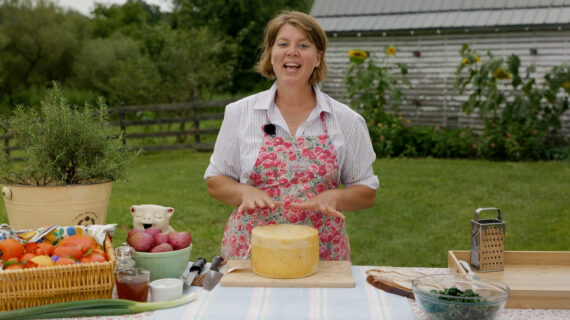
I'm so thankful that I took the time to gather my ingredients beforehand because now I have all day to cook before my guests arrive for our Friendsgiving celebration. I'm planning on making a homemade pumpkin pie. So, let's get started. I have my roasted pumpkin here.
I personally enjoy the flavor of the roasted pumpkins. And it's not that much work so it's not a big headache when you're getting ready for your holiday parties. And then, just save the shell of the pumpkin and you can give that to your pigs or your chickens. I think they'll both like it just the same, or your compost pile even.
All right, now we've got to mash this up. I'm going to take my little masher here. You want to get a nice puree. You don't want any lumps in your pumpkin pie.
Now that looks like it's perfect. This holiday season, I'm thankful that my mother passed on her tips for making pumpkin pie. She's always been the best pumpkin pie maker in our family. When I was a little girl, my job helping her out was to run out to the bulk tank and bring back the milk that she used in her pumpkin pie.
I don't use milk, though. I like to use the sweetened condensed milk. It gives it that nice sweet flavor and I don't have to add any sugar. So, let's get that in there.
So stir that milk in. And now I'm going to crack two eggs. So two beaten eggs goes right in. Get those nice and stirred up.
And once the eggs and the condensed milk's mixed in, then you can add your spices. And my spice mixture that I prefer is a little bit of ground ginger, a little bit of cinnamon, and then some fresh ground nutmeg. And my mom's tips that I was telling you about earlier, is to let this batter sit as long as possible. That way the flavors can all marry together.
And it just creates a special pie. And also you can do it a day ahead of time, stick in your refrigerator, and then fill your pie crust, pop in the oven, and less stress on the big day. So, let's get this in the oven and then, we'll get started on some gravy.
folksy music
it's worth it. - Brian
Now for my favorite part of Thanksgiving, or Friendsgiving is the gravy. The first thing I'm going to do is I'm going to take the, well melt some butter. And then I'm going to take the neck and the giblets of the turkey and get those nice and brown. Okay now my pan's nice and hot and the butter's melted.
And I want to get a nice sear on these. I want to get 'em brown 'cause those brown bits are great for flavor.
sizzling
it's worth it. - Brian
Once the turkey neck and the giblets are nice and brown, and you're starting to get those brown bits on the bottom of the pan, then you can pop in garlic. I add a whole head of garlic. So about 10 cloves. And then a few sprigs of fresh rosemary.
So now that I can smell those flavors coming out. Now I can deglaze the pan with four cups of chicken broth. So I'm scraping at the bottom of that pan so I can get all those little bits up. Then just add the rest of the chicken stock, give it a good stir.
I'm going to turn this up higher, let it come to a boil, and then simmer it for about 20 minutes to reduce that. And by reducing it, I'll be creating more flavor.
folksy music
it's worth it. - Brian
So now, I'll just strain it out so I don't get any of the rosemary or the turkey bits in here. And now I can start with the final preparations for the gravy. Now I'm going to add my butter to the pan. That's about a stick of butter.
Now that the butter is melted and it's starting to boil, I'm going to add in a half a cup of flour and I'm using flour from King's Hill Farm. They're doing some flour these days and I love it that we can use local flour. I want to stir this constantly 'cause I'm cooking out that flour taste and developing the thickness of my gravy. But you don't want to leave the pan at this point or else you're going to burn it.
Now that I've cooked off that flour flavor, I'm going to slowly add in my stock. A little bit at a time here.
pan sizzling
it's worth it. - Brian
Stirring constantly. It's starting to get a little bit thick. And then I want about two cups of hard cider. Let's see.
Look at me, I'm double tasking. And then slowly add in your cider. It smells delicious, that nice apple scent. And last,
but certainly not least
a lot of cracked pepper is what I like. And then season with some salt. I'm going to give this a stir and put it on the back burner so it can simmer for about 20 minutes more. And now I'm going to start making cocktails 'cause my guests will be arriving soon.
folksy music
but certainly not least
To get Friendsgiving rolling, I'm going to serve everybody a cranberry cocktail. And I wanted to make it extra festive by having a nice little accompaniment to that cocktail. So I'm making little rosemary and cranberry Christmas trees. What you do for this is you'll use your rosemary as a skewer and just go through that cranberry.
And then, I'll just dip the rosemary in my rosemary simple syrup to give it a little coating. So, I've coated the rosemary here. And now I'm going to sprinkle with a little bit of sugar. And then when the light hits the sugar, it'll have a glimmery effect and it'll look like a lit Christmas tree.
I'll put those right into my cocktail glasses here. The base of my cranberry cocktail today is gin that I've been marinating these cranberries in. And that's what gives it that beautiful color. And it's going to have a little bit of that cranberry flavor.
So, I'm going to strain these out. You want to soak the cranberries for about seven days, but you really don't want to do it any longer than that. So I'll strain 'em out. Oops.
All right, in my martini shaker, I'm going to add some ice. And then, a little bit of that rosemary simple syrup. It's just a nice touch. A little bit of orange to warm it up.
And I'll even add some orange zest to it. That gets the oils of the orange, which is going to add more flavor to it. Okay, and now, just add your cranberry gin. All righty and then, give it a good shake.
You want these ice cold. Now let's find out how our cocktails taste.
folksy music
but certainly not least
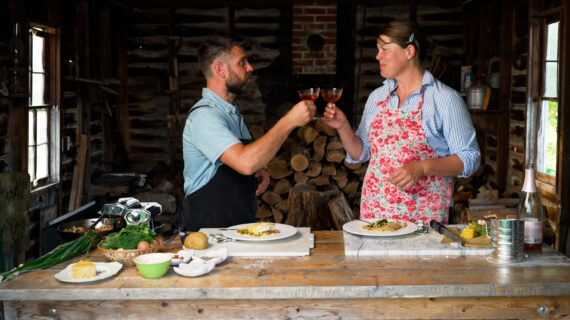
Well, my guests are arriving and it's time to get this Friendsgiving started. Cheers!
Man
Cheers. Toast friends and Friendsgiving with an herby, tangy cranberry cocktail. Cider gravy and mashed potatoes are a match made in Friendsgiving heaven. Organic cranberry sauce, the perfect Wisconsin touch.
Roast turkey and all the fixins are center stage for this wonderful get together. Sparkling cider is a perfect complement for this festive meal. Who wants dessert? Pumpkin pie and whipped cream.
The classic way to end a wonderful meal. Well, I hope this has inspired you to host your own Friendsgiving and I hope you'll gather with us next time Around the Farm Table. I'm your host, Inga Witscher. Cheers.
folksy music
Man
Around the Farm Table is funded in part by Wisconsin Farmers Union, united to grow family agriculture, Heartland Credit Union, and Friends of Wisconsin Public Television.
Search Episodes
Related Stories from PBS Wisconsin's Blog


Donate to sign up. Activate and sign in to Passport. It's that easy to help PBS Wisconsin serve your community through media that educates, inspires, and entertains.
Make your membership gift today
Only for new users: Activate Passport using your code or email address
Already a member?
Look up my account
Need some help? Go to FAQ or visit PBS Passport Help
Need help accessing PBS Wisconsin anywhere?

Online Access | Platform & Device Access | Cable or Satellite Access | Over-The-Air Access
Visit Access Guide
Need help accessing PBS Wisconsin anywhere?
Visit Our
Live TV Access Guide
Online AccessPlatform & Device Access
Cable or Satellite Access
Over-The-Air Access
Visit Access Guide




Follow Us