

 Passport






Fireman's Lunch
11/01/18 | 26m 47s | Rating: NR
Volunteer firefighters are the backbone of rural emergency services. Inga and Cousin CeCe prepare the volunteers a meal of Waygu beef, stops by the largest horseradish producer in the world and checks out an urban yard in Eau Claire that has been converted into a garden paradise.


Copy and Paste the Following Code to Embed this Video:
Fireman's Lunch
folksy music
Welcome to the farm. Cousin CeCe's here helping me get the last of the baled hay in the barn before it starts to rain. And then we're going to be celebrating some very special people. The volunteer firefighters.
For the meal, we're heading out to get Wagyu beef for some delicious burgers. And then it's off to an urban vegetable garden for some vegetables. And finally, we'll be visiting the world's largest horseradish farm. Gather with us Around the Farm Table.
I'm your host, Inga Witscher. Good morning, girls. I'm Inga and I love everything about farming. Midwestern farms are a bounty of good food made by good people.
I love being able to travel to search out good ingredients. Cooking is all about what's seasonal, what's fresh. Every day can be filled with good food, good friends, and a beautiful herd of cows. Welcome to the farm!
affectionately to cow
Good girl! Around the Farm Table is funded in part by Wisconsin Farmers Union, United to grow family agriculture, Heartland Credit Union, and Friends of Wisconsin Public Television. Last one for a while, then we get to take a little break.
laughing
Usually, we think about water as something that puts fires out. But if there's too much moisture in your hay, it can actually cause a fire. So you want to make sure that you're not baling your hay above 20% moisture. If you do do that, there's a bacteria in the hay that can actually increase the temperature up to 175 degrees and that can cause spontaneous combustion.
So one thing I do is I want to make sure I'm not above 20% when I'm baling. And then I go through and I check those bales. I just stick my hand in and make sure that they're not getting too hot. I'm going to finish stacking the hay with CeCe.
And then, why don't you check out what I did last week when I went to go pick up some Wagyu?
folksy music
I'm here in De Pere at Baycroft Farms. Jim turned his family dairy farm into a Wagyu farm and I want to go find out more about the beef. Jim's just over in the barn so let's go say hi. Hi, kitty.
Hi, Jim, thanks for having me on your farm today. Well, I'm glad to have you here. I'm interested to know a little bit about the Wagyu breed. It is a beef breed, but it's not from the United States.
Tell me a little bit about the Wagyu. The Wagyu breed was developed in Japan. How do you say it, "Way gue?" I pronounce it "Wag you." - I pronounce everything wrong. Well, it's /'wa:gju:/.
And five or ten years ago, nobody knew how to pronounce it. But the Wagyu breed was developed in Japan and it goes back 130 years. They have records with parentage back that far. And this breed's sort of known for all that marbling.
When I can afford it if I go visit a restaurant, I'll get a Wagyu steak and it's just layered with fat. The Wagyu breed is known as the marbling breed and it is one of the important things. Marbling gives you taste, tenderness, flavor, and it's what the Wagyu breed has been known for. And it's the good fats, right?
- You bet. There's been some research done and it's got to do with omega-3s and omega-6s. There's more research being done currently to substantiate the good fat part of it. Not only does it taste good but we think that there's some real positive attributes to the fatty acid composition.
And how's the market for this breed of cow? It's a limited number of animals. So right now people are becoming more aware of the quality of the product. So, there is a big demand whether it's breeding stock, whether it's meat.
Restaurants generally will charge two to three times as much for a Wagyu steak as they do for a traditional European beef brand. But it's, really it's worth it. It's kind of an experience. It really is.
It's exceptional. It has, people get hooked on it. They really like the quality. It's a unique experience.
And it's becoming more available. It's not just a few steaks that are imported from Japan. There are now 450 Wagyu breeders in the American Wagyu Association. That's quite a bit.
- They're registering about 4,000 full-blood Wagyu every year and then, there's an influence of Wagyu mated with some of the traditional breeds like Angus. And do these take a little bit longer to develop to grow 'em out? We found that the Wagyu breed, especially the full-bloods, are usually harvested at maybe 27 months of age compared to an Angus steer that might well be harvested at 16 or 18 months of age. So it's a bit of a slower process.
And that's part of the cost too. I think when people, when they're buying beef from a farm or at a restaurant, you got to figure in it's going to take you a lot longer to raise that animal. So you've got more costs at the farming end, too. You have to be patient.
There's more cost over time. And the genetics, the breeding stock can be a bit pricey to get started in the Wagyu market. How do you figure that out? 'Cause how many farms are in Wisconsin doing what you're doing?
There was one breeder that went out of business last October and had a very successful genetics part of dispersal. Everybody says that they are massaged and they are fed beer and everything like that. Are you doing the same thing here? Not every day.
Inga laughing
We're not feeding them beer. They get a fairly traditional diet here in Wisconsin. We feed a lot of corn silage, especially to our steers. They get alfalfa or alfalfa mix grass hay.
And a little corn and corn gluten and when we're trying to get some energy into the steers at the end of their growing period. As far as the massaging goes, I think that goes back to Japan, where they don't have a lot of pasture and some of the cattle actually get a little muscle bound. And as far as the beer, I think that goes with the humidity. It was so humid and appetite depressing in Japan that they tried to give them a couple of beers to see if that wouldn't stimulate the appetite and get 'em to eat a little more grain when they're finishing up.
Well, I would love to see if Jim will take me for a walk in the pasture to see some of the other cows. So, Jim, would you mind? - We'd be glad to do that. Okay, I'll see you when I'm done.
upbeat music
I'm here in Eau Claire's historic Third Ward. I wanted to find out from my friend Dennis how he and his wife turned their lawn into a beautiful garden oasis. Hello, Dennis. Hi, Inga, how are you?
Good, it's so nice to be in your lovely garden. Well, welcome and thank you for coming. It's incredible to see this amount of food being grown in your front yard. How many different plants do you guys have here?
It's huge. Oh, probably have 30 different plants that are growing. Anything from tomatoes, pumpkins, four or five different types of kale, all sorts of greens. Everything you need to have a sustainable type of a lifestyle in your eating habits.
I'm a little bit embarrassed. You guys are growing more food in your front yard in Downtown Eau Claire than I am on my farm.
laughing
Yes but you have cows and they won't let us have them here.
laughing
Can anybody start a garden in their front yard? People think, "Oh, I have to have a farm. I have to have a lot of acreage." But you really don't. You need a little bit of sunshine, that's sort of one of the ingredients.
And some good dirt, and some water and a little bit of care, and off you go. Have you just been enjoying having the garden as just a place to come to and just wind down for the day? Yeah, for us, it's very important. Both Shelly and I, we have our own businesses.
And owning your own business can be stressful. I'm sure having a dairy farm can be stressful, too. And we need a way to wind down, just relax ourselves. You know, in modern society we're really controlled by technology.
You have your phone that's always beeping, flashing, something and our attention spans tend to be very short. But you know when you have a garden, you commit to growing things. You have an ability to slow down. We come out every morning and stay in the garden.
And we come out every night when we're from home. And we spend time in the garden. I can't tell you how rewarding it is to see things going from a little tiny seed to a big plant that's full of fruit. You just cannot get that experience going to the grocery store and buying something right off the shelves or out of the refrigerated.
It's just a wonderful experience, an experience of accomplishment. It's one of those things that's measurable. So you put all this work in but you're getting something on the back end. And it tastes so good.
There is nothing like a homegrown tomato. You just cannot buy that. Even if you go to the farmer's market. It's your tomato.
Yeah, it's that sense of pride almost and just accomplishment. It is, absolutely. And then we share that with our neighbors too. We love giving people things out of the garden.
Actually, we let other people come in and pick, you know, and just enjoy the bounty. So, we worked hard but, you know, you feel good getting dirt under your fingers. So, if you're canning this much food off of, essentially, your little urban farm here, what's your winter eating like? You must be able to have a lot of garden produce in the winter.
We actually have three freezers going, yeah. Wow! - That has everything in there. So we actually have a lot of food.
So what's your grocery bill like? Our grocery bill in the winter is between $70 and $80. So, it's a little over $5 a day. Well, you have such a bigger variety in your garden than I do and I would love it if I could wander through, look at some things and maybe harvest some stuff for the firemen's dinner?
Oh, that would be great. We'd love to help out with that.
folksy music
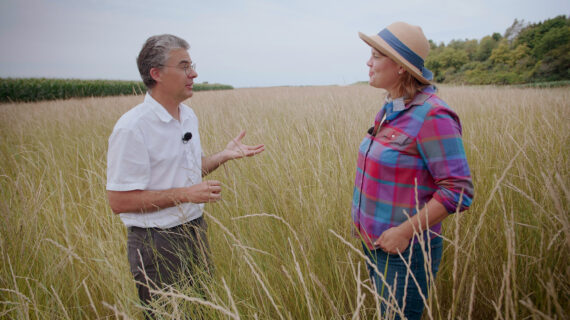
I'm here in Eau Claire at Huntsinger Farm, home to Silver Spring Foods, the largest horseradish producer in the world. Let's go meet up with Eric and talk horseradish.
upbeat music
This is exciting to be out in the field with this much horseradish. I've never seen this much growing. Thank you yeah, this is what a typical horseradish field looks like in beautiful Eau Claire, Wisconsin. You notice these big, beautiful green leaves.
That give the plant its nutrients, but really what we're most interested in is the big root underneath. So actually don't use the leaves for anything at the moment. When we actually harvest horseradish, we will cut the leaves off, rake 'em to the side. And then we come in with some specialized horseradish harvesting equipment to be able to get the big, burly roots out of the ground.
And how many-- You guys are the largest in the world for producing horseradish?
Eric
That's correct. - That's amazing. We are the world's largest grower and processor of horseradish, which means we do it all. We're totally vertically integrated when it comes to horseradish.
We grow about 900 acres of horseradish a year.
Inga
Wow.
Eric
But we have 9,000 acres of farmland.
So we need to have-- - Inga
Why that much? We need to have a crop rotation, a five- to seven- year crop rotation for horseradish for sustainability purposes. Wow, so what do you rotate your crops with? So we grow corn and soybeans and oats and alfalfa.
We've found that's the best mixture for us to be able to sustain our horseradish yields throughout the years. How did your family get involved in horseradish? You're fourth generation? Is that right?
I'm a fourth-generation horseradish farmer. My great-grandfather was Ellis Huntsinger. So, he was actually a door-to-door lightning rod salesman back in the twenties. And there's only so many lightning rods you can sell, I think.
So to be able to support his family he actually fell back on the family business which was farming. So he grew sweet corn, melons, strawberries, and horseradish. I think it came from his German heritage. And what was interesting about horseradish was it is a crop that he could grind, bottle and sell during the winter months.
Where some of the other products that he was making would just be more of a farmer's market summer selling process. Interesting. So over the years, we've definitely grown and developed and acquired more land. And more expertise when it comes to horseradish.
What does the roots look like? If I'm just digging this up in my garden, how am I going to dig it up? What am I looking for? A couple things to note about horseradish.
It's a perennial. It's in the mustard family. And what we do on a fairly large scale is we will plant and harvest simultaneously in spring and the fall. We like to leave the roots in the ground for 12 to 18 months.
And they like that cold weather? And they love the cold weather here. So the cold weather and the soil conditions here are ideal for horseradish. It likes that long winter.
It likes that cold winter. And actually, you have to keep horseradish cold to keep it hot. So there's some component to the temperature, which is a little bit backwards. Interesting.
What I'm going to do here is show you what the root looks like.
Inga
Can you imagine digging this whole field by hand? That's what we used to do a long time ago. So what you see here is the biggest root here will be called the mother root. Okay.
And so this is actually about 12 to 18 months ago, we planted this in the ground, this piece in the ground. And it got a little bit bigger. And then, it grew all these other structures. The crown is where the leaves are coming out.
And then these are all called sets. So what we do to actually plant another horseradish plant is we'll save these sets. This one's a little bit thin. We're looking for something about the size of your thumb and about six inches long.
So again, this would be a little bit thin. But this would grow into a whole other plant structure. So, for us, we actually have to harvest the horseradish, save sets, go back into the field. And hand plant it.
- And hand plant these. So this is still done by hand. Very labor intensive. And then once we harvest it, we bring it into our cold storage.
We never freeze a horseradish, it's always fresh, never frozen. And it sits in our root cooler at about 100% humidity just above freezing and we're able to store in there until we're ready to process it. Goes through a whole cleaning process, peeling process. And it goes into our grinders.
And we ship it out nationally at that point. Wow, well, it's been really lovely to be able to learn more about your business so thank you for your time. - Well, thank you very much. I'm going to take some of those horseradish back to the kitchen and we're going to get cooking.
upbeat music
chickens clucking
Inga
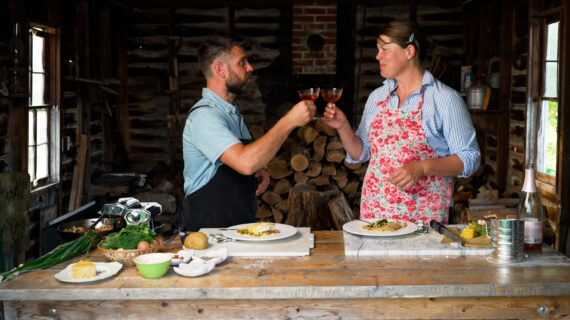
Well, cheers! Let's kick off our little cousin time.
CeCe
Cheers. I put some of that horseradish that I got in here
so they're going to be spicy. - Cece
Mm. Well, I thought we would do kind of a delicious burger for the firefighters. So I've got the Wagyu. And I thought that we would just grind it fresh.
So it's nice and fresh, everything's delicious. I don't think we need to add too much to the beef because it's so special and delicious already, right?
CeCe
Yeah it's so good you don't need to mask it with anything like additives in there or make it flavor enhanced. It's already really good so. Well, you start cutting and I'm going to start grinding. Okay, sounds good.
I think the Wagyu's so special. You can see the fat right through the meat and it just kind of melts. You know, it'll just melt in that burger and just kind of make it nice and juicy. Oh my God, it's going to be so good.
I think it's nice that we're doing this for the firemen because our grandfather was a firefighter. I know, a volunteer firefighter at that. Out here in rural Wisconsin, we depend on those volunteers to be there for us when we need help because nobody's-- you know, we don't live in a big city. Right.
It's gotta be our neighbors that are there to help us out. It's just, it's really nice and it's so selfless of the families, too, of the volunteer firefighters to have their family members be helpful members of the community, you know? I feel so old-fashioned right now with our little gingham dresses. And we're just hand-cranking this out.
I know. - Look at us. I know. It's my favorite.
Cousin time's always my favorite time. Same. - Mm-hmm.
laughing
Inga
Oh, that looks good coming out too.
CeCe
It really does. It's going to patty up really nicely. I mean we could probably put a little salt and pepper in it, maybe a little bit?
Inga
Right before we grill maybe?
CeCe
Yeah, we don't really need anything else than that.
Inga
All right, throw the last one in here for me. All right, sounds good. Okay, do that, perfect. Just a couple of homemakers we are.
I know, look at us. All right now that the meat is ground. Now we're going to make our patties. And you wanted to make 'em thin, right?
Yeah, I think it's always good to make, you know, you always see these burgers that are huge and thick which is fine. But if you make the patties really nice and thin. Like, are we talking paper thin? We're talking pretty thin, like that, yeah.
Then you could stack two of them on your burger and you have four sides of charring instead of just two. Right, okay. I've been doing mine too meaty and then the outsides are also a lot more done than the inside. Right.
So it's not really evenly cooked.
CeCe
Right, and I also like to let 'em rest for a little bit too just so they don't bounce back and shrink up, you know?
Inga
I think it sounds good. We're going to finish up doing the patties and then we're going to put them in the fridge to chill and then we're going to start our sides.
upbeat music
Inga
I'm excited to have CeCe here. CeCe makes the best refrigerator pickles. I love summertime and I love inviting you up 'cause she makes these beautiful cucumber pickles and so I wanted to show you guys just how to do it. Yeah, no problem.
It's my favorite thing to do. Everyone in my house loves it. But I call them a "quickle." Because you don't have to put 'em up 'cause they're refrigerator pickles. Nice and easy.
A quickle, CeCe's quickles. Yeah. So I always start with a clove of garlic and you smash it up. And I always use garlic that you grow at the farm.
Thank you. So now you're using the fresh heads of dill.
CeCe
So, it's super important. I've seen some with just the dill seed? You could. I like the whole head of dill.
It looks cool. I think it's better flavor, it tastes fresher to me. And then we're going to put a little bit of that, or a lot of it, of that horseradish in. Just because "why not?" Why not have a spicy pickle?
I love a spicy pickle.
Inga
I like what CeCe does is she cuts her cucumbers pretty thick. And it gives you a nice crunch when you're biting into 'em. It's nice to have like a little, 'cause that's what you want to eat. If you like pickles, you want to have a bitey.
Not like a little thin strip. No, you want to have a bitey pickle. So I fill them up here. Just shoving them in there.
All right, let's do this. So, I already-- The brine's finished. So, I've got one cup of vinegar to four cups of water and a quarter cup of pickling salt. Okay.
- And then I just pour it over. Whoop, that's all right. That's what the tablecloth is for, to soak it all up. Whatever...
It happens. And then, I close her up and we'll have pickles either later on tonight or whenever. Well, I made up a couple-- I used your recipe to make up a couple so we're ready for today. - Oh, perfect.
I'm glad you used it. Good, awesome. Well, my contribution as a side dish is going to be a beautiful fresh green bean salad. The green beans, what I did to them, is just I boiled them for a few minutes and then popped them right into a bowl of ice cold water with some ice in it.
And that stops the cooking. And now they're nice and crisp, they're not overcooked. And we can put on the rest of our dressing on it. So, I'm going to dice up a red onion here.
Half of one. I'm just going to sprinkle the red onions just right on here for some nice color. And I love the flavor. Put these up here.
And then, I'm going to do some tomatoes for some color. And these are a little bit bigger cherry tomatoes so I think I'll do these in quarters. Oh, my God, what a good idea. CeCe, if you would've seen the amount of food that Dennis gets off of his yard, you would be amazed.
Okay, I'm going to cut up a few more of these beautiful tomatoes without cutting my finger. I have horrible knife skills. I don't know if you've ever noticed that. You're fine, it's fine.
- Thank you. I'm going to sprinkle some eggs on top. These are just hard-boiled. - Yum.
Our chickens are almost to the age where they're laying again. But luckily, I have a neighbor who has some chickens, too, so I was able to get some eggs. Okay, so my dressing is just going to be really simple. I have some mayonnaise here and then, a little bit of sour cream, about a quarter cup of sour cream.
My father-in-law made these bowls by hand.
CeCe
Really? - Yeah. And then some horseradish to spice it up. I hope everyone that's coming today likes a little bit of spice in their life.
I hope so! If they don't they're going to have to go somewhere else. Right. And then I have two cloves of minced garlic.
And then, a little bit of salt and pepper. You know what would be nice is a little bit of lemon, but maybe I'll put that out right before we serve it. Yeah, that might be a good idea to brighten it up a little bit. And then, just stir all that together.
Homemade dressings are so easy to make whether you're making it for a slaw or just a green salad. You make your own. - Oh, yeah, all the time. Then you know exactly what you're getting in there too.
You don't have all the sugars and the, you know what kind of oil is being put in there and it's just-- and it's so easy. Yeah. Okay, get all my lumps out of there. And then, I'm just going to dress it all over.
And this can sit in your fridge for overnight if you want it to if you want to make it ahead of time. What a good idea. It looks so beautiful and special. Doesn't it look kind of festive?
It really does, like summertime. It's summertime, yeah. I always get excited when it turns out the way I've always envisioned it in my head. It doesn't always turn out that way so when it does, I'm excited about it.
Well, Cece, I think we're ready to wrap all this stuff up. Let's take it down to the fire hall and start grilling some burgers. Sounds good to me.
upbeat music
CeCe
I'm so excited to be here in my own township of Hale to celebrate the rural firefighters. A lot of you are volunteers, is that right? Yup, all the firemen in Hale are. All the firemen are?
- Yup. Wow, and you and your wife are both in the department, and you guys are dairy farmers. I love that! I love that we have that in common.
But without the rural firefighters, we're kind of out of luck, aren't we? Yeah, the next closest would be your cities and that's a long haul from one side to the other. So, what does your day look like? If you're out milking cows and you get a call, you just got to jump in the truck and go?
Depends on if we got enough help in the barns then me or my brother, one or the other, will leave. Oh, you guys are both firefighters? Yup. - Wow.
Are we doing anything to help the next generation coming up, inspire them to become firefighters? It's getting tougher and tougher 'cause of all the schooling and it's still volunteer. So, you still got to have the schooling behind you in order to have the safe part of it. So how long did you have to go to classes for?
The firefighter class for entry level one and two is 96 hours. Wow. And then, it's usually a couple nights a week. So they try to do it like 6 to 10 at night or something like that so it's after work hours.
Oh, wow. Have you ever had to go to a barn fire 'cause somebody put up their hay too wet and put it in the barn? Couple barn fires, but a lot of round bale piles. Oh, no kidding.
laughing
CeCe
Well, hopefully, the hay I put in the barn today is dry enough. I don't want to be seeing you down at the farm for that anytime soon. - Yeah, hopefully. Well, let's go get something to eat.
Okay.
sizzling
CeCe
Wonderful Wagyu burgers, grilled to perfection, an excellent thank you to our farming firemen friends. All the classic fixins' and a couple of new ones. Quickle pickles, with just a pinch of Wisconsin horseradish. Fresh from the garden, the spicy string bean salad, an old family tradition.
The perfect ending to our party in Pleasantville
CeCe's buttery, beautiful homemade cookies.
laughing
The perfect ending to our party in Pleasantville
Well, I hope this has inspired you to do something nice for the volunteer firefighters in your community. And I hope you'll gather with us next time Around the Farm Table. I'm your host, Inga Witscher. Great cookies, CeCe.
upbeat music
The perfect ending to our party in Pleasantville
Around the Farm Table is funded in part by Wisconsin Farmers Union, united to grow family agriculture, Heartland Credit Union, and Friends of Wisconsin Public Television.
Search Episodes
Related Stories from PBS Wisconsin's Blog



Donate to sign up. Activate and sign in to Passport. It's that easy to help PBS Wisconsin serve your community through media that educates, inspires, and entertains.
Make your membership gift today
Only for new users: Activate Passport using your code or email address
Already a member?
Look up my account
Need some help? Go to FAQ or visit PBS Passport Help
Need help accessing PBS Wisconsin anywhere?

Online Access | Platform & Device Access | Cable or Satellite Access | Over-The-Air Access
Visit Access Guide
Need help accessing PBS Wisconsin anywhere?
Visit Our
Live TV Access Guide
Online AccessPlatform & Device Access
Cable or Satellite Access
Over-The-Air Access
Visit Access Guide




Follow Us