

 Passport





Earth Day: Wisconsin
10/11/18 | 27m 1s | Rating: NR
The idea for Earth Day was born in Wisconsin and upon the 50th Anniversary Inga goes foraging the landscape for wild greens, visits a bison farm that is nurturing the land and shows what it takes to restore a Wisconsin prairie.


Copy and Paste the Following Code to Embed this Video:
Earth Day: Wisconsin
upbeat Americana music
Welcome to a rainy day here at the farm. We're going to be celebrating Earth Day in Wisconsin with a little shin dig up in Bayfield. For the ingredients, I'm heading to Rice Lake to North Star Bison and then I'll stop up on the way to do a little foraging for some greens. But first, I need to take care of the scapes on the garlic.
Gather with us Around the Farm Table! I'm your host, Inga Witscher. Good morning, girls! I'm Inga and I love everything about farming.
Midwestern farms are a bounty of good food made by good people. I love being able to travel, to search out good ingredients. Cooking is all about what's seasonal, what's fresh. Every day can be filled with good food, good friends and a beautiful herd of cows.
Welcome to the farm.
affectionately to cow
Good girl. Around the Farm Table is funded in part by Wisconsin Farmers Union, united to grow family agriculture, Heartland Credit Union and Friends of Wisconsin Public Television.
happy rhythmic guitar music
affectionately to cow
I've been really happy growing a garlic crop. I've been at it for a few years now. The only thing you really have to be thinking about when you're growing garlic, hardneck varieties, is that the garlic's going to send out a scape. So what the scape is, it's basically the leafless shoot that comes out from the garlic plant and eventually it would send out a flower.
I want the energy of the plant to go into the bulb so I need to take that flower off, otherwise the energy in the plant's going to go to produce that flower. So sometime around June you'll see your garlic scapes starting to form. Just head out with a knife and just cut those scapes off. I think they look really beautiful and they're delicious in things like vinaigrettes, garlic pestos, stir-frys, chop them up into salads.
They have this vibrant garlic flavor, so don't waste them. I'm going to pick some more and then why don't we go see if you can wrangle up some bison in Rice Lake.
happy country music
affectionately to cow
Hi, Marielle. - Hey. Thanks for meeting up with me today. Yeah, thanks for comin'.
I'm doing a little celebration of Earth Day and when I think about sustainable meat, I often will think about bison. Can you tell me a little bit about the farm and about the grazing here? Absolutely. Yeah, my father fell in love with bison when he was a young boy and grew up on a dairy farm and had some challenges, of course, in the late '70s, early '80s.
My father's dream of having bison started to become an interest, and now today we use our bison as a tool to graze our landscape of grass and diverse pastures. And how many acres are you grazing? We're grazing 2,400 acres this season. That's exciting, it's exciting to know that there's that much grass out here, because it's such a great habitat for birds and the bees and everything.
Yes, we believe so. We think there's one thing that this part of dairy country being so lush and nutritious allows for us to provide a very nutritious product through growing grass, and grass and just a wide variety of prairie flowers, and also allowing them into some of the transition areas and restoring oak savannas as well. And by having that diversity in the pasture, they're getting different nutrients and different minerals, right? Mm-hmm.
Does it affect the nutrition of the meat then? Yeah, absolutely. We focus heavily on our nutrients that are available to them in what they consume, and so we do routine checks to see what kind of nutrients are coming out in the grasses that they're grazing, and it's been really fun to see the land as the mineral cycle and the water cycle starts to really click and you see that synergy, the bison just shine. It's fun to watch as the land starts to heal and we see some tremendous animals and we know that transfers over to a very nutritious product on the table.
I think when people think about bison they don't think about northern Wisconsin as being a place for raising bison but bison were here back from the beginning of time, right?
Marielle
Yeah, the last bison east of the Mississippi was actually seen in Pepin, Wisconsin.
Inga
Really?
Marielle
Mm-hmm.
Inga
This is like the 10th largest state for raising bison.
Marielle
Yeah, I think because of the pasture quality that we can achieve in Wisconsin through very management-intensive styles and really becoming a student of the land, there's been some pretty good critics of grazing that have called Wisconsin the New Zealand of North America. Really? For folks that have never tried bison before, what is the favor of it? Sure, our flavor, as our customers call it, is sweet and juicy, and we believe that comes from our cool season grasses, clovers and orchard, timothy, brome.
There's a certain sugar content in the maturity of the grass so we try get past the high protein level of the grass and getting into the high sugars which comes from the sun. We harvest solar energy and turn it into a nutritious, juicy protein that finishes very well in the fall with a very high Omega-3 and C-L-A content in the fat, really the fat that your body and your brain craves. And this is, you can use bison in place of beef in any recipe, really. Absolutely.
Yeah, bison tends to be, it doesn't marble so sometimes people say, well bison is really lean. It can be leaner. We're on a pure grass diet so depending on if the cut was from March or August or October, there's going to be a different fat profile, none of which will marble. So, we think about the juice and the flavor in the meat and we just be careful as we're cooking, and as we're cooking that product, keep it contained and enjoy that fat and don't cook it out.
That's the magic. Well, I'm excited to try some of this bison but before we do, let's head out and collect a few more ingredients for the table.
upbeat guitar music
Marielle
Hey, Alan, how are you? - Hey, Inga. What are you doin'? I am trimming a burdock flower stock.
What are you going to do with the burdock? So this is a, believe it or not, it looks a little weird but this is the best part of the burdock plant. Really? I've got a ton of this around my farm.
Everyone has a ton of this around their farm and you can eat it and it is great but I don't dig the roots. This is a lot easier to pick. All I got to do is go in with a knife and cut it and it is excellent. I was talkin' to another forager that I speak with sometimes about market prices, and this one's going to go for about $20 a pound.
Are you kidding me? And I've just been mowing down my burdock. I should be harvesting it and selling it. Everyone has been mowing down their burdock.
I wish my cows would eat it. Maybe if I tell 'em it goes for $20 a pound they'll start eating it. So what is this going to taste like and how are you going to prepare it? Well, you can almost think of it like the texture of a root vegetable.
I like to compare it to salsify, which is kind of an old-fashioned root vegetable but I'm going to peel it, I'm actually going to peel it twice and first I like to go through and peel this like this with a knife, and then after that, I will go through with a vegetable peeler and peel it again. And after that, I put into a little bit of lemon water and then I can cut it into pieces and cook it in some chicken stock, and then after it's nice and tender I could put it on the grill, I could slice it and eat it just like that, I could marinate it. So how did you get into foraging? Well, I was working at a restaurant and I noticed that the most expensive stuff that we bought was wild food, nettles, mushrooms, all that stuff.
And I knew how to cook a chicken breast, I knew how to put a steak on the grill, I knew how to cook with herbs, but this was, wild food was a new challenge. It was something new to study and something new to master and I quickly found out that I will never master it. What are your favorite wild foods to get? That's not a fair question, 'cause I got to list them all.
It depends on the season. I mean, things can change from day to day, in one week. Stuff that I could pick today will be totally gone and it will change and it won't be in a good stage to eat. A lot of these things are only available for, it could be a few days.
What are some of those other things that we're going to forage for today? I'm hoping to kind of put together a little salad on the side. There's still a lot of nice little greens available. There's going to be lamb's quarter, there's going to be chickweed, wild mustard greens, and depending on what you do, you could even use some of the burdock stalks.
It looks a little too intense for me.
chuckles
Marielle
I'm more of a farmer than I am a chef. You got to give 'em a shot.
laughs
Marielle
You're a farmer with wonderful ingredients sitting right on your property. That's the thing, they're so much out there that we're just sort of wasting. Yeah, it's a very healthy way to eat. It's a way of life.
I don't have to pay for a lot of groceries during the season for vegetables and I can consume pound for pound, infinitely more by harvesting them out here in the field than I would do if I'd go to a grocery store. Good. Well, I'm hoping to do a little bit more foraging with Alan but I wanted to show you something I did a few months ago. I visited a native prairie and I thought it'd be a perfect little tidbit for Earth Day and I think you'll all enjoy it.
upbeat guitar music
Marielle
We're here in Brodhead, Wisconsin, home to one of the largest native plant nurseries in the Midwest. You should see the acre upon acre of blooms here. It is absolutely gorgeous. Now let's go find Corrie in the greenhouse and she's going to talk to us a little bit more about what native plants really are.
upbeat guitar music
Marielle
Corrie, thanks for taking time out of your day today to be with me. It's fun to be around so many beautiful plants. Tell me, what do you do here? We grow native plants.
Everything that we do here is native to the upper Midwest, southern Wisconsin, northern Illinois, especially. So define native, 'cause I know people talk about native grasses, native this. What exactly is a native plant? You know we get asked that question all the time.
My mother will say, well I was born here, I'm native.
laughs
Marielle
That's not what we're talking about. We're talking about plants that were indigenous here that were here at the time, prior to, actually, European settlement. So not like a dandelion. I think, oh, a dandelion, it's in my yard, it's been there forever but that was really brought over and introduced.
It was brought over. There are so many, even ones that we love, like chicory, one of my favorites, Queen Anne's lace That's one of my favorites, I love Queen Anne's lace. That's not native? - No, not native.
Beautiful, does good things, but not native. Well a lot of these I feel like, this is familiar. I think I've seen this or something like it growing in my pasture. Exactly, this is blue vervain and it's actually pretty common if you drive along wetlands, as you said, old pastures, you will see this.
This is a plant that's servicing pollinators out there. It's an important part but common. And it looks beautiful, too. What are some other common plants that we might see driving through Wisconsin?
Oh, black-eyed Susan is one that most will be familiar with. Milkweed is one, of course that's big right now. Everyone loves the milkweed. And that's the monarchs, is that why?
That's the monarch host plant, so that's a common one that people will know. Another one that people will often see if they ever get out in the woodlands is this one, and this is the great blue lobelia, a gorgeous plant. Bumblebees love it, you can, bumblebee pollinated. Lot of good, rich nectar in this particular one.
Interesting. Can you do something like this in your backyard or is it only beneficial on a big scale? Large scale is great, of course, that's the ultimate beneficial thing that you can do but we can all do a part. I'm doing a part in my backyard.
People are startin' to get excited about it. Butterfly gardens, rain gardens, that kind of thing. As you can see, there's some really lovely choices that you can make. Well, I'd like to see native plants on a bigger scale so I'm going to go head over to Steve's farm and see what he's done over there.
Oh, you're going to enjoy it.
upbeat Americana music
Marielle
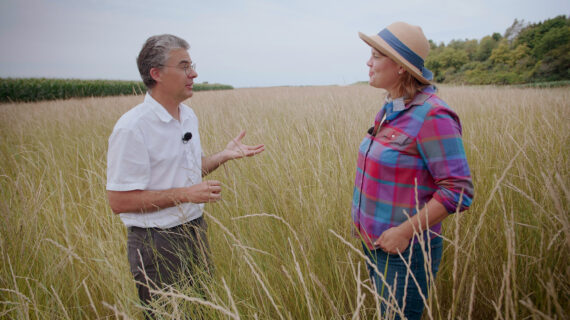
Steve, thanks for having me up to the farm. I just came from your nurseries and talking with Corrie. You're the founder of A-E-S. Tell us all that you do, 'cause it's kind of amazing things.
We work on about 1,500 projects a year all over the world that are ecological restoration projects, reclamation projects converting old mine sites into beneficially reusable landscapes, doing alternative agricultural projects, doing prairie, wetlands, savanna restoration, designing urban parks and restoring farms to prairie and wetland and so forth. Making the world a better place. Yeah, trying. One little acre at a time, yeah, exactly.
So your farm looks a little bit different than a lot of the farms that I see around Wisconsin. There's a lot of diversity here, a lot of prairie. How many acres of prairie do you have here at your farm? We have probably around 70 acres of prairie and eight to 10 acres of wetland and several acres of savanna and first order trout stream we've restored, and then a couple of acres of gardens and orchards.
You've got everything here, you don't have to ever leave the farm. It's awfully nice to be here. A lot of people have a summer cottage. We don't need one.
laughs
Marielle
One thing that you talked to me about is how you're seeing in these native prairies like you have here at your farm, you're seeing food sources, not only for the pollinators or for the animals, but there's human food in there, too. I never thought of it as a food source for human beings. Well, it used to be. Native Americans harvested many of the species, seeds, and other plant materials and utilized the products for food and we're experimenting with the same, and what we're learning is some of the native legumes are 38% digestible protein, just the seeds, and some of the native grasses are 25% digestible protein, and very, very palatable and actually quite delicious and we've made some beer and we've made some bread and a whole range of different food products that we're experimenting with.
We're not selling it or anything like that at this point. Oh, that'll be interesting to see how you take that further because thinking about these plants coming off of this prairie, I don't have to tell you, the root systems must be so long and just going down so far, and they're pulling up all that nutrients, is that correct? Well, that's exactly right. Many of the plants here have root systems that go down 6 to 10 feet, as opposed to conventional crops, which some, they may have straggling roots that go down that deep but most are much shallower than that.
So we're remineralizing the full soil column by growing these plants that are bringing up cations from two or three meters deep and it's doing it without any fertilizer, any help. Do you think a prairie like this would be beneficial to me as a dairy farmer to run my cows through so that they can kind of get mineralized, too? Well, I would say the buffalo had it right, because the buffalo and elk lived on this sort of landscape and I've seen very weak and drab-looking buffalo and elk. They usually are big and healthy animals.
You'll have to ask them.
Inga laughs
Marielle
Well, I know that you're a busy man and I'll let you get back to work, but if you don't mind, I would love to be able to walk through and see what different kind of species and see if I recognize anything that's growing that may be growing on my farm. Have at it and enjoy it. Enjoy the butterflies, they're quite abundant right now. Well, thank you, Steve.
Have a great rest of the day. - Steve
Enjoy your walk.
upbeat guitar music
Have a great rest of the day. - Steve
As we approach the 50th anniversary of Earth Day, I thought it would be nice to stop by Clear Lake, Wisconsin to visit where Gaylord Nelson was born. This is where he developed his love of everything environmental. He was not only a Wisconsin Senator and Governor, he's also the founder of Earth Day and I'm excited to be able to celebrate Earth Day and his legacy with his daughter, Tia.
Native American flute
Have a great rest of the day. - Steve
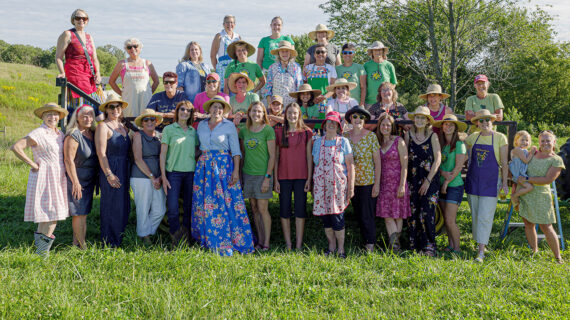
I'm here at Blue Vista Farm near Bayfield. I wanted to move up with Tia, Gaylord Nelson's daughter, to celebrate Earth Day with her and some of her friends.
Inga
Hello, Tia!
Tia
Oh, hi, Inga, welcome to Blue Vista Farm. - Thank you. I was just coming up from Clear Lake, which is where your father was born, and now we're in another special place overlooking the Apostle Islands. It's really my favorite place, most magical place in all the world for me and for my father.
He came here as a child and later brought President John F. Kennedy to visit here and that became the beginning of an effort to protect the Apostle Islands. The largest freshwater archipelago in the world is now the Apostle Island National Lakeshore and the Gaylord Nelson Wilderness area.
Inga
Wisconsin has so many treasures.
Tia
Oh, certainly. I'd love to hear more about it but I need to get out of the heat. Yeah. - Could we head to the shade?
Sure.
Native American flute
Tia
Tia, can you tell me a little bit about your father and why the environment was so important to him? Sure, he was born in Clear Lake, Wisconsin, a small town in northwestern Wisconsin, Polk county, and nature was his playground and his experiences as a child very much imbued in him an environmental ethos that stayed with him all his life and became a distinguishing part of his career once he was elected governor, and later a United States senator. He's not only a governor and a senator, but he was also the founder of Earth Day. How do we celebrate Earth Day beyond April 22nd?
There's lots of things we can do. Doing our best to avoid single-use plastic whenever we can. That has a big environmental footprint. It doesn't tend to be recyclable because it has less value so aluminum is more frequently recycled, glass much more frequently recycled because they have higher value.
So, things like the choices we make about the food we eat, the choices we make about the food we purchase but don't consume, choices about single-use plastic and packaging of food products, as well. It's the nice thing about buying at the farmers market, right, you don't have all this-- All the extra. All the extra packaging that goes with some of your grocery store trips, you know? Well I'm absolutely so excited to be able to come up here and to meet you and to be with you today, and to celebrate your father and to celebrate Earth Day.
Thank you so much for having me. Well, thank you. I'm so grateful and thank you for your interest. I'm really happy to be here.
Well, I'm going to head over to my little makeshift kitchen and get our feast started.
upbeat happy music
Tia
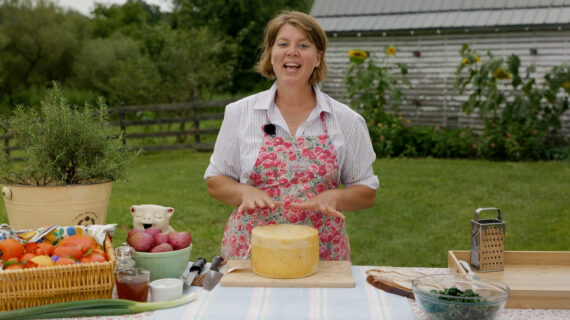
For today's Earth Day celebration, I wanted to do something simple but really delicious. Since we're using these amazing ingredients and they're so fresh, I decided to turn the bison into a bison tartare. It's something my cousin CeCe and I ate all over France. It's very popular there and I just thought, with a great piece of meat, it's something that I wanted to serve today.
I'm going to serve that alongside of our wild green salad, so we have some of the greens that we collected, and I added a few radishes and tomatoes just to make the color bright, and I'm going to dress that with a garlic scape vinaigrette. And if you've never had fresh garlic before, I suggest you find yourself a farmers market and get some fresh garlic. It's a whole different experience. Or better yet, grow your own.
And I'm just going to use three garlic scapes and then, to that I'm going to add a couple of scallions. And I'm just going to dice these up real quick. And right in they go. And then some lemon, a fresh squeeze of lemon.
That's going to be my acid. If you wanted to add a little red wine vinegar, you could do that, too. And then I'm going to do a little Dijon mustard. Alrighty.
And then some salt and pepper. If you had some local honey, you could put a little drizzle in there to sweeten it up a bit.
blender whirs
Tia
Once it's pureed a little bit, then slowly add a little bit of olive oil.
blender whirs
Tia
And that is how you can make a quick, simple vinaigrette. So I'm just going to pour that into a bowl here. And look at how gorgeous it is. It looks like a green goddess dressing.
It's going to be really good. And then just give it a taste. It's nice and garlicky, but the perfect amount of garlic. I'm going to get this kind of cleaned up and then, we'll start making the bison tartare.
birds chirping
Tia
So you can make different tartares. Today we're doing a bison tartare, but if you wanted to do a salmon tartare or even a beet tartare, it's basically just a raw formation with some different spices and things added to it. So, let's get our spices all ready. I'm going to do some shallots.
I think that will be a nice flavor with this. I'm big fan of that sort of oniony, garlicky flavor. I like everything strong. And with some fresh parsley.
I love cooking with fresh herbs, especially if they're coming out of my garden. So I'm just going to chop up some cornichons right here, and a few capers, and I'm just going to do a rough chop. Now I'm going to add this to my bowl here. You really want to know where your meat's coming from.
I know the farmers that it's coming from, I trust that. You don't want to buy just ground burger from the store because there's oftentimes more than one animal in that package of burger, and so you don't know what you're getting into. So you want to make sure it's a full joint that you're using and that you know the person that's growing it, and you're handling it well. You could also put some salt on it and leave it in the fridge for an hour with a coating of salt, and then rinse that salt off after an hour and then dry the meat well so that you know there's any bacteria that may have been on there is getting off.
And now you just want to dice this up as thinly as you can get it. So once you have it diced to the consistency that you want, just add it into those capers and the shallots and some of those lovely cornichons and the parsley. Now you can add your seasonings so I'm going to use a nice Dijon mustard and then a little ketchup and some hot sauce is traditional. Spice things up.
I love hot sauce. I'm going to put a little bit of lemon juice in there just to brighten those flavors up a little bit and some salt and pepper. And then, now I'm just going to mix everything together. So when I plate it, I want it to look really beautiful so I'm going to get a little help from, just a little can is going to be my guide.
If you do this ahead of time, just make sure you put the mixture back in the fridge to chill. Look at that. And then you can top that off with a little quail egg to be extra pretty. And then maybe some greens around there.
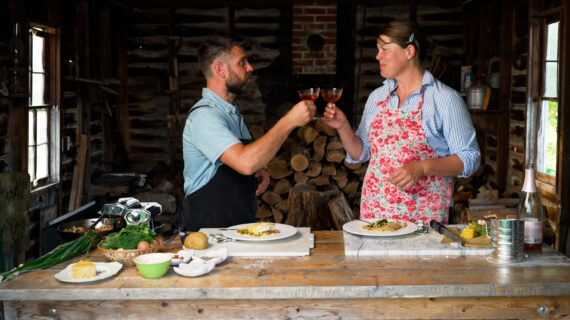
And it's kind of a fun celebratory lunch that you can have with a fresh glass of champagne. I'm going to get the other plates plated and then we'll all sit down for a feast.
acoustic Americana music
Inga Voiceover
Serve the tartare with cornichons and toast points. Spice up the wild green salad with radishes and tomatoes. Top the tartare with a quail egg.
loud pop
people exclaim
laughter
Inga Voiceover
That's a good senior moment.
laughter
Inga
A bit of sparkling wine to cool you down on a hot summer day. Well, I hope this has inspired you to celebrate Earth Day every day, and I hope you'll gather with us next time Around the Farm Table! I'm your host, Inga Witscher. Cheers, guys.
upbeat Americana music
Inga
Around the Farm Table is funded in part by Wisconsin Farmers Union, united to grow family agriculture, Heartland Credit Union and Friends of Wisconsin Public Television.
Search Episodes
Related Stories from PBS Wisconsin's Blog



Donate to sign up. Activate and sign in to Passport. It's that easy to help PBS Wisconsin serve your community through media that educates, inspires, and entertains.
Make your membership gift today
Only for new users: Activate Passport using your code or email address
Already a member?
Look up my account
Need some help? Go to FAQ or visit PBS Passport Help
Need help accessing PBS Wisconsin anywhere?

Online Access | Platform & Device Access | Cable or Satellite Access | Over-The-Air Access
Visit Access Guide
Need help accessing PBS Wisconsin anywhere?
Visit Our
Live TV Access Guide
Online AccessPlatform & Device Access
Cable or Satellite Access
Over-The-Air Access
Visit Access Guide




Follow Us