

 Passport



Cowboy Campfire
10/24/19 | 26m 47s | Rating: NR
Inga invites friends to the farm for a trail ride, live country music and a campfire barbecue. She travels to the town of Dane to meet a family who are producing high-quality bourbon from the corn they grow on their farm. She then meets up with some ranchers in Hillsboro who use their horses and rodeo skills to herd cattle. Inga’s brother pays a visit to the farm to show her how to shoe horses.


Copy and Paste the Following Code to Embed this Video:
Cowboy Campfire
Announcer
The following program is a PBS Wisconsin original production.
upbeat country music
Announcer
Howdy y'all, welcome to the farm. We're going a little bit country today by having a cowboy campfire. For the ingredients, I'm heading over to J. Henry for some bourbon.
And then I'll stop by and say hi to some cowboy friends of mine, and finally, I've invited some friends over for a trail ride. Gather with us Around the Farm Table. I'm your host Inga Witscher. Good morning, girls.
I'm Inga, and I love everything about farming.
upbeat folksy music
Announcer
Midwestern farms are a bounty of good food, made by good people. I love being able to travel, to search out good ingredients. Cooking is all about what's seasonal, what's fresh. Every day can be filled with good food, good friends, and a beautiful herd of cows.
Welcome to the farm.
Inga to cow
Good girl.
Announcer
Around the Farm Table is funded in part by
Wisconsin Farmers Union
United to Grow Family Agriculture, Heartland Credit Union, A gift in memory of Wendy Bladorn, Focus Fund for Wisconsin Programming, and Friends of Wisconsin Public Television.
upbeat country music
Wisconsin Farmers Union
My brother Lee is visiting from Virginia. In Virginia, he is a farrier, which is also another word for a horse shoer, right? Yes. So to be a horse shoer, do you need to have a full mustache and a Southern accent?
You don't have to, but it sure helps.
Inga laughing
Wisconsin Farmers Union
I think it's-- a lot of people I don't think, are gonna understand that we're brother and sister because our accents are so completely different. Right. Now I'm a Midwesterner, well no, I'm doing a Southern accent.
laughing
Wisconsin Farmers Union
All right. Well, so why is it important to be trimming hooves, and making sure the hooves are healthy on horses?
Lee
So we try to trim them every six to eight weeks, to help keep the foot where it needs to be for the health of the tendons and ligaments. And because they're just using their hooves so much? Right. Okay, 'cause with my cows like, I don't have to trim their feet nearly as much as a horse, but I just think 'cause it's out there, what's the difference between cows and horses and feet?
I think it's because we exercise them so much and use them so much, they have a lot of blood flow that goes to that foot
and it grows a lot faster. - Inga
Right, right, okay. So what is the process of trimming feet? So we just kinda clean it out and kinda clean up the frog and the sole, and establish where we want our balance and trim the hoof all to that, and round up the outside real well to keep it from chipping up during a six-week deal.
metal scraping
Inga
And this is just kind of a part of what the cowboys used to do in the old days too, right?
Lee
Right. I bet it was a lot more difficult back then with the-- or is it still the same tools? Still pretty much the same tools, we've had a few advances, but-- - No kidding. Kinda the same stuff since they started.
upbeat country music
Lee
I'm gonna help my brother finish up with this horse and then I'll see you down at J. Henry, where we're gonna get some bourbon for our cowboy campfire. For generations, the Henry family has been running a successful seed corn business on their farm in the town of Dane. Now, they found a unique way to involve the next generation
in the family business
by turning their corn into delicious, high-quality bourbon. I'm here at J. Henry & Sons. I wanted to pick up some bourbon for our cowboy campfire, but most importantly, I wanted to find out how bourbon is made right here in Wisconsin.
upbeat country music
in the family business
Hey, Liz. Hi Inga, welcome to the farm. Thank you, thanks for having me. I'm really interested to learn about the corn, how it's made into bourbon, and just the whole farm history.
Joe's out in the field, would you like to go? Absolutely.
upbeat country music
in the family business
Hi, Joe. - Hi Inga, how are you? Nice to see you. - Nice to meet you.
Thanks for having us out here. - Absolutely, yeah. So I wanted to find out from you, about the history of this family farm. Well, my father purchased this farm in 1946, and we've been farming here ever since.
He came and started out as a hybrid seed corn farmer, at that time, it was kinda the new technology in its day, hybrid seed corn was you know, the thing. So he was one of the first ones, among a number of other small family farms that kinda picked it up as well. Was this a good corn area down here? Oh, it's great; this is called Arlington Prairie, great deep black soil, Plano soil, clay subsoil, so great water-holding capacity, perfect for raising hybrid seed corn and any kinda corn and grains and soybeans.
You're very unique because you're doing this, is it the red corn, for the bourbon, is that right? Right. - Tell me about that. So this was a hybrid that was very popular in its day, it was developed by the University of Wisconsin about the 1940s and my father was, this was one of the first hybrids that he produced and sold as, to farmers for them to plant.
Inga
Was this for cow feed or was this... You know, the great thing about this hybrid was that it made a great grain, but it was also great because you could make silage out of it as well. Okay. So it gets very tall and makes great silage corn, but if you have enough silage you can let it go and harvest it as grain, but today it's not a very good hybrid, in comparison a very low-yielding hybrid, maybe if you're lucky a hundred-bushel maker, and it doesn't stand very well, unfortunately.
But it makes good bourbon, right?
Joe
Makes great bourbon.
all laughing
Joe
It's the best thing, yeah. And this is one of the main ingredients in the bourbon. Right, so bourbon has to be made of a minimum 51% corn, our mash bill happens to be about 65% corn, and then we have about 14% wheat and 14 rye, and then we use barley malt as well, which we purchase from Briess in Chilton, Wisconsin, but all the corn, the wheat, and the rye are all raised here. I always thought bourbon was more of like, a Southern thing, I thought it had to be grown in a certain region to be considered bourbon, is that not true?
No, so the Kentucky boys would like you to believe that, but we're proving that we can make great bourbon in Wisconsin. The law, federal law, is that bourbon has to be made in the United States, 90% of the bourbon in the world is made in Kentucky, so we visited a number of distilleries down there, and just kind of caught the bug, and of course, because bourbon has to be made from at least 51% corn, it just kind of made sense, I thought, to give it a, give it a try. Well, I'm so inspired by people doing value-added on their farms; I think nowadays, it's a great way to keep the family on the farm and continue with that legacy, and I'm all about it, and I had never thought about turning corn into bourbon, and this is just so neat that we could do it here in Wisconsin. Yeah, great.
Liquid gold. - Liquid gold. Do you want to see where the magic happens? I absolutely do.
Our sons are out in the rickhouse. Alrighty, well Joe, good to see you. Yeah, absolutely. - Bye.
upbeat country music
Joe
So this is our rickhouse, and this is where we age and mature all of our bourbon. It smells delicious in here. Oh, good, we always hope people notice that, that's because once the bourbon is distilled, it's put into a new charred oak barrel and it is set in here on its side. We call this racking or a rickhouse, so that the air can circulate around it, the barrels can breathe, and what happens is the barrels work with the weather and bourbon is evaporating out of the barrels.
Over 5 years, we lose 15 to 20% to that evaporation, and that's called the "angel's share," and that is what you may have noticed when we walked up to the building, there's a little distiller's shadow on the building.
Inga
Yeah, I saw it. Little dark, murkiness and the guys on the farm always wanted to clean that off, they didn't want people to see our buildings being dirty. They're not dirty; that's a growth that comes from feeding on the angel's share, so it's a really important part of showing that we have a healthy rickhouse. And that's something you're only gonna see in a rickhouse.
Yup, because the alcohol is evaporating and this rickhouse doesn't have electricity in it or lights, so it's just breathing and working with the great outdoors. And you don't have to worry when we have these really tough Wisconsin winters that any-- I suppose alcohol doesn't freeze. We came in during the polar vortex, we wanted to be sure, but alcohol doesn't freeze, it's a very, very, nearly impossible thing, even in that cold of weather. What else happens in this room, what's part of the aging process in here?
Well, we should go talk to the boys, they can explain a couple of things, we can do a sample, and we can look at a barrel stave and see what's really happening.
midtempo country music
Inga
So Jack, what've got going on here, what's this in your hand? Hi, so this is actually one of the staves from the barrel, and I know my mom was telling you just about how all the flavor and all the color comes from this barrel, so as you can see here, this is a new charred oak stave here, so right here is where all the char is, that almost acts as a filter between the wood and the bourbon, and then if you look closely here, you can see this, we call this the red line, so that's actually how far the bourbon has made it into the wood over the course of its life. So that's how far it's seeped in and then seeped back out. And then seeped back out, exactly, and so here in Wisconsin we have those wild temperature swings, so just like this past winter was negative 50 and this summer was 120 degrees, so all that's doing is helping expand the wood and contract it when it gets cold, and pulling that bourbon in and out of the wood, so we really think our climate here in Wisconsin helps us make a really quality bourbon.
I'm glad it's good for that.
all laughing
Inga
So how do you guys, how do you know if it's, when to bottle it and when it's ready to go? So we actually sample every single one of our barrels. Okay. - As they're becoming of age, so I'm gonna use this whiskey thief and just pull some samples out.
And this is done once a year, right? This is done once a year, kind of towards the end of the summer, where we taste through all the barrels that are gonna be coming to maturity in that next season, so that we can taste the individuality, the uniqueness of each barrel, and using those different flavor profiles, we can then build blends on top of one another and create really complex blends, that are also very approachable. So when you're tasting a bourbon, what are you looking for, what are those flavors that you're looking for? A lot of, for our products specifically has a lot of caramels, a lot of vanilla, a lot of really, like, dark stone fruits, so think of plums, pears, dark figs, apricots, cinnamon, and brown sugar, so really a dense, very sweet flavor profile that has a lot of good fruity flavors to it as well.
It's really good. So how long do you age it before you know it's ready? Five years is our minimum. - Really?
For our youngest product, yes, but now, the barrel that we're trying right here is actually about seven to eight years old, and we're hoping it makes it to a 10-year product. Wow, it's delicious right now.
Joe
Yeah, thank you. So how did you guys learn how to do this? A lot of trial and error, honestly, we actually work with a consultant. Her name is Nancy Fraley.
She has been training both my brother and I to do a lot of the blending and warehouse management so that we can really have those complex flavor profiles and blends put together in a really, really easy way for you to enjoy. Well, this is really fun, cheers guys, thanks for having me. - Cheers.
midtempo country music
Inga
This has just been really fun spending some time with you and getting to know how bourbon is produced here in Wisconsin, and it's lovely to be here and see everything. Thank you. I want to know, what is it like for you, to be able to work with your family, to be able to see your sons as a part of the business and working with your husband? It's been one of the most meaningful and exciting parts of our business.
Neither of the boys was especially keen to take over the seed corn business, but now they are both firmly entrenched in our future and our legacy of both the seed corn and the bourbon business, so we're very excited to see what's coming next, and we're letting them make all the hard decisions. Well, hopefully here's to many more generations at J. Henry. Thanks.
I'm gonna grab a bottle of bourbon for our cowboy campfire, and I'll see you guys right on down the road.
upbeat country music
Inga
I'm here in Hillsboro, Wisconsin to visit some of my cowboy friends. I'm planning on doing some ridin' and some ropin' and now it's time for me to get saddled up. Hi guys, nice to see you. How's it going?
Good, I am so excited to ride horses and work with cows. Are you guys ready to go? Yeah, it's gonna be a great day for it. Okay, well, let's get goin'.
Matthew Davison
Yeah, let's hit the trails.
midtempo country music
Matthew Davison
The cowboys took me on a ride over the ridge to show me how they work with horses and dogs to manage their herd of cattle. Here, here, here. Bingo. Here, lie down, Bingo!
Lie down. This is the perfect day for me; I'm having such a good time, so this is what you guys get to do every day. Yeah, we got horses to ride and we've got cattle to check, so we like to get out here and ride in the hills and, and get all that done, dogs to work.
Inga
What came first, the cows or the horses?
Matthew
Well, I grew up on a dairy farm, but then I started training horses after that, so I've been training horses and as I learned about different events, I became focused on the cattle events, so training horses went to needing cows to train the horses with. And that's where the beef cows came in. And that's where the beef cows came in, yeah. So what kinds of things do you have to think about when you're training those horses?
Well, we need to get 'em to understand what the cow's gonna do next, and think like the cow, so that they can read the cow, because by the time that we see what the cow's gonna do and tell the horse about what to do, it's too late. So we try to develop that "cow sense" in our horses, so they do the job. There is a certain way of working with cows that I found, growing up on a farm and farming now, it's there certain angles that I want to be, when I'm herding my cows behind them or on different things 'cause the way the cows can see, is it the same with horses, is that what you're teaching them as well? Yup, those cows all have a bubble, and our horses learn how to use that to their advantage.
Do many people out in Wisconsin farm with horses now? You know, it would surprise you how many do. I do day work for different places, so I'll get a wage to come that day and do a task, like I do day work for a cow-calf operation, I may get hired to come on a day that they're pregnancy checking or if they have to check a lot of pastures and they need an extra hand, so not full-time because I have my own full-time horse training, but we'll saddle up and go, and we'll help out for the day and that creates a great opportunity for us to get our horses broke, and see new country and it's awesome. So what are, what's the benefits then, of working with a horse?
For me, I would love to have horses on my dairy farm, just because I would love to ride around and herd my cows around, but what are the benefits for some of those ranchers out there? Well, for one thing, where we live, it's not safe to take a four-wheeler or the terrain is too tough, and we teach our cows to accept the horses being around 'em and it's really a lot easier for us to do herd health; we're up high, we can see 'em better, and that's just a couple of advantages, not to mention the peacefulness is awesome. Well, the cows seem to be so at ease around you guys too. I see beef herds a lot, and I always think the difference between beef herds and dairy herds, are dairy herds, they get worked with twice a day when they're coming in, being milked and everything like that, where I always think of beef herds as being a little bit more skittish, but these guys seem to be better behaved than my cows.
Even though they're a cow, they do think a little different than a dairy cow, but they get used to us, and we'll put 'em in situations where we'll hold 'em and be quiet with 'em and just ride through 'em, and they learn to accept us not as a predator. How long does it take you to train a horse to be a cattle horse? Well, it really takes two years to get well going, but it's a lifetime learning for you and the horse. It takes time.
slow country music
Inga
Did you always know you wanted to be a cowboy when you grew up? Well, I always said I wasn't gonna do it because I didn't want to lose the fun, but here we are doing it for a living and still having fun. This is so much fun.
laughing
Inga
I know what you mean though, I mean I still love milking cows after all these years, but it takes me longer to complain about going out to milk cows than it does for me to actually milk cows, but I still enjoy it nonetheless; but this is really, it's so quiet out here, it's so beautiful, just coming over the hillside, we got to see just so much and hear the birds and see the insects going, and this just seems like, why would you ever want to get a four-wheeler when you've got something like this? Tell me about the beef cows here, so do you raise 'em, you're just raising steers, you're raising some heifers too? So what I do, is when it gets to be, grass times comin', I buy some, I go to the sales and buy 'em, and then I keep 'em close at home, you know, and get 'em their shots and make sure they're settled in good, and then when grass comes, then I turn 'em out. So what we have left is just a few of what I ran, you know, I've sold most of them, but I kept a handful to work my horses, show season's coming up for these young horses, so I need to have a few cows yet.
So tell me about show season, what do you show? Well, I show in the ring cow horse, so we'll do a three event, like this is a three-year-old, his first show's coming up this weekend. He'll show out of the herd, which will be herd work similar to cutting, but we get to guide our horses, then we'll do a reining pattern another day, and then we'll go down the fence another day, which we will box a cow, turn it on the fence, and circle and that will be a very fast, high action sport. Did you grow up with horses or is this something you just started to do on your own?
When I grew up milking cows, we always had a couple horses around, but I bought my first horse when I was in sixth grade. So you've been committed for a while. Yeah. Now I want to become a horse girl.
But I don't know that I'm there yet. I like to be able to come and visit folks like you and have them saddled up and waiting for me. That's perfect.
slow country music
Inga
Matthew, what does it mean to you to be able to be out here working with these animals and be outside? You know, I'm just fortunate that when morning comes, I can head outside and get to work, and when lunch comes, I can go inside and see my family. You know, that opportunity is really gone by the wayside. It really has; well it's been fun working with the cows and I know you gotta bring 'em home so we can take a look at 'em, and I'm interested to get back 'cause I want to see what you do at the horse shows.
Yeah, well that sounds great; let's gather these cows up and head over the hill and get in the outdoor arena.
midtempo country music
Inga
All this skilled riding doesn't come without practice. That's why Matt has set up a rodeo arena, where they train horses and practice their skills roping and herding cattle. This has been a super fun day getting back in the saddle. I'm a little saddle sore.
They say if your knees hurt, your stirrups are too short, if your butt hurts, your stirrups are too long, if everything hurts, it's just right.
Inga laughing
Inga
Well now that we're back in the arena, what are you guys gonna show me up here? We were in the pasture, now we're in the outdoor arena, so here we just kind of refine the little things we want to work on, and then if we need to fix our horse and let the cow go wherever the cow needs to, we have four walls around us, so the cow can't get away versus in the pasture, where we might be trying to get a job done and we gotta keep our cows under control, so we'll just refine some little things and work on refining ourselves and our horse to get our job done just right. And so these competitions that happen in rodeo or in showing, they are happening because this is what cowboys do and this is a way to go to town, to kind of show off your experience right? Yes ma'am, back in the West, the hands used to get together in town or something and everyone would bring a few stock from their house, and then they'd just kind of show off who was the best in that area, at the day-to-day tasks that they needed to get done.
Well, if there was a hand milking competition, I'd probably be up for a blue ribbon in that competition. I wouldn't compete against you. Not horse riding though. Well, I'm gonna see these guys doing a little bit more ropin' and ridin' and then I'll see you cowpokes back at the fire.
upbeat country music
Inga
That was perfect, I needed a fall starter too.
gentle country music
Inga
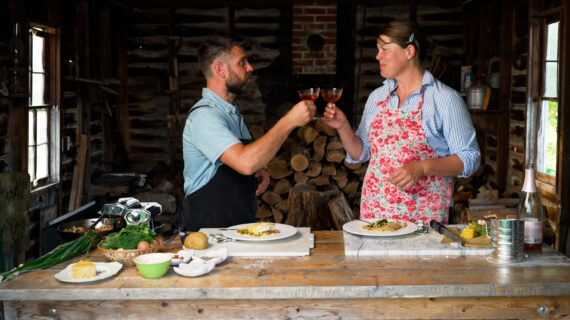
I'm gonna be making some cornbread today for all the trail riders, we've got some barbecue coming and I thought cornbread would be a nice addition to the barbecue. So the first thing I'm gonna do is add my cornmeal. I've got a cup of cornmeal and then I'm gonna add a cup of flour, 2/3 cup of sugar, 3 1/2 teaspoons of baking powder, about a half a cup of crisped up bacon, a good handful of cheese, one egg that I just lightly got beat up, a cup of milk, a half a cup of bacon fat, which I rendered when I was cooking the bacon, and my secret ingredient is gonna be this wonderful bourbon that's made right here in Wisconsin. And then I'm just gonna give this a good stir up.
Now that the batter's mixed together, I'm gonna let that sit for about an hour while we go on our trail ride, and then once we get back, we're gonna get the fire stoked and cook that right over the fire. Cheers.
upbeat country music
Inga
Have the kids help cook the cornbread right over the campfire. Serve up pulled pork sandwiches with all the fixings. Cheers to summer with ripe watermelon slices. No cowboy campfire's complete without chili.
Have a sip of bourbon and enjoy some country music.
all laughing
Inga
Well I hope this has inspired you to have a cowboy campfire, and I hope you'll gather with us again,
in unison
Inga
Around the Farm Table! I'm your host, Inga Witscher.
Ben Stillwater & Family performing "Stillwater Canyon"
Inga
I rode 18 miles today on the trail On my way to Santa Fe Rode my quarter horse down the canyon at dusk Looking for a place to bed down I found a spot where the cottonwood trees Sway in long, shimmering leaves To the evening breeze As I lay my head down at night I'm reminded that I live quite a life I ride on when the moon sets at dawn Rhythm of the horseshoes Clanking across the stones headed west On the trail home Sway in the leather, and the shiny old saddle Nod along, a cowboy song As I lay my head down at night I'm reminded that I live quite a life I ride on when the moon sets at dawn I take my pen and write a letter In the woodfire light to the girl That I love I ride at dawn with a yearnin' in my heart Saddle up and ride on As I lay my head down at night I'm reminded that I Live quite a life Down in the valley Where I lay still
applause and cheers
Announcer
Around the Farm Table is funded in part by
Wisconsin Farmers Union
United to Grow Family Agriculture, Heartland Credit Union, a gift in memory of Wendy Bladorn, Focus Fund for Wisconsin Programming, and Friends of Wisconsin Public Television.
Search Episodes
Related Stories from PBS Wisconsin's Blog

Donate to sign up. Activate and sign in to Passport. It's that easy to help PBS Wisconsin serve your community through media that educates, inspires, and entertains.
Make your membership gift today
Only for new users: Activate Passport using your code or email address
Already a member?
Look up my account
Need some help? Go to FAQ or visit PBS Passport Help
Need help accessing PBS Wisconsin anywhere?

Online Access | Platform & Device Access | Cable or Satellite Access | Over-The-Air Access
Visit Access Guide
Need help accessing PBS Wisconsin anywhere?
Visit Our
Live TV Access Guide
Online AccessPlatform & Device Access
Cable or Satellite Access
Over-The-Air Access
Visit Access Guide




Follow Us