

 Passport






Book Club Lunch with Author John Hildebrand
12/13/18 | 26m 47s | Rating: NR
Inga visits Cherry Tree Mushroom Farm and America’s Largest Pheasant Farm in Janesville to gather ingredients for the Book Club’s lunch with John Hildebrand, author of ‘Mapping the Farm.’


Copy and Paste the Following Code to Embed this Video:
Book Club Lunch with Author John Hildebrand
folksy music
Welcome to the farm.
hay rustles
It's time for our Annual Book Club Luncheon. For the ingredients, I went to Janesville for some pheasants. And then, it was off to Clayton for some shiitake mushrooms. We're also going to be visiting with Wisconsin author, John Hildebrand.
Gather with us, Around the Farm Table. I'm your host, Inga Witscher. Good morning, girls. I'm Inga and I love everything about farming.
Midwestern farms are a bounty of good food made by good people. I love being able to travel to search out good ingredients. Cooking is all about what's seasonal, what's fresh. Every day can be filled with good food, good friends, and a beautiful herd of cows.
Welcome to the farm!
affectionately to cow
Good girl! Around the Farm Table is funded in part by Wisconsin Farmers Union, united to grow family agriculture, Heartland Credit Union, and Friends of Wisconsin Public Television. So, here at the farm, we milk cows twice a day, every 12 hours, whether they need it or not. And the first step of milking cows is we want to make sure the cows are very clean.
So I take some hot, soapy water, and I'm washing off her teats. And this, also, is going to stimulate her to let her milk down. She's got that nice, warm water. And it's just like having her calf nurse her.
So she's going to get relaxed and let her milk down. And then, I'll take a dry towel and clean those teats off, make sure they're nice and dry. I always like to have a little bit of classical music or some public radio in the background to make the cows
metal door clanks
feel nice and relaxed. And it's been proven that they actually milk a little bit more with classical music. Now that she's nice and dry, I'm going to strip her. So what I'm going to do is just hand milk her out a little bit.
This way, I can check her milk for any discoloration or anything that might be off, before I put her in the bucket.
milk splatters
And it'll also let her Oxytocin kick in and let her milk down. I'm going to finish milking out Sweetie. Why don't you all head down to Janesville and see where I picked out the pheasant?
milking machine motor rumbles
lively music
I'm here in Janesville at the largest pheasant farm in America. Let's go say hi to Bill and learn about some pheasants.
lively band music
Bill, thank you so much for having me out. This is the first time I've ever been on a pheasant farm. And it's so beautiful to see the pheasants up close. Tell me a little bit about the history of this farm.
Well, the farm was started by my father's brother, Ken McFarlane, in 1929. And he bought some eggs from a farm in England and hatched and started raising the birds.
Inga
What made him want to do pheasants? Well, he was an avid sportsman and a hunter. And I think he just decided he wanted to raise some birds. And he thought there was a market, and he went with it.
- Interesting. Pheasants, they're not native to the United States, right? No, they're not. So, they're from China?
Pheasants, originally, are from China. Some of them came to the United States through Europe. In other words, the birds were exported from China into Europe and were raised on farms in England and France for hundreds of years. And then, they were shipped over to the States and released, hatched, and raised, and released in the States.
Interesting, and now, people love hunting pheasant here in Wisconsin, yeah. They love hunting pheasants in South Dakota. Do they?
chuckles
Inga
Yes, that's where the big-- and Kansas and Nebraska, but they're certainly a hunting industry in Wisconsin, too. I guess here, it's all about deer, right? Yeah, it is. Pheasants don't seem to be-- There's not as sustainable populations in Wisconsin as there are out in South Dakota and Nebraska.
Is it just harder to raise 'em here? No, I think the habitat and the weather is such that it's just a little, not quite matches up quite as well as it does in South Dakota. What kind of habitat do you have here in the pens? It looks like it's great for shade.
Is that the main purpose of it? - Yeah, we have-- The vegetative growth in our pens are for many reasons. One is to protect the birds, give them something to do, picking at it. Show them, if a threat comes along, a person comes along, they can get back into the cover.
birds chirp
Inga
And, of course, it protects them from the weather, too. So there's a number of reasons. Interesting, and now, you're raising the ring-necks for the game farms. - Yes.
Can anyone just buy them and raise them on their farms? They can; they can. - Interesting. You don't need a special license to raise and release birds.
You can just buy them and sell 'em. And they do okay, and they're running around, and you don't have to feed them? They do, yep. - Why do you think that pheasants are not as popular as chicken?
It seems like you go to a restaurant, and pheasants are kind of, like, well, it's special occasion food. Right, well one thing is the price. Pheasant is quite a bit more expensive than chicken. But we're workin' on that.
- Well, it takes longer to raise the pheasants, doesn't it? It does, but we're making some progress in getting the birds to grow a little more quickly, not as quick as a chicken would, of course-- and we don't want that-- but more quickly than it initially did. Pheasants are expensive to raise.
chicks peep
Inga
And people perceive them as expensive. They also, often, think of them as gamey because they're eating pheasant that are shot. Or they think about biting on a pellet, you know. Yeah.
There's some real negative connotations. The reality is, we're working hard to break those kind of mindset, you know. Right. I think it's delicious because when you're.
I'm watching them out here. They're moving; they're moving their muscles. I really think that has an effect on the flavor. It deepens the flavor; it makes it better.
Without a doubt, right. - For sure. Chicken tends to be a little more flabby of a meat. And I'm not being negative about it.
It's just that's the kind of... Pheasant has more structure to the meat. There's no doubt that it does. Doesn't mean it's chewy or tough.
But it has more structure. So how many weeks does it take to raise a pheasant? Well, the ring-neck pheasants, like we have here, those birds would be about 22 weeks old. And they're ready to be shipped.
Okay. - White pheasants, we're quicker than that, now. We're able to get them to grow to full size, quicker than that. And when we were talking before, you were telling me about the CRP land.
When they opened up CRP land, that was a huge boom for pheasants 'cause people wanted to start - Right. raising pheasants out there? CRP, or Conservation Reserve Program, was instituted to idle a lot of land to try to boost prices of commodities, like corn and soybeans. And the CRP land was usually the marginal land that was more subject to erosion and problems.
So the CRP land, the government paid people to put the land in the CRP. The government also gave people the right to hunt the land. So if they released pheasants on the land, they could hunt it. So they actually had another source of income on this land that couldn't be used to raise crops.
pheasant clucks
Inga
So people, immediately, when that started happening, there was an uptick in demand for pheasants. - Oh, interesting. And where's your market for the pheasant meat? The market for the pheasant meat, primarily, is large chains, like Whole Foods, cruise lines through distributors, and then, mostly urban areas, big cities, where we have distributors that sell to white tablecloth restaurants, New York City, Las Vegas, big cities, Chicago.
So basically, if I go somewhere, I'm going to ask where the pheasant's from, and it's probably from Janesville, Wisconsin. We hope it is, yes. - If it's not, I'm going to tell 'em where to go find it. That's right, you should.
Well, thank you so much for showing me around. It's just been so neat. It's so neat to see something other than dairy cows... Cool.
-...in Wisconsin. Yeah, thank you. Well, I'm going to grab some pheasant, and then, I'll see you right on down the road.
folksy music
Inga
I'm here in Clayton at Northwood Mushrooms. I wanted to find out from Jeremy little tips and tricks on growing mushrooms and find out what's goin' on here at the farm. Jeremy, did you always know you wanted to do something in agriculture? Well, in high school, I was very interested in both agriculture and architecture.
It was a farm school so I got a great introduction to that. But I went into architecture. And now, I've done both careers. Wow, and how did you get excited about mushrooms?
Well, I was living out in the Northwest for a couple of years. And there, I discovered, you know, like, forage mushrooms like porcinis and things like that. Just kind of fell in love with them. And then, I heard a lecture by Paul Stamets, who talks a lot about, still, about culinary uses, but also medicinal, and how you can remediate soil and things like that with it.
And it just really captured my imagination. So how did you? You started in the backyard in Minneapolis? Yeah, I started with like, 50 or 100 mushroom logs.
And then, the next year, I found some neighbors who were willing to take some in their yards, too. See, urban farming. - Urban farming. And then, after one too many citations for improperly stacked firewood,
Inga laughs
Inga
I decided it was time to move out of the city a little bit and have our own consolidated farm. So we rented a couple of places in the cities, Maplewood and Ham Lake. And then, about two and a half years ago, we moved here. And now, how many logs do you have?
Well, yeah, so now, we have about 10,000 mushroom logs. Wow. So you really scaled up. - We did, yeah.
So explain to me the process of growing. Are you growing, what is this, shiitakes? Yeah so, most of our mushrooms that we grow are shiitake.
birds chirp
Inga
And every winter, we cut fresh wood or hire folks to cut wood for us as well. So we take freshly cut logs like this. We drill holes in it and then, put what we call spores in or spawn in, which is the mushroom organism growing on sawdust. Oh, okay.
- So we put that in with a cap. And then, we put it out in the woods to incubate, basically. The mushroom organism then grows from those inoculation sites into the rest of the wood. Do you have to use a specific type of wood or can I just go out and find some logs in the forest?
Well, you know, there are different kinds of wood that different mushrooms like. So, like, shiitake really likes oak or ironwood. That's what this is, or some other things. Whereas, like oyster mushrooms, which we do, they like aspen, et cetera.
- Okay. So the flavors must be so different. 'Cause where do a lot of our mushrooms that we find in our grocery stores, here, where do they come from? The East Coast or...?
- Yeah, a lot of them come from Pennsylvania or also, the West Coast in Oregon. Actually, not only wild mushrooms, there are a lot of cultivated mushrooms as well.
birds chirp
Inga
Most of the shiitake in the country come from, and probably in the world, are actually grown in a combination of wood chips and sawdust, grown in plastic bags. Oh. - And so, I got to say the log-grown mushrooms are just exceptional in flavor. They last longer; they have a firmer texture.
I'm really proud that we, you know, can grow mushrooms in the old-fashioned way.
laughs
Inga
So, do you see yourself now expanding?
wind whispers
Inga
Or is this about the amount of logs that you're going to stop with? We're, you know, we take it year, you know, year by year. And so, we actually reduced our production, this last year, so that, just to kind of like catch up a little bit, take a breather. But it is possible that we'll keep expanding.
It just depends on our markets and how, you know, how we can finesse things on the farm to do what we do, better. Sure, so one thing, I tried my first fresh mushrooms years ago, and it blew my mind. It was just a totally different flavor. And so, I've always kind of wanted to get into.
Well, I want my husband to start growing mushrooms. Ah, nice. I want him to do it so I can just enjoy it. But how does somebody like me start doing it in the backyard?
- Well, how I started was I tried just a little kit, which is, you know, either a log kit, which is a little section of log, very much like this, or a bag kit, which is, like I said, kind of like the way they're often done, commercially. And you just take a kit like that home, and maybe you soak it or something like that. I think that's a great way to get started. Well, I think that's what I'm going to get him for his birthday this year.
Nice, yeah. I'm going to go have a look around with Jeremy, and then, why don't you meet me on down the road?
folksy music
Inga
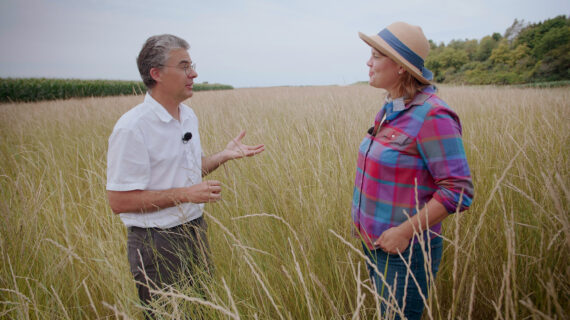
Hi, John, it's so good to see you. Hey, Inga, good to see you. Thanks for comin' out to the farm, today. Ah, thanks for inviting me.
We're so excited that you're here to have our book club lunch with us. We just finished reading Mapping the Farm. And I love to sort of hear your perspective on farming because you're a city boy. Was it hard to write that?
Well, it was daunting at first. I didn't think that, maybe, I had a right to tell the story. But the more I thought about it, I thought, "You know, most readers, most Americans, "don't--" - Have a farm, yeah.
insects buzz
Inga
Don't have any background on a farm so I was sort of the stand-in for the reader. What do you think it is about, sort of, the Midwest? There's great writers here in the Midwest. We have Michael Perry.
We have Nickolas Butler. We have you. And you all kind of touch a little bit on agriculture. Is there something in the Chippewa Valley that just breeds great writers and great imaginations?
Or, is it...? - I hope not. You know, I don't want more guys movin' here. I admire the people that you mentioned.
They're some really good writing going on. And the nice thing is that we all have a different take on this place. We have different things to say about it. And I look forward to Mike and Nick's books and the other writers in town.
What do you think of? 'Cause you're doing food, you guys have a little garden at your house. You're doin' shiitake mushrooms. What do you think is the future of farming?
Well, I'm glad I don't have to rely on my shiitake mushrooms to get by.
Inga chuckles
Inga
I think that people are always going to have to eat. One good note on the horizon
insect chatter
Inga
is the last agricultural census found that, for the first time, there were more people making money off the land than not. Prior to that, the numbers had always declined. Those new people tend not to be growing corn and soybeans and raising big herds of livestock. They found a niche in farming.
And I think, maybe, that's the future. And certainly, it's more possible for a young couple to get into it without a huge capital expenditure. Yeah. - So I think this is a good development.
Well, I hope so. It's exciting for me to be able to around Wisconsin and see all these amazing people who are making a living on not a lot of acres and just putting their heart and soul to it. And they want to grow good food, healthy food for their customers.
John
Well, that's what I like about your show. Well, I'm so excited that you're here. Would you mind signing an autograph for me? Oh, no, I'd be glad to.
- It's so nice to have celebrities, here. - Really, where? Where are they?
Inga chuckles
John
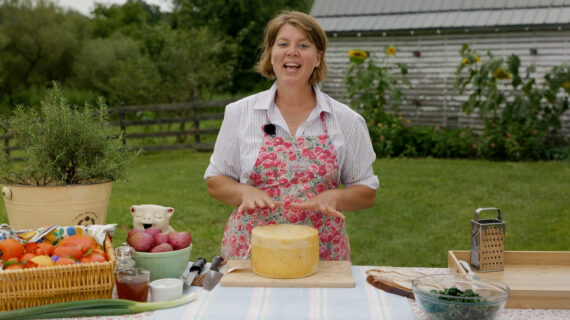
Well, I'm going to get his autograph. And then, why don't you guys meet me in the kitchen, so I can make a little lunch? Summer is coming to an end and fall's in the air. I thought it'd be a perfect time to serve 'Pheasant Under Glass.' It's kind of a special meal, and I think it's a wonderful thing to serve to my guests.
Since I'm terrible at hunting, I'm so glad that I was able to find this pheasant down in Janesville. It makes life a lot easier. The first thing I'm going to do with my beautiful pheasant breasts, they're just pheasant breasts, bone out, lovely, is add a little bit of lemon. That's going to help tenderize 'em.
When I was talking to Bill, we were looking through the different cuts of pheasant, and he had an airplane. It was called an airplane split. And I says, "Well, why do you have an...? "What's the deal with the airplane pheasant?" And he says, "That's what they would call it "'cause they'd serve it on airplanes, years and years ago." And I suppose that's when it was fun to travel, back in those days when you had great food on airplanes, and it was something special.
One thing Bill was also tellin' me, though, is that he doesn't want pheasant to be thought of as something to only have on special occasions. So hopefully, we're all going to start enjoying it, more often. It is lower in cholesterol
pan clanks
John
than chicken or any other meat. And it's higher in protein. So it is a healthy meat for us. And I wonder if people are just, aren't eating it as much 'cause we're just not used to it.
Or it's one of those things that we only get hunting. But I think we should be eating a lot more of it. So I'm going to add a little bit of butter to my pan, here. I think it's delicious.
And then, I'm going to cook this, let this pan heat up. And when my butter starts to foam, that's when I know it's time to sear my pheasant. All righty, so now that's nice and foamy, the butter. And I'm going to put these in, skin side down, to sear 'em.
meat sizzles
John
All right, like that. Those will take about 10 minutes. So in the meantime, I'm going to slice up my shallots and get the mushrooms ready.
meat sizzles
John
After a few minutes, you want to flip it, depending on the size of your bird.
meat sizzles
John
Get that nice sear going. So once your breast is cooked through, we're just going to set it off to the side. I'm going to grab a plate here. And let those rest a little bit.
They're looking beautiful. They're a nice portion size, too. All right, we'll set those off to the side. And then, I'm going to add a little bit more butter to my pan and start sauteing those shallots.
I put two shallots in, just did a rough chop here.
shallots sizzle
John
And then, now, I'm going to do my mushrooms. So I have a few morel mushrooms that I reconstituted in some boiling water. And we'll use the juice from those in a little bit. Slice up a few of these.
knife whispers
John
These are going to be great. I love mushrooms, this time of the year. And I think mushrooms and poultry are just made for each other. Add these to the pan
mushrooms sizzle
John
with the shallot. And then, our shiitakes that we picked up, I'm going to take the stems off 'em. You don't really want to eat the stems. They're just a little bit hard.
And then, I'm just going to thinly slice the mushrooms. And then, I'll just add these right to my pan, too.
food sizzles
John
And then, I'll cook these for a few minutes until everything gets nice and soft.
pan rattles
utensil clatters
food sizzles
John
So now that the mushrooms are cooked down, I'm going to set them off to the side. It's smelling so good in here. And then, I'm going to cover them with a plate so that they can stay warm. And now, I'm going to deglaze my pan.
I'm going to add a little bit more butter because why not? Get that foaming again.
butter sizzles
John
I want to de-glaze the pan to get all those delicious bits from when I seared that pheasant. I'm going to do some white wine.
wine sizzles
John
When it starts to sear like that, then you just take your tool, here, and just get up all those nice brown bits. That's where all the flavor is. And then, a little bit of brandy. And then, I'm going to take some of that morel juice where I reconstituted the morels.
All that flavor is right in here.
liquid sloshes
John
And now, I'm going to simmer this down and reduce it by half.
liquid bubbling
John
So now, that mixture's reduced by half. And I'm going to add a little bit of demi-glace to the pan.
utensil clatters
John
Demi-glace is kind of. It's just like, basically, like stock, but cooked way, way down. So it's just the flavors intensify as it goes.
spatula scrapes pan
John
Give this a minute. I'll go back to my whisk, here.
whisk scrapes pan
John
Whisk that in. And that's thickening up a little bit. And that's going to create just a really great sauce. Okay, and now, I'm going to add a little bit of cream, Jersey cream, of course.
whisk scrapes pan
John
Mix that in to get a little bit thicker. The final thing I'm going to do is just add a little bit of cayenne pepper for a little bit of spice. Come on, cayenne.
whisk scrapes pan
John
So now, to plate it, I've had my plates in the oven, just on warm, so they can be nice and warm. And then, I'm going to add a little bit of sauce to the bottom of my plates. I'll just twirl that around here. And then, I'll put my pheasant right on top of here.
And now, I'll put those lovely mushrooms and the shallots just around a little bit. These flavors are going to be so great, together. And then, a little bit more sauce on top 'cause I love sauce. And then, around the dish, I'm going to put a little bit of arugula.
The arugula goes so lovely. It just adds a little bit of peppery note and brightness to this dish.
arugula leaves rustle
John
Oops. And then, I'll just put a little bit of lemon on here, right on the arugula, just a bit. And then, finish with a little bit of pepper.
pepper mill crackles
John
Now, I'm going to put my dome back on.
glass clatters
John
So the whole point of the dome is to capture the essence and the smells, those gorgeous smells of the food. And when my diners open them up, hopefully, there'll be a nice steam that will come out, if I make sure I plate them hot.
chuckles
John
Well, I'm going to finish plating the others, and then, I'll meet you up at the table.
folksy music
John
So this is a piece from a new book I'm working on about a small town softball game. But it's also about small towns. "The girls in the outfield had so little to do. "They cradled their gloves like dolls "and stared at the lengthening shadows.
"If you only watched the players wilting in the heat, "you saw discouragement or ineptitude "or an attack of yawns. "But if you shut your eyes and just listened, "you experience an altogether different game. "Baseball, like most games, is about time, "the passage of it. "And even if the players on the field "were oblivious to its ticking clock, "their parents in the stands weren't.
"They understood the game as a small segment "of a much longer interval of time called childhood. "And they hoped beyond hope "it would go into extra innings. "Years from now, if they wanted to remember "Maggie or Brianna or Anna at age 10 or 12, "they could reach back and recall this very game "or one like it, on a warm evening of a long-ago summer. "What you heard in the voices calling from the stands "women's voices, was a bittersweet ambivalence "toward a game that both eats time "and momentarily pauses it.
"Go ahead and be a hitter, the voices urged. "Step into the pitch and swing. "And if, by some miracle you connect with the ball, run, "run for all you're worth, "counterclockwise, around the baseline, "being sure to touch all the bases, then slide. "Slide, if you must, "just as long as you arrive feet first and safe, "back at the very place you started, home."
audience claps
lively music
John
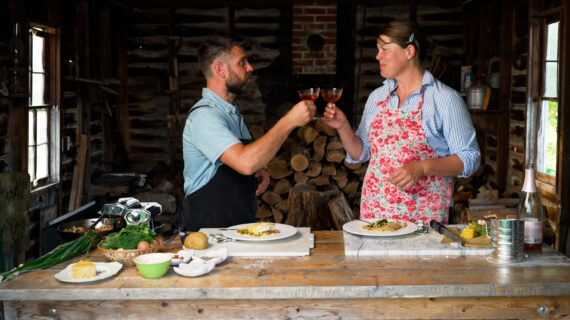
'Pheasant Under Glass' is perfect for a book club luncheon. Arugula salad pairs nicely with the pheasant. Serve your tomatoes fresh off the vine with a little bit of red wine vinegar and sea salt. A full-bodied, red wine is delicious with the pheasant.
laughing
John
Well, I hope this has inspired you to have 'Pheasant Under Glass' at your next book club. And I hope you'll gather with us next time Around the Farm Table. I'm your host, Inga Witscher. Cheers, guys.
- Cheers.
wine glasses clink
John
Around the Farm Table is funded in part by Wisconsin Farmers Union, united to grow family agriculture, Heartland Credit Union, and Friends of Wisconsin Public Television.
Search Episodes
Related Stories from PBS Wisconsin's Blog


Donate to sign up. Activate and sign in to Passport. It's that easy to help PBS Wisconsin serve your community through media that educates, inspires, and entertains.
Make your membership gift today
Only for new users: Activate Passport using your code or email address
Already a member?
Look up my account
Need some help? Go to FAQ or visit PBS Passport Help
Need help accessing PBS Wisconsin anywhere?

Online Access | Platform & Device Access | Cable or Satellite Access | Over-The-Air Access
Visit Access Guide
Need help accessing PBS Wisconsin anywhere?
Visit Our
Live TV Access Guide
Online AccessPlatform & Device Access
Cable or Satellite Access
Over-The-Air Access
Visit Access Guide




Follow Us