

 Passport






Red Devons, Rhubarb and Frank Lloyd Wright
10/28/15 | 24m 12s | Rating: TV-G
It's calving season at the farm and Inga helps Isabella the cow through an easy birth. She then bikes off to Spring Green to attend a Devon cattle auction and visits Taliesin to pick fresh veggies and rhubarb. Inga finishes a busy day by serving a delicious meal in Frank Lloyd Wright¹s dining room.


Copy and Paste the Following Code to Embed this Video:
Red Devons, Rhubarb and Frank Lloyd Wright
(acoustic music) (cow moos) Hi, there. Welcome to the farm. Springtime means calving season here at St. Isidore's Mead, and Charlie and I are just waiting for Isabelle to have a calf. And once I get her settled, I'm heading to Spring Green, Wisconsin. There's a registered Devon cattle sale happening today. Right next door is Taliesin, Frank Lloyd Wright's estate, and they're doing amazing things with agriculture, including a CSA. And I told the folks that I'd come down and make lunch. So I'll be gathering ingredients and cooking up a feast. I hope you'll gather with us. (acoustic music) Gather with us Around the Farm Table! (instrumental music) A few years ago, I moved up to Wisconsin. I started an organic dairy farm at St. Isidore's Mead. That's when I discovered the abundance of Midwestern local food and small scale farmers growing everything from green zebra tomatoes to pasture pork. I'm taking a break from the cows hitting the road, and seeing if I can't satisfy my epicurious appetite. That's great.
frying pan sizzles
This is amazing. Funding for Around the Farm Table is provided in part by Wisconsin Farmers Union, a member-driven organization for family farmers, rural communities, and all people. Wisconsin Farmers Union, united to grow family agriculture. Information at WisconsinFarmersUnion.com. With additional support from these community members and Friends of Wisconsin Public Television. (cow moos with agitation) She's just started to push out right now, and I just want to give her a little assistance, if she needs it. (instrumental music) Come on. Come on. Come on, get out. Now I've got to get the nose cleaned off so the calf can start breathing. And then I-- You're a good girl, Isabelle! That's a big calf. And then, I'm just gonna make sure his airways are open, too.
trying to catch breath
I'm a little out of breath. This is really good that Isabelle is standing up, that she's looking alert, that she just looks really good. The calf looks really good. I'm going to let these two be together for a little while, and then I'll bring them up to barn and just make sure that she's got enough calcium in her body. I'll get her some nice, fresh cal pills that I have, and just make sure we get her and her calf off to a good start. (instrumental music) So, calving is, like, a really stressful time in that cow's life. Before she calves, about two weeks before she calves, I give her some aloe vera to help boost her immune system. I'm going to follow that up for the next two weeks with some more aloe vera. That way, she's just nice and healthy, and she can fight off different things, like mastitis or different kinds of infections that might want to come in when her immune system is weak. The other thing I do is I feel her ears. If her ears are cold, I know that she needs some additional calcium, so I'll give her some calcium pills or some fresh cal pills, as I call them. Izzy's ears are nice and warm, so I don't feel bad about leaving her. And she looks good. So, I'm going to head out now, and I'm going to entrust Isabelle to my hired man, Craig, to get her milked. (instrumental music) Well, you know I like to ride my bike everywhere, but Spring Green is a little far for this little lady, so I'm going to put it in the back of my truck and then take it out when we get there. Let's go on down to Spring Green. (instrumental music) Red Devons arrived in the United States from England in 1623. Devons are known as a triple purpose breed, being used for meat, milk, and even as oxen. They still have the grazing genetics, which makes them ideal for grazing in the lush green pastures. (cow moos) You're hosting the sale. You're an advocate for this breed. What is it about it that you want to share and get out there to share with people? With this sale, the whole idea here is to bring some Devon cattle from other parts of the United States and bring them to the Upper Midwest and introduce them to a lot of new breeders. And so that's what we're working on. This project is about, we've got cooperation from Devon farmers in upstate New York and New Jersey and Virginia, Kentucky, Arkansas. They've been shipping cattle to our farm, and we'll see. Well, Daniel, I think I hear the auctioneer. I'm not going to buy anything at the auction, but I'd like to go watch it. Oh, shoots. (laughing) Let's go watch. (instrumental music) (cow moos) All right, dive right in. The auction is open. Help yourself. Give about $10,000 a piece. And $10,000 where? All right, $10,000.
auctioneer mumbling bids
(flies buzzing)
auctioneer rattling bids
I think I'm going to take off and head over to Taliesin to see the CSA. (fly buzzing) Sold to the little lady in the straw hat for $4750. Congratulations, ma'am. You bought a great pair. I'm going to get out of here before I buy anything else. (instrumental music) I'm at Taliesin in Spring Green, Wisconsin. You know, a lot of people come here to find out about the architecture. Well, I'm here today to find out about the agriculture. (instrumental music) Hey, John. - Hey, Inga. How are you doing today? Good. -
Inga
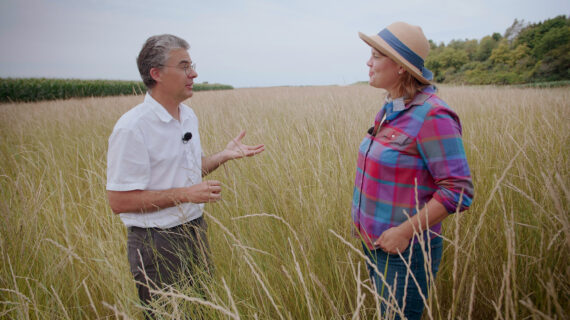
Good. Boy, these are looking good, these beets. Oh, yeah. Tell us what a CSA is. A CSA is an acronym for community supported agriculture. It's been around for a long time, and it's a relationship where farmers and people who care about good food work together. And, basically, a person from the community invests in part of the harvest for that farm for that year. So, what they do is they pay the farmer up front, and then throughout the season, they will basically pay them back the bounty of the season. This is a way for those people in the community, too, to kind of share the risks on the farm. So, if you had a complete crop failure of, say, your beets or something, they would have to kind of say, "Okay, well, that's part of farming." Yeah, and that's part of it. And I think that's part of the strength of a farm like that, it's the diversity where we're growing over 40 different crops. And, inevitably, we're going to have some fail every year, but, we have 35, 40 other crops, or, if these beets fail, there's going to be four other plantings of beets. I'm learning so much after talking to farmers just about how diversity is really the key of any farming operation, not only because you can rely on different things to make your income, but also is you're feeding the soil for those different crops, aren't you, and kind of helping everything work? Yeah, I think a lot of different crops you're helping to control diseases and pests. You can put other things in there, then. You can mitigate a lot of problems. I'm down here today. I've been asked to cook some lunch. And I thought, "It'd be wonderful on a day like today to have a nice, big, healthy salad." So, I'm hoping I can grab some salad greens. Yeah, absolutely. (instrumental music) This is kind of a nice way to mulch down and not have too many weeds. Yeah, that helps quite a bit. So, John, how do you choose the varieties of things that you're growing here? Like, how did you choose the lettuces or anything else? Well, I think our head lettuce, in particular, is kind of always an evolving one. It's one of the ones everyone's always rotating different varieties and looking for the best one, which is mostly heat tolerance once you're getting into summer. Something that doesn't bolt quickly, doesn't get really bitter or get brown burns on the ends. Sure. We select a lot for flavor. Have a good mix of textures and colors. I also heard that maybe there's some rhubarb that I could maybe harvest. Yeah, I think Jim might have a bit over the hill back here. Okay. (instrumental music) Hello, there. (birds chirp) Hey. - Why, hello. Hi, I'm Inga. Hi, Inga. I'm Jim. Nice to meet you, Jim. Nice to meet you. Are you the rhubarb guy? I came to get some rhubarb. I was just getting started on picking some rhubarb for you. Good. Is it a special variety? Well, what's great about this is this is Taliesin rhubarb, and this is genetically-related to the plants that were growing here for many years at Taliesin, Frank Lloyd Wright's home. You know, I really had no idea that he was such a farmer. Well, people know Frank Lloyd Wright very well as an architect, but he was really a farmer for all his career. It was a very important part of his life here in the valley. When he came to......to his ancestral valley here to build his home, it was built as a farm, a studio, and a home. So it was all under one roof. What kind of agriculture was happening here? It was a wide variety of field crops, as well as large vegetable gardens. Orchards were planted. Vineyards were planted. All manners of fruits were grown here. There was a dairy herd. Oh, I have a dairy farm. I love dairy cows. Oh, you have a dairy farm? - I do. -
Jim
That's great. It seems like there's so many people going back to that style of agriculture now, with the diverse farming. You know, crops and livestock and all kinds of different things. I think that Frank Lloyd Wright was a real agricultural innovator. He started very early with contour farming, and they would do field trips here from the University. Tell me, what's contour farming? That's farming with the grade of the land so that you keep your farm, your crops planted level along with the contours of the property. Does that kind of help hold the soil in, too, on the hillsides? That's definitely one of the real advantages, and it's then done in strips and certain areas are cropped and others are left to cover crops, similar to what you've seen in the vegetable garden here at Taliesin. The rhubarb is just beautiful here. I love the rich colors of this kind of... It's beautiful. Are you a fan of rhubarb? I am a fan of rhubarb, especially the strawberries. Oh, I know. None are ripe to pick just yet, though. I know, I know, that's unfortunate. But I have an idea of what I could do with the rhubarb right now. You know, my neighbor taught me when I pick rhubarb I've got to just got to pull it out. Is that right? And then she said just leave the leaves for the compost. Leave the leaves right on the ground. That's perfect. You know, I'm a sucker for dairy barns. I don't want to take up too much of your time, but do you think I could just kind of take a look? I love that kind of stuff. Oh, absolutely. It's right over here. Okay. (instrumental music) Who's this? Oh, this is Gary Zimmer, our Taliesin farmer. Oh, okay. I'm going to just get my bike out of the way here. Hi, there. - Hello. Hey, Gary. How you doing? -
Jim
This is Inga. - I'm Inga. Nice to meet you, Gary. So you're the farmer at Taliesin right now, right? Yes, we've been here since about 2000. Oh, great. Well, Jim was telling me a little bit about the past history of agriculture here at Taliesin. What's happening now with agriculture? I see in agriculture there's a lot of interest in we have to environmental things, but this farm here is certified organic just because way back years ago, it was going to be an organic cooking school when that started and that allows, if you're just renting land out and everybody's growing the cheapest commodity, no one was able, wanted to or willing to or able to fix it. So as an organic farm, we put on the compost and the minerals, and we fixed this all. So, it's changed and then there's more strips. It's not monocultured, there's a variety things grown on the farm, and it's for our organic dairy farm. What are some of those benefits of not having the monoculture, having the diversity of crops? The diversity of crops really is about soil health and it's about different plants, and the more variety of plants, the more variety of soil, the healthier our crops will be. As an organic farm, we don't have a choice. In order to be, you can't grow monoculture, so you'd be in trouble with insects, diseases, and poor yields and so, growing the clovers and the other legumes and the soybeans and rye and a whole variety of stuff is a way, and remineralizing and putting a lot of compost and manure is a way to really be able to survive as an organic farm. Huh, I think it's interesting what's happening here with-- I got to meet the young couple that's doing the CSA and seeing you here doing crops for your dairy cows, it's kind of lovely that there's a whole community of farmers here at Taliesin. It is kind of a nice area, and I think that's why we certainly want to make a lot more visibility of a way to farm for young people to get involved in farming as a teaching, learning, and a lot of city folks to get involved with the tourist, and things that go on here at the farm, as time goes on. Well, so what's the next 10 years going to happen with agriculture, do you think, here? Here at Taliesin, the next 10 years? I think you're going to see more vegetables, more variety of things, more educational stuff going on, and we have big projects to have more people getting involved with the farm. There will always be some of this land.......that someday, we'll maybe do grass-fed beef or things. Now it all goes home to our dairy farm. But there will be lots of variety of stuff that can be shown and grown here, including grains and things that could be, how food is actually grown, and we'll have a variety of stuff going on. Can you predict the milk price in 10 years, too? Well, organically, we've been pretty steady and the design is really good. -
Inga
I hope so. (laughing) No, you can't, and that's why, I guess, variety also helps. That's why we do cash cropping and dairy. Yeah, not all your eggs in one basket and all that, right? Well, I don't want to take up too much time. I want to go see where the cows used to be at. Well, we'll keep on our walk. -
Inga
Nice to meet you, Gary. - Nice to meet you. (instrumental music) -
Jim
Bye, Gary. What is this thing right here? That was actually the milk house that was constructed in the early '50s. Wow. And Frank Lloyd Wright referred to that as the ode to the Guernsey teat. It looks similar. That's amazing. I love that that's a milk house inside there. I love that. -
Jim
It's amazing. -
Inga
Yeah. -
Jim
With the spire on the top almost like it's a church. So, tell me a little bit about the history of the milk house here. Well, the farm originally was at Taliesin, and Frank Lloyd Wright started his school of architecture in the early '30s. And at that point, he'd moved the farming operation from under the roof of Taliesin, his home, here to Midway and did extensive remodeling, in addition to the barn, so that he had, this was a diversified center for the farming operation. What kind of cows were here? Well, Frank Lloyd Wright had tried out Holstein cows, and he really didn't like how they looked on the landscape. He thought the black and the white was the wrong color for the landscape. A little clashy. -
Jim
A little clashy. And so, he went back to Guernsey. Guernsey cows. -
Inga
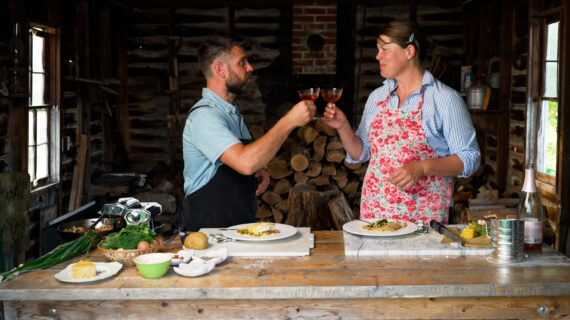
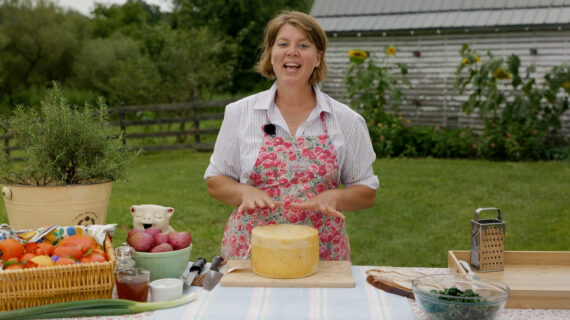
Okay. That was what the milk herd was here at Taliesin. How many cows do you milk here? Or how many cows do they milk here? Up to 40 cows, I think, probably at the most. Oh, good, good. I love that-- They must have been the happiest cows ever to be able to be in such a beautiful space and just inspired to give milk, I suppose. Absolutely. Living in real architecture and in a beautiful spot here, as well. Well, I better get cooking. Where are we gonna go cook at? We're going to be cooking at Taliesin. So, let's go there now. - Okay. (instrumental music) Springtime for me is not only the time of the year when the cows are calving, but it's the time of the year when the rhubarb is abundant. Mrs. Thompson, the lady who grew up on the farm that I'm at and who farmed there with her husband for many years, she planted a huge batch of rhubarb on the farm. And there's something about knowing that she planted it when she was my age and I'm harvesting it now, generations later, and cooking from the same plants that she did. It really helps me feel a part of that community. Not only that, my neighbor Bonnie, the only time I ever seem to see her, she's so busy, the only time I see her is during rhubarb season when she comes down to the rhubarb patch to get her rhubarb pie's worth of rhubarb and cookies and bars and all kinds of things. I love rhubarb pie. I love all the desserts that you do with rhubarb. But rhubarb is actually classified as a vegetable. I wanted to use it a little bit differently today because I think if I eat one more rhubarb pie this spring, I will probably go insane. So I thought about doing a rhubarb vinaigrette. Really easy. I'm just going to do a nice little syrup. I'm using the Frank Lloyd Wright-planted rhubarb here on the farm, and I love that. I love the history that connects with food and farming and all of this stuff. So let's get started right away. We're going to start out this vinaigrette by making a syrup. Just a simple rhubarb syrup. So, for that, I'll need 1 cup of rhubarb, and you want to cut it up not too thin, but thin enough. Let's call it 1/8" thick. And you know, you want to almost use the pinker part of the rhubarb because it gives you that nice, pink color in the rhubarb syrup. So, we've got 1 cup of rhubarb here. I'm just going to put it in a saucepan. And 1/2 cup of sugar. Right in there we go. And then about 1/4 cup of water. I'm going to cook this syrup over medium high heat. I want to let it boil, and then I'm going to let it boil for about five minutes until the fibers in the rhubarb starts breaking down, and it kind of gets to be a nice ooey-gooey mess. That way, all the flavors from the rhubarb can come out in the syrup. I've given the rhubarb about five minutes just to cook down, and I'm mushing it with the back of my spatula here just to kind of break it up and just make it all one. I just want the rhubarb and the sugar to become one, is what I'm really after here. Okay, time to take it off the heat. Strain that right on through. Oh, good. I like it. I like this pink color. Push this through with the back of your spoon. You want to get all the good bits here. Okay, and set this to the side. Ideally, you'd probably want to let that cool down in your fridge for an hour or something like that, but knowing, like, I'm always late, everything I do so I'm a little bit late making lunch, so I'm going to only let that cool down for like a couple of minutes. I found some ramps when I was on the way down here, so I thought instead of garlic I would use a ramp as the base for my vinaigrette. And if you've never had a ramp, it's a whole experience. So ramps are a wild food, and you'd find them out in your... You know, out in the forest where a lot of maple trees are growing. That's where I see them most of the time. They come out this time of the year, same with rhubarb. You know, the rhubarb - ramp time of the year. So, I'll take one. I'm only going to use the white part, and just mince it up just like I would garlic. Springtime is one of my favorite times of the year I say that every time of the year, I know, but springtime, I love, because there's an abundance of different foods, whether it's dandelions or nettles or ramps, all these great wild foods, and then you have the rhubarbs and the... the... I don't know, what else? Chives comes up in spring and everything. I just think it's great because I don't have to wear a winter jacket probably is the best part about it. So, throw your ramp in there, and you can just use, if you don't feel like getting out and foraging, just use garlic. Get it all in there. And some mustard. About, oh, I don't know... like 1 tablespoon. A little bit of red wine vinegar, and that's about 1 tablespoon on that, too. Mix that up good. Salt and pepper. And a little bit-- I use kosher salt. Drizzle in some sunflower oil. You're looking for about 2 or 3 tablespoons if you are the measuring kind of person. And get that nice and emulsified. And then, lastly, you want to add some of the rhubarb syrup. About 1 tablespoon. This is going to give it a nice, it's a nice, sweet - sour contrast with the ramps and the rhubarb. We're going to get this all mixed together. Now, putting your salad together. Luckily, I was able to get these amazing greens from a few feet away from where I'm standing right now, and they're fresh and they're good and they're delicious. So, to my salad, I'm going to do some asparagus. I've just blanched the asparagus. And I'm just basically making a simple spring salad. So, I'm just going to take the asparagus tips here. Just the tops. So, I've got my asparagus, got my rhubarb, got my ramps, and then I'm going to also slice up some radishes for the salad. Slice your radishes pretty thin. You could put anything in the salad that you want, anything that's around. Edible flowers are always nice. It just kind of classes it up a bit, if you're cooking for people. Toss those right in your salad. Add a bit of cheese. Today, I've just brought with me some feta cheese. And then really, with salads, you should always season them with salt and pepper, too, before you add the dressing. So, a little bit of salt right around there, a little bit of pepper. And I'm going to serve this right away so I'm just going to dress the salad right now. Give that a stir. And that is how you make a simple spring salad with rhubarb vinaigrette. Let's go enjoy lunch. (instrumental music) This vinaigrette is quickly becoming my new favorite way to use rhubarb. Dress your salad just before serving. Serve the salad with crusty bread and a generous pat of butter. Grilled Devon beef is the perfect way to round out this springtime lunch. (instrumental music) Gather with us next time. I'm your host, Inga Witscher. Cheers! Cheers! (glasses clinking) (instrumental music) Funding for Around the Farm Table is provided in part by Wisconsin Farmers Union, a member-driven organization for family farmers, rural communities, and all people. Wisconsin Farmers Union, united to grow family agriculture. Information at WisconsinFarmersUnion.com. With additional support from these community members and Friends of Wisconsin Public Television.
Search Episodes
Related Stories from PBS Wisconsin's Blog

Donate to sign up. Activate and sign in to Passport. It's that easy to help PBS Wisconsin serve your community through media that educates, inspires, and entertains.
Make your membership gift today
Only for new users: Activate Passport using your code or email address
Already a member?
Look up my account
Need some help? Go to FAQ or visit PBS Passport Help
Need help accessing PBS Wisconsin anywhere?

Online Access | Platform & Device Access | Cable or Satellite Access | Over-The-Air Access
Visit Access Guide
Need help accessing PBS Wisconsin anywhere?
Visit Our
Live TV Access Guide
Online AccessPlatform & Device Access
Cable or Satellite Access
Over-The-Air Access
Visit Access Guide




Follow Us