

 Passport






Bike to the Barn
11/05/15 | 26m 29s | Rating: TV-G
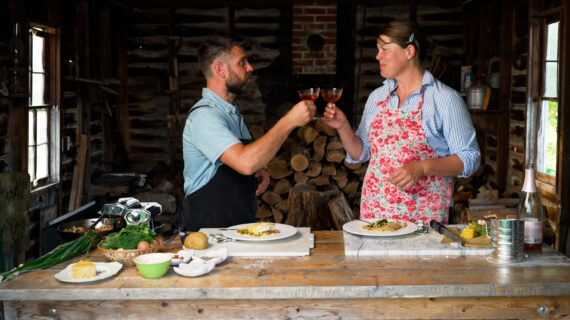
Inga visits a quail farm and finds out about the Beginning Farmer Project. After milking, some of Inga's biking friends visit the farm and Inga serves them a meal of pickled quail eggs, lamb ragù and fresh homemade pasta.


Copy and Paste the Following Code to Embed this Video:
Bike to the Barn
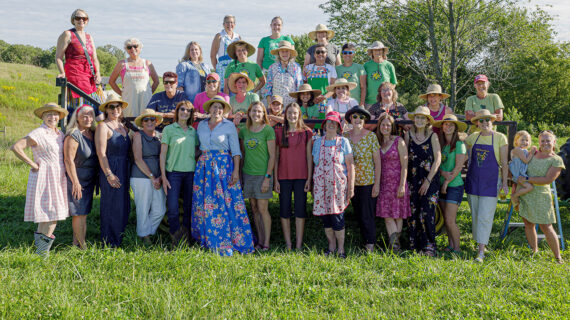
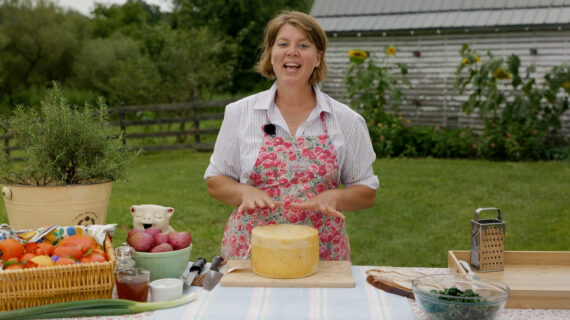
(folksy music) Hi there, welcome to the farm. I've got a great day planned today. My cousin CeCe's coming up from Chicago, and whenever she comes she loves to cook and she always cooks enough to feed a small country, so I'm inviting some folks by. Luckily, there's some bicyclers on their way through Osseo, so we've invited 'em to the farm for our farm-fresh dinner.
But first, I've got to gather some ingredients, so I'm heading up to Gemini Farm for quail eggs, and then, it's off to Blue Ox Farm (baa-aa, baa-aa) for some grass-fed lamb. Gather with us Around the Farm Table. I'm your host, Inga Witscher. Gather with us Around the Farm Table!
A few years ago, I moved up to Wisconsin. I started an organic dairy farm at St. Isidore's Mead. That's when I discovered the abundance of Midwestern local food and small scale farmers growing everything from green zebra tomatoes to pasture pork.
I'm taking a break from the cows hitting the road, and seeing if I can't satisfy my epicurious appetite. That's great.
frying pan sizzles
This is amazing. Funding for Around the Farm Table is provided in part by Wisconsin Farmers Union, a member-driven organization for family farmers, rural communities, and all people. Wisconsin Farmers Union, united to grow family agriculture. Information at WisconsinFarmersUnion.com.
With additional support from these community members and Friends of Wisconsin Public Television. Every fall, here at the Mead, I spread manure on my pastures. This helps get those important nutrients back out on the land, and, of course, having a dairy farm, I have a by-product of cow manure, but it's a wonderful by-product. It's a fertilizer and it's pretty much free for me to use.
Some people have big tankers where they have liquid manure, and there's even people that can put it underneath the ground, so it can get right into the soil. But this seems to work for me. I've invited Amber from Discovery Farms out to just learn a little bit more about manure management and how she's working with farmers to make sure we're stewards of the environment, and that we're also getting the most bang for our buck out of our manure. (birds chirping) Hey Amber, nice to see you.
Hi, thanks for having me, Inga. Amber, tell us, what is Discovery Farms? So Discovery Farms is a University of Wisconsin-Extension program that works with farmers all across Wisconsin to help us put science to understanding how to best manage manure and fertilizer in Wisconsin to protect our water resources. What a great resource for farmers.
Amber, what is a manure management plan? And how is it helping farmers in our communities? Farmers put them in place to help put nutrients where they're best used for crop production, and also to protect our water resources in Wisconsin. So there are nutrients in manure like nitrogen and phosphorus and potassium and lots of other things that plants really love and need to grow.
And so, when putting that manure out on the landscape, we need to make sure that we're putting it in a place where the crops can use it the best and places where it doesn't harm our surface waters. So what we do to try and manage that manure is to help farmers think about how much manure should be in a certain place and when it should be put there. So I like to spread my manure in the fall. It's a nice time of the year for me.
Is there a better time of the year? Is there a perfect time to be hauling manure? There's a lot of good times of the year to haul manure, and it really depends on the farming system. So, what we tell farmers is to figure out what works in your system.
So, some farmers have the ability to only haul manure twice a year, in the spring and in the fall. And those are good times, as long as we pay attention to where it's being spread and how much is being put there. We also have farmers that spread every day of the year, and those farmers also can do a very good job of making sure that manure gets into a really good place for the crops and for the soils of our state. Should I be thinking about the weather, too, before I spread?
Because I really don't want to spread before we have torrential downpours or anything like that. Is that correct? Yes, what Discovery Farms has been able to help farmers with, is to put some general terms on, in terms of certain months where we see a better chance for runoff from fields and to help farmers try to make their decisions on a whole annual basis and really put a lot of thought into every step along the way. So, how do you get the farmers involved in what you do?
Yeah, so our monitoring and our research is done on private family farms around the state. And so, being able to have those farms take this proactive stance to a partnership to understand how their manure management might impact environmental quality,
and being able to have those farms be at the head of
"I see this as something "that's positive for my farm. "I'd like to understand more about it." Or if we do find something that we think could be adjusted and to improve, then they're the first ones coming up with ideas on how to make those improvements, and how to really work towards our common goal of protecting water quality. I love how the farmers have these resources and that you have the resource of the farmers, and we can all work together to make sure that we're responsibly farming and we're thinking about the environment, and we're also thinking about how to improve our crops and our pastures and things like this. And speaking of improving our crops and pastures, I'm gonna finish hauling my manure, and I really appreciate you coming on out and seeing me.
Thank you, Inga. It's been wonderful. Have a great day. (folksy music) Hey little lady!
How are you? - I'm good, how are you? Good, how was the drive? - Oh, easy, easy.
Good, are you ready to cook for some people? I'm super ready. Why don't we just start going cooking? Well, I gotta pick up some ingredients, and I gotta do some farm work.
So,
I tell you what
If you finish up for me, I'll get the ingredients. We can start cooking. - You got it. Alright.
- Alrighty. Hop on. (folksy music) Well, I'm gonna put a fresh pair of overalls on, and then I'll meet you up at Gemini Farm. (folksy music) (quack, quack, quack) (honk, honk, honk) (Bruck-burrrk-boc-burrrk) (folksy music) Good morning.
- Good morning, how are you? Doing really well, and you? - I'm great. Good, well, I wanted to stop in today.
I'm curious to find out more about quail eggs, and I'd like to serve them at a dinner party I'm having tonight. Great idea. - They just look beautiful. They are, and they're all different, and what people most often say about them when they first see them is that they look like candy.
They do. - (giggling) They look like those little candies you get in your Easter basket every year. Dorian, I'm hoping to find out a little bit more about quail. This is such a unique thing you are doing here at your farm.
These particular quail are Japanese quail, so they've been raised in captivity for about 5,000 years, mostly for their eggs. They're prolific egg-layers, but their season is very short. So there's a season for the egg laying? And what is that season?
There is. They start laying at six weeks, which is extraordinarily early for any egg-laying bird, but they only have a life span of about two years. Oh, wow. So their first season is their most productive.
They are born usually in late May, they're laying by Fourth of July and the flesh of the egg season lasts until September. What kinds of things do you have to take into consideration when you're raising the quail? Right. 'Cause they're still kind of pretty wild, aren't they?
They are, and because they've been raised in captivity for so long, they've lost a lot of their natural ability to protect themselves, and to reproduce, and to eat a varied diet. They are insectivores, so they need a much higher protein diet than chickens. Oh, okay. And they don't thrive on soy as a protein supplement, so we supplement them actually with mealworm and with organ meats from our lamb operation.
Oh, what a great idea. Yeah, they have a specialized diet. They have a specialized environment that they like. They're ground birds, so they feel better closed in on the ground.
So I'm planning on taking these home and making little tiny deviled eggs for a hors d'oeuvre, but what is some of the different ways that you use the quail eggs? Well, one of my interests in raising them is that I love to cook, and they're special, especially if you have company, or for a special occasion. So I have made Scotch eggs, which are hard-boiled eggs then wrapped in sausage. And it's sort of that British picnic food.
Yes, British picnic food, then you dip it in, like, a Colman's mustard. Mmmm. I've made pickled eggs, spicy- and beet-pickled eggs. The deviled eggs are very popular, and it just feels special to people because they're tiny.
And cute! - And cute. Do you have any tips on boiling the eggs? I know sometimes if I grab eggs right out of my chicken coop and boil them, it's really hard to peel them.
Yes, I boil them very gently. I put them in water, bring the water to boil, and turn the water off immediately. Let them cool down, and then put 'em in an ice bath. Well, this is gonna be such a wonderful addition to my menu tonight.
I'm excited about it. I'm actually on my way, not too far from here, to Lauren and Caleb Langworthy's house, and I know that they worked a little bit with the Land Stewardship Project, and that's something that your working at, right? Tell me a little bit about that. So, yes, in addition to raising quail, I also worked with the Land Stewardship Project in their Farm Beginnings program.
And we have run a comprehensive business planning class for beginning farmers for the last 17 years, and I facilitate that class now. Caleb and Lauren took it several years ago and it really set them on a path toward realizing their farm and their farming dreams. What a great tool to have for beginning farmers, because it's so difficult to start out and just try to figure out how much money is it gonna take me. What's my income gonna be.
And to be able to have those tools available, like that, the land stewardship project is really amazing. And we start by focusing on quality of life, so we ask all of the beginning farmers to really consider why they want to farm, what their goals are, write it down, have those deep discussions, and let that frame the decisions they make about their farm. And then it also connects them to this network of supportive other farmers, which is huge for any beginning farmer to kinda' have established farmers to get advice from, but also other beginners and your cohorts to offer that kind of support. - Yeah.
'Cause sometimes you just need somebody else to hear what you're saying and the frustrations, and the struggles, and then have them say, "I know, I have the same thing going on with me." That just kind of makes everything better. Yeah, well, and farming's hard, even with all the planning in the world. Nature is unpredictable. Life is unpredictable.
Market's are unpredictable. And, so having a strong foundation, and that community of support is huge for people's long-term success in farming. Well, thanks for taking the time with me today, and I'm excited to take these home with me. Yay!
(giggling) Have a good rest of the day. - Thank you. (sheep baaing and country music) Hi, Lauren. Hi, how are you?
- Really good. I just came from Dorian's farm, and your name came up 'cause we were talking about the Land Stewardship Project. Oh, yeah, we love the Land Stewardship Project. What was that experience like for you and Caleb?
Well, we went through both the Farm Beginnings Program and their Journeyperson program, so we went from imagining the farm that we wanted someday, to goal setting, to finally writing a business plan and then tweaking the business we already had over the course of several years. So, yeah, between the friends we made and mentors, business choices that we made, it was really worthwhile. And now, you guys are doing sheep here on the farm, but you also have a CSA, right? Yeah, yeah, we run a fall and winter CSA that goes November through January.
What a nice idea! - Yeah, we're enjoying it. It spreads the season out for us a little bit. Well, tell me a little bit about your sheep.
What breed are these? - These are "Coopworth." They're a "Border Leicester" / "Romney" cross out of New Zealand. They're dual purpose, so they provide us with both meat and wool. And what made you get into sheep, being a shepherdess?
You look great as a shepherdess by the way. It just makes me want to buy sheep and just roam in the pastures. It's inspiring. - Yeah, they require a little bit of work, but they're pretty great.
I started interacting with sheep on someone else's farm and just really had a knack for them. We understood one another, those animals and I. And so we started looking into buying our own flock, and eventually purchased this farm, and were able to get our own. That's wonderful.
It looks like you guys are doing a little bit of intensive grazing here? - We are. We are. The sheep move from paddock to paddock.
They get moved every couple of days, and that keeps them on the freshest grass, it helps us with cutting parasite cycles, and different health issues that can happen with sheep, and it also really helps us improve the pasture. You really have to know sheep to be able to raise them correctly, is that right? It sure helps. - (laughing) It sure helps to know a lot about sheep.
They're pretty secretive, so they don't really tell you what's happening with them. Like they won't show signs when they're getting sick or anything like that, that's what I've heard. Yeah, no, the old wives' tale about sheep is that once you see they're sick, it's already too late. Yeah, so you have to be very attentive with your sheep.
Is there anything that you can do, like preventative medicine that you guys do? Or just by being outside in this wonderful conditions they're probably do pretty well. I think being outside and eating grass is a really good step in the right direction. We've also interseeded our pastures with a couple of different healthy foods for them, including chicory, which is really high in tannins, so that helps their gut kind of maintain itself and prevents some of the internal parasite issues that you see if they're not getting high tannins.
What a great idea. And now how are you selling your lamb? We sell by the whole animal. So people come to us throughout the year and sign up, they'll give us a deposit, and then we work with them and the butcher to get them exactly the cuts that they want.
If they want more ground, we do that. And then they can split it amongst friends if they'd like. It helps the farmer because we don't have to figure out some of the cuts that people are less familiar with, where they're gonna go, and it's also great for the consumer because you get to know your animal, and you get to make choices, and you get to learn how to cook with every part of it. How much weight is on one of those lambs to be able to fit into your freezer?
We're usually looking at 35 to 45 pounds. Oh, so not too bad. - Not too bad. So it is realistic to be able to buy a whole lamb and take it on home.
Yeah, and share it with a friend if you're a small eater. Good, good, good. I'm gonna go grab some when I get down to the farmside and say, "Hi," to Caleb. Great!
I'll let you get back to it. - Alright, thanks. (folksy music) Hi Caleb. - Hey Inga, how's it going?
Good, I love this bounty of fall vegetables in here. Thank you. - It's just beautiful. So, I was just talking with Lauren a little bit, and she said you guys decided to do a winter CSA.
I love the concept of community supported agriculture. I love how people can buy into a farm and receive produce. But even more, I'm so intrigued by this idea of having a winter CSA, so people can get boxes of vegetables all year long. It must be amazing for your members.
It really is. It allows our members to be engaged all year, so not only during the summer months, but then we're able to provide them with a bounty of our farm in the fall and winter months, when a lot of farms traditionally slow down. What are some of those varieties of vegetables that you're offering in the winter CSA? We have a lot of cold-hearty greens, root crops, dried beans, and dried corn, popcorn, maple syrup, all those kinds of things go into our boxes in the winter.
I don't want to take up too much of your time, but I'm just gonna grab some lamb out of the house, if you don't mind. - Absolutely. And I'll see you guys another time. I have such abundant vegetables in my garden this year that I-- It's been a great year for great produce.
But I'm gonna come back in a little while and get some great, hearty vegetables from you guys. Absolutely. (folksy music) Well, you can't have a proper dinner party without having a proper cocktail and I found some wild plums along the way, so I thought we'd make a plum martini. I think that sounds delicious.
Really good. Now what usually happens when CeCe's here is we make a cocktail, I go sit on the porch and drink it, and you make dinner, but I thought today I'd help you. Thank you, amazing. - Just wanna be a good sport.
Okay, I'm gonna take these. Why don't you start muddling me up some basil? 'Cause I think we do like a little bit of basil. I thought would go nice with the plums.
Sure, yeah. And let me just pit these guys. So summer cocktails are very simple. I think one of the secrets is having fresh fruit.
And also having some herbs, maybe, to make a simple syrup with. I love herbal simple syrups, and we made, already, a basil simple syrup. So we just infused some sugar water with some basil, just for a nice herbal hint to the cocktail. I think it's a fun dynamic to have, don't you think?
- Oh, yeah. So let's put the plums in with you, and just get another basil flavor going with the plums and everything is married together, and they're just happy as can be. So muddling is really good to be able to bring those flavors together, and get everything going into one. So I'm gonna put that in my martini shaker, and it's gonna have an essence of this plum.
I'm gonna put a little vodka in here, and I've got tons of ice in here 'cause you want to make sure that it's super cold. A little bit of simple syrup, not too much. Look at-- I love that little cow. And a squeeze of lemon to balance it all out with.
Mmm, it's gonna be so good. It smells great, doesn't it? - Oh, yeah, it does. I love basil in the summertime.
Why just put it on pasta? Use it in everything if you can. (ice shaking) Okay, well... - I'm ready for 'ya.
I hope it comes out. (laughing) It looks good. It's got kind of a pretty little color, maybe I didn't put enough vodka in. Alright, little lady, cheers!
Cheers, little lady! (glasses clinking) - Oops, sorry. Ooh, it's good. It's good, maybe a little bit more simple syrup next time.
I'm fine with it, even if it's not in there. I am, too. I kind of like it. - I know, I know.
Alright, well, let us get this cleaned up, and then we're gonna start using our quail eggs. Alright, cheers. - Alrighty. The first course is gonna be deviled quail eggs.
I think it's something that kind of is a little bit special, looks cute. Yeah. Tiny, who doesn't like tiny things? So what you want to do with your quail eggs is put them in lukewarm water to start to boil.
And so I just gonna pop these guys in here gently, you don't want to crack them. So once this comes to a boil, you can put your lid back on. And once the lid's on, put the timer on. It's gonna take four minutes, and then we're gonna plunge that into an ice water bath.
You know this is what I love about Wisconsin agriculture, is the diversity in what's happening here, and it's beautiful. - Mm-hmm. One thing I thought was very fun is that pickling these, not even pickling them, coloring them in beet juice. So once you have them boiled, once you have them peeled, pop 'em in some beet juice, like canned beets, you know, just take the beets out of the can, whatever, pop the eggs in, and let them get that beautiful color for about 12 hours or so.
So, gently-- Oh, how pretty. - How pretty. So I'm kind of a simple lady, so I'm just gonna do, like, a simple filling. Why don't you start mashing that up?
And I'm gonna add some ingredients here. Alright. -Horseradish,
I love horseradish because Wisconsin
they grow most of the horseradish in the United States. Oh, I didn't know that. There you go. A little fun fact for 'ya.
Little mayonnaise... and I'm gonna do a little salt and pepper. They're so colorful. Our mothers would be proud.
Yeah. (giggling) Once you've had homemade pasta, it's so hard to go back to dry store bought pasta, isn't it? Oh, it is, and it's just so easy, It's so easy. It's a lot easier than you think.
It really is. - Yeah. 'Cause all you need is a few ingredients-- There's a double zero flour from Italy that I like to use. It's a really fine flour, but it's high in gluten, which is great for tougher things like pastas and breads.
One way to dress up your pasta which I've been doing, is putting herbs in. It makes me feel very fancy. Mm-hmm, it's special. Yeah, but people always get super impressed, you know, and you're just like, "I slaved, I slaved away." Let's put that back in and then we're gonna do-- It gets messy.
Well, you know, it does get a little messy. I love to make this with my nephews because you get to get your hands dirty. Here I'll hold this 'cause you're gonna get your hands dirty. Let's get this mixed in a little bit.
And you can put water in, too, like I always use cold water. I don't know why she uses oil. Well, I got a little bit of cold water in there, too. You want this to come together so it's not too dry, but it's also not too wet.
But it's a really rich dough, and it's so good with just even like, you know, butter and herbs. You don't have to use a sauce like we're making today. And pasta, it's like, practice with it a couple of times, and you really can't screw it up too much. No, we're gonna cover it up with some plastic and leave it on the counter to rest for a little while.
In the meantime, we're gonna make -
both
I love horseradish because Wisconsin
lamb ragu. - Jinx. (laughing) So the first thing I'm doing here is I'm gonna brown the lamb. Something that's great about the Langworthy's is that they sell their lambs whole.
It's a great thing for farmers to be able to do because you're not stuck with all the other parts of the animals that people are maybe not as familiar with, so they're not cooking those parts. Yeah, mm-hmm. As farmers, we have to get rid of everything. Right, right, - It's a good thing.
And with lamb, it's not a huge animal, so there's freezer space, at home, you can fit it in. Right, and it's delicious. It's delicious, I encourage people to buy by the quarter, or by the half, or by the whole animal because it kinda' gets you outta' your comfort zone a little bit. Okay, CeC, I think it's looking good.
Looking pretty good. We let this brown for a few minutes, just until everything gets browned, and now adding the vegetables. What are we adding? We've got celery from the garden, carrots, and onions, and a little garlic.
Now white wine? Yes. We're gonna use this to deglaze the pan, just to bring up all those brown bits, and that's a lot of the flavor, too. That's where all of the flavor is, yeah.
It's smells amazing. A little bit of the wine adds something. Yeah. - What's next?
So next, we're gonna add the tomato paste. I think the pasta-- These guys have been biking all day long. I think pasta's a great thing to be able to recharge them. Get 'em a little bit of carbohydrates.
Tomatoes. - Home-canned tomatoes. CeCe canned the tomatoes. - Mm-hmm Thank you.
Put 'em in there. Looking good. When's the chicken stock go in? Chicken stock's gonna go in.
Let's cook this down a little bit. Then we can roll out our rested dough in the meantime, while that's cooking. The pasta is ready to be rolled out, and I found this nifty little pasta maker years ago, If you don't have a pasta maker, you can roll it out by hand, but I love my little pasta maker. And you see the herbs look gorgeous inside here.
They just kinda' speckle it all up, and it just looks really kinda' fun. So now I'm just gonna get 'em a little bit of floured up and roll these guys up like you would a pastry or something and slice them. We want these to be a little bit thick, so they can pick up all that wonderful lamb ragu that we just made. So CeCe and I are gonna finish up here, plate everything, and we'll see you out there for supper.
Remember, just three or four minutes is all you need to boil up fresh noodles. (folksy music) I see the bikers are starting to rally, and they look like they're ready for some dinner. (folksy music) Deviled quail eggs make the perfect hors d'oeuvres for any get-together. Refreshing wild plum cocktail.
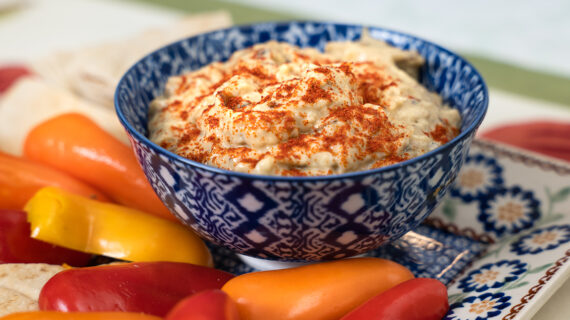
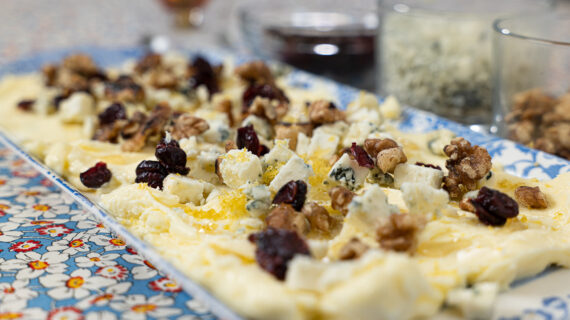
A cheese and charcuterie plate is perfect after a long ride. Simple salad. Wisconsin grated cheese. A platter of pasta, and local wine.
(folksy music) Breaking bread with the bikers. A wonderful way to celebrate a Wisconsin summer afternoon. Well, I hope this has inspired you to start cooking with your cousin and invite some beautiful bicyclers out to your farm. And I hope you'll gather with us next time Around the Farm Table.
I'm your host, Inga Witscher. (folksy music) (bright guitar music) Funding for Around the Farm Table is provided in part by Wisconsin Farmers Union, a member-driven organization for family farmers, rural communities, and all people. Wisconsin Farmers Union, united to grow family agriculture. Information at WisconsinFarmersUnion.com.
With additional support from these community members and Friends of Wisconsin Public Television.
Search Episodes
Related Stories from PBS Wisconsin's Blog



Donate to sign up. Activate and sign in to Passport. It's that easy to help PBS Wisconsin serve your community through media that educates, inspires, and entertains.
Make your membership gift today
Only for new users: Activate Passport using your code or email address
Already a member?
Look up my account
Need some help? Go to FAQ or visit PBS Passport Help
Need help accessing PBS Wisconsin anywhere?

Online Access | Platform & Device Access | Cable or Satellite Access | Over-The-Air Access
Visit Access Guide
Need help accessing PBS Wisconsin anywhere?
Visit Our
Live TV Access Guide
Online AccessPlatform & Device Access
Cable or Satellite Access
Over-The-Air Access
Visit Access Guide




Follow Us