

 Passport






Alice in Dairyland Reunion
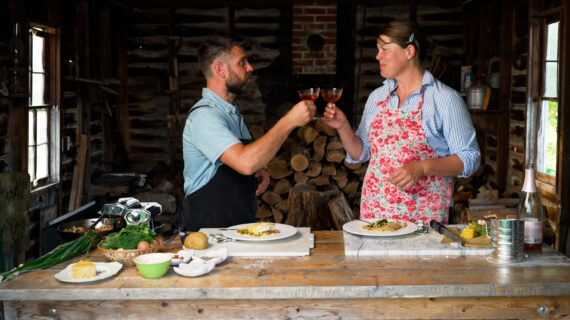
(folksy music) June is Dairy Month and I'm down here at the historic Hoard's Dairyman Farm to find out a little bit more about the Guernsey cows. Once I'm finished up here, it's off to some udder dairies. I'm gonna start with a goat dairy to learn about goats' cheese and then it's up to Spooner to learn about a sheeps' dairy. I'm gonna be gathering ingredients to make a beautiful cheesecake for the Alice in Dairyland Luncheon. Gather with us Around the Farm Table. I'm your host, Inga Witscher. -
Group
Gather with us Around the Farm Table. -
Inga
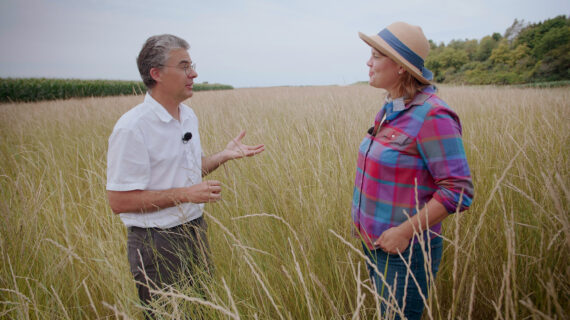
A few years ago, I moved up to Wisconsin. I started an organic dairy farm at St. Isidore's Mead. That's when I discovered the abundance of Midwestern local food and small-scale farmers, growing everything from green zebra tomatoes to pasture pork. I'm taking a break from the cows, hitting the road and seeing if I can't satisfy my epicurious appetite. That's great. This is amazing. Around the Farm Table is funded in part by Wisconsin Farmers Union, Heartland Credit Union, and Friends of Wisconsin Public Television. (folksy music) This is the dairy farm behind the iconic magazine Hoard's Dairyman. It's a place where the editors can keep their boots on the ground and continue learning about cows and agriculture and it's also the only magazine that I have ever known of that has an active dairy farm. Let's go find Corey and find out a little bit more about the farm. (folksy music) Hey there, Corey. - Hi Inga. Hey, Maggie, will you take her for me? Here you go, thank you. What are you up to right now? So we use the wand these days to do our health checks and it's Monday so this would be one of the events we're getting ready for with our veterinarian. And the wand is able to read the radio frequency identification transponders that are on these cows and essentially we don't have to use a clipboard anymore to hand in our data. And we can know if the cow is feeling well based on her activity or if she needs to get checked by the veterinarian and it's just wonderful technology. What a great tool to have. Ya know, one of the things I really enjoy about reading Hoard's Dairyman Magazine, which I've been reading since I was a little kid, is catching up on the technologies that's happening in dairy farms. Tell me a little bit about how the magazine got started. Ya know, it's a fascinating story, and really, it's been a voyage since 1885 on really improving life for dairy farmers and we have readers from 90 countries around the world now. Hoard came to Wisconsin from New York State and he started a small newspaper, and eventually, he was one of the people that started the Wisconsin Dairymen's Association. Wisconsin started out as a wheat state and eventually transformed into "America's Dairyland" and Hoard was a big, big part of that. He helped secure the first refrigerated rail car to ship Wisconsin cheese to New York. We became a cheese exporter. In 1885, he started Hoard's Da iryman and three years later, kind of, all this cow idea was taking off and he ran for governor of Wisconsin and he ran as the cow candidate and he got elected. (laughing) -
Inga
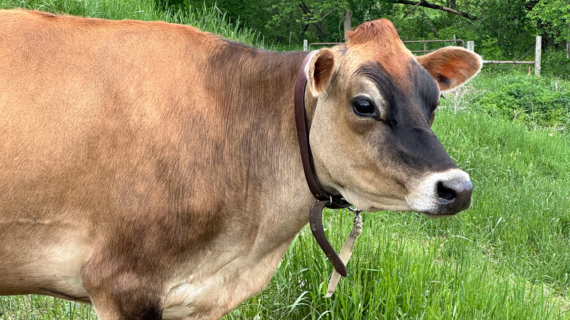
Nice. He loved dairy and he wanted other people to experience it and while he was governor they started the College of Agriculture at University of Wisconsin- Madison, they started the first dairy school, and they recruited a guy named Stephen Babcock, which became-- if you've ever been to UW- Madison, you know Babcock Hall and Babcock Ice Cream, but he helped make milk pricing streamlined so everybody was on a fair plane. Tell me a little bit about the farm. The Hoard's Dairyman Farm is actually on the National Register of Historic Places. We are the only known magazine that actually has a farm and we have dairy cows here and about 900 acres of crop land that we farm around here. And we've had Guernseys at this farm since 1899. But the real uniqueness about this farm is it's where some of the very classic research on alfalfa, which is a legume, which means it fixates nitrogen to fertilize itself, took place here and it's one of the crops that transformed and helped make America's Dairyland. So tell me about the Guernsey breed. These are Guernseys. It's nice to see a big group like this all together because really you don't see 'em that often anymore. Guernseys actually were about 1/3 of the dairy herd back at the turn of the last century here in early 1900s and they're wonderful for making butter. Because of the high butterfat? The high butterfat, they produce more butterfat than any other breeds. And back in that era, a lot of people were churning, making their own dairy products, after they milked their cows and butter was a great dairy product because you could store it pretty easily without refrigeration. The milk market's changed a little bit to favor fluid milk, but that's all changing now. The Guernseys are very high in A2. A2 is a type of protein, it's very digestible for people's stomachs and there's some people that are bottling that kind of milk now. So that's been a new product that's come out. Well, I'm celebrating June Dairy Month by visiting some other types of dairies in Wisconsin including a goat dairy and a sheep dairy and I'm making up a wonderful little cheesecake for Alice in Dairyland. So, it was really nice to be with you today, but I gotta get my clothes changed and head out. Thanks Inga, I really appreciate you coming to Hoard's Dairyman Farm. Have a good day. (folksy music) (crunching and shuffling) Wisconsin's known as the dairy state and when we think of dairy we think of cows' milk but Wisconsin's the leading producer of goats' milk in the whole United States. There's over 165 farms here and Bifrost Farm is just one of them. Let's go say hi to Meg and find out what a farmstead creamery is. -
Meg
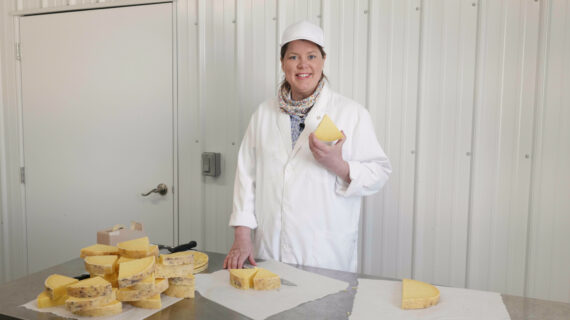
Hi Inga. Good to see you. It's nice to be here. I've been kind of following your progress on social media and it's nice to be in the actual creamery. Yes, it's nice to have it finally. So tell me a little bit about your farmstead operation here. Explain to us what a farmstead is. Farmstead means that all the cheese that I make comes from the goats that I milk on my farm Okay. Not from anywhere else. Alright. So there's not too many farmstead operations. And you're sort of a micro dairy, just like myself. Very micro. How many goats are you milking? Starting out with four and adding a couple more this summer and I hope to be up to 16 next year. Speaking from experience, it's nice to gradually add animals on and not be overwhelmed in the beginning. That's about as big as I wanna be. Especially 'cause you're doing everything yourself. You're doing the milking and you're making cheese too? Yes, I'm it. One woman show here. That's good. How did you get involved in this? I wanted the goats first because I've always loved goats and as soon as we moved out here and had the land we got a couple of goats which also comes with milk. Sure. And I love to cook and kind of a foodie, so I learned how to make cheese in the kitchen and decided this is my next adventure, I wanna do this. What varieties of cheese do you make? Right now I'm just doing fresh cheese just like Chevre, ricotta, feta. That's great. And a little bit of yogurt cheese and I also make Cajeta, which is a goat caramel sauce. That sounds amazing. Yeah. That sounds really good. I have to tell you, it's so nice to see creameries like this springing up throughout Wisconsin and you're not that far away from my house, which makes me really excited 'cause I love goats' milk cheese and having it available to us, it's just amazing. Was it difficult to start the process of cheese making? Yeah, you know Wisconsin being the only state that requires a cheese maker's license. Sure. So that took about three years mostly because it was hard to find a place for the internship. Oh right, 'cause you have to do so many hours. 240. Did you learn a lot doing the internship. I'm really glad that I did, yeah. My father, he's a licensed cheese maker and he was kinda like, "Oh, I gotta go through the classes, and all this stuff." Then afterwards, he said, "I'm so glad I did because I learned so much." I was the same way. I'm like, "Are you kidding? I have to pick the one state that..." (laughing) But I feel like I learned a lot more than I would have, otherwise, so it was good, it was worth it. So tell me about your goats. Well I raise Mini-Nubians which you don't find too much in a commercial dairy because they're smaller. But I'm the one wrangling them so I wanted a goat that I could handle, plus they give almost as much milk as a full-size goat, but they have the higher butterfat from the Nigerian Dwarf side. And I hear that goats have, is it one of the highest butterfat milks? Yeah, not quite as high as sheep, but it's higher than cow. I always thought Jersey cows were like the highest ever. Well, I know that I get quite a bit of cheese out of a gallon of milk. That's nice, and how many gallons do they produce? I get probably a gallon a day from each of 'em. That's not bad. Yeah. I was thinking about transitioning my dairy from a cow dairy to sheep or a goats just because I only have 30 acres available to me and I know that you can have more animals on less acres with these smaller, Right. The goats or the sheep but I don't know. When I see my little Jerseys out there with their eyelashes, then I can't do it. Yeah, the Jerseys are cute. But I'd love to find out more about goats. Can I go take a look at 'em? - Yeah, we got babies. Oh, perfect. - Okay. (folksy music) Whoa. Meg, I think I wanna get goats now. I like how friendly they are. Oh, they're-- I love 'em. I don't love it when they chew on me, but... (laughing) -
Meg
Well you know, they're not just-- I wouldn't call 'em pets, but they're my partners. -
Inga
Yeah. And so I respect them, ya know. I kinda love it. - They're part of the-- I feel so loved right now. They're my employees. (laughing) Tell me, you do a different kind of-- I try to get my cows pregnant every year, a couple months after they calf. What's your system here? -
Meg
I like to alternate years. So I'm breeding half my herd one year and the other half I'm doing extended lactation, which means that I'm gonna keep milking them through and not dry 'em off like people normally do. -
Inga
Oh, no kidding. Do they drop in milk production? -
Meg
It drops in the winter and then once the weather starts gettin' warm again it picks back up. -
Inga
What made you wanna do it that way? -
Meg
A couple of reasons. It's hard to find homes for a bunch of goats. -
Inga
I'll take some home with me today, that's fine. (both laughing) -
Meg
So I don't have so many babies to find homes for and it's also easier on the does. Yeah. Oh, for sure. Because they're not kidding every year. -
Inga
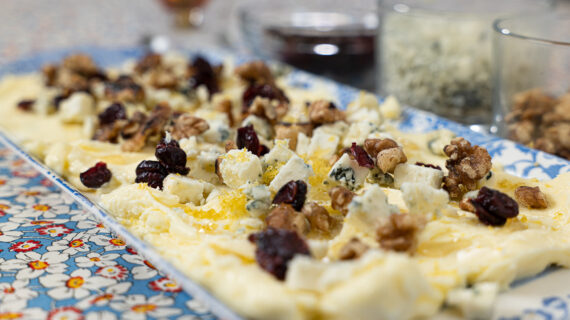
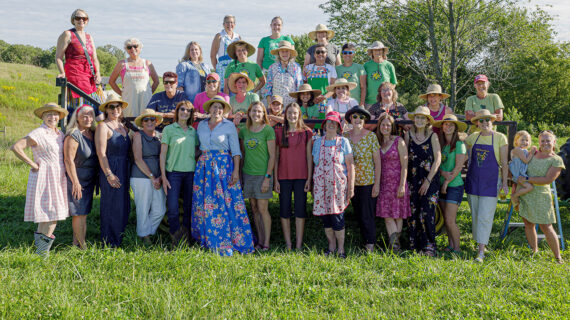
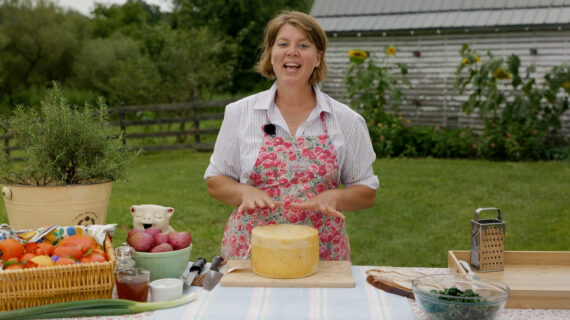
Yeah, you're not kidding right? Just kidding, how can you not make a joke? Well, Meg, thanks for taking the time today to teach us about what a farmstead creamery is and introducing us to these wonderful goats. Now that we've learned about goats' milk in Wisconsin let's head it up and learn about sheeps' milk. (folksy music) (bleating) Hey, Phil, how are you doin' today? I'm doing good, Inga. How are you? Really well, nice to see ya. Hey, I've been trying to get up to the Spooner Research Center here for years and years, but I finally got up here today. Tell me a little bit about what's happening here? The station started in 1909 with a donation of land from the city of Spooner to the University to help train the locals in farming methods and back then it was subsistence farming. Everybody grew their own food and had large vegetable patches and some animals to raise and so it was for the University to get information out to local farmers. And there's Ag research stations across the state, but we're pretty much the furthest north one that does production Ag work and that by, I mean crops and our animals that we have is we have sheep. And it's a little different sheep farm because we milk sheep and it's a neat place to work with a lot of different research projects going on. Now, we're kind of having a celebration at my farm later on for celebrating Dairy Month and all the different dairy in Wisconsin. Is there a lot of sheep dairies here in Wisconsin? There's about 20 sheep dairies in Wisconsin. We gain a few each year and we lose a few sometimes and it is gaining popularity throughout the United States and North American and we're members of the North American Sheep Dairy Association and last year Wisconsin hosted the Symposium. Oh, so did you guys have everyone up here? We hosted the Symposium in Madison. And we toured one of the farms out of the Westby area, as well as a cheese plant. Oh, nice. - On the way. Now, I've noticed there's some different colors on your sheep. Is that part of the research or just-- Yes, we're doing a research trial right now where we're milking either twice a day or once a day. Little bit early, we're seasonal milkers where we lamb in January, February, and March and then we milk through September. And normally, once their production level's low enough, we drop to once a day milking. Well, we're seeing if we could drop to once a day milking a couple months early and we didn't wanna run 'em all through the parlor so we sort 'em going through the parlor. Research has a lot of extra work at times and this is part of the extra work that we have, but we color coded the sheep so we can say the greens go in one pen and the blues go in another and the red and orange go in the milking line at night. And then they're all put back together and they're all milked in the morning. What other kind of research are you trying to find out about sheep? We've done a lot of milk production as far as what their feed is, protein level, different forages level, grain level for their energy, and if they need added protein. And we've done a lot of research on lamb raising, the fat content in their milk replacer and different feeding strategies as we're growing the replacement ewe lambs and last year did a grazing parasite trial, so. What a great resource for folks in Wisconsin and probably throughout the United States to be able to tap into find out about sheep and how to do it and how to make their farms better. Yes, we get calls from all over the United States and the Wisconsin producers. I had one Wisconsin producer call today and we just talked about a number of different production-related things. And then I've got calls from people all across the United States. That's fantastic. Well, hey, I got a few extra minutes. Can I help you guys milk? Sure. - I'd love to see your parlor. Sure, the more the merrier and it's a good experience to milk sheep. (folksy music) (bleating) (mechanical whirring) Well I'm gonna help the ladies finish up with milking and then why don't you meet me back in the kitchen where we're gonna cook up some desserts for Alice In Dairyland. (folksy music) I'm honored to be able to bake up a cheesecake for Alice In Dairyland. Alice is the ambassador for Wisconsin agriculture. Each Alice takes a full year to travel the state and around the country to promote Wisconsin agriculture and I'm not just talking about dairy farms. I'm talking about the mink industry, cranberries, potatoes, everything we have going on here in Wisconsin. And I think as a farmer, it's wonderful that we have this resource of this woman who can be the voice and tell people what we're doing and promote all the wonderful things that we do here on our farms. I thought a cheesecake might be the perfect thing to make for our little afternoon tea because it's June Dairy Month. And in this cheesecake, I wanted to celebrate all of the dairy here in Wisconsin by adding some goat cheese to the cheesecake. We actually are the number one state for goats' milk, for producing goats' milk and I think it's a lovely, tangy addition to this cheesecake here today. First we're gonna start with the crust. Now when I was a little girl, I would bake cheesecake with my grandmother almost once a week and she would have me put Graham crackers in a Ziploc bag and beat it with a rolling pin until it was a fine crumb. Luckily, I have a Cuisinart that does that for me now. And what I did to make mine a little different than my grandmother's is I'm gonna use a ginger snap crust. I love that flavor of the ginger and I think it'll go well with the goat cheese. So add 2 cups of pulverized ginger snaps to a bowl here. And then, I'll do 1/4 cup of sugar, and 6 tablespoons of melted butter. Now you can just whisk this all together and you don't want it soaking. You want it just to be damp enough that the crumb will come together. Okay, and now we'll just pour that right into my springform pan. Now using your hands or a measuring cup you just wanna spread out your crumb and then push it about halfway up the sides of your pan. When you're pushing that crumb in, try to get it as even as possible so that each piece has about the same amount of crumb. It just makes for a nicer experience when you're eating it. Okay, well, I'm gonna set that to the side and we'll make the filling. First, I'm gonna start out with the goat cheese. And I'm excited for this. I really like that flavor, that zinginess of the goat cheese and I think it's nice to use in baking instead of just more savory dishes, like I usually do. And next is the cream cheese. Now cheesecake has been around since ancient Greece. It was actually served at the very first Olympics to the athletes. It was thought to be a health food and give them tons and tons of energy. So I have two 8-ounce packages of cream cheese and then I'm gonna add some sour cream. You could also use some creme fraiche too. And my grandmother always mixed up her cheesecake with her old blender, so I'm gonna do the same. And this is gonna allow me not to overmix anything too. Now that everything's mixed up nicely I'm gonna add 4 eggs, one egg at a time and I wanna just gently stir those into my cheese mixture here. I love having chickens this time of the year because the yolks on the eggs get to just be such a beautiful orange color and that's because of the grass that they're out there eating right now. So just gently mix in your egg. And after each one is incorporated, you can go ahead and add the next. So here's number two. One of my favorite parts about being able to farm is to have these ingredients here on my farm whether it's from my garden or my chicken coop or from the cows. It's a way of making the things I make a little bit more special for my guests. It's worth all the work and the early mornings to be able to offer my guests something special, right from the farm. And now that the eggs are in, I'm gonna add my sugar, and a little bit of vanilla for flavor. And again, just gently mixing that in. Now that everything's incorporated it can go right into my crust. I think this is gonna be delicious. When I bake cheesecakes, I always get a little bit nervous that the top's gonna crack, but it's okay 'cause I have a wonderful homemade blueberry topping that I can put on top to disguise it if it does. Now you wanna cook this low and slow, and pull it out of the oven when it's still a little bit jiggly so you don't overcook it. I'm gonna pop this in the oven, and then, why don't you meet me down at the barn to celebrate with the Alices? (folksy music) So, Ann, you're the current residing Alice in Dairyland. That's right. Do you have a history? Did you grow up on a farm? I did not grow up on a farm. I'm the first generation removed from the farm, which I think is one of the unique things about the Alice in Dairyland program, as well as Wisconsin's agricultural industry. You don't have to have grown up on a farm to be involved in the industry, by any means. We're all affected by it. It contributes $88.3 billion dollars to Wisconsin's economy each year. So knowing that large impact, I wanted to get involved somehow. And I did show dairy cattle growing up. That's how I got my start in agriculture was through 4-H. And through that opportunity, I had the chance to interact with some of the most supportive people I've ever had the pleasure of meeting and so being able to give back to them by serving as Alice in Dairyland and promoting this industry is just a wonderful opportunity. Well, thank you so much for being here today. Yeah, thanks for having me. Well, she's Wisconsin's sales lady with a crown. (laughing) She plays a very big role in educating folks. I was so proud to represent Wisconsin agriculture. Every year, there's a different Alice that comes from a different background. It's such a unique experience to be Alice. Mary Ellen, thank you so much for being with us today. It's wonderful to see all these different generations of women who've been Alice In Dairyland. Explain to us, what is Alice in Dairyland? Well, the spokesperson for the dairy industry, dairy and agricultural industry of Wisconsin. And at the time I was chosen, I was a sophomore in college at the University of Wisconsin in Eau Claire, and then moved to Madison to travel and I did 53 cities throughout the United States that year. Wow, and what kind of experience did you have? Did it help kind of build you for the future? Oh, it was a marvelous experience. You did radio and television interviews, and you called on utility companies, and you gave food demonstrations, which was a lot of fun, using dairy products and then I ultimately ran a little food specialty shop with my mom in downtown Madison at 129 State Street, just a block down from the capital. How lovely, and then, what did you go on to do for a career? Well then I finished my undergrad and my graduate work, and then I joined the Jolly Green Giant company, and did radio and television for them, was their spokesperson. And what year were you Alice? 1953. Fantastic, I wonder... It must be interesting to see how much agriculture has changed from 1953 until the present day with just all the technology we have and everything nowadays. Oh, that's true, that's true. -
Inga
Well thank you so much for coming to the party today. It was fun to come, thank you for having me, enjoyed it. (folksy music) Pour a cup a kindness, tea and desserts, perfect for an Alice in Dairyland reunion. (folksy music) Chevre cheesecake, tangy and tasty. Top it off with your favorite fruit compote. Buttery rosemary shortbread cookies, savory and sweet. Strawberry rhubarb tiny cakes, crowned with a delicious dollop of buttercream frosting. Well, I hope you've enjoyed celebrating June Dairy Month with me and all the different Alices. And I hope you'll gather with us next time -
All
Around the Farm Table. I'm your host, Inga Witscher. (Klezmazel band performs "Old MacDonald Had a Farm") (eastern European old world style music) (Klezmer music) (acoustic guitar) Around the Farm Table is funded in part by Wisconsin Farmers Union, Heartland Credit Union, and Friends of Wisconsin Public Television.
Search Episodes
Related Stories from PBS Wisconsin's Blog

Donate to sign up. Activate and sign in to Passport. It's that easy to help PBS Wisconsin serve your community through media that educates, inspires, and entertains.
Make your membership gift today
Only for new users: Activate Passport using your code or email address
Already a member?
Look up my account
Need some help? Go to FAQ or visit PBS Passport Help
Need help accessing PBS Wisconsin anywhere?

Online Access | Platform & Device Access | Cable or Satellite Access | Over-The-Air Access
Visit Access Guide
Need help accessing PBS Wisconsin anywhere?
Visit Our
Live TV Access Guide
Online AccessPlatform & Device Access
Cable or Satellite Access
Over-The-Air Access
Visit Access Guide




Follow Us