

 Passport





Tamara Thomsen on researching Lake Mendota's ancient canoes
Wisconsin Historical Society maritime archaeologist Tamara Thomsen details how researchers determined the age of multiple ancient Native canoes found in Lake Mendota and how two are being preserved.
By Erica Ayisi | Here & Now, ICT News
February 25, 2026 • South Central Region


Tamara Thomsen on the age of ancient Native canoes and how two are being preserved.

VIDEO TRANSCRIPT
Tamara Thomsen:
With each one of the canoes — and this is for all of them across the state, including the Lake Mendota ones — we take a sample of wood about the size of your pinky finger, just the fingernail portion. That's split in two. Half of it goes to Forest Products Laboratory, where the wood type analysis is done. So we determine, again, what tree species were selected for making the dugout canoes, and those vary throughout the state as far as the preference of wood that's being selected. And then, the other half of the wood goes to a laboratory for radiocarbon dating. So, that gives us a range of dates when it's likely that that canoe was harvested. Where we take the wood is from the outermost part of the canoe — that's more representative of when the tree was harvested than when the tree first developed.
Erica Ayisi:
Right, 'cause that tree could have been there for decades or hundreds of years...
Tamara Thomsen:
Right, yeah, right.
Erica Ayisi:
...compared to when it was actually built.
Tamara Thomsen:
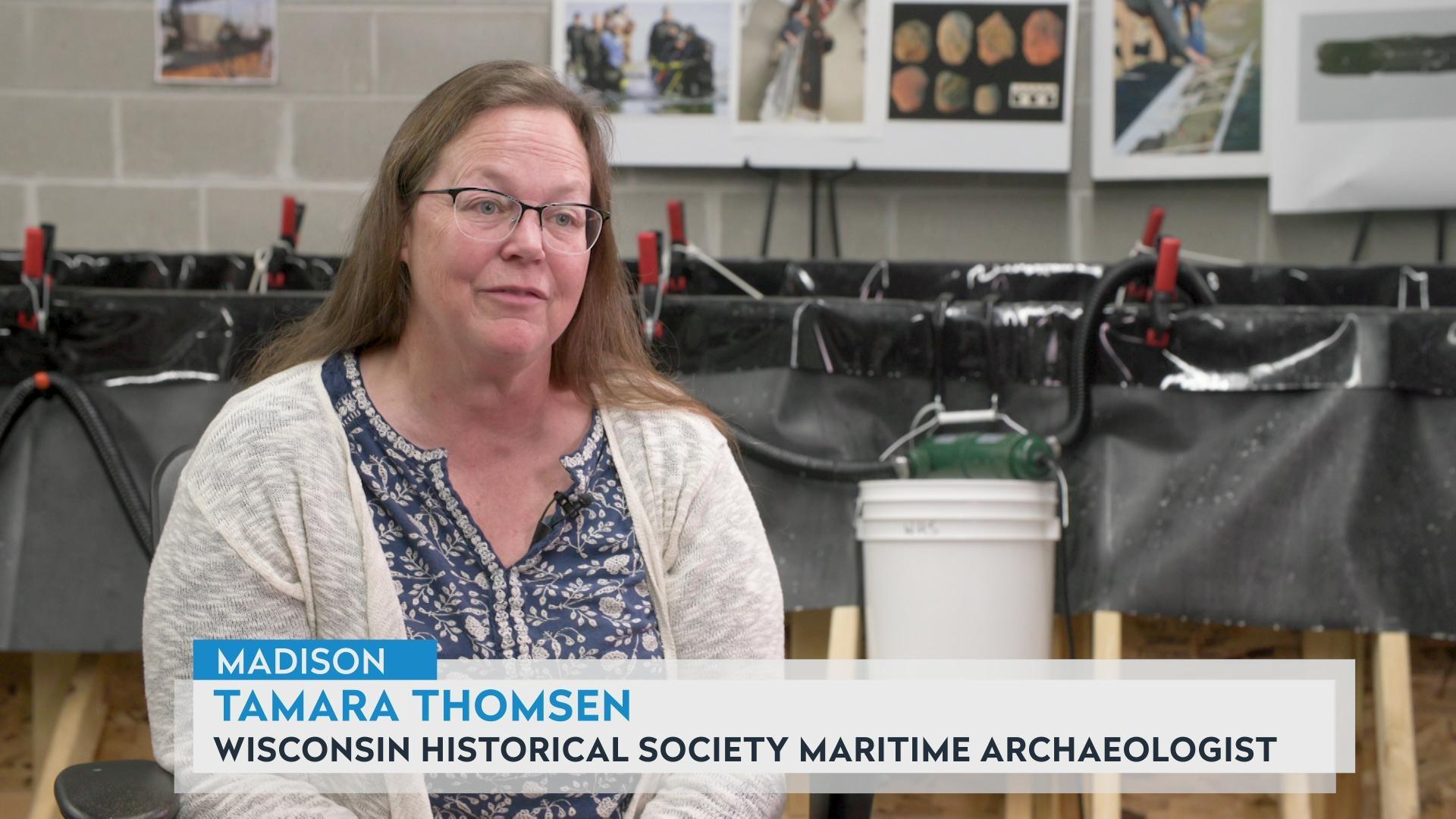
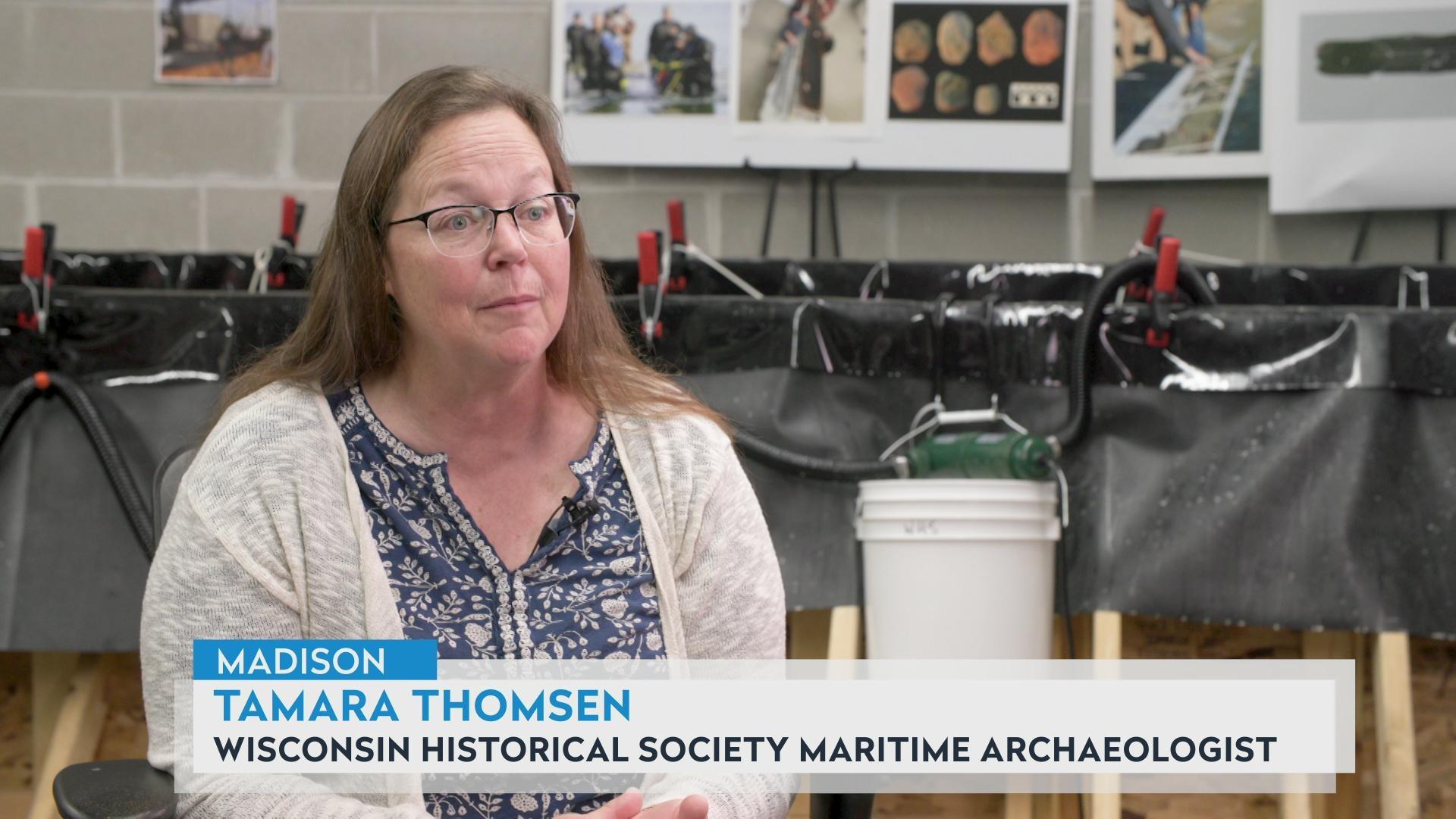
We're in the large object storage room here at the State Archive Preservation Facility. This is a makeshift tank that we have here, which is where we're doing conservation work on the two dugout canoes that were recovered from Lake Mendota in 2021 and 2022. So, it's been a long time that we've been doing preservation work on them. We soak them for a few years in water to try to stabilize and control the objects. Then we introduce polyethylene glycol to them, which is sort of a bulking agent. It's a preservative that bulks up the wood. If you think about waterlogged wood, the only thing that's holding the cellular structure up of that wood is the water itself. So, when you start drawing it out, it collapses, and the object wouldn't be able to be shown in a museum. Polyethylene glycol replaces the water in the cellular structure of the wood. It will make it shelf stable, so that it will be able to be displayed at the new history center, which will be opening in 2027.
Erica Ayisi:
That's exciting.
Tamara Thomsen:
Yeah. So, we're almost through the conservation process. We've got maybe a few weeks or a month left, and we're waiting for an opening at a preservation facility in Texas where the remaining water that's in the cellular structure will be freeze dried off. And so, it'll be shipped to Texas soon. Then it will come back just in time for the opening of the new museum.
This report is in collaboration with our partners at ICT.
Video Interviews
More Science


Our Partners




PBS Wisconsin is a service of the Wisconsin Educational Communications Board and the University of Wisconsin-Madison. © 2026 All Rights Reserved.
Follow Us