








PBS Wisconsin Passport
Watch this video with
PBS Wisconsin Passport
Become a member of PBS Wisconsin, support your local community, and get extended access to PBS shows, films, and specials, like this one.
Iceman Murder Mystery
10/25/11 | 53m 7s | Rating: NR
(This program is no longer available for online streaming.) He's been dead for more than 5,000 years and poked, prodded, and probed by scientists for the last 20. Yet ítzi the Iceman, the famous mummified corpse pulled from a glacier in the Italian Alps, continues to keep many secrets. Now, through an autopsy like none other, scientists will attempt to unravel mysteries about this ancient mummy.


Copy and Paste the Following Code to Embed this Video:
Iceman Murder Mystery
NARRATOR
Frozen for more than 5,000 years on a remote mountain pass and now preserved for the ages in a refrigerated tomb, he is the Iceman, a frozen relic from the Stone Age, the oldest intact human body ever found. He's a messenger from the past bearing secrets of how humans lived nearly a thousand years before the Pyramids. He is also a homicide waiting to be solved. Who was he? And who shot an arrow into his back?
PATRICK HUNT
Whoever shot him went up and pulled the arrow shaft out of his back. Why would you do that? Why would you take the arrow away?
NARRATOR
Was it warfare or murder? Now, a rare and dangerous procedure leads to some startlingly fresh clues. A piece of bone, a copper ax and a last meal surprise the experts as they come closer to understanding our ancient past and to solving the Iceman murder mystery. Right now on this NOVA-National Geographic special.
Major funding for NOVA is pr NARRATOR
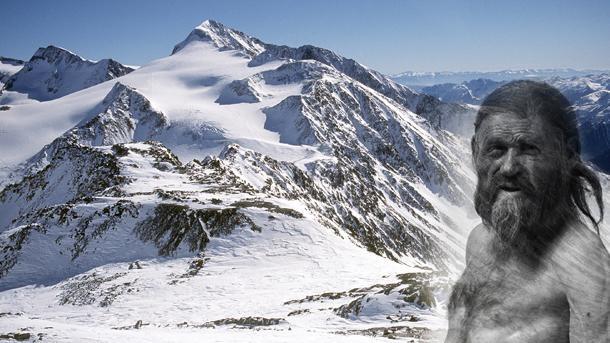
On a remote mountainside high in the European Alps, a man makes his way through the thin mountain air. It is a desolate place. But he is not alone. On this day 3,000 years before the birth of Christ, this man's life will end in a violent death. But his body will remain on the mountain for over 5,000 years. September 1991. Two hikers climbing in the Italian Alps wander off the trail and stumble across a gruesome sight... the head and shoulders of a man emerging from the ice. At first, the pathologist responding to the scene assumes it's simply the remains of an unfortunate hiker, one of many lost to the Alps over the years. But this body looks different. It shows almost no signs of decomposition. Its skin and flesh appear to have been freeze-dried. Hands, feet, even eyeballs are still intact. The mountain air and ice had transformed this corpse into a mummy. As the recovery continues,
some unusual items begin popping up
bits of leather and handmade rope and a knife with a flint blade. This was no ordinary hiker. Initial analysis of his gear suggests he was thousands of years old. The find causes a worldwide sensation. The press dubs him "the Iceman,"or "Otzi," after the Otztal Mountains where he died. Eventually, carbon dating confirms that Otzi died 5,300 years ago. His were the oldest intact human remains ever recovered. What can they tell us about our own history and about how this man died up on that mountain?
HUNT
For some reason, Otzi makes a fateful journey up this ridge, along this valley, all the way up. He goes from essentially about 1,000 feet to almost 11,000 feet. Why?
NARRATOR
At first they suspect he was lost in a storm, but mounting evidence begins to suggest something else happened to the Iceman, something more violent. Exactly what that was will likely be uncovered here in Bolzano, Italy. Just 30 miles from the spot where he died, a multimillion-dollar museum celebrates what could be the world's oldest open case of homicide. Otzi's mummified body is on display, carefully frozen in a custom-made crypt.
Temperature
20.3 degrees Fahrenheit.
Relative humidity
98%. Now, doctors in charge of the body are hoping to force a break in the ancient case by conducting a rare and dangerous procedure. They are letting the Iceman's body defrost. Scientists flock to Bolzano to get their hands and instruments on the 5,000-year-old corpse. They will be following fresh leads about the Iceman's death, but also his life at a key turning point in human civilization. They will have just nine hours to complete their investigations before the Iceman must be refrozen. Pathologist Eduardo Egarter Vigl is leading an operation that could be risky. (Egarter Vigl speaking German)
TRANSLATOR
One risk is that scientists who enter the room bring their bacteria and germs with them. Another risk is that we have no way of knowing if there are still living organisms in the mummy itself and if these would be reactivated in the defrosting.
NARRATOR
If the body is harmed by the defrosting, the loss would be profound. Scholars depend on this one corpse to shed light on a crucial time in human history. Otzi is unique. He's from the very end of the Stone Age, a time when humans still used stone tools, but before they had mastered the art of smelting metal. Struck down in mid-stride, he provides a glimpse of what life was like in those times, with some surprising twists.
HUNT
One find, a man in the ice, opened up a whole new window on the ancient world that was never there before.
NARRATOR
5,000 years ago on the European continent is a time before countries, before kings, even before the introduction of the wheel. In these Alpine valleys, some people are living in small settlements, just beginning to grow crops like wheat and barley and to raise goat, sheep and cattle. But others are nomadic hunters still depending on wild game for survival. Population is increasing, and so is competition between those hunters and early farmers.
HUNT
We now know that with increasing population, there are more people contesting boundaries. This is the first time we're actually farming. So people can now fight over a plot of land and over the resources on it.
NARRATOR
This is 1,000 years before so Otzi's gear, well preserved by the icy glacier, provides a critical insight into prehistoric culture.
HUNT
Everything was placed in that refrigerator and the door was sealed, and we can open up that window in time 5,300 years later and everything was almost just as he left it.
NARRATOR
In fact, when they found the Iceman, he was still wearing one of his shoes. The artifacts are now in the Bolzano museum, where Patrick Hunt is joined by Annaluisa Pedrotti of nearby Trento University to carefully examine each item, searching for clues not only about Otzi's culture but about his last day alive. Why would he have been carrying these things with him at the time of his death? The shoe is one of the earliest examples of its kind and surprisingly complex.
HUNT
You can just see here at least three different kinds of material. You see grass, you see skin, and you see cord.
NARRATOR
It's unlikely a man from the Stone Age would wear shoes all the time. But if he knew he was going to cross the rocky slopes and glaciers of the Alps, shoes like this would be important to pack along. The artifacts not only provide personal details about the man who carried them, they prove that Stone Age designs could be surprisingly sophisticated. His backpack, with its wooden frame, seems almost modern. A leather pouch was possibly tied around his waist like a fanny pack. Chunks of tree fungus, thought to have medicinal powers, served as a first-aid kit. Maple leaves were used to carry hot embers for starting fires.
HUNT
Otzi's culture knew the use of every possible plant and stone and wood.
PEDROTTI
They used the optimal material.
NARRATOR
But venturing into the mountains beyond his settlement could be dangerous. Wolves, wild boar and bears were common. Clashes between settlements and hunters were also possible, so Otzi carried weapons. Along with his knife, he had a bow and arrows. His quiver, the oldest ever found, contained carefully crafted wooden arrows, with flint arrowheads chipped to a razor's edge and glued on with pitch made from the sap of a birch tree. The feathers on the shafts are also carefully attached to stabilize the arrow in flight. But for some mysterious reason, the bow and arrows were not ready to use.
HUNT
If you count the number of arrows here, easily over a dozen, most of the arrows are completely unusable at this time. Why do we have so many arrows unfinished? (speaking Italian)
TRANSLATOR
This is a huge mystery. He was found with equipment that was not fully prepared.
NARRATOR
It's as if he were walking in the wilderness with an unloaded gun.
HUNT
I would say that Otzi is going to be in trouble. This is a serious flaw in his plan for survival.
NARRATOR
But he wasn't completely unarmed. He was carrying a weapon far advanced for his time, an ax made of copper. The one object that continues to draw our attention like a magnet is that copper ax. It's so intriguing because the technology required to make it is far beyond anything we've seen before. The Iceman's copper ax surprises archaeologists and forces a revision in the timeline of history. Before Otzi, scholars didn't think Alpine cultures had learned to smelt copper until about 2,000 B.C., but carbon dating shows that the Iceman's ax is far older than that. This means his people already knew how to heat copper-rich rock up to 2,000 degrees Fahrenheit, hot enough to extract the metal from the ore. The discovery of the ax meant they were stepping out of the age of stone tools a thousand years before experts thought possible. To be that far ahead so far back, this is simply incredible. This is one find that changes forever what we think about the past. The mind that can create that copper ax is practically and for all purposes the same mind that can create a computer, a circuit board. In other words, Otzi is us. For years after the Iceman was discovered in 1991, scholars believed he had frozen to death in an Alpine storm. But how could someone so in tune with his environment get caught out in a storm? Experts searched for other clues to explain his death. The body was CT-scanned and X-rayed. But all they saw was some broken bones, nothing fatal. Then one day, ten years after the Iceman's discovery, Dr. Paul Gostner, a Bolzano radiologist, was studying images from the Iceman when he saw something that struck him as strange. (Gostner speaking German)
TRANSLATOR
It's this little white spot here. But you could also confuse it for a rib. It's hard to see right away, isn't it?
NARRATOR
As Gostner began to look again at the original X-rays, he saw something that didn't add up. So he had a CT scan image taken and this time, there could be no doubt. There it was, lodged in the Iceman's back-- an arrowhead made of stone.
GOSTNER (translated)
That was a great surprise since up until that time we didn't know that he was shot.
NARRATOR
But did the arrow kill the Iceman? We know he was shot in the back from slightly down below, with an arrow that penetrated his scapula, his shoulder blade. The CAT scans revealed that the arrowhead had, in fact, hit its mark.
HUNT
The arrowhead penetrated a subclavial artery so that Otzi bled to death very, very quickly.
NARRATOR
Who killed the Iceman, and why? The desire to solve this ancient homicide drives researchers back to the body one more time. In the small operating room at the Bolzano museum, an international team of nearly two dozen researchers has gathered for the chance to examine the mummy. One of their first objectives will be to see if they can get a look at the fatal arrowhead. Over two decades, scientists have learned a great deal about the Iceman. From his skeleton, they know he was about five feet, two inches tall. Evidence of muscle development in his legs indicates a grueling routine of mountain hikes. The softness of his hands suggests he was not a farmer working the earth, but perhaps a hunter or a shepherd... while study of his bones reveals that he was in his 40s the day he died. Identifying marks include over 50 tattoos of unknown significance. Biological anthropologist Albert Zink is head of the Institute for Mummies and the Iceman. Together with Dr. Egarter Vigl, Zink is leading the procedure.
ZINK
We're all a little bit excited and also nervous because we have a lot to do and we also have to be sure that the Iceman doesn't have any damage due to this investigation.
NARRATOR
After a night spent outside his freezer, Otzi is thawing nicely. As the mummy melts, he starts to sag. To prevent the body from completely falling apart, scientists place him in a special box. The box will allow them to move the body without damaging it and without altering the position of the limbs.
EGARTER VIGL
You can see the mummy is well defrosted, the tissue is soft, so I think that we can start now with the investigation.
NARRATOR
Body parts that were frozen now move. With just nine hours to conduct their investigations, each team must stick to a tight schedule. In order to gain access to his left shoulder and the arrowhead, doctors move quickly to flip Otzi face down. They hope the arrowhead may provide a clue to help solve one of the key mysteries of Otzi's death. Was he killed in a skirmish with another settlement or some hunters fighting over territory? Or was the arrowhead still in his back put there by one of his own? Perhaps a jealous rival from his clan. One clue supporting this idea is his copper ax. That ax was so advanced, some believe it marks Otzi as a man of great importance in his community. Stone carvings found in the valley below where he died prominently feature the exact same kind of ax, suggesting that the weapon had great symbolic power.
HUNT
And that makes us wonder more about Otzi. Who was he? Why did he have this? What kind of status did he have in the culture?
NARRATOR
Zink and Egarter Vigl wonder whether the arrowhead might be able to provide other clues.
ZINK
So we really hope to get close to the arrowhead, because the arrowhead is still inside the body and we never really saw the arrowhead. So we really hope to get close to it, to maybe even see what's going on there.
NARRATOR
Guided by an endoscope, they are now within half an inch of the actual arrowhead. But their route is blocked by tissue. With minutes ticking by, Egarter Vigl has a key decision to make. So far, they have used pre-existing access routes created long before the presence of the arrowhead was known. If Egarter Vigl gives the okay to cut the Iceman in a new place, they will surely be able to gain access to the Stone Age arrowhead. But this creates a dilemma. It's Egarter Vigl's mission to learn all he can about the mummy. But it's his duty to keep it from harm. The Iceman's body has become a kind of protected landscape, an archaeological site older than Stonehenge, with distinct areas marked out for exploration over the years. So the Iceman is not just an extremely cold case, he's considered by the government to be a cultural treasure. That prevents Egarter Vigl from performing a true autopsy, the kind of procedure that might radically alter a human time capsule that has remained intact for nearly two million days. Egarter Vigl and Zink have devoted much of their careers to studying this time traveler from the Stone Age. Now they visit the remote pass where Otzi met his fate.
EGARTER VIGL
We see in front of us this wall, the place the Iceman was found.
NARRATOR
Otzi was found just 100 yards from the border between Italy and Austria. 5,000 years ago, he climbed to this ridge and was killed.
EGARTER VIGL
Here we are on the top of the mountain. And if you look, down in the valley we see that the distance is very, very long. There are more than 1,500 meters.
ZINK
So we can see here very well that here was the glacier and the glacier tends to move down. And normally a dead body would have been transported with the glacier down and destroyed completely.
NARRATOR
Most bodies lost in glaciers get buried in the river of ice and slowly glide down the mountain along with tons of stone and other debris, all grinding together. Alpine glaciers typically move about 100 feet per year, and after a few hundred years, most of the debris that gets caught up in them emerges at the bottom along the melting edge of the ice. But while the circumstances of Otzi's death appear extremely unlucky, in archaeological terms, he couldn't have fallen in a better spot. The sun and wind dried his body out completely. Rocks on either side of him formed a small trench. This eventually filled in with ten feet of snow and ice, preventing the Iceman's body from being swept into the deadly frozen current that flowed all around it. 50 feet to the right or left and his body would have been ground to bits and lost forever. The mountain created and then protected the Iceman. Back in the operating room, Egarter Vigl and Zink have to decide whether they are going to cut into the mummy, risking permanent damage. Though investigators have known for a decade that Otzi was killed, no one has ever seen the actual murder weapon. It's the last piece of unexamined evidence remaining. The team going after the arrowhead is tantalizingly close. But there is no way to get through the tissue without doing damage to the mummy. Egarter Vigl decides to play it safe and move on without making a new incision.
HUNT
We want to make sure that Otzi is kept intact. Archaeologists have a tendency to alter the artifacts in a very destructive way. Once you excavate some sites, you can never go back and you can't correct your mistakes, you can't do it over again.
NARRATOR
Though the arrowhead is critical, it's not the only evidence in the case. The idea that Otzi was killed in a skirmish with a rival settlement or band of hunters seems to be supported by microscopic signs that he was on the run in the days leading up to his violent death. He's carrying those tiny clues in his intestine. Wherever you walk in late spring to early summer, there's going to be a lot of pollen in the air. The pollen is going to also be in his throat and on his food. At different elevations, different trees release their pollen. In this region, a tree called hornbeam dominates the lower elevations, while higher up the mountain, conifer forests cover the slopes. In Otzi's intestine, scientists find a layer of hornbeam pollen. On top of that, a layer of conifer. It's a clear indication he's moving up the mountain.
HUNT
Oddly enough, we believe he came back down again because there's another layer of hornbeam pollen on top of the conifer pollen, which means he went up, for some reason came back down, and then went back up again to his death. What possesses a man to make such a journey, unless, for life-threatening reasons, he has to move?
NARRATOR
And there is more forensic evidence that the Iceman was being pursued in the days leading up to his death. On his right hand, a deep cut slicing across the palm, possibly the result of hand-to-hand combat involving a knife. So has he been in a battle? Has he already been fighting for his life? There's some evidence that would lead to that interpretation. But this warlike scenario has one hitch, and it has to do with what must have been
the Iceman's most prized possession
his ax. Why would the killers leave such a valuable object behind? It makes sense if Otzi is just a victim of a long-distance kill shot, where someone would shoot him, leave the arrow, leave the ax, and run away.
NARRATOR
But the shaft of the fatal arrow was never found, suggesting the attacker got close enough to pull it from the Iceman's back. Anyone getting that close to the body would have been within reach of Otzi's copper ax.
HUNT
Why was the ax left by his body? A huge mystery. Surely people knew its value.
NARRATOR
Perhaps the killer left the ax and took the arrow to avoid being discovered. If you took his ax, you'd be identified. If you left your arrow shaft, you could be identified. So to leave the ax and take the arrow says that someone is exercising great caution. They're thinking this through. Possibly, they don't want to be identified as Otzi's killer. In the search for more clues about Otzi's killer, it's time for a new group to have their turn with the body. This team will be looking for blood, specifically in Otzi's brain. On scans of Otzi's skull, there are clear signs of fracture, and in pictures of the shrunken- but-still-intact brain, some areas appear darker than others, which could be either blood or rot. If it's blood, it's proof he suffered a blunt-force trauma to the head just before dying.
ZINK
If you really could find an evidence for a bleeding, this would prove that this was an injury that happened during the process when he was dying. The bleeding just happens if you are still alive or maybe if you are in the process of dying.
NARRATOR
Pincers, threaded through holes drilled in Otzi's cranium years ago, snip samples of his brain. When analyzed in the lab, these dark clumps of brain matter test positive for blood, confirming that Otzi suffered a blow to the head before he died. But how? Either he was finished off by his killer at close range, or he hit his head on a rock after being struck by the arrow. Ultimately, the forensic evidence is inconclusive, but the blood in the brain confirms that his last moments were traumatic. All this analysis has taken time, and the body cannot remain defrosted much longer. With so much information about his death still inconclusive, scientists shift their focus to look for more clues about Otzi's life. The copper ax suggests he was a figure of some importance. But was he a farmer? A hunter? A shepherd? Why was he alone? Was he perhaps on the run? Unfortunately, the one vital organ that could possibly answer all these questions has been missing for 20 years. But recently, it has been found by the same radiologist who discovered the arrowhead. Over the years, Dr. Paul Gostner has seen thousands of images of the mummy's insides, but one day, while scanning the familiar images, a unexpected shape seemed to emerge. (Gostner speaking German)
TRANSLATOR
Here we have the esophagus, heart, lungs. See? And if you go further down, then you see an image that corresponds to that of an organ, a big hollow organ.
NARRATOR
The big hollow organ was something
no one had noticed before
the Iceman's stomach. How was it possible for everyone to miss something so basic as his stomach?
The answer
because it was not where it should have been. The stomach had moved. When the Iceman was found, his body was draped, face down, over a rock. For 50 centuries he hugged that rock, pressed under tons of ice, his body, squeezed between the rock below and the ice above, pancaked. While the organs inside his body were preserved intact, some of them were squeezed out of place.
TRANSLATOR
The stomach usually sits in the upper abdomen. When a person stands, then the stomach moves down a bit. When a person lies on his stomach, then the stomach pushes up. When a person lies on his stomach and has a ton of ice on top of him, then the stomach is pushed up even further. You don't see the stomach because it's too far up.
NARRATOR
The team assembled to explore the stomach first tries to reach it the usual way, passing an endoscope in between the Iceman's teeth, through his mouth and down his throat. But the Iceman's body is too compressed.
DOCTOR
We cannot pass. We cannot pass.
NARRATOR
So the team takes a different route, through an existing incision in the abdomen, and here they find the stomach, almost in his chest, just where Dr. Gostner predicted it would be.
ZINK
I think this is stomach, here.
NARRATOR
The stomach is not only there, it is full of food. Grain, fat and meat.
ZINK
So much material from the stomach now.
NARRATOR
Initial analysis establishes the grain is a variety of wheat called einkorn. Einkorn was one of the first grains cultivated by human beings. The meat is ibex, a kind of wild goat still roaming the Alps. This last meal confirms the Iceman lived at a turning point in history. He and his people were just beginning to farm, but they still depended on meat from wild game. Otzi himself may have been a hunter connected to a small farming community. However he made his living, he was well fed. After nine hours, Otzi is resewn, holes plugged, flaps put back in place. This one day has yielded 149 biological samples, enough material to keep scientists busy for years to come. The most important of all could be the vials that may contain the Iceman's DNA. Techniques of salvaging and sequencing DNA have only recently improved enough to make it possible to get useful information from a mummy as old as Otzi, but it will still be extremely difficult.
ZINK
Testing the DNA of the Iceman is difficult on one hand because he's a wet mummy and wet mummies have a lot of humidity. This is very bad for the DNA preservation. On the other hand, he was frozen for more than 5,000 years and this turned out to be good because the coldness preserves the DNA.
NARRATOR
If fragments of DNA can be reconstructed, scientists have hopes they will be able to learn a great deal about characteristics like his eye color, medical history and genetic mutations. But first, they have to get the DNA. They will follow a multistep process in order to see if it is even possible. For Angela Graefen, a researcher at Albert Zink's lab, helping to piece together the Iceman's genetic profile is the chance of a lifetime.
GRAEFEN
I've always been very interested in mummies, and when I got the chance to work on the Iceman, yeah, well, of course. It's everybody's dream to work on such a well-known sample as that.
NARRATOR
First, Graefen cuts the precious sample of Otzi's bone into smaller pieces using a diamond-tipped saw. Tiny bone samples are placed into a sterile container with a steel ball. When the container is shaken at a high speed, the ball pulverizes the bone, breaking apart individual cells. Graefen adds various chemicals to make the DNA easier to extract. Days later, what's left is a mixture of clear water and a golden-hued pure DNA. The DNA is sent from Bolzano, Italy, to a lab outside of Boston that specializes in reconstructing DNA. Ancient DNA is very different from modern DNA for several reasons. One of the bigger issues with ancient DNA is contamination. Contamination occurs when the DNA from an outside source, whether from a microbe or a human being, gets mixed up with the DNA being studied. Over the years, countless people have touched the mummy, leaving traces of their own DNA behind. So Zink and Egarter Vigl took their samples from deep within Otzi's bone, counting on the outer bone to provide a natural seal to protect the inner bone from contamination. Because the procedure was so meticulous, the DNA extracted is remarkably pure; 97% is Otzi's. But there is a mysterious three percent that clearly does not belong to him.
HARKINS
We found an interesting surprise when we looked at this contamination. A significant portion of the contamination was actually attributable to a microbe that causes Lyme disease.
NARRATOR
Lyme disease is caused by a bacteria spread to humans by ticks. Untreated, its symptoms can include muscle weakness and serious swelling of the joints, and arthritis. While Lyme disease is common today, the microbial DNA contained within Otzi's genes is proof that the disease is at least as old as the Stone Age. It's the oldest trace of Lyme disease ever identified. And here is where Otzi's
ancient DNA is nearly unique
his DNA has an actual body connected to it.
GRAEFEN
This is different, because this is not just a bone we can't tell anything of, but this is a whole mummy. The whole body is preserved. This is the first time we can actually compare a whole genome with a whole preserved body.
NARRATOR
X-rays reveal that the Iceman's left knee shows signs of swelling consistent with someone suffering from arthritis or Lyme disease. And there are more revelations to come. After tediously reconstructing 98% of Otzi's fragmented DNA, a clearer picture of who he was emerges. On the chromosomes of the genes that determine eye color, there's a marker showing that Otzi had brown eyes. Other markers reveal that those with the closest genetic match living today are not from the Alps, but from Sardinia. They also found that Lyme disease is not the only ailment Otzi shares with 21st-century humans.
HARKINS
Another surprising thing that we find in sequencing Otzi's whole genome is that he had a marker for heart disease. And of course one would ask, "Isn't that a modern disease? Why should he have those?" And we know a bit about his lifestyle. He wasn't overweight. He wasn't lazy. He didn't sit on his sofa all day. Um, so, where could he have got those from?
ZINK
We still think that many of the diseases are very modern diseases, are civilization diseases that just occur maybe 100, 200 years ago. Now we see that these genetic modifications were already present much, much longer before.
NARRATOR
In fact, Otzi's predisposition to heart disease is more than just a genetic curiosity. Dr. Paul Gostner's CT images reveal a sight familiar in today's cardiology labs.
GOSTNER
These two small clumps of calcium correspond to arteriosclerosis of the blood vessels.
NARRATOR
While cholesterol forms the blockage that people are most familiar with, these calcium deposits in Otzi's artery are also a common sign of heart disease. Despite a lifetime of exercise and what surely must have been an organic diet, Otzi's arteries look like those of a typical 40-year-old man in the 21st century. Perhaps that shouldn't be surprising since genetically we are almost unchanged from Otzi's kind.
EGARTER VIGL
We are in a big mistake, because we believe that 5,000 years are a lot of time in the human being development, but 5,000 years are only 250 generations, and so we can't expect changing in our genome in so short time.
NARRATOR
But a few genes do adapt quickly to environmental and cultural factors. There's more DNA evidence suggesting Otzi lived in a time of great transition. Otzi's genes indicate he was lactose intolerant. He couldn't digest milk as an adult. It's a condition many believe to be a result of an ailment or allergy, but they're wrong.
GRAEFEN
Many people think lactose intolerance is an illness, but it's... you have to bear in mind, it's not actually. It's the original state of humans. In the Stone Age, all humans were lactose intolerant.
NARRATOR
In the ancient past, all humans could DNA analysis suggests Otzi lived in a time of significant change, but it gives few clues as to how he died.
That leaves some key questions
What was he doing on the mountain, and why was he killed? The key evidence to emerge from the autopsy comes from his stomach. Analysis of the extracted material reveals it is a balanced meal of meat and grain. The most important clue is the amount of food itself. During the autopsy, they removed nearly a quarter pound of food. Another quarter pound was left behind. Food remains in the human stomach for an average of about one hour. Otzi ate this very large meal shortly before dying. This does not seem to be the behavior of a man on the run, being pursued up and down the Alps by enemies.
ZINK
So I think now this completely changes the picture. So he really felt sure he was not fleeing from somebody because otherwise, I cannot imagine that somebody is sitting down, having a big meal.
NARRATOR
So what does this tell us about how Otzi died? Add up the evidence. The missing arrow. The bleeding from his brain. A valuable copper ax left behind. A full stomach. Zink and Egarter Vigl think this final clue tips the balance. They now are convinced the Iceman was killed by someone he knew, perhaps a member of his own community. And he never saw it coming. With the procedures complete, the samples taken, the visiting scientists gone, Egarter Vigl preps the body to be refrozen.
EGARTER VIGL
During this period, I am alone with the mummy. Naturally, you let your mind wander, and science is no longer the focus, but you think about how this was actually a person who lived 5,000 years ago. What is his face telling me? What is the position of his body telling me? Then I start thinking about mortality and, well, I feel a real connection with him.
NARRATOR
Now, for a while at least, the Iceman will be left in peace. Of the estimated one hundred billion humans who have been born and passed from this earth, the Iceman has managed to survive the ravages of time, and he continues to help us understand what it means to be human. This NOVA program is available on DVD or call 1-800-play-PBS. NOVA is also available for download on iTunes. Captioned by Media Access Group at WGBH access.wgbh.org
Search Episodes
Related Stories from PBS Wisconsin's Blog


Donate to sign up. Activate and sign in to Passport. It's that easy to help PBS Wisconsin serve your community through media that educates, inspires, and entertains.
Make your membership gift today
Only for new users: Activate Passport using your code or email address
Already a member?
Look up my account
Need some help? Go to FAQ or visit PBS Passport Help
Need help accessing PBS Wisconsin anywhere?

Online Access | Platform & Device Access | Cable or Satellite Access | Over-The-Air Access
Visit Access Guide
Need help accessing PBS Wisconsin anywhere?
Visit Our
Live TV Access Guide
Online AccessPlatform & Device Access
Cable or Satellite Access
Over-The-Air Access
Visit Access Guide




Follow Us