-Funding for "Kitchen
Queens
New Orleans" was provided by... -This time on "Kitchen New Orleans," the chefs present hearty dishes that are a meat lover's dream come true. First, house-made Italian sausage stars in a sandwich by Leighann Smith, boucher of Piece of Meat. Next, a rustic pasta al ragu by chef Rebecca Wilcomb of Gianna. And finally, a traditional Vietnamese thit kou by Chef Cynthia VuTran of Caf Minh. Stirring the pot with creativity and style, they're the New Orleans Kitchen Queens.
Twinkling
Queens
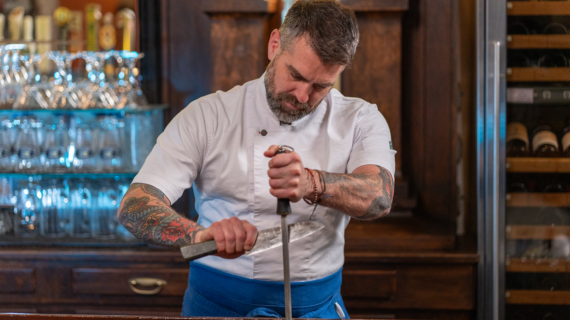
We head to culturally diverse Mid-City and Piece of Meat, a butcher shop that doubles as a restaurant. The bistro, established by butcher Leighann Smith, has become a focal point for the neighborhood and a hangout for fans of the shop's sustainably raised product. The meat-centric specialties of this California transplant earned Piece of Meat a spot on Food & Wine magazine's list of best new restaurants in 2019. -So, this is Italian sausage. We start with a pork shoulder. It's very important that you keep all the fat on. When you do make sausage, you're looking for about an 80/20 ratio of fat to meat. So if you end up using a ham, you add fat or whatever it is. The shoulder seems to work the best for just making sausage. Our first step is we are gonna grind it. For fresh sausage, it's important to use about a 3/16-inch die depending on the type of sausage you want. If you're making andouille or something like that, you usually go for a little bit larger grind -- for smoked sausages and such. For fresh, we do it on 3/16". And now we are going to grind.
Whirring
Queens
So, for our Italian sausage, we use whole and cracked fennel, salt, black pepper, chili flake, and a little bit of cayenne, and that's it. If you want to make it spicier, you can add a little bit more cayenne, add a little bit of chili flake. If you want to make it more mild, you can remove those. The salt-to-meat ratio is the only thing that's incredibly important. While making sausage, it is important to mix the sausage really well. If you're doing it in a mixer, it's somewhere right around probably 1 1/2 to 2 minutes. If you're doing it by hand, it's gonna take just a little bit longer. It's just our version of, like, a mixture of all the Italian sausages that we've ever eaten or tried to make or read about. What makes the nice -- like, a classic Italian flavor would be the chili flake mixing with the fennel and that nice, rich black pepper. It is really important that you keep everything incredibly cold while you're doing it, because otherwise the fat will smear, so your sausage in the casing will actually break. So there's our mixed Italian sausage. The next step is we're gonna load it into our sausage press, and we're gonna pump it into our casings. This is our canister for our sausage pump. I assume the ones elsewhere aren't quite as big. This one holds 30 pounds of sausage. Um...yeah. You're gonna load it in through the top. And the whole way through, you press it down to make sure that there's no air bubbles in there. We sell it in bulk here, and then we have a few restaurants locally in town that use a lot of our product. But we make, I'd say on average, depending on the week, between 300 and 500 pounds of all different sorts of sausages throughout. I don't know how it's not boring yet. I still like doing it. So, for Italian sausage, we use a natural casing. So, now, to make the links, we try to keep most of our sausages in the 6-inch range. And there you have it. So, once the Italian sausage is pumped -- or loose, if you wanted to make meatballs out of it. It's a great use for that, as well. We let it sit in the fridge for about 24 hours for the casing to set up around the meat. Honestly, if you just let it sit in the fridge for like 30 to 45 minutes, that's plenty of time if you're just using it for home use. You can cook the sausage any way. We don't have a grill inside the restaurant, so we cook it in the oven. It works really well at about 375, 400 degrees, depending on your oven, for about 7 to 10 minutes. We make a sandwich, and we call it Steve's Jersey Special because it's a pretty old-school Italian sandwich with peppers and onions. We start with a toasted bun that we get from a local bakery. We load up the inside with your favorite yellow mustard. We prefer one that's loaded with horseradish. And then you slide down a couple of pieces of provolone cheese. You're looking for the bread to be warm enough so that your cheese kind of melts and your sausage will be nice and warm, as well. So, once you have your sausage in a bun, you're just gonna scoop on these nice peppers and onions. It's just butter, whatever bell peppers you have around, and white onions. And this is our Steve's Jersey Special, our sausage sandwich. -Located in Downtown New Orleans, Gianna is a stylish dining establishment named for the Italian grandmother of Chef Rebecca Wilcomb. The restaurant's food pays homage to the chef's culinary heritage in the Veneto region of Northern Italy. But the menu casts a wider net on Italian food traditions and flavors. So, now we're gonna be making the ragu. It is a meat-based sauce. This one has several kinds of meat. It has guanciale, which is cured pork jowl, which we cure in house. It is also gonna have some beef chuck and some chicken livers. We serve it with our baked lasagnette, which is a free-form lasagna, but you can serve it with anything -- pappardelle, rigatoni, any kind of pasta you want. So, guanciale is very, very fatty, which is great because this is what we end up cooking everything in. Instead of starting with a lot of olive oil, we render this and start with the guanciale fat, and that's what we cook the beef in and the veggies. So it really adds a great kind of depth and layer of flavor that you can't otherwise achieve with just another kind of fat like olive oil. So we're gonna cut these into pretty large chunks. Since it does cook for three hours, we want to cut them in large chunks so that they still have a presence at the end when the ragu is finished. So, my grandmother lives in Southern Veneto, which is right on the border of Emilia-Romagna. Not too far from Bologna. Maybe just over an hour drive. So she makes a more traditional kind of bolognese -- kind of a more traditional ragu from Bologna, which is primarily beef, ground beef, and still with the mirepoix, the veggies. This one is a little bit more rustico. So it's a meat sauce that simmers for about -- Again, depending on the kind of meat that we put in it, it simmers for about 3 hours. It's really aromatic and flavorful and deep and rich. So we're gonna start out with some olive oil in the pot. For cooking, we use this 51/49 blend of extra virgin and canola. Gonna start out with a pretty hot pot so we can render the guanciale.
Sizzling
Queens
A lot of the fat has rendered off. We're using chuck because it has a lot of nice intramuscular fat, but then it also lends itself to long cooking times, takes a while to break down. And when it does, it's really soft and unctuous and tender, and it's really great. But it's still really beefy and rich. We're just gonna season it with salt and pepper. You want to season it fairly liberally. Not too, too heavy. The guanciale is a really salty product and will add a lot of salt to the dish, so we hold back a little bit. We have a little more control at the end. All right. So, now I'm gonna remove all the guanciale now that it's rendered and golden... a little crisp on the outside. I remove it with a slotted spoon so we can leave all that delicious fat in there to cook the meat and the veggies in. All right. Now we're gonna add the meat to the dish. And now we're just browning it on all sides. Helps develop some of those layers of flavor. So, once your meat is a little brown, you're gonna add your veggies. I'm just adding mirepoix here. So carrots, celery, onion. Surprisingly, there's no garlic in this recipe. So, the water from all of the veggies will help lift up any little bits that are stuck to the bottom of the pan to help, again, create more layers of flavor. And these are just nice and small-diced, so they cook quickly and evenly. Right now we're serving it with lasagnette, which is a free-form lasagna, with a spinach pasta sheet. So pasta verde. A little bit of fontina bchamel. And the ragu. And then Parmesan. And we bake it in a wood-burning oven. So...very homey and satisfying. So, now that the veggies are nice and soft, we're gonna go ahead and add our tomato paste. A lot of ragus you see will have, you know, milled, canned tomatoes or jarred tomatoes. But we just use a little bit of tomato paste here for a little bit of acid and a little bit of that kind of background tomato flavor. So, once the tomato paste is toasted off, we add our bay leaves and chili flake. Um... Bay is actually the only herb in this recipe. This one calls for 10 bay leaves. You can use fresh or dried. If you use fresh, you want to pull back a little bit. Maybe just add 8 rather than 10. And chili flake, you can add to your taste. We're gonna add the chicken livers. They're just chicken livers that are chopped. All right. This is when I turn the temperature down just a little bit. We'll start the process of going low and slow so it all kind of marries together and cooks together... until you have a deep, rich ragu. I'm gonna add the guanciale back. And we're gonna add some white wine. I like to use a good, dry Italian white wine. I think it's really important to use, when you're cooking with wine, that you're using a wine that you would also drink. About half a bottle. Then once this cooks for a little while and the alcohol starts cooking out of the wine, I'm gonna add just a little bit of chicken stock to keep it nice and moist. Not wet. You never want it simmering away. You want to add just enough so that it's not sticking to the bottom. And, that way, you're just continuing to concentrate the flavors. So, at this point, we're gonna put in just enough stock so that it has some moisture. And then we'll cover it and let it cook for several hours... adding stock as needed. Stirring it once in a while. And keeping it really, really low, cooking it really slow. And that's it. With just a little pasta. And a little Parmesan. This is a rigatoni that we make in-house. We use this really great durum, freshly milled durum, that gives it a really deep flavor and really nice structure. I'm just gonna add a little bit of stock just to loosen it up. You don't want it to be too wet. You want to just coat the noodles. Kind of like dressing lettuce for a salad. Then you top with Parmesan. And that's it. Pasta al ragu. -Our final stop takes us back to Mid-City, which straddles historic Canal Street. On the thoroughfare's red Streetcar Line, Caf Minh features a creative blend of Vietnamese, French, and New Orleans fare prepared by Chef Cynthia VuTran. After escaping Vietnam in 1979, she settled in New Orleans East and began working in restaurants to help support her family. Chef Cynthia furthered her lifelong love of cooking as a graduate of the Johnson & Wales Culinary program, opening Caf Minh in 2007. -Okay. Today, I'm preparing for you a caramel pork belly. In Vietnam, we call it thit kou. And we eat this almost every day. And I love this. This is one of my favorite dish. We have a pork belly here, so I'm just gonna show it to you how the pork belly look like. This is a good piece of meat right here. You see a layer of fat, meat, a little bit fat, and then meat, and a little bit fat, and then the skin. See how beautiful they look? And so all you have to do is buy the meat and go home and wash it with salt, cold water, and a little bit of vinegar. So it'll take out all that smell that's been sitting there, you know? So, you wash it really good, and then you cut it about half an inch thick. See that? Half an inch thick. And then you cut it again in small pieces, like a bite size, you know? But then when you cook them, they're gonna shrink a little bit. Okay. After you finish cutting the meat, just put it in the bowl. And in the bowl, you're gonna marinate the meat with soy sauce, fish sauce, brown sugar, black pepper, and a little bit of salt. So, you just mix them all up. Let it sit for 10 minute or 15 minute while you're making your caramel, which I will show you in a second. Okay. And let it sit. Dancing together in the bowl. So, soon, your -- your pork marinade. Just let it sit there. They not go anywhere, so don't worry. And then your pan, heat up the pan. Not too hot. Okay? You put in your little oil. I got, once again, canola oil. Don't do olive oil. Olive oil is too much high heat. So you don't want to put olive oil in there. It will burn your sugar so fast. You don't want to do that. So, you got your brown sugar. If you have a chopstick, using chopstick to make this is fun. So, you just kind of stir it up. We're making a caramel sauce right now. So, the heat is low heat. Not high heat, okay? You can use brown sugar or white sugar, granulated sugar, but brown sugar is better. I like the sweetness of it. You know, it's not too strong like a regular sugar, I would say, but personal preference. But brown sugar, it help you caramelize faster. At home, we would cook a pork belly like thit kou, and then we'd have, like, a steamed vegetable or boiled vegetable, any kind of vegetable, and then you have a rice. So you have steamed vegetable, and then you have a thit kou. Thit kou have a little spicy, some salt, and then spice, and then sweet. So it's go all together. If I invited you to my house, if you wanted, like, regular, like, typical Vietnamese dinner, that's what you're gonna see. Like, thit kou, steamed vegetable, and jasmine rice. So, now you see how your sugar getting a little bit brown? But be careful at this stage. You don't want to put on over the heat. It could burn really fast. Okay? So get a little bit longer. See that? See that color? Okay. Now you're ready to put your pork in there. Because of the sugar in here and oil, when you put this in, it's gonna flash. So be careful. Don't stand in too close, okay? Well, at home, if you cook it on the stove, you have to make sure that you plan to clean after. After this, it's gonna flash all over the place. But it wasn't. It's very good. See how the sugar is sticking on the chopstick? But it's okay. Don't worry. It will slowly come down, and it melt it, and it go into your meat. At this time, you can smell it. You can smell the fish sauce, the soy sauce, and the black peppers that was in there. This is fun. You just stand there and stir and stir. You know? I mean, you may get your kids involved. Work their arm. You know? Like us. We work our arm every day. So we don't have to go to the gym. Oh, no! We do have to go to the gym after you eat this. Just kidding. You see how the sauce is slowly soaking in your meat? See it a little bit thick right there? Yeah. Like a syrup. Almost there. You're almost there. Before -- Make sure you have a pot of hot water, too, because you're gonna add hot water to this dish, to this thit kou, and you're gonna simmer it down for another 15, 20 minutes to get it tender. See how beautiful it looks right now? See? Mmm. I can smell it. I wish you can, too. But you will. If you cook this, you're gonna smell what I'm smelling right now. This is what we call cooked with love. And I have a hot water ready. So I just pour in here. See? Ahh. See how that bubbles? So, you got your hot water in there, and it come back to boil again, see? It's already boiling, simmering. So, you simmer for 15 to 20 minutes depending on how thick the meat cut. When I grow up in New Orleans East, and then I see all these people bringing the fresh seafood that they caught the night before, bring to the market. And I just look at. I said, "Oh, my God. This is so beautiful. You know, what I'm gonna do with this?" You know, at that time I was young, you know. Didn't any better, you know? So, I didn't know that I'm gonna be cooking for a living. So, soon I find out that I love cooking. Oh, my goodness. My dad is a fisherman. So every time he came back, you know, from the big boat, you know, we'd have all these, like, red snapper. We don't know that was the American red snapper. We just know that's the red snapper, because the fish is so red, we called it red snapper! But we don't have a word "American red snapper" until we came to the United States. They say, "American red snapper." I say, "Really?" We call that "ca hong" in Vietnam. We call it "ca hong." So we got the call of the fish. And then we have, like, pompano... All kind of seafood that you can think of. So, I grow up with seafood a lot, so I love seafood. This is the finished product within 15 to 20 minute. You can see how the meat getting smaller because it shrink. And the caramel sauce right there. Okay? This is how it looks like when you're done. And now we're gonna get ready to plate. It go good with cucumber, also. So, cucumber, rice, and thit kou together? You're gonna have fun. So, here we have some rice ready. And we're just gonna scoop this around it. You can make it look pretty like this, too, at home. Pretend that you are at the restaurant and cooking for all the chef. Ooh, that'd be nice, huh? So, we just do like this. Like that. A little bit of sauce. Dribble a little bit of sauce on it. There it go. Fresh black pepper. Okay? So, this dish, you're gonna taste salty, peppery, and a little bit of sweet aftertaste. Bon apptit. -Thank you for joining this dining tour spotlighting women who are changing the culinary landscape of the Crescent City. See you next time for more inspirational chefs on "Kitchen New Orleans." You can find recipes for all of the dishes in this series, chef profiles, plus more information about "Kitchen New Orleans" by visiting wyes.org. Like and follow WYESTV on Facebook and Instagram. -Funding for "Kitchen New Orleans" was provided by...










 Passport














Follow Us