







PBS Wisconsin Passport
Watch this video with
PBS Wisconsin Passport
Become a member of PBS Wisconsin, support your local community, and get extended access to PBS shows, films, and specials, like this one.
The Long Way Home
03/01/16 | 52m 40s | Rating: TV-PG
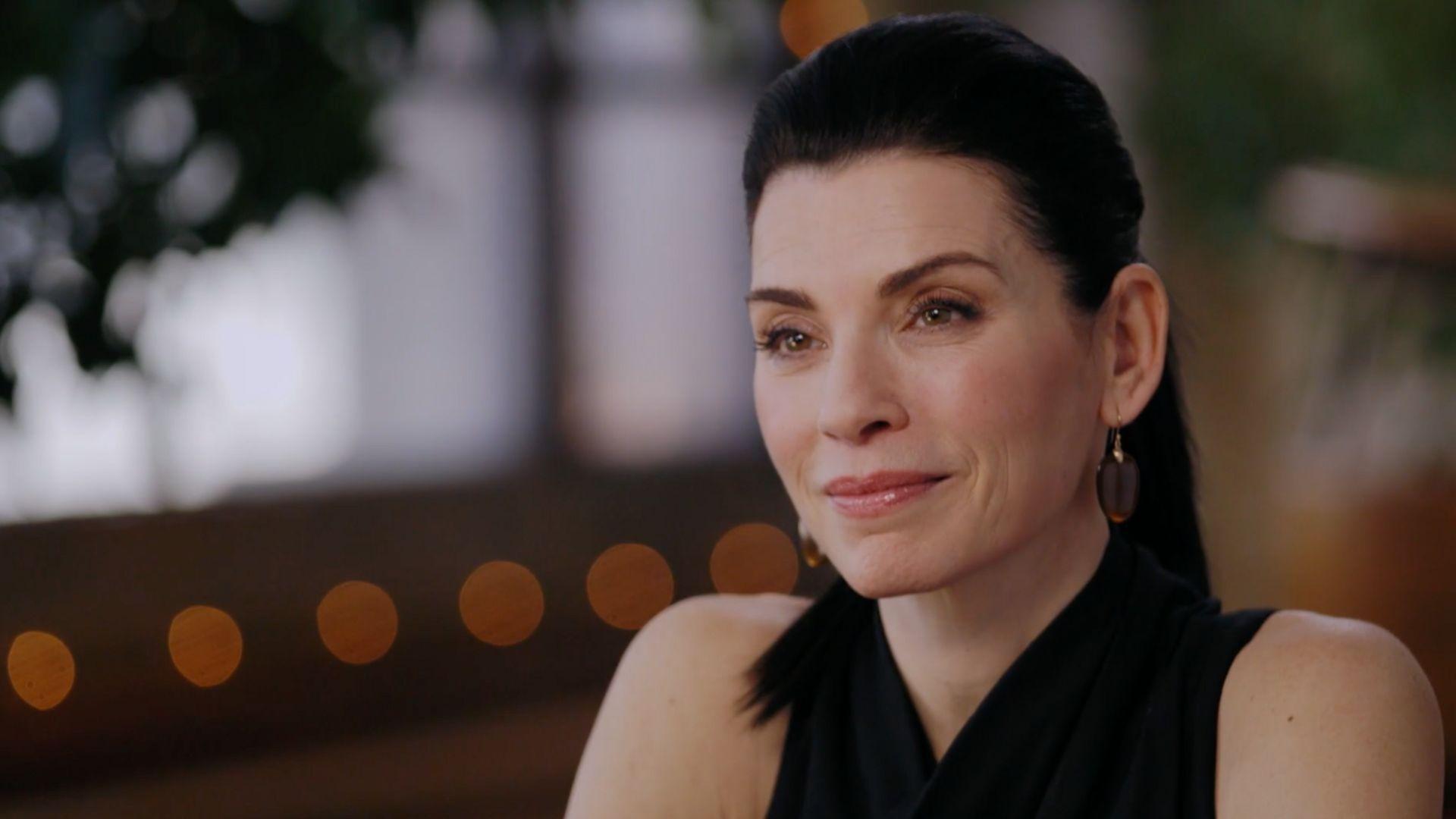
Discover how actress Julianna Margulies, author Azar Nafisi and chef Lidia Bastianich are bound together by their ancestors’ singular and deeply human desire to preserve their most cherished traditions.


Copy and Paste the Following Code to Embed this Video:
The Long Way Home
I'm Henry Louis Gates Jr. Welcome to "Finding Your Roots." In this episode, we'll explore the family trees of actress Julianna Margulies...
Woman
Julianna!Julianna! chef Lidia Bastianich, and writer Azar Nafisi, 3 women from diverse backgrounds, who share something profound-- ancestors who were willing to sacrifice everything in order to preserve their heritage.
Margulies
Being Jewish, um, I feel like I am one of the people, my people.
Nafisi
The worst thing that they do to you is not just kill you. They kill you when they ask you not to be yourself.
Bastianich
I cannot help but think of myself as a refugee. I just wanted to belong and be secure someplace. It's a story of survival, of people who tenaciously held fast to their traditions no matter the risk. To tell it, we've used every tool available. Genealogists helped map out our guests' ancestors, tracing the paper trail they left behind, while geneticists have drawn on the latest advances in DNA analysis to reveal secrets hundreds of years old, and we've compiled everything into a book of life, a record of all of our discoveries.
Margulies
I can't believe you found this. Wow. I can die happy now.
Bastianich
Aah!Amazing. I was so happy and so proud.
Nafisi
My God! You're bringing back-- oh, Jesus. Though Julianna, Lidia, and Azar come from vastly different parts of the world, they're about to see that their ancestors are linked by a singular and deeply human desire, the desire to preserve their culture.
Woman
Julianna, right over here!
Different woman
Julianna, Julianna! Smile, sweetheart!
Gates
Julianna Margulies is a superstar. She's achieved critical and commercial success, first in the hit medical drama "ER" and now on one of America's top-rated shows "The Good Wife." Along the way, she's garnered an array of awards, including 3 Emmys, a Golden Globe, and 8 Screen Actors Guild awards, the most ever awarded to any female actor. It's been quite a journey since college, where she was first bit by the acting bug.
Margulies
I got cast as a freshman in a senior play called "In the Boom Boom Room" by David Rabe... Hmm. as a go-go dancer-- Melissa. It was one of the-- a smaller role, and I remember the fir-- opening night, standing in that go-go cage and looking out onstage and having this very strange feeling of "I belong. This is where I belong."Yeah. I was drawn to it. I loved it. I loved everythingabout it.
Gates
The allure of the stage, I discovered, was hardly a surprise. The arts, after all, were in her blood. Her mother Francesca was a ballerina, and her father Paul was a writer, who had a hand in some of Madison Avenue's most successful ad campaigns. Now there's your father Paul. So handsome. He was the creative director for a number of advertising agencies, and he helped create the famous... Plop plop, fizz fizz Oh, what a relief it is Plop plop,fizz fizz Oh, what a relief it is
Yes. Gates
Huge hit. Huge hit. And obviously it's seared into my mind and every other American's... Yeah. of my generation. Did you know that your father was a star in the ad world? I knew peoplerevered him and that he was bigin what he did... Mm-hmm. but we didn't have a TV.Hmm. So I never really knew it until I gotto college, and I remember saying to someone, "Well"-- they said, "What'd your dad--what does your dad do?" I said, "He's in advertising." "Anything I would know?" I said, "Well, you know, plop plop, fizz fizz." Ha ha ha! And the reactions of people-- He was a genius. Yeah. So I always got to see someone who was thinking outside the box... Mm-hmm. And figuring out ways to make life interesting.
Gates
Born in Spring Valley, New York, Julianna spent her early years in Europe, first in Paris and then England. Though she appreciated her cosmopolitan upbringing, Julianna told me that one of the downsides was feeling disconnected both from her extended family and from the Jewish tradition. Not until meeting her future husband did she begin to incorporate Jewish religious rituals into her life.
Margulies
I married a Jewish man and had a--well, you can't call it too traditional of a Jewish wedding because I was 7 months pregnant, but, um, we got married under a chuppah, and I really enjoyed my time with the rabbi, learning all the things that we were gonna be doing within this bond, and, uh--and we're raising our son Jewish, so I feel like I've come back to my Jewish roots through my marriage.
Gates
My next guest is top chef and restaurateur Lidia Bastianich. OK.So... Gates,
voice-over
I met up with her at her popular restaurant Felidia, where she treated me to a classic Italian meal, reminiscent of the kind that graced her family's table every Sunday. Oh, my God. That's great. Yeah? Mmm. Yeah. Gates, Lidia has dedicated her life to celebrating her Italian heritage through food. When Lidia was just 24 years old, she opened her first Italian restaurant Buonavia in Forest Hills, Queens, with her husband Felice.
Bastianich
A little parsley.
Gates
Today, she's the proud owner of a flourishing food and entertainment empire, including 7 restaurants, her own pasta line, and cooking shows broadcast on public television. I know all your secrets. As we talked, I came to understand why food has so much meaning for Lidia. As an immigrant, cooking and eating helped her hold on to her past. Bastianich,
voice-over
Now everybody wantsto keep their individuality, their culturaltraditions, but at the timethat I came, America was a melting pot. You were to become as soon as possible American and be part of this melting pot, and I think my passion for food is kind of staying connectedwith food. That was my kind of umbilical cord. Mm-hmm. It's like burning a candle. It is because the food that you cook, kind of the odors, the smells, brings back the family.
Gates
For Lidia, cooking evokes memories of her childhood in her hometown of Pola on the Istrian Peninsula, especially the cherished moments she spent in the garden with her grandmother Rosario.
Bastianich
We had the chickens, we had the goats, we had pigs, then we had a garden, very seasonal garden. So I was raisedin a setting of really helpingGrandma. It was kind of an idyllic setting... Yeah. of food--was really food connected to the earth, connected to the seasons, and that stayedwith me. Cheers. Chin chin. Salute. Chin chin.
Speaks Italian
Bastianich
It is interesting how our name is changing...
Gates
Like Lidia, best-selling author Azar Nafisi is also an immigrant. She was born in Iran. In 1997, no longer able to endure the repression she faced as a secular woman living in the Islamic Republic of Iran, she and her family left, adopting Washington, D.C., as their new home, but while Azar was fiercely at odds with the politics of the Iranian regime, she hardly recognized her homeland as it was depicted in the media here in the United States.
Nafisi
I was appalled when I came here at the images from Iran. It was only the images of men with turbans, mmm, saying extreme things, and the Iran I had lived even under the most extreme conditions was another Iran. Mm-hmm. And it was an Iran that connected to the world through the best that the world had to offer, which was its work of art, and--and I wanted people to know that we're equal to you because we know you.
Gates
In 2003, she set out to create a more nuanced portrait of Iran. She published "Reading Lolita in Tehran," a memoir that chronicles her experiences during Iran's turbulent cultural revolution. Translated into 32 languages, it spent over 100 weeks on the "New York Times" Best Sellers list and was named one of the 100 best books of the decade by the "Times of London." Its success was an affirmation of Azar's faith in the power of literature to bridge cultural divides, a belief instilled in her at an early age.
Nafisi
The thing that, uh, linked us one to the other in my family was always books. Mm-hmm. From the moment I came into consciousness, my father would tell me stories and not just of Iran. Um, the next day, we'll go to Italy with "Pinocchio"... Oh, great! The next day, we'll go to France with "Little Prince," uh, "Charlotte's Web," so I learned that, uh, there was a universality to the world. Mm-hmm.You know?
Gates
Julianna, Lidia, Azar have each found creative ways to honor the traditions of their ancestors, even as their families have been scattered throughout the globe, but along the way, crucial details about the lives of those ancestors have been lost. Our goal was to recover those details.
Margulies
It is amazing, though, to think this is the street, and I wonder how much of it... Gates,
voice-over
I started with Julianna Margulies. As an adult, Julianna reconnected with her Jewish faith, and her passion for her religious heritage is infectious. Margulies, It's very important to me to keep up the traditions of the Jewish religion, and we are bringing our son up this way, and it's not about religion, but it is about feeling very proud to be a Jew and bringing up my son in a way that he'll always have this heritage as part of who he is.
Gates
To uncover that heritage, we began to work our way up Julianna's family tree. We started with the immigrant ancestors On her father's side, her great grandparents Pincus and Matilda Margulies. Julianna had heard that they were both born in Romania, but she didn't know where, and she had no idea what had drawn them to the United States. We were able to find out. In the Romanian National Archives, we discovered a birth certificate for Pincus and Matilda's son Lazar, which revealed the name of the hometown of the Margulies family. "Born the day before yesterday"-- ha ha--"at 10 A.M.at Braila in his parents' house." Wow! Now that's a photograph of Braila. It's from the 19th century. It was a port city. It's so interesting. It--it looks like Italy to me. Yeah. It looks so beautiful. Braila may have been beautiful, but it wasn't peaceful, at least not for its Jewish population. Throughout the 19th century, nationalist fervor buffeted Romania, fueled in part by anti-Semitism. By 1866, it had reached fever pitch. That year, the Romanian constitution restricted naturalized citizenship to foreigners who were Christian. For families like the Margulies, the message was clear.
Margulies
"Jews are a social plague "that threaten our nationality. Only administrative measures can save us from this calamity." Wow. You know, I mean, I grew up always being very conscious of the persecution of Jews and Hitler and, you know--I mean,but, um... it's just always been, hasn't it? Mm-hmm.
Gates
For Julianna's ancestors, things would only get worse. The Romanian government soon barred Jews from living in certain areas. As a final blow, the government systematically restricted both their civil rights and the jobs they could hold. It was a breaking point. Approximately 75,000 Romanian Jews immigrated to the United States between 1881 and 1914. The Romanian exodus represented roughly 30% of the country's total Jewish population, making it one of the most significant mass migrations of Jewish people in modern history. Among those who fled were Julianna's great grandparents Pincus and Matilda. In the late 1880s, they sailed into New York Harbor, and while we couldn't find a record of their arrival, we did find something that was just as special. Now, Julianna, this is an incredible document. Oh, my God! It's his citizenship application. 1894, Pincus Margulies?Yeah. Look at his gorgeous signature. Very elegant. Have you ever thought of this moment when your immigrant ancestor became an American? You know, I never have.Hmm. I never gave it much thought, and then when you see his signature... Mm-hmm. That's when you feel that it's re--real. You know, that's the only thing I know of him now. Mm-hmm, mm-hmm. He must have felt proud that he could escape and get away and start a new life. Oh, yeah. You know, I mean, I think... it must have been a huge relief. Wow! What a day that must have been. He and his wife, like so many other Jewish immigrants, settled in New York City's Lower East Side. In the early 1900s, it was the epicenter of New York's Jewish community, home to half a million Jewish people. Now, Julianna, this is the 1910 census for New York City. Can you find your great grandparents? So here they are.Mm-hmm. "Pincus Margulies,head." Wow! That is incredible. And this is where they lived. Ohh! Stanton Street. Ha! Really?Yeah. That's not far from where I live now. Ha ha! On Stanton Street, Julianna's great grandfather set about making the most of the kind of opportunities he was denied in his former homeland. Can you tell me what your great grandfather Pincus was doing for a living? This says, "Millinery. Own store." Yeah! He was a hat maker, and he owned his own store by 1910. That's a pretty amazing success story. Oh, my God. Good on you, Pincus. Think how far he had come. He comes to the States... Right. becomes a citizen within a very few years, and a decade or so later... Owns his own business. owns his own business. Wow! As we continued our research, we located an advertisement buried in the archives that helped us understand one of the reasons for Julianna's great grandfather's business success. "P. Margulies, hatter from 40 Delancey Street, "invites all Jews to come see "the fresh holiday stock of latest style hats. Special $1.50 and $2.00 hats that would cost double everywhere else." Now that's a good Jew. Isn't that great? That's a great ad. That's how you sell a product.Yeah. I cannot believe you found that, and it says, "P. Mar"-- oh, I wish my dad was alive to see this. My dad always had such a great sense of humor, and I feel like this is advertising with humor, smarts... Yeah. and class all in one. And you can begin to see some of the role models that shaped him. Yeah. You really do. That's fantastic. Like Julianna's ancestors, Lidia Bastianich came to the United States seeking a better life. She was born in the town of Pola on the eastern shores of the Adriatic Sea on what is known as the Istrian Peninsula. Italian and Slavic people have intermingled here for centuries, and it's been ruled by many different powers over the years. Since the 14th century, Venice, Austria, France, Italy, and Yugoslavia have each spent time controlling Pola. Growing up here gave Lidia a unique perspective on the questionof identity. Lidia, what do you think is the difference between identity and nationality? I think there's a big difference.Mm-hmm. I think that identity is who you ultimately feel you are... Mm-hmm. and how do you relate-- so your identity could be mixed. You know, I certainly feel very Italian, but I do have some Slavic in me... Mm-hmm. And I relate to that, as well, so that forms this mixture that is Lidia. Mm-hmm. Nationality is sometimes just a changing of borders. The curious notion that one's national and cultural identity could be changed literally overnight is a lesson Lidia's family learned firsthand. In September 1939, the Second World War erupted in Europe. At the time, the Istrian Peninsula was part of Italy, which had aligned with Germany in what as known as the Axis Alliance.
Newsreel announcer
April 6, 1941. The German Blitzkrieg strikes at Yugoslavia and Greece. Both countries fall within 17 days.
Gates
To ensure Italian domination of the Slavic majority, Italy's fascist dictator Benito Mussolini brutally subdued the region's Slavic population. Many Slavs were thrown into concentration camps, where thousands died of starvation and disease, buy the Italians would soon pay a heavy price for their actions. In 1943, Slavic partisans seized much of the Istrian Peninsula from the fascists. Now the Slavs were in control, and as the war in Europe raged on, they would kill approximately 5,000 Istrian Italians in what came to be known as the Foibe massacres. The death toll remains a matter of fierce debate. Unmistakable, though, was the toll the massacres took on daily life in Istria. Did your parents ever talk about-- They--they did,they did. It was kind of neighbor againstneighbor. It's a terribleplace to be. Anything that was seen as you aiding the other side, somebody--even a neighbor would take action. There were the partisans, the fascists. Uh, there was all different sections, and all we wanted to be was Istrian. That's what I said everybody say...Right. but, you know, "If you're not with us, you're against us" was the--the thing. You were an enemy. Yeah. It was a scary time. In 1945, the war in Europe finally ended. As one of the terms of peace, 2/3 of Istria was ceded to communist Yugoslavia. Fearing more retaliation, hundreds of thousands of ethnic Italians fled the peninsula for mainland Italy in what was known as the Istrian Exodus. Did your parents ever tell you how they felt at this moment? My--I remember one specific story that my motherwould tell. She said, "The big boat"-- the Toscana was the big boat, and she said all her friends was on the Toscana, and--and she said, "There I was. It was in the wintertime, pregnant and cold," and she says, "Tears pouring down because I was saying good-bye to my friends." Ohh. And it, you know, still moves me. Do you know, Skip, that these people took-- you know, they took their--their--their belongings, their tables,their chairs. They even took the bones of their dead from the cemetery. My God. I didn't know that. Yeah. They took them with them. Now that is uprooting. Italian families like Lidia's that stayed behind suffered under Yugoslavia's communist regime. They were afraid to speak their native language, and the Government's open hostility to the Catholic church made it difficult to practice their Roman Catholic faith. Lidia told me that her family even went so far as to change their surname from the Italian Matticchio to the Slavic Motika in order to downplay their heritage, but these desperate gestures did little to improve their lives. Did you remember hearing parents say, "Look. As soon as we can, we're gonna escape"? There was always this secrecy, you know, the adults talking, uh, that the children wouldn't hear and closing of doors. I thought still being in that kind of communist state of mind, I took it that that's the way they communicated, but I didn't know before we left that we would not come back. After 10 torturous years, her parents decided to flee. Under the guise of visiting a sick aunt, Lidia, her mother, and brother Franco traveled to Trieste, Italy, but Lidia's father could not get a pass to leave, so the only way to join his family was to sneak across the border. It was a risky venture that could easily have cost him his life. My father walked, which is about a 3-kilometer walk, from the border to the centerof Trieste. He walked. My God. That's amazing. Yeah. He had, um, this--this guide bring him up, and the guide said, "Now you go up that border, and you cross over," and just left him, and he tells the story-- when he came on the other side of the--of the hill, you see Trieste and, uh, the whole cityin front of you, and he looked at it, and he felt so relieved. One morning,
it was about 2
00
or 3
00, we were all sleeping, and, uh, we hearda knock, and there was my father, and everybody was crying. Oh, it was so moving.
Gates
Once in Italy, Lidia's family immediately applied for asylum. "The children Franco and Lidia Giuliana came "to Trieste from Pola on January 23, 1958, "with regular Yugoslav passports. "The documents were handed immediately "to police headquartersin Trieste "and in so doing granted the aforementionedchildren with political asylum." Have you ever seen that document before? No. I have never-- I have never seen it.Amazing. It's from your father's application for Italian citizenship. Can I ask you what its like to see your name and Franco's name on that document? It's very--it's--it's moving, it's, um-- you know, through these times, there was such a definite division. Oh, yeah. You know, that border really meant a division, and, uh, to kind of have been taken from one and given asylum in another, in Italian, it's--it's a relief, it's a welcome in a sense, and then we were there unified as a familyin Italy. Like Lidia, renowned author Azar Nafisi knows what it means to have to straddle two worlds, and as an immigrant who came to the United States well into her adulthood, she doesn't have a simple answer when it comes to the question of her identity. Where do you consider home? When someone says, "Azar, where is home?" where is home? Well, physically, there is Iran. I mean, the country of your birth, like your first love, even when you leave it, will come with you, and, um, then there's America. I have lived almost as many years in America as I have in Iran now, but I have a portable home that I always take with me, and that is literature and, uh, memories. Mm-hmm. Uh, that is where I feel at home, in my republic of imagination, truly. Given Azar's complicated feelings about her homeland, I was astonished to discover how significant a role both her parents had in shaping modern Iranian history. Her father Ahmad Nafisi was appointed mayor of Tehran in 1962. At the age of 43, he was at the time the youngest person ever to hold that office. Just one year later, her mother Nezhat became one of the first women ever elected to the Iranian parliament. Azar told me that her parents had entertained dignitaries from all over the world-- Charles de Gaulle, Leonid Brezhnev, the queen of Holland, the king of Denmark-- but even Azar was stunned by a letter of thanks we uncovered from one important visitor. Oh! That's a copy of the letter that your father received on August 25, 1962. "Dear
Mr. Mayor
"My wife and I would like to express our appreciation "for your great kindness in traveling personally to the airport to great us." What did they expect? Yeah. Ha ha ha! "Sincerely yours, Lyndon B. Johnson." Oh, my God! I--I don't know where you got this from. I've never seen this.
Gates
Azar's father was also a favorite of Iran's monarch Mohammad Reza Shah Pahlavi, but his good standing was short-lived. His popularity as mayor and his swift rise to prominence threatened other political players in Iran and made enemies. Less than two years into his term, the state police arrested him, creating a situation that would become international news. Now this article's from the "Washington Post,"July 1966. "The most notorious case at the moment "is the 32 month imprisonment without trial "of the former Lord Mayor of Tehran, Ahmed Nafisi. "The case smells of a frame-up "by his personal and political enemies. Nafisi may remain in jail for years without trial." The "Washington Post" speculation was not far off. Nafisi would spend nearly 3 years in prison before the high court finally overturned the trumped-up charges.
Nafisi
When he was freed finally, there was such a crowd outside. I mean, the people of Tehran, the media, I mean, people you never expected... Hmm. showed their love. Uh, I--I was very-- now that I think of it, I'm touched. At that time, I was just bitter.
Gates
Azar's father would never return to political office again. Meanwhile, the Shah's power and his regime's corruption grew exponentially. Then in 1978 to the world's great shock, the streets of Iran erupted in revolution.
Shouting
Boom
Whistle blowing
Gates
Over the course of one year, the Shah abdicated his throne, and Iran became an Islamic republic, electing the hard-line religious cleric Ayatollah Khomeini as their supreme leader. A young literature professor at the University of Tehran, Azar had no choice but to conform to the Ayatollah's new religious mandates.
Nafisi
At that time, universities were the center of turmoil, and of course, the targets were humanities, and those were the worst times. Mm-hmm. There were times when so many friends and relatives were hiding, uh, in our homes, being executed. Mmm. They killed a lot of former students actually. Um, I stopped going. I--I just couldn't, and so they expelled me, and I never went back to University of Tehran again.
Gates
Azar was terrified, but she refused to remain passive. In March of 1981, the "Monthly Review," an American magazine, published an article called "The Women's Struggle in Iran." "Many women," the article bluntly stated, "have been threatened, dismissed from their jobs, even beaten and stabbed on the streets." Signed only by the letters AZ, Azar's piece was a powerful indictment of the Islamic regime. Did you think that this could build up support for toppling this new regime perhaps? I thought there would be pressure on this regime, and I felt that the more the world supports the democratic voices in any country, the more both those forces become empowered and the regimes feel weak and have to give up. For the next 16 years, Azar and her family continued to live in Iran, refusing to abandon their country, but for Azar, the personal cost eventually took its toll.
Nafisi
It reached a point where not only was I ashamed of the way I was complying as a woman, it was taking over my whole person. If I couldn't write the way I wanted, and if I couldn't teach the way I wanted, and my children-- I wanted them to have the same choices my husband and I had... Mm-hmm. because the worst thing that they do to you is not just kill you. They kill you when they ask you not to be yourself. Mm-hmm. Uh, and, um, we left.
Gates
Each of my guests had now shared stories of the sacrifices their families had made to preserve their beliefs and traditions. Now I wanted to take them back further in time, closer to where those traditions began, to the most distant ancestors on their family trees whom we can name. For Julianna Margulies, we started by looking at her great grandfather Pincus Margulies' death certificate. It was a treasure trove, as it listed the names of his parents, Julianna's great-great grandparents, Abraham Margulies and Bela Riker. For Julianna, it also raised an interesting question about the origins of her last name.
Margulies
What's amazing to me is that his father is still Margulies, and it's still spelt the same way. Why does that surprise you? I had heard that the Margulieses were originally Margarita or something Spanish and they were Sephardic Jews that le--that got kicked out of Spain. We're always getting kicked out of everywhere. That's true. And we--our clan went to Eastern Europe.Right. So I think to see my great grandfather Pincus' father still with the name Margulies... Mm-hmm. it's my name. It's your name. Right. Still.
Gates
Julianna's story was intriguing, but as we've discovered with many of our guests, family lore is sometimes more like a game of telephone than a source of reliable genealogy, so we consulted with Jewish scholars, who told us something remarkable. They were able to trace the Margulies name all the way back to the 1500s to a man whom they believe is Julianna's ancestor-- Jacob Margolioth, the rabbi of a synagogue in Ratisbon, Bavaria. So that means that the name has stayed fundamentally the same for 500 years. Wow! I can't believe it dates back all those years. Yeah. Heavy Jewish roots. Yeah. I better get back to it.
Both laugh
Gates
We were amazed at how far back we were able to trace Julianna's family tree on her father's side. Now we wanted to see what we might uncover about her mother's side of her family tree. We began by looking at Julianna's great grandmother Ida Ginsberg. Julianna had told us an unusual story about how Ida had made her way to the United States.
Margulies
I know that my Great Grandma Ida come over from Russia on a ship... Mm-hmm. that was, like, the size of the Titanic and hit an iceberg.Mmm. And the story my Great Grandma Ida told me was that her mother Rebecca took her and threw her over the sideof the boat and then jumped inafter her because they weren't taking any more people in the lifeboats. Now you believe that? That's the same place as that Margarita story. Is that the same thing? Was she lying? Heh heh heh!
Gates
We set out to see whether this family story would hold up under closer scrutiny. A marriage record revealed that Julianna's great grandmother Ida Ginsberg was, in fact, born in Russia. Like many Russian Jews, Ida's family sought a better life in America, but they didn't all come at once. Passenger records show that Ida's father, Julianna's great-great grandfather, and her older sister landed at Ellis Island on July 1, 1903. A year later, on June 22, 1904, Ida and her mother boarded the SS Norge and set sail to reunite with the rest of their family. It would be a fateful voyage. 6 days into the journey, the Norge crashed into a reef off the coast of Scotland. The ship sank in about 20 minutes. Of the 700 or so passengers on board, fewer than 200 were lucky enough to scramble into lifeboats. Julianna's ancestors were among them, but as a firsthand account from a survivor makes clear, they were far from being out of harm's way.
Margulies
"3 times the sea washed over the small boat's stern "and completely covered me. "But I held on to the rope "or all would have drowned. "Some fellows tried to climb into the boat, but I knocked them away because we had too many already."
Inhales
Margulies
Wow. Oh, my God. Your ancestors were on an overcrowded lifeboat with almost no food or water. She told me they gave her a--a handkerchief,3 drops. They would go around like that to give people... Amazing. from a handkerchief for water. That's amazing. And she used to tell me that she remembered waking up to warm milk, and they were on a Scottish boat that had come and saved them.Mm-hmm. She just always described--she had this beautiful accent-- that "varm milk," that she couldn't bel-- she thought she had gone to heaven because she wasn't sure...Yeah. if she was alive.
Gates
Finally on July 3 after 6 days in the lifeboat on the open sea, Julianna's ancestors were rescued. Unbelievably, we found an account of the ordeal written by the man who had piloted them to safety. His testimony verified Julianna's great grandmother's recollections almost verbatim.
Margulies
"We saw a big steamer coming. "We hoisted the red flag, "and she came down at once to us. "They took us allon board and treated us very kindly."
Sighs
Choked up
Margulies
"They gave the children milk, and we got wine and hot rum." That's so sad. It's sad, and the fact that she remembered that milk. She always used to talk about the warm milk so they could warm them up. OK. Ha! It's a really incredible story. You know how rare it is that-- there are so many family stories, right, but to have an actual eyewitness, not even just somebody who was on the boat but on the damn lifeboat with your great grandmother. Yeah. Wow! That's--there it is in writing. There it is. You know, you tell a story your whole life... Yeah. and you wonder-- but it's just how she said it. It was absolutely the way it happened. Uh, it's unbelievable. That's a tough way to make it to America.
Gates
Like Julianna, Lidia Bastianich wanted to know about her deep roots. We had already learned how much her family had endured during the tumult of World War II. Now we wanted to travel further up the branches of her family tree, so we dived into the Italian Archives, where we found a record that revealed an unexpected fact about Lidia's family's last name. Lidia told us that her family had changed their name From Matticchio to Motika after the Istrian Peninsula was ceded to Yugoslavia by Italy in 1947, but according to a record dating back to the 1930s, Lidia's family was using a variation of the name Motika even earlier.
Bastianich
"Vittorio Matticchio, nee Motika, son of Antonio and Francesca Lovrecich." As you can see, your father was Motika before he was called Matticchio, so we wanted to see why your family was using the name before the war...OK. as well as after the war. Oh. I want to know, too!Ha ha ha!
Gates
To resolve the mystery, we had to look back to the history of Lidia's homeland in the early 1900s. At that time, the Istrian Peninsula was part of the Austro-Hungarian empire, and though it was home to ethnic Italians, they were by no means the majority, so it was not surprising that Lidia's family was using the Slavic surname Motika, but that was about to change.
Explosions
Gates
In 1914, Europe was engulfed in the First World War. The Austro-Hungarian Empire was allied with Germany and at war with Italy, a war the Austro-Hungarians would lose. In the peace treaties that followed, the Istrian Peninsula became part of Italy. With the stroke of a pen, Lidia's family saw its nationality transformed. They were suddenly and officially Italians, and the difference was very important to one particularly ambitious, up-and-coming Italian politician. This is an excerpt from a speech that Benito Mussolini gave when he visited Pola on September 20, 1920. "When dealing with a race suchas Slavic, "inferior and barbaric, "we must not pursue the carrot but the stick policy." Two years later, Benito Mussolini was named prime minister. Then in 1925, he declared himself dictator for life. For non-Italian Istrians, especially those of Slavic origin, his rule had devastating consequences. "It's vehemently prohibited to sing "or speak in Slavic in public areas "or in the streets. "Also in shops of any kind. "Only Italian must be used. "We Squadristi will use persuasive measures to uphold this rule." And the Squadristi of course are the goons... Exactly. who coerce the population to follow the new fascist rules. Oh, you now, it just continues. Mm-hmm. It's pressuring one culture to become what they're not, and it's just-- it doesn't make sense. In 1926, Mussolini's regime decried that all Slavic surnames had to be Italianized. Although Lidia's grandfather Antonio was Roman Catholic and spoke Italian, his last name Motika was Slavic-sounding, and so it was changed. "The last name of Mr. Motika Antonio, "is returned for all purposes of the law "in the form of Italian Matticchio. "With this determination, his surname is to become Italian." Ahh! Heh heh. Isn't that amazing? Wow! That's the official changeof the name. That--that is it. November 11, 1930, your family changed its name from Motika to Matticchio due to political repression. You know what? This is my reality. This is the reality of being a border and of time passing and of history doing its course. Mm-hmm. It just proves that I am much more of those--those-- rather than stationary, uh, culture, mine was a crossroads, so a lot of people... Absolutely. came and went, and I was part of that flow or transition, which makes that areaso volatile through the--through the ages. Now it was time to trace Azar's genealogy as far back as we could. We started with her third great grandfather, a man named Mohammad Kouhbanani. Mohammed lived in Iran's Kerman Province during the late 18th century. Azar had never heard of this ancestor, but the inscription on his tomb led to a thrilling discovery.
Nafisi
"Undoubtedly, he was the origin of intellect. "Certainly, he was the spring of knowledge. "On Sunday, Mid-Sha'aban, his body became separated from his spirit. "He martyred by the sword of anguish on the way to Mashhad to resolve forsooth." That is a Sufi poem written in honor of your third great grandfather... Oh, my God. and we discovered that eh was a Sufi himself. That--that is really something.
Gates
An Islamic doctrine that began to emerge in the Middle East around the ninth century, Sufism is a mystical dimension of Islam. The Sufi are renowned for their poetry and have authored some of Iran's most significant works of literature, and it turned out that Azar had not one but eminent Sufis in her family line. The second was a man named Muzaffar Ali Shah. We found a poem of his dating back to the late 1700s. This is so typical the way they loved to play with the ideas and the words. Isn't beautiful. Muzaffar Ali Shah. He was Sufi, and guess what. He is your fourth great granduncle. He is your relative, and he was a very popular Sufi poet. That I had no bloody idea. That is amazing to me. Azar told me that she adores the Sufi poets and had no idea that any of her ancestors had played a role in this revered tradition, nor what it would cost them. In the late 18th century, the renewed popularity of Sufism aroused the hostility of Shi'ah clerics. They waged violent campaigns against the Sufis, condemning their mystical practices as deviations from true Islam. Azar's fourth great granduncle Muzaffar Ali Shah found himself caught up in the struggle. The popularity of his poems angered an influential member of the Shi'ah clergy, a man named Aga Mohammed Ali, and Muzaffar would pay the highest price for his religious convictions. "Muzaffar Ali saw a lot of cruelty "from the religious authorities "and the scholars of his time. "He said good-bye to this mortal world "with a poison that was given to him by Aga Mohammed Ali." Oh! Does it changethe way... Wow! you think about yourself or that you think about your ancestors? I--I feel that if I were to write my book, my memoir, I would not start where I started. Why do you think your family placed such an emphasis on the written word? There's this amazing, um, collection of books left in a small city in Slovakia called "The Last Folio," where the Jews had been all killed, and on one of those books, uh, there's the word "Hanishar," which means "all that remains." Aha. And I think that, um, this is what they--they did. I think at some point it started for some other reason, for an intellectual curiosity, uh, you know, for something in their genes, and then as it was passed on, that is all that remains. Yeah. All that remains is--is this. We had reached the end of the paper trail for all 3 of our guests. Now it was time to see what DNA analysis could tell us about their more distant past. Genetic genealogy allows us to look back centuries and discover even deeper origins than we can using a paper trail. For Azar Nafisi and Julianna Margulies, our tests echoed what we'd already learned and happily confirmed their cherished family roots. 94.3% Middle Eastern. I'm Super Jew. I'm 96.3% Ashkenazi. Unlike Julianna and Azar, Lidia Bastianich's DNA was far less homogenous, defying traditional notions of genetic or national purity, reflecting the complex history of the various people of the Istrian Peninsula. 63 Eastern Europe... Mm-hmm. 28% Italy and Greece, 6% Europe West. So you are culturally and ethnically Italian, but you also share DNA with many people who today would call themselves Croats... Yes.and Slovenes. Yes, yeah. So what do youthink of that? It gives mea great insight, sort of a finishto the picture of who my familyreally is, especially my areaback and forth, so this--this answered a lot of those questions for me, and, uh, you know, I always say I'm Italian because that's what we do at home. Mm-hmm. I judge by what do I speak with my mother. I speak Italian, so we're Italian...Right. but I think that this is a messagereally for-- very contemporarymessage, and that is that, you know, we're not so different. We're not these different clans, but we're rather part of each other. That's beautifully put. I couldn't agree more. Thank you so much for allowing me to introduce you to your ancestors. Oh. Grazie! Prego. Gates,
voice-over
That's the end of my journey into the family stories of Julianna, Lidia, and Azar. Join me next time when we unlock the secrets of the past for 3 new guests on another episode of "Finding Your Roots."
Announcer
To learn about "Finding Your Roots," visit PBS.org/FindingYourRoots and join the conversation on Twitter at #FindingYourRoots. "Finding Your Roots" Season 3 is availableon DVD. To order, visitshopPBS.org or call1-800-PLAY-PBS. "Finding Your Roots"Season 3 is also available for download in iTunes.
Search Episodes
Related Stories from PBS Wisconsin's Blog


Donate to sign up. Activate and sign in to Passport. It's that easy to help PBS Wisconsin serve your community through media that educates, inspires, and entertains.
Make your membership gift today
Only for new users: Activate Passport using your code or email address
Already a member?
Look up my account
Need some help? Go to FAQ or visit PBS Passport Help
Need help accessing PBS Wisconsin anywhere?

Online Access | Platform & Device Access | Cable or Satellite Access | Over-The-Air Access
Visit Access Guide
Need help accessing PBS Wisconsin anywhere?
Visit Our
Live TV Access Guide
Online AccessPlatform & Device Access
Cable or Satellite Access
Over-The-Air Access
Visit Access Guide




Follow Us