

 Passport



Grace Lee - "Janeane From Des Moines"
07/10/14 | 26m 48s | Rating: TV-G
A conservative Iowa housewife’s personal and political convictions are severely tested as she seeks answers from the Republican presidential candidates leading up to the 2012 Iowa Caucuses in the mockumentary.


Copy and Paste the Following Code to Embed this Video:
Grace Lee | Director, Co-Producer, Co-Writer
Grace Lee’s most recent documentary film is AMERICAN REVOLUTIONARY: THE EVOLUTION OF GRACE LEE BOGGS which will be broadcast nationally on PBS’ POV on June 30, 2014. Prior to that, she produced and directed JANEANE FROM DES MOINES (Toronto FF 2012) set during the 2012 Iowa caucuses. Prior to that, she wrote and directed AMERICAN ZOMBIE, which premiered at Slamdance and SXSW before being released by Cinema Libre. She also produced and directed THE GRACE LEE PROJECT, a feature documentary that was broadcast on Sundance Channel and is distributed by Women Make Movies. Grace received her MFA in Directing from UCLA Film School, where her thesis film BARRIER DEVICE, won a Student Academy Award and Directors Guild of America award. She is the recipient of the Henry Hampton Award for Excellence in Digital Media, a Rockefeller Media Arts grant as well as funding from the Center for Asian American Media, Chicken and Egg Pictures and the Ford Foundation. She is currently producing and directing a documentary for PBS’ MAKERS series on women in politics.
Related Links for this Video:
Grace Lee - "Janeane From Des Moines"
We wanted to know more about the man who headed in tonight with that razor-thin lead, and that's Governor Mitt Romney. ABC's anchor, David Muir, has been with him all day today. David. I wanted to show you a moment here earlier today, a supporter approaching Romney, saying, if you are elected, if you're sent to Washington, you've got to do something about the jobs.
She doesn't have one, her husband does not have one, and neither of them have healthcare. Here's what she said to the former governor. Please, if you win, if you go on to Washington DC, just save the small families of America. We're just falling apart.
So moving to listen to that woman. Hi, welcome to Director's Cut. I'm Pete Schwaba. And that was a clip from Janeane From Des Moines, a story about a woman whose beliefs are tested as she tries to decide which candidate to support during the 2012 Iowa Republican caucuses.
We're joined today by the film's director and co-writer, Grace Lee. Grace, welcome to Director's Cut. Thanks for having me. Good to have you.
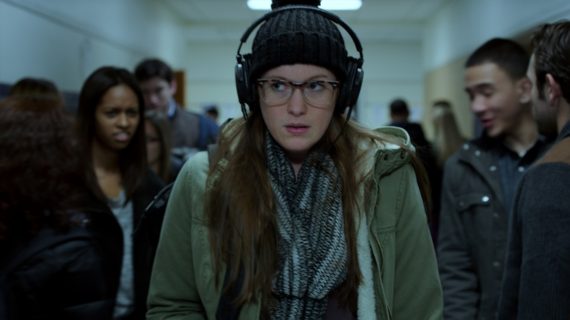
Tell us a little bit about what's going on in that clip right there. Well, the character in the film, Janeane Wilson, is a housewife who lives in Des Moines who is, essentially, a Tea Party patriot. She's very conservative. She is sort of searching for a candidate during the 2012 Iowa caucuses to support so she could take our country back from Barack Obama.
Okay. Usually in our open I say whether a film is a narrative or a documentary. I have to admit, I knew nothing about this film when I started watching it, and I was trying to figure it out. It wasn't until I saw a friend of mine in the movie where I go, oh, okay.
This is a hybrid, right, of a narrative and a documentary. Tell us about the genre here. Yeah, I mean it's hard to-- You know, a lot of people want to label things as a mockumentary or as a documentary. This particular piece, we sort of like to call it a kind of political fiction, or sort of a work of political theater.
But really it's just a story that we wanted to tell about a woman named Janeane from Des Moines. It, obviously-- Jane Wilson, who plays Janeane, is an actress. But the sort of issues and situations that she comes up in are very real. They were filmed during the actual Iowa caucuses for 2012.
Explain how-- Because your background is documentaries. Is that when you got the idea? The two of you are friends, I assume. You thought, hey, let's do this together?
Yeah. Well, I actually make all different kinds of films, sort of depending on what-- I sort of think of the idea for a story and figure out how to make it. Jane Wilson is an actress I worked with before on a film called American Zombie, which actually is a mockumentary. I come from the documentary world so I'm familiar with the language of documentary.
We wanted to make something set during sort of the current political climate, which sort of-- In a climate where we're always hearing from politicians, we wanted to go back and look at the character, the person who's actually being most effected by the policies that are being espoused by these candidates. Jane, she and I are both from the Midwest. She's actually from Iowa. I grew up, born and raised in Missouri.
We wanted to tell a story where she could use her skills as an actress and a very talented improvisationalist, and I'm coming from documentary, we figured that the Iowa caucuses would be a great place to kind of unleash and unfold the story. I think I have an idea for your next project. Throw a zombie in there as one of the candidates. That's right.
Did you guys work together well writing? Or was it all improve? Some of it must have been scripted. No, no, we came up with the characters and what we wanted to happen.
I mean it really stemmed from this idea that I wanted to see a person who is in real sort of turmoil, existential, kind of crisis about what she believed in. It all sort of stemmed from the idea, this person has to have a breakdown at the Iowa caucuses in front of the front runner. We didn't know who that would be, but she really needs to get to that point. We sort of work backwards from there.
Who is this person? What is her life? What is she going through to get us to this point? Let's see another clip from Janeane From Des Moines.
Most people have no idea what the Tea Party is about. I've met so many folks at these events who, if I just saw them on the street, I'd never know that they shared the same views as me. Once our forefathers Had God on their side We had more than 200 years Of patriotic pride But now there are People in Washington They want to tear us down Welfare mommas And healthcare papas Gonna burn this country To the ground Don't take my liberty My liberty Keep me free From sea to shining sea Gonna take this country back For you and me Don't take me liberty We are going to restore America's greatness. --down to Miami This is a Christian nation under God.
We will no longer live under this tyranny, and Barack Obama will be a one term president. --ring the bell Of liberty
applause
That's catchy. Let me ask you, did anyone ever suspect that Janeane was not really Janeane while you were filming? Um, no. I mean, Jane is an amazing actress and she is-- Like I said, she's from Iowa.
She sort of blends into the background. And I think in a lot of these-- Actually, that scene we just saw was not filmed in Iowa. It was actually recreated later in Los Angeles. But it's interesting to be in these situations in a caucus period because every single situation you walk in to is already a heightened performance space.
You know, candidates are saying the lines that they're going to say. Everyone's sort of playing their role. The media's playing their role, asking the question, waiting for everything to come out in a certain way. And there are actually more media and more handlers and politicos there than there are actual citizens in many cases.
I don't think anyone was really paying attention. It was pretty amazing. She got access to all the candidates. I don't know how hard that was to do, but that leads me to my next question.
It's from a production standpoint. Was it hard getting that access? You have to get her in and you have to believe that she is who she is, and then you've got a crew there. Was us hard from a production standpoint?
We're a very small crew. It's me, a camera person and a sound person. And there are many, many crews there, you know, following from the national news to local news to local bloggers or citizen journalists. So we just sort of blended in.
In terms of access, I think that's part of what is the Iowa caucuses. It is kind of a place where people have incredible access to candidates. That's part of why it's so appealing. For this small, minority of the country gets to actually influence a lot of people.
But at the same time, you know, not much else is going one besides the business of politics and media. Yeah, why does Iowa have dibs on anointing these candidates? What's the deal there? I don't know.
Tradition. Was there an inspiration for this character? How did the Janeane character kind of come to be? I think we really-- You know, living in our political bubble of where we are and where we fit into things-- What do you mean political bubble?
Do you mean LA? Yeah, in LA or in the circles that we're in. It's very easy to get-- You know, you're in your own bubble and you don't really communicate of have conversations with people who think differently from you. I think our goal in making Janeane From Des Moines was not to make fun of Janeane, but actually to humanize her.
We really wanted to sort of be in Janeane's shoes. We both know Janeane. Not literately, but she's people we went to high school with or grew up with. And really trying for ourselves to answer the question that kept confounding us over that period, you know, early 2010 to 2012 and even now.
Why are there so many people in our country who seem to vote against what seems to be there own best interests. If you're in a situation where you're out of a job or you're struggling economically, why wouldn't you want healthcare, you know? I do that and I vote for myself every time on a write-in. So I hear what you're sayin' So it comes from a very serious place where we wanted to ask this question.
And we don't know the answers. But we felt, as artists, it was a chance for us to really delve into this character, delve into a situation, and ask questions. Yeah. Let's see another clip from Janeane From Des Moines.
Excuse me. I'm a volunteer with Michelle Bachmann's campaign. Would you care for some literature? No.
No? Okay, thank you. Excuse me. I'm a volunteer with Michelle Bachmann's campaign.
Would you care for some literature? Oh, heavens no. Oh, okay. You're not a fan of Michelle Bachmann's.
No, no, no, nor Sarah Palin. Oh, I'm sorry to hear that. Oh, well, we'll agree to disagree I guess. Yeah.
Thanks. Campaigning sure is hard. You've got to have the patience of a saint. Excuse me.
I'm a volunteer with Michelle Bachmann's campaign. Would you care for some--
laughing
You've got to have thick skin too. You know, she's just about getting big government out of our schools, and getting big government off of our backs. She was just talking about Michelle Bachmann and how she's for definitely not taxing the big corporations because when you do that they can't produce jobs. And I was saying, yeah, I agree with that, because they are the ones making the jobs.
But on the other hand, where are the jobs? You know, I drive the city bus, and everyday I have people getting on my bus looking for a job, wanting work. Sometimes I like to sneak off and take in the sights, relax. I've been coming to the fair my whole life.
It's our family tradition. There's two butter cows. I loved taking Lissi on the rides when she was little. I wish she were here.
Fred and I had our first-- no, our second date at the fair. We go every year. So many great memories. That's such a melancholy scene.
Her life is falling apart and she's on a Ferris Wheel by herself. You had a couple scenes where you're talking about Janeane's job as a healthcare provider, but you never see the patients. I have to ask you if that was a choice to really commit to the mockumentary in style and say, we're going to act like those people didn't sign clearance or releases, or was it just easier not to film those scenes? Well, this film came together so quickly.
And you know, it was probably more out of convenience and not having time. But, yeah sure.
laughing
We did it documentary style. We just were really committed to this genre. How hard was it to cast people? You know, I had trouble figuring out who was planted there, so to speak, and who was a real Iowan.
Right. You did a pretty good job. That had to be seamless, didn't it? Yeah.
I think one of the things-- The people who-- There's a lot of scenes that take place in actual-- You know, you can tell. It's in Iowa. And there are other scenes that maybe some people-- It's really hard when people don't really know. You're just sort of going along with the story.
But everybody that we did cast were incredible. We really tried to cast people who could appear-- You know, who were good improvisers, first of all, but also-- For example, the song that we saw. That's an actual singer/song writer who wrote the song for the film. Everyone in that scene, they're not-- They're actors.
Coming from documentary and also making fiction films I kind of am drawn to that. You know, people who really can come off as very natural performers. If it has any whiff of, kind of-- I don't know. Not being real.
Authenticity. Yeah, authentic. Non-authenticity. I know what you mean.
You know, we sort of tried to edit around it. There's plenty of scenes that also didn't work, so we had to edit them out. You had Sylvester Stallon in one of the scenes. It just didn't work.
I assume you have friends with opposing political points of view. What's been the reaction to the movie? Well, interestingly in 2012 the film actually premiered at the Toronto International Film Festival. Then we spent two months on the road doing a swing state tour.
We actually came to Wisconsin, Iowa, Minnesota, North Carolina, and it was great to actually screen the film in small groups. There were quite a few conservatives and Republicans who came to the film. When you sort of see the headline of what the film is people think we're sort of punking Republicans, or it's kind of a Borat-stlye film, which it actually isn't. If you actually sit a watch it, it's really about Janeane and what she's going through.
I think that the people who came and watched the film really understood that. They really could identify with Janeane. I remember there was one screening and somebody stood up in the audience and said, "I am Janeane." And she talked about all of the contradictions in her own life. That's really why we made the film.
How else are we going to start the conversation? Yeah. It's not going to come from a place of mocking or pointing finger or things like that. It's really trying to sort of, in Jane Wilson's case, really embodying Janeane and having that connection with a lot of people.
She'd be in character for like eight straight hours, and have conversations with Rick Santorum supporters, you know, waiting for hours for Newt Gingrich to show up, and just getting involved in conversations with people about their own healthcare bills and things like that. Those were my favorite scenes, I think, was her doing that. Yeah. Well, let's see another clip from Janeane from Des Moines.
So you travelin' or are you stayin' here? Oh, we're staying here. Fred should be home any second now. But Lissi's not coming home.
She's staying in Minneapolis. She got a cater gig at a cater hall. Oh, that's very industrious of her. Hey, you know what?
I have an idea. Why don't you guys come over for Thanksgiving at our house. You know how much I love to cook that meal. I have nobody to cook it for.
Oh, no, I mean, thanks and everything. We can't. We've got a big crowd comin'. Thanks though.
Wow. Janeane? Yeah. Are you okay?
No.
weeping
What's wrong? No. What's wrong? I know there must be a reason why you're not inviting me and Fred over for Thanksgiving dinner.
There is a reason-- It's so funny, 'cause I see all these peace and love bumper stickers on your car. But for some reason you can't-- You find out that me and Fred have no place to go for Thanksgiving dinner and -- The reason we're not inviting you over for Thanksgiving dinner is because you've gotten so conservative that we don't want to make you uncomfortable. You know something-- Okay, I'm sorry I hurt your feelings, I didn't mean too. I would be uncomfortable, and so would Fred, because we are conservative.
But you know what we would do? We would be polite and we would make conversation, and we would try and fit in, even though you and all of your friends support a president who's trying to destroy this country. Oh! Come on, Janeane!
Turn off Fox News for two second and face reality. Nobody has worked harder than my family has worked for this country. My husband served, he served this country! Your husband served during peacetime, okay?
Jason's still over there. He's done four tours, three of them in Iraq where we shouldn't have even been in the first place. It's bull###. Freedom isn't free.
It makes me want to puke. Say, I'm on the phone. Let's watch the language, ladies. Sorry.
I'm sorry, I just can't take any more of this tea bagger bull###. What if at any point, when you're watching this film with an audience, do they realize, wait a minute, this isn't-- If at all. Yeah. When we were premiering at Toronto Film Festival there were several people in the audience who didn't realize until Jane walked up to the front of the stage.
And then they were really upset Really? One guy was just-- He felt betrayed by us. You know, it was interesting, and we got into kind of a back and forth about it. You know, how do you feel about tricking politicians?
Our answer was like, who's performing? There's lots of different levels of performance here. What about the candidates who are saying things to Janeane and never really following through. Again, we made the film to start a conversation.
I think part of it is, our goal was never to hide the fact that we made this kind of a film and that she'd an actress. We're very upfront about it after the fact. But while making it it was part of the strategy. Was there ever a point-- maybe not with the politicians because it's easy to kind of-- But when Janeane was talking to someone where you really felt sorry for that person and you didn't want to use the footage.
Ah, no. There's actually a scene in the film with a woman that she meets outside of a rally. Yeah. That person really wanted to help Janeane.
It's very moving. She was a good character because she just seemed like a very compassionate person. You don't really know where her political leanings were. Yeah, exactly.
I waited until our film opened in Des Moines in 2012 and I called her. She was so surprised but so happy that-- She had wondered what had happened to Janeane. Those are the moments, you'll see it when you watch the film, you'll see, people are just sort of reaching out to another human being. I think that that's what Janeane elicits from us.
It'd be funny if she didn't know. She thought this really was Janeane, but now she's pursuing a comedy career. Good for you, Janeane. Yeah.
You have another completed project that premiered on POV, American Revolutionary, The Evolution of Grace Lee Boggs. Tell us about that a little bit. Sure, it's kind of the opposite of this film. It's a documentary.
Grace Lee Boggs is a 99 year old Chinese American philosopher and activist in Detroit who devoted her life to social justice primarily in the African American community. The film explores her evolution of ideas, her political evolution, over the 20th century. It kind of embodies all the of major movements of the last 100 years. Wow, no kidding.
So that must have been a really different-- Obviously. Well, it was interesting. As I was actually working on it at the same time as the Janeane idea just kind of came up, and we had to do it. To sort of think about what Grace Lee Boggs's life has been and also looking at Janeane's story, were two very interesting facets of American stories.
Americana. So who do you admire more, Janeane or Grace Lee Boggs? You know, I have a lot of fondness for Janeane. We wouldn't make a film about Janeane from Des Moines if we hated Janeane from Des Moines.
She's somebody who I would love to have more conversations with. I don't have enough of them. Your name is Grace Lee. I notice that you have other projects-- How many project do you have where your own name is in the title?
Only two. Just two. I mean, the Grace Lee Boggs-- I met Grace Lee Boggs while making another documentary called The Grace Lee Project, which is about many different women who share this very common Asian American name of Grace Lee. That's how I met Grace Boggs.
I'm interested to see that movie too, because that must have been incredible. Has she seen the finished project, Grace Lee Boggs? American Revolutionary? Oh, yeah, yeah.
She's been-- We premiered it a year ago at the LA Film Festival. She's come to several festivals. It's on television, PBS. Without further ado, let's see a clip from that movie.
Back in 1963 Grace was still speaking as an outsider. I want to make very clear that I do not claim in any sense of the word to be a Negro. I have not lived all my life as a Negro, and I don't think anyone who hasn't really can speak for the Negro. But once she becomes a Black Power activist she starts using the word 'we.' In the black movement, when we were demanding first-class citizenship, we were saying we were being denied that.
We were very ethical, but we wanted more than that. Right. We wanted to become part of the people who took responsibility for the country. So by 1966-'67 she's well known, particularly in Detroit circles, but also nationally as a Black Power figure.
And I became so active in the Black Power movement that FBI records of that time say that I was probably Afro-Chinese.
laughter
Nobody ever really-- I don't know how to say this, but folks didn't really think about Grace as a Chinese American. She was Grace, you know. She was just one of us. I'm excited to see that one now too.
You've got quite a body of work. How do you stay busy as a documentarian or filmmaker? Do you just-- How do you pick your projects? Do you look for something that inspires you, to tell that story?
In the two cases of American Revolutionary and Janeane From Des Moines, those are both independent projects that I started on my own. I'm just completely obsessed with the topic or person, or the concept of making something at the Iowa caucuses. In those cases, you know, it's just pure, like, I want to tell this story. You probably have to be obsessed to get though that whole process of making any indy film, whether it's a narrative of a documentary.
Exactly, yeah. And that leads me kind of to my next question. Are you-- It's so hard to find an audience for films that don't have millions of dollars promoting them when they're done. How do you do that?
And are you content with the audience you find for all of your films? Or would you love to-- What's your challenge there to get your work seen? To me what's more important, actually, as an independent artist is to tell the story that I want to tell. I always for confidence that they will find their audience.
American Revolutionary, for example, was a long time in the making and I knew always that there some audiences there who wanted to watch the film, because I wanted to see it. Yeah. I think I've been doing it long enough that if that desire, that obsession is there for me, it is for other people too. I guess that's what keeps me going.
That's good. Talk a little bit-- Without giving it away too much, the end is a little vague. Talk about that choice, not having any definite closure for Janeane from Des Moines, for Janeane's story, I guess. I think, like most of our lives, there isn't a definite closure.
Especially for Janeane, we're referring to a choice that she makes. I think it's constantly evolving. Just like Grace Lee Boggs. It's called The Evolution of Grace Lee Boggs, and if I learned anything from making that film about a 99 year old woman is that there are no final-- There's no final battle.
Life sort of throws you these things every once in a while and you have to keep evolving through them. I think the same thing is happening to Janeane, at least I hope so. If you're still evolving at 99, that's pretty impressive. You'd think at some point you just go, forget it.
This is me. I'm not gonna keep-- I think that's where problems happen, if you don't continue to evolve. Sure. So what was your biggest challenge?
I love asking directors this question. What was your biggest challenge in making Janeane From Des Moines? The biggest challenge was it could have fallen apart at any moment. We completely relied on chance, like a documentary, that we're going to get this.
And every step of the way there's a big moment there's a big moment with Mitt Romney. We didn't know Mitt Romney was going to be the winner. We didn't know he was going to e the front runner. We didn't know we were even going to get that scene.
It just so happened on the very last day before the caucuses, I told her, you have to talk to him. And she made it happen. Nice when some things fall into place. Yeah, but pure-- Janeane, she sort of used her own motivation as an actress and as a character.
She had to go to him and tell him what was on her mind. Please go make another movie with Grace Lee in the title, and then come back and show it here, okay? Okay. Thanks for being here today.
Thank you. And thank you for watching Director's Cut. For more information on Janeane From Des Moines please go to wpt.org and click on Director's Cut. I'm Pete Schwaba, and I approve this interview.
We'll see you next time on Director's Cut. You need treatment immediately. My recommendation is surgery to remove the tumor, then radiation and chemotherapy. We're going to set you up with an oncologist as soon as possible.
But I have to work this week. And the caucus is coming up. And I don't have any money to pay for any of this. I know, we'll help you figure it out.
Okay, as long as it's not Obamacare.
Search Episodes
Related Stories from PBS Wisconsin's Blog

Donate to sign up. Activate and sign in to Passport. It's that easy to help PBS Wisconsin serve your community through media that educates, inspires, and entertains.
Make your membership gift today
Only for new users: Activate Passport using your code or email address
Already a member?
Look up my account
Need some help? Go to FAQ or visit PBS Passport Help
Need help accessing PBS Wisconsin anywhere?

Online Access | Platform & Device Access | Cable or Satellite Access | Over-The-Air Access
Visit Access Guide
Need help accessing PBS Wisconsin anywhere?
Visit Our
Live TV Access Guide
Online AccessPlatform & Device Access
Cable or Satellite Access
Over-The-Air Access
Visit Access Guide




Follow Us