

 Passport





Wisconsin's 2026 Supreme Court race and the issue of recusal
Wisconsin Supreme Court justices are being asked to recuse themselves from cases more often — candidates in the state's 2026 high court race share how they consider this question about court rules.
By Zac Schultz | Here & Now
March 25, 2026


Candidates in Wisconsin's 2026 Supreme Court race share how they consider recusal.
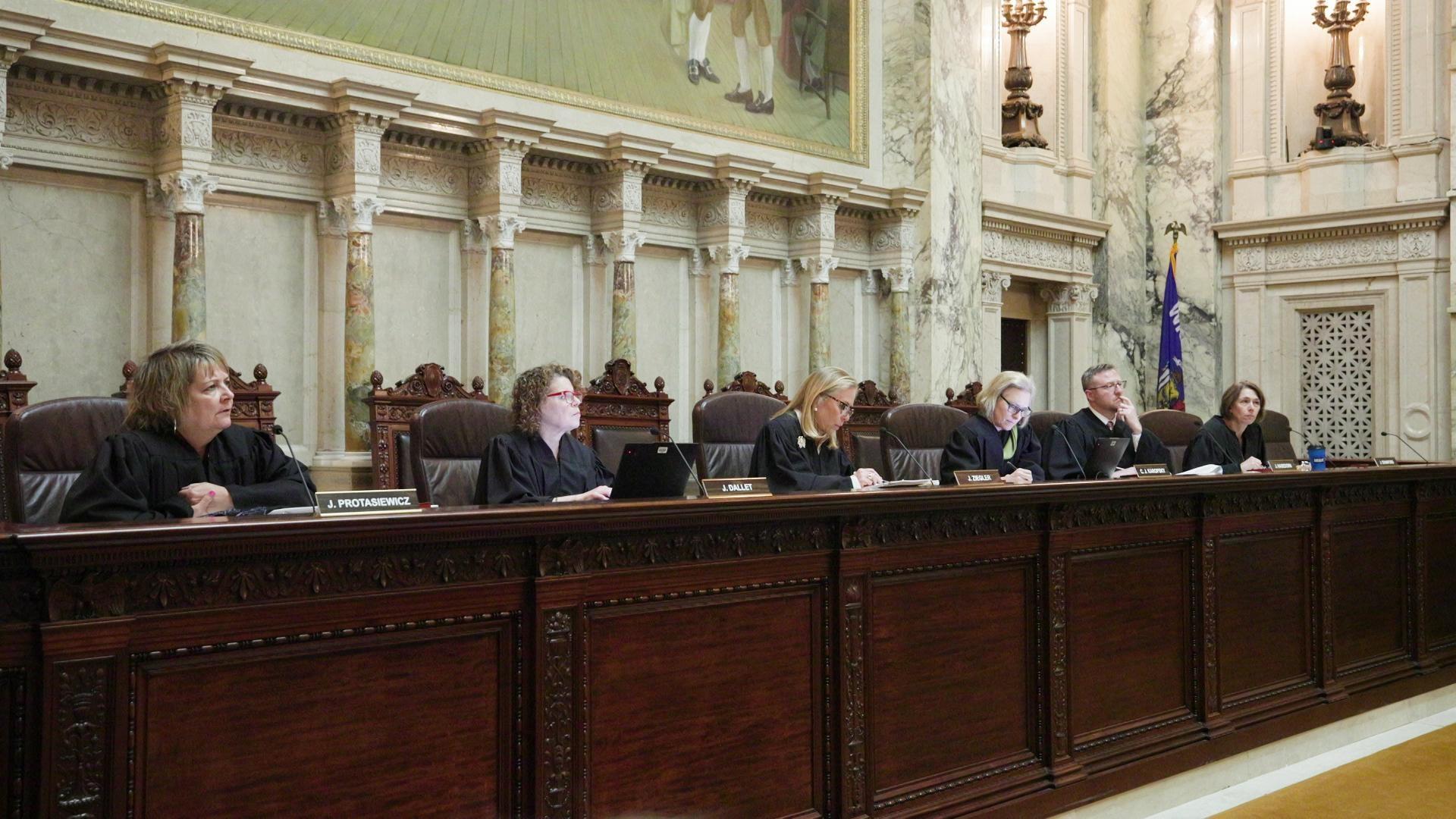
Wisconsin Supreme Court elections have become more expensive and more partisan than ever before. While justices on the court are technically independent, they are easily sorted into liberal and conservative groups. That can create an appearance of bias in the eyes of some people, and has led to an increase in the number of requests for justices to recuse themselves from a case.
“So that’s when I say, yes, those maps are rigged,” said Janet Protasiewicz,in 2023, ushering in a new era in Wisconsin Supreme Court elections by openly talking about her values while on the campaign trail. She called legislative maps passed by Republicans and adopted by the Supreme Court “rigged.”
Since then, multiple lawsuits filed against those maps have come before the court, and each time lawyers representing the Republicans have asked Protasiewicz to recuse herself, basing part of their case on an interview she conducted with Here & Now.
Each time, she’s said no, concluding, “The presumption of impartiality stands. I therefore deny the motion for my recusal.”
Rob Yablon, a professor at the University of Wisconsin Law School, described how recusal plays a role in the courts.
“Recusal is important in the sense that it is part of this big-picture notion that people are entitled to unbiased adjudicators,” he said.
Most judicial recusals come from a judge who’s already weighed in on a case, or who has a financial or personal relationship with one of the parties — but that doesn’t include campaign contributions or statements from the campaign trail.
“The expectation is that, under the current rules, that judges and justices won’t step aside because of their discussions of issues or values on the campaign trail or because of money they’ve received,” Yablon said.
Under the Wisconsin Supreme Court’s own guidelines, each justice decides for themselves if they should recuse.
Here & Now asked the candidates in the state’s 2026 Supreme Court election about their recusal standards.
“I follow the rules set by the US Supreme Court as well as by the state of Wisconsin. I have had to look at different circumstances and decide when and how to recuse, and I always look at not only is it objectively but subjectively biased. So, if there is an appearance of impropriety, then I will take a step back,” said Judge Maria Lazar, the conservative candidate.
“I’m instructed by my ethical obligations to look at each case on a case-by-case basis and make sure that I can be fair and impartial, and that’s what I do every day,” said Judge Chris Taylor, the liberal candidate.
Two current cases have shown a new tactic in recusal requests.
Former Wisconsin Supreme Court Justice Mike Gableman and lawyer Jim Troupis have each attempted to remove enough justices through recusal to change the make up of the court that would hear their case.
In 2020, Troupis represented the Trump campaign as they attempted to throw out more than 220,000 votes in Dane and Milwaukee counties. In oral arguments, he sparred with Justice Jill Karofsky.
“What you want is you want us to overturn this election so that your king can stay in power, and that is so un-American,” Karofsky said.
Troupis lost that case, but at the same time he was the lawyer behind Wisconsin’s false elector scheme — an effort to send an alternate slate of electoral votes to Washington D.C. on January 6, 2021.
For that, he has been charged by the Wisconsin Attorney General for forgery, and Troupis claims all the judges in Dane County are biased and should recuse. His motions were rejected, and while appealing to the Wisconsin Supreme Court he asked Justices Jill Karofsky and Rebecca Dallet to recuse based on their comments in the Trump v. Biden case.
Neither justice has responded yet.
Meanwhile, Gableman was hired to investigate Republican claims of fraud during the 2020 election. His investigation found no fraud, but it was determined he violated the open records law repeatedly, and when in Dane County Court he insulted the judge and opposing council. A report by the Office of Lawyer Regulation found 10 violations committed by Gableman and recommended he lose his law license for three years.
Final action belongs to the state Supreme Court, and Gableman has asked three different members to recuse themselves. Protasiewicz and Karofsky said no, while Crawford did recuse…not because of Gableman’s request, but because she was a Dane County Judge during his court case.
“My strong sense is that the volume of recusal requests that we’ve seen over the past year or two are more than we’ve ever seen before in Wisconsin,” Yablon said. “The nature of those requests really tends to be quite political.
He explained that whether recusal requests get justices to sit out a case or not, the request itself is a message to the public.
“Maybe the goal is actually to try to change the composition of the court in a way that you think will help you,” Yablon said. “But at the very least, it is an attempt, maybe, to raise some doubts about whether we should give credence to the legal decision that this body is issuing.”

Our Partners




PBS Wisconsin is a service of the Wisconsin Educational Communications Board and the University of Wisconsin-Madison. © 2026 All Rights Reserved.
Follow Us