

 Passport






Wisconsin's 2026 Supreme Court candidates get out the vote
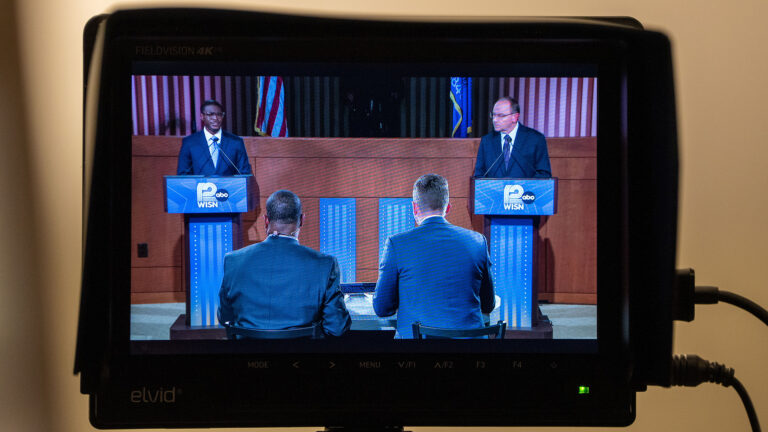
The 2026 race between Maria Lazar and Chris Taylor for the Wisconsin Supreme Court will not determine its balance of power, but partisan efforts to turn out voters are considering long-term control.
By Zac Schultz | Here & Now
April 1, 2026


Partisan efforts in the 2026 for Wisconsin Supreme Court consider long-term control.
In Wisconsin’s 2026 spring election on April 7, voters will choose a justice to serve on the state Supreme Court for the next 10 years. Liberal candidate Chris Taylor has held a commanding fundraising lead over conservative candidate Maria Lazar, with most of that money being poured into ads on TV and online.
But this election has a lower profile than the previous two Supreme Court elections, in part because the winner of this race will not determine the ideological balance of power on the court. Rather, the race will likely come down to get-out-the-vote efforts of each campaign.
“We have 1,500 cards,” said Pam Van Handel, chair of the Republican Party of Outagamie County.
On the morning of Saturday, March 7, a crowd of volunteers is busy filling out postcards at the party’s headquarters in Appleton.
“Address, then sign your name, write a little something about Lazar, or vote on April 7 — we really got to get out the vote,” she added.
The cards encourage voters to support Lazar in the Wisconsin Supreme Court election.
Van Handel said handwritten postcards have a personal touch and are more likely to be read than a glossy campaign flyer.
“What we’re doing is we’re looking for people that are more likely to go out and vote in these smaller elections, because it is tough to get people out to vote — so that’s our goal here,” she said. “So, we get a list from the Republican Party of Wisconsin and we tell them, ‘Give us the ones that are really going to go up and vote.'”
On that same Saturday morning, Colin Roberts, a member of the Democratic Party of Milwaukee County, knocked doors for Taylor.
“I plan on voting. OK, can I ask who you plan on voting for? The Democratic candidate, Chris Taylor,” Roberts said. “Don’t forget to vote on April 7!”
Technically, state Supreme Court elections are non-partisan, and candidates use labels like conservative or liberal instead of Republican or Democrat, but in reality the Democratic and Republican parties of Wisconsin each donate millions of dollars and coordinate thousands of volunteers in their get-out-the-vote effort.
“I just think going everywhere is the key and talking to people,” said Lazar during a Feb. 8 talk to the Grant County Republican Party in Platteville.
“Hello mam, I’m Chris Taylor,” said the candidate at a Feb. 7 event held by the Jackson County Democratic Party in Black River Falls.
“So nice to meet you — you’ll have my vote,” replied the voter.
“Thank you,” Taylor responded.
Liberal candidates have won four out of the last five Supreme Court elections, flipping a court that in 2019 had a 5-2 conservative majority. If Taylor wins, liberals will hold a 5-2 majority.
“How many of you are fired up to protect our democracy? All right.” Taylor asked in Black River Falls.
“We are looking at a court that is now 4-3. When I win, it will stay 4-3 — we’re not changing its composition — but the three votes are so very important,” Lazar said in Platteville.
Republicans around the state have expressed worry about how backlash to Donald Trump’s presidencies and political realignment have led to this losing streak.
“I don’t know if it’s impacted morale,” Lazar said. “What I will say is this: I think that the state of Wisconsin is looking at these races, and they’re asking who’s running and why people are running and for what reason. And when I look at this race, the reason I am running is because I want to be someone on that court who represents the law for the state of Wisconsin.”
Taylor wants to make sure her supporters don’t get complacent with their winning streak.
“There’s four more state Supreme Court elections coming up after mine,” she said. “No one should take anything for granted. This court can change very quickly. But if I am able to get elected, there will be a pro-democracy majority on the court until at least 2030.”
In their wins, Rebecca Dallet, Jill Karofsky, Janet Protasiewicz and Susan Crawford each received 55% of the vote. But the one conservative victory in this streak was in 2019, when Brian Hagedorn won by less than 6,000 votes — which was half a percentage point.
That was a low turnout election, with a million fewer voters than in 2025 Hagedorn was outspent and written off by most election observers who expected to see him lose easily. It’s no surprise Lazar hopes this election ends up following the same pattern.
“Well, secretly, yes. So the parallels are there,” she said. “I think that through my entire career, people have underestimated me. It’s sort of been a theme that they don’t think someone a little shorter, a little softer-spoken can be as strong as steel, and I am. In this race, I think, that’s important too. People think that it’s written off, it’s a done deal, and it’s not.”
Taylor is aware of the Hagedorn comparisons.
“Oh, I won’t rest until April 8, the day after this election,” she said. “I take nothing for granted. This is going to be a hard competitive race. I will need every vote that I can get. I need all the help that I get from the people, the state of Wisconsin.”
The final weekend before Election Day will feature the final push for get-out-the-vote efforts.
“I really feel like the people now are really getting involved at this level,” Van Handel said. “And we’re getting more signs out, we’re just really getting the grassroots going on.”
Volunteers are knocking on doors and reminding their supporters to vote on April 7.
“Do you know your polling location?” Roberts asked a voter “Yep, right there, I can see it.”






Follow Us