

 Passport





The defense makes their case at the Dugan trial in Milwaukee
Attorneys for Milwaukee County Circuit Court Judge Hannah Dugan, who faces federal charges of obstruction and concealing an individual to prevent arrest, called four witnesses but not the defendant on the trial's fourth day, with both sides following with closing arguments.
Associated Press
December 18, 2025


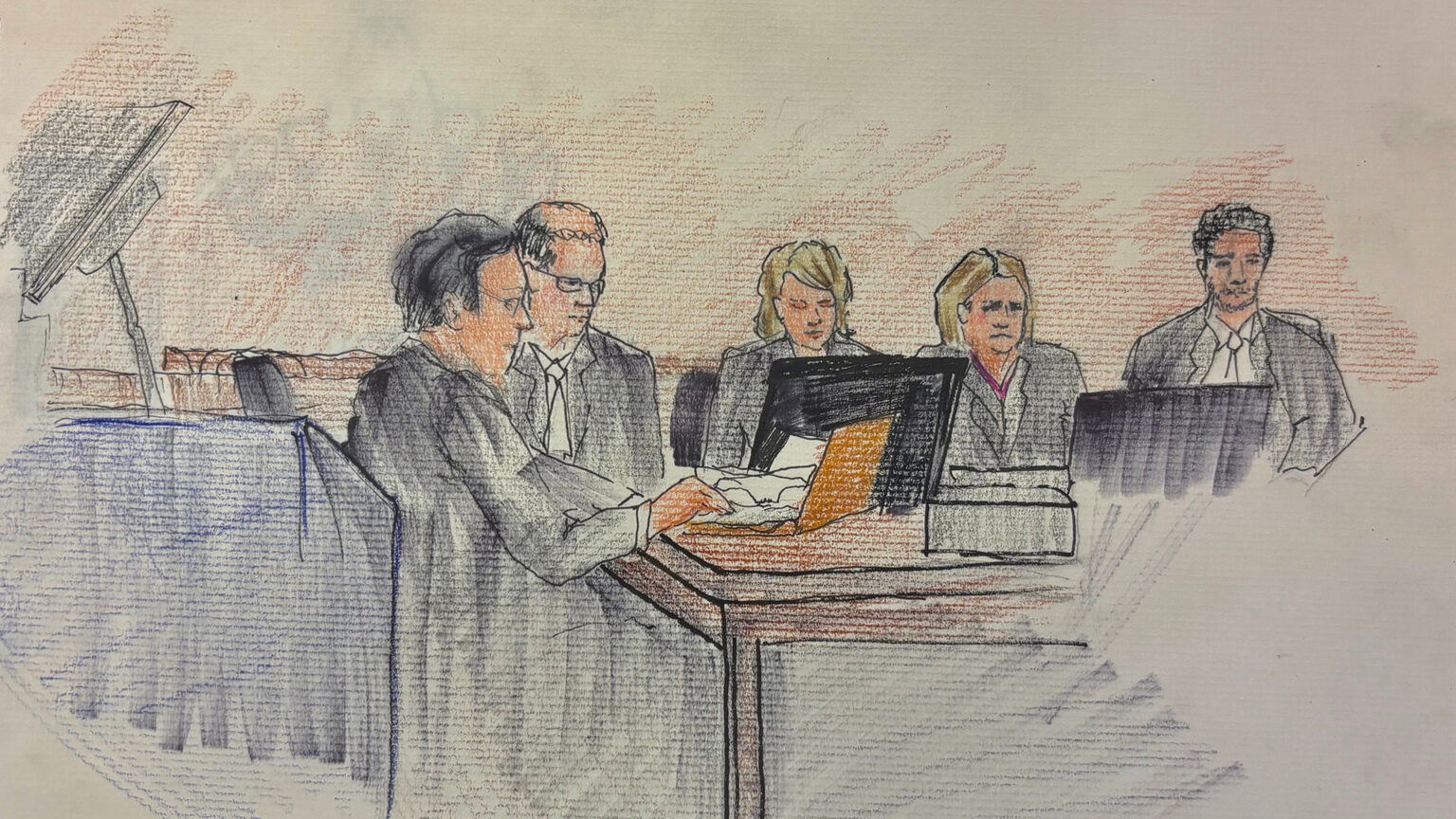
A courtroom sketch depicts Milwaukee County Circuit Judge Hannah Dugan, second right, with her attorneys in court as jury selection in her trial began on Dec. 11, 2025, in Milwaukee. (Credit: Adele Tesnow via AP)

MILWAUKEE (AP) — The “top levels of government” were involved in bringing charges against a Wisconsin judge accused of helping a Mexican immigrant evade federal authorities, her defense attorney told jurors during closing arguments at her trial on Dec. 18 in an attempt to blunt prosecutors’ arguments that the judge acted inappropriately.
Prosecutors argued that Milwaukee County Circuit Judge Hannah Dugan put her personal beliefs above the law.
“You don’t have to agree with immigration enforcement policy to see this was wrong,” Assistant U.S. Attorney Kelly Brown Watzka told the jury in closing arguments. “You just have to agree the law applies equally to everyone.”
Federal prosecutors charged Dugan with obstruction and concealment in April. Jurors got the case around mid-afternoon on Dec. 18 after listening to four days of testimony and more than two hours of closing arguments.
The highly unusual charges against a sitting judge are an extraordinary consequence of President Donald Trump’s immigration crackdown. Dugan’s supporters say Trump is looking to make an example of her to chill judicial opposition to immigration arrests.
According to an FBI affidavit and trial testimony, a team of six federal agents and officers traveled to the Milwaukee County Courthouse on April 18 to arrest 31-year-old Eduardo Flores-Ruiz for being in the country illegally.
He was scheduled to appear in front of Dugan in a state battery case and the team planned to arrest him as he left the proceeding. But Dugan learned the team was in the hall outside her courtroom and angrily confronted them with Judge Kristela Cervera in tow.
Dugan directed the agents to the chief judge’s office, then hurried back into her courtroom, moved Flores-Ruiz’s case to the top of the docket, told him he could next appear by Zoom and directed him out a private door into a restricted hallway. He emerged in the public hallway. Agents followed him outside and tackled him after a foot chase through traffic.
Dugan didn’t take the stand in her own defense, but defense attorney Jason Luczak said during his closing that she would never jeopardize her career by “going out on a limb” to help the wanted man slip away. “Give me a break,” Luczak said.
He said Dugan was legitimately confused about how to handle immigration arrests in the courthouse and was concerned that the national immigration sweep is resulting in deportations that deprive crime victims of justice.
He stressed that Flores-Ruiz still ended up in the public hallway and agents could have arrested him at any time. He implored jurors to consider that the “top levels of government” are influencing the case and to act as a check on what he called “government overreach.”
But Brown Watzka, the prosecutor, insisted in her closing that Dugan went rogue because she was frustrated with immigration arrests in courthouses and intentionally distracted the arrest team to buy time to help Flores-Ruiz escape.
“A judge does not have absolute authority to do whatever she wants whenever she puts on her robe,” Brown Watzka said. “The defendant is not on trial for her views on immigration policy. She is on trial because she made a series of deliberate decisions to step outside the law in order to help an individual evade federal arrest.”
Brown Watzka pointed out that audio recordings from Dugan’s courtroom picked up a whispered discussion between Dugan and her court reporter about who should guide Flores-Ruiz out the private door and down a back staircase. Dugan said she’d do it and that she’d take “the heat” for it.
Flores-Ruiz ultimately did not take the stairs and instead went through the private door into the public hallway, but Brown Watzka said that means nothing.
“The only thing that matters is the defendant’s intent,” she said.
Luczak asked jurors during his closing to consider whether the government manipulated the recordings.
Assistant U.S. Attorney Rick Frohling warned jurors in a rebuttal speech that Luczak was simply trying to distract them.
“This isn’t a referendum on ICE,” Frohling said, referring to U.S. Immigration and Customs Enforcement. “It’s about preserving the rule of law.”
The case is a “shot across the bow” to state judges everywhere meant to intimidate them, said Howard Schweber, a political scientist and affiliate faculty of the University of Wisconsin Law School.
“It is unthinkable that this prosecution would have been brought in a prior administration,” Schweber said. “This is truly extraordinary, I would even say unprecedented certainly in my adult lifetime. I have never seen anything like it. And professionally its quite shocking.”
Associated Press writer Scott Bauer contributed to this report.





Follow Us