

 Passport





The 2026 election for Wisconsin governor begins with competitive primary campaigns
An open seat in Wisconsin's governor's office is setting up vigorous Democratic and Republican primaries in the 2026 election cycle, with candidates in both parties sharing thoughts about how they seek to win support from voters.
By Zac Schultz | Here & Now
January 6, 2026


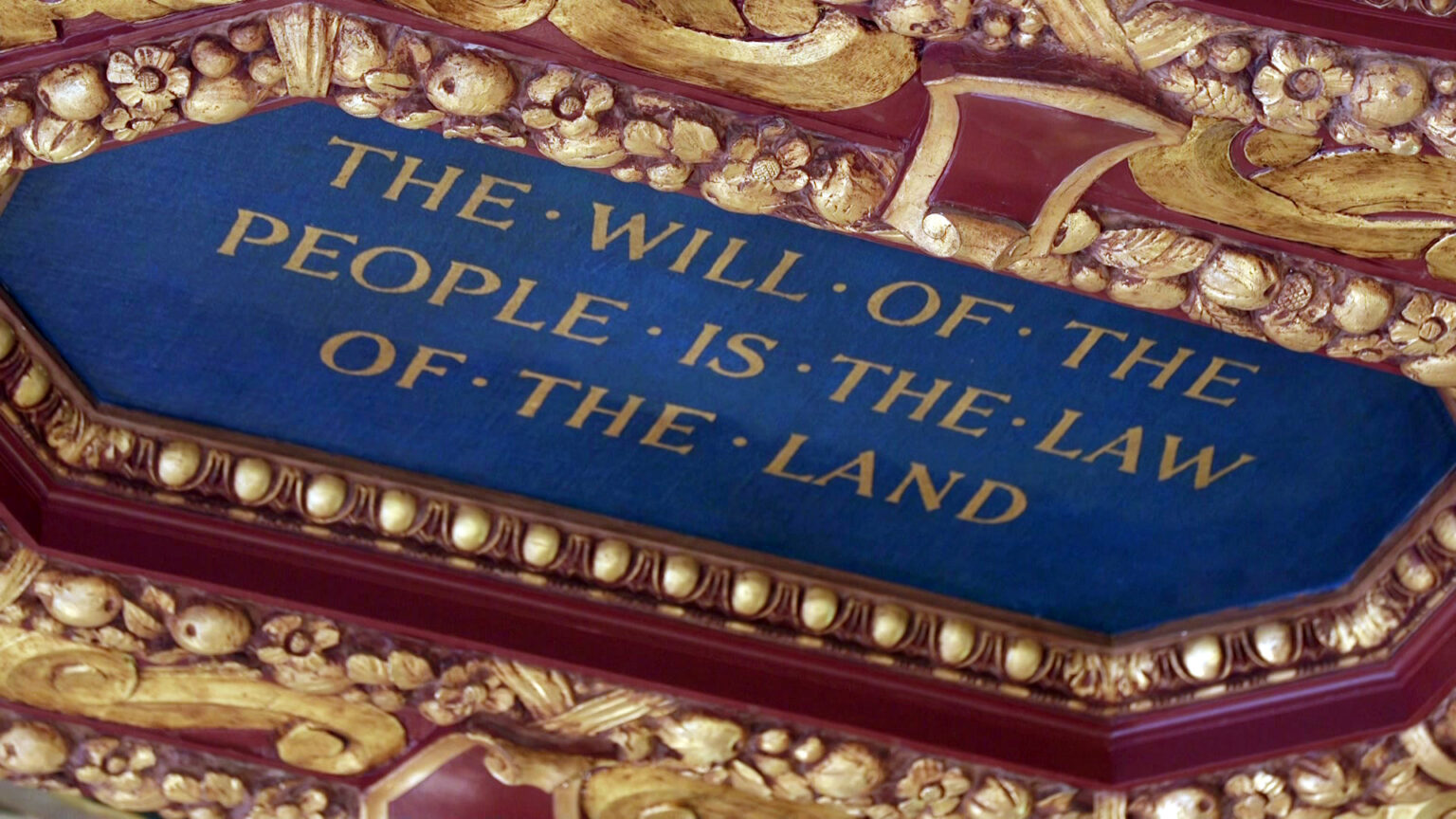
A fresco presenting the saying "The Will of the People Is the Law of the Land" is displayed on the ceiling of the Governor's Conference Room at the Wisconsin State Capitol on June 1, 2017, in Madison. (Credit: PBS Wisconsin)
The 2026 race for governor of Wisconsin features one of the largest primary fields in recent memory, at least on one side of the aisle. Incumbent Democratic Gov. Tony Evers announced in July he would not seek a third term in office. One day later, Lt. Gov. Sara Rodriguez announced she was running. Four months after that, former Lt. Gov. Mandela Barnes announced he was running. In between, a steady stream of Democrats joined the race, as did a pair of Republicans.
Announcing many months ahead of the primary, candidates have to show they can raise enough money and gain enough support in polling to remain viable until August. Early polling showed voters said they did not know enough about most of the candidates running. As for money, the immediate concern among Democrats was the candidates would have to spend so much in the summer to win the primary that it would leave the winner without enough for the general election. That’s why the Democratic Party of Wisconsin announced it would start fundraising for the eventual nominee and hold that money until after the primary.
The Republican gubernatorial primary field is much smaller. U.S. Rep. Tom Tiffany, R-7th Congressional District, is generally considered the frontrunner, as he has the most name recognition and a close affiliation with President Donald Trump and his MAGA movement. Tiffany started his career in politics winning a seat in the Wisconsin Assembly during the tea party wave of 2010. He moved on to the state Senate following the 2012 election, and then ran for and won a special election to the U.S. House in 2020. Tiffany has represented Wisconsin’s North Woods the last 16 years as the region has gone from a Democratic stronghold to the among the most conservative parts of the state.
Tiffany said he will bring his campaign everywhere, though. In an interview with Here & Now, he described this approach: “We have a 72-county strategy. Sometimes Republicans have not done that, including ignoring right where we sit right now in Dane County. We will not ignore Dane County, the fastest growing county in the state and, but we have a 72-county strategy and we’re going to cover every bit of it.”
Representing one of the state’s older Republican strongholds in southeastern Wisconsin, Washington County Executive Josh Schoemann is also running in the Republican primary. Schoemann understands he is considered the underdog to Tiffany, but wants voters to think past the primary.
Schoemann described his approach toward the campaign’s two phases in an interview with Here & Now: “I think this has got to be about the people and local communities, a little bit more about Washington County type and a little less about Washington, D.C. But then I also think there’s something to be said about the types of attributes it’s going to take to win a general election. Generals are of course much different than primaries. I think on the Republican side in particular, we’ve spent a little bit too much time focusing on who can win a primary purity test of sorts, and we need to spend more time thinking about what can win in the general election. I think when you put my resume next to anybody, I think the answer is clear. If we want to be in the governor’s mansion in January of 2027, I think not only me, but my profile and our campaign is the type that wins.”
On the Democratic side, former Lt. Gov Mandela Barnes has the highest name recognition, not only from his four years serving in that role during the first term of Gov. Tony Evers, but also from his 2022 loss to incumbent Republican U.S. Sen. Ron Johnson in 2022. Barnes got his start in politics in the Wisconsin Assembly in the 2012 election, which he won and went on to represent a district in the city of Milwaukee, but he says his brand is now statewide.
In an interview with Here & Now, Barnes spoke to a statewide focus: “Well, I can tell you there’s not a person in this race who has the experience in all parts of Wisconsin that I have. In ’22, I won the Wisconsin Farmers Union Friend of the Family Farmer Award because of my dedication to rural Wisconsin. I ran into a guy leaving that conference a few years ago and said that he never thought that he’d be voting for a guy from Milwaukee based on his rural policy. And also understanding that rural Wisconsin isn’t just farms, it is small businesses that make up rural Wisconsin. It’s also the outdoor activities that bring tourism to rural Wisconsin.”
Current Lt. Gov. Sara Rodriguez was the first Democrat to enter the race. She got her start in politics in 2020, flipping a Republican-held state Assembly seat that spanned Milwaukee and Waukesha counties, before succeeding Barnes as lieutenant governor following the 2022 election.
Before her start in politics Rodriguez worked in health care, and in an interview with Here & Now said that experience will help her in the campaign and in office: “I’m also somebody who has extensive private industry experience, but also has been in elected office. That’s a good balance between those two things. I know what it’s like to work shift work, I know what it’s like to be an executive within a large company, and I know what it’s like to be an elected official. You’re going ton need all those skills to make sure that you have a governor who’s going to be ready on day one.”
Milwaukee County Executive David Crowley was elected to that position in 2020. Prior to that, he had served in the state Assembly since being elected in 2016.
In an interview with Here & Now, Crowley said he wants voters to know he’s ready to represent more than just the largest county in the state: “I’m the only candidate in this race that has experience in the Legislature, but actually running a government, balancing billion-dollar budgets and really tackling the issues head on. So I think it’s a combination of both, but it’s about how do we continue, again to step outside of our comfort zone, go all across the entire state of Wisconsin to let voters know what we’re putting on the table.”
Missy Hughes served as CEO and Secretary of the Wisconsin Economic Development Corporation under Evers since early in his first term. Prior to that she worked at Organic Valley cooperative for a decade-and-a-half.
Hughes said her lack of electoral experience is a positive in an interview with Here & Now: “I have a story that is fresh and different. I’ve never run for office before. I’m the only one who is from outside of Madison or Milwaukee, so I have a lot to say about myself and I’m going to be focused on telling my story.”
Joel Brennan has also never been elected to office. He served as Secretary of the Department of Administration in Evers’ first term. Before and following his time in state government, Brennan worked in Milwaukee.
As a later entrant to the race, Brennan said in an interview with Here & Now that the crowded primary does not scare him. “I’m the second youngest of 11 kids. I know what it’s like to have to go to a crowded table and elbow your way in, whether it’s for attention or even to get a meal. And so I’m comfortable with that. But what I am going to do in this campaign is really talk to people about me and about my background — 30 years of progressive executive experience, things like running the largest science museum in the state of Wisconsin at Discovery World, three years as the top appointed official in Gov. Evers’ cabinet and the work that we did there. So the way that I’m going to try to distinguish myself from others is to just communicate with them about the depth of relationships and what we have done.”
State Sen. Kelda Roys, D-Madison, began her career in the Wisconsin Assembly, first elected to a seat in 2008 before moving on to the upper chamber of the Legislature in the 2020 election. She has also previously run in Democratic primaries, in 2012 for the U.S. House of Representative and in 2018 for governor.
In an interview with Here & Now, Roys said she wants primary voters to think about how the candidates would govern, not just run for governor: “I really want to make the argument that whatever the issue that you care about is, the most important thing is having a governor who can win and who can actually get things done. I have spent over twenty years working in and around state government in a variety of capacities as a legislator in the Senate and the Assembly, as the only candidate running that served on the Joint Finance Committee, small business owner, mom, attorney. I have been able to get meaningful legislation passed on a whole variety of issues through every kind of Legislature — Democratic, Republican, split. Those skills are going to be essential for our next governor if we want to actually make change in this state.”
State Rep. Francesca Hong, D-Madison, was first elected to the Wisconsin Assembly in 2020. She owned a restaurant in Madison and is focusing on workers’ rights in this campaign.
Hong spoke about how she seeks to stand out among the other Democrats in an interview with Here & Now: “Crowded primaries are good for democracy. But I think, in this moment, people are stressed and demanding bold change. And so we’re really focused on making sure that the issues that we see folks struggling with affordability and, you know, living in times of fascism. We want to make sure that we are naming the billionaires and the culprits of these issues, and then how the state is responsible for presenting and delivering solutions to help people live a life of dignity.”
The primary election for governor is Aug. 11, with one Democrat and one Republican from this field moving on along with independent and third-party candidates to run in the general election on Nov. 3.




Follow Us