

 Passport




One Menominee Nation family's story of tragedy and advocacy
Advocates and family gathered at an annual rally to honor missing and murdered Indigenous women — the murder of Linda Dickenson is one among many tragedies the movement hopes to prevent in the future.
By Erica Ayisi | Here & Now, ICT News
May 8, 2026


Advocates and family gathered at a rally to honor missing and murdered Indigenous women.

This report is in partnership with ICT, formerly Indian Country Today.
“She was just so cool, down to earth, kind, loving,” said Rachel Fernandez while holding a picture of her late sister-in-law Linda Amy Dickenson, a day care teacher who gave nicknames to her preschoolers.
“She would help anybody and she loved the children,” Fernandez remembered, who remembers Dickenson as a patient listener committed to family.
“She treated my kids like her own, you know, and she just had that caring personality,” added Fernandez, who is executive director of Maeqtekuahkihkiw Metaemohsak Inc., Woodland Women and serves on the Wisconsin Women’s Council.
Dickenson and Fernandez — both of the Menominee Indian Tribe of Wisconsin — spent time together as friends and family on the rural reservation north of Green Bay.
“She always had me cracking up. She always had a joke. She’s very witty,” Fernandez recalled.
Dickenson eventually relocated from the reservation to Green Bay with her new partner. Fernandez says Dickenson’s life with him was private, but the impact of their 10 year relationship was public.
“She would show up to work with black eyes,” Fernandez shared.
Where did she say she got these black eyes?
“From him.” Fernandez said. “And she wouldn’t really talk about it.”
According to Fernandez, when Dickenson didn’t show up for work at the day care on the morning of February 24, 2014, her colleagues requested a police welfare check to her home. The officers found the unthinkable by the door.
“She was shot through her left cheek,” Fernandez said, “and the coroner told them that she died in seconds.
Her partner was found dead in the bedroom.
“He shot himself — so it was a murder-suicide,” Fernandez said.
The murder left Dickenson’s three children — Vanessa, Kenny and Warren — motherless.
‘It’s tragic all around because he has kids too,” Fernandez added.
She said news of double tragedy spread quickly throughout the tight knit Menominee community.
“They were both from the reservation,” Fernandez said. “They’re both tribal members.”
Fernandez said many Indigenous people follow a code of silence in violence and abuse, stemming from historical trauma during the federal Indian boarding school era.
“Because our children were taken from their homes,” she said, “and they were taught in these boarding schools not to talk about what happened to them.”
Fernandez said she’s also a victim of abuse and trafficking, but has been able to work through her challenges and support other Indigenous people through intergenerational suffering.
“I’m OK to accept forgiveness of myself, and so that really birthed the activist and the advocate in me,” she said.
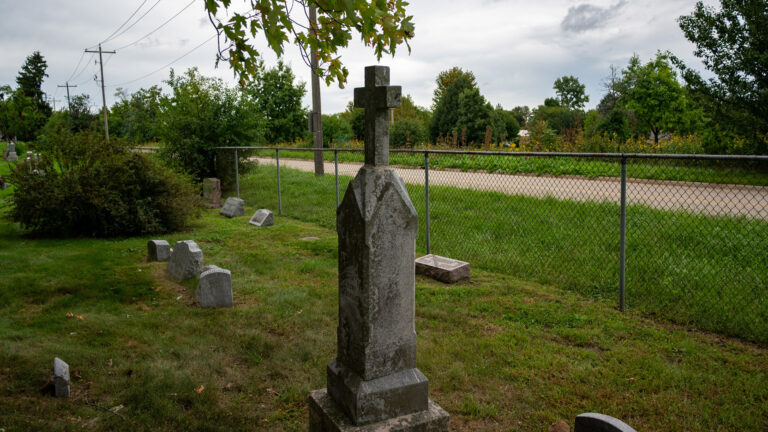
An empty lot in Neopit marks where Linda Amy Dickenson lived on the Menominee reservation with her children before moving to Green Bay. She lived in a trailer that’s gone now, but Fernandez said her memory is alive forever.
Fernandez shared Dickenson’s name at a May 5 rally in Madison held to remember missing and murdered Indigenous women and relatives.
“Linda Amy Dickinson,” she said into a microphone in front of the Wisconsin State Capitol.
Fernandez explained the Wrap The Capitol Red rally is about breaking the code of silence within Indigenous communities.
“You know who was involved in someone being missing — you know. Why aren’t you saying anything?” she asked.
Relatives of victims of homicide shared their loved ones’ names.
“I want to speak today on behalf of my cousin,” said one speaker, “who succumbed to domestic violence.”
“Bad River Ojibwe, Wisconsin — Angeline Whitebird-Sweet, murdered February 1989,” said another speaker, reading from a resolution that was proposed in the Wisconsin Legislature in 2019.
“Susan Poupart, Lac du Flambeau, murder, 1990 — two children, unsolved,” the same speaker read, referencing the victim in a long-standing cold case.
The speakers mentioned family members who never came home.
“Charlene Couture, Bad River missing — 2009,” the speaker continued. “LaVonne Frank, Lac du Flambeau, 1997.”.
This list included Indigenous men.
“Braxton Lee Phillips, say his name,” said Tracy Phillips about her nephew at the rally.
Rally-goers made pleas for more justice.
“My lawmakers here — are you listening?” Phillips asked.
Wisconsin Attorney General Josh Kaul said the state’s Missing and Murdered Indigenous Women/Relatives task force recommends a permanent office inside the Capitol and a report tracking tribal data.
“That unfortunately was not included in the last state budget, but hopefully we’ll see some progress on these ideas once the report is out,” he said in an interview at the rally.
Kaul said the state is investing in violence prevention and collaborative efforts between tribal, state and federal law enforcement to effectively respond to incidents.
At the rally, more than 100 advocates, survivors and families held hands to wrap the Capitol red — in solidarity, so that their testimonies will be heard.
“No more stolen sisters, no more stolen brothers, no violence,” said Fernandez to the group. “We demand justice for our relatives, for those that cannot speak.
This report is in collaboration with our partners at ICT.






Follow Us