

 Passport




For Wisconsin high schools to offer more college credit options, more teachers must go to grad school
School officials around Wisconsin want to give more students a jump start on college with dual enrollment classes, but they say they lack qualified teachers — for busy teachers, the return on investing their time and money to attend graduate school is a hard sell.
Wisconsin Watch
December 4, 2025


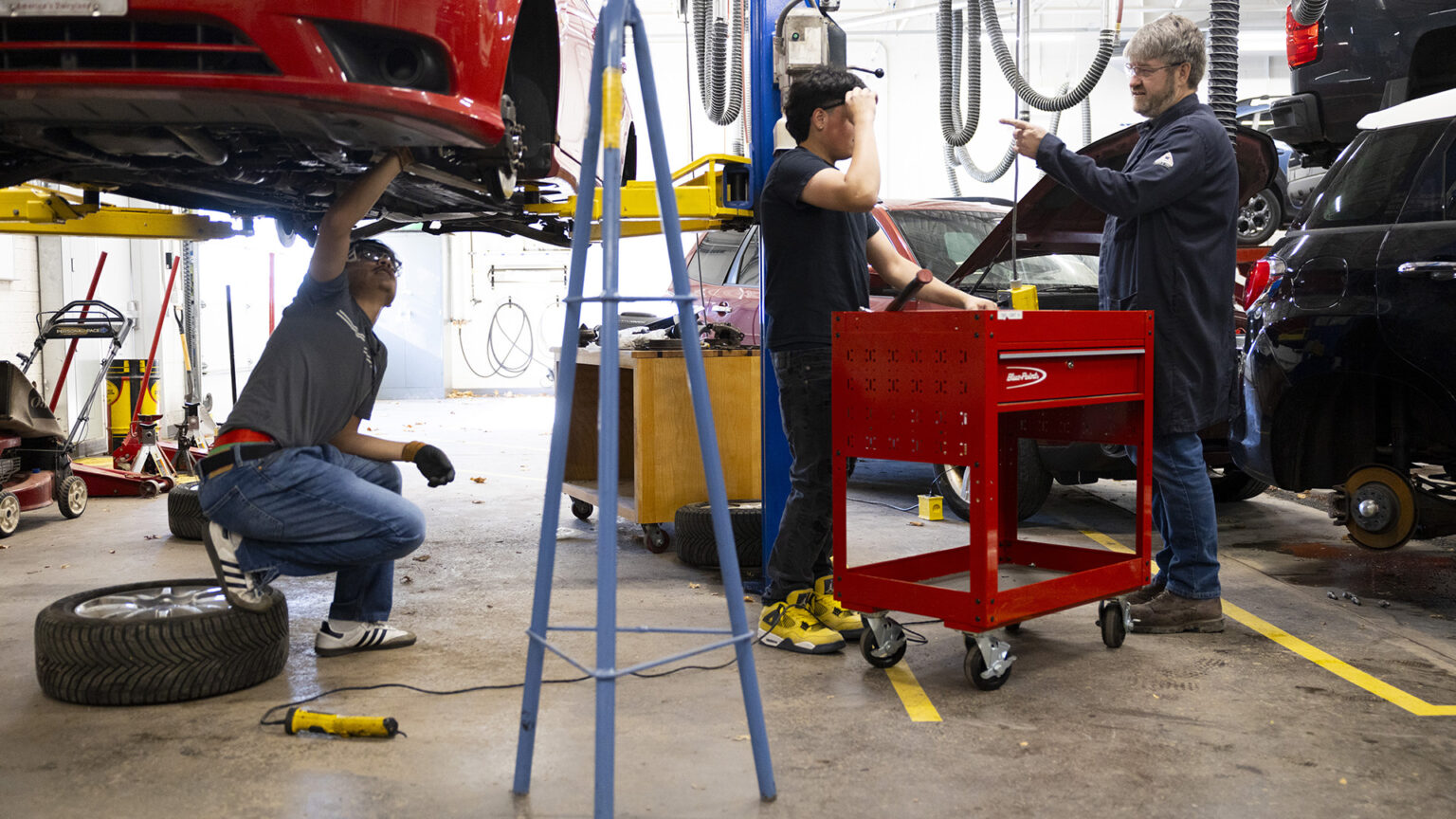
Oscar Haro Rodriguéz, left, works on a car as José Ruiz, center, talks to their teacher, Miles Tokheim, during an Auto 3 dual enrollment class on Nov. 12, 2025, at Vel Phillips Memorial High School in Madison. Students who pass the course earn five Madison College credits for free and skip the class if they enroll at the college. (Credit: Joe Timmerman / Wisconsin Watch)

This story was produced and originally published by Wisconsin Watch, a nonprofit, nonpartisan newsroom.
It’s fourth period in the auto lab at Madison’s Vel Phillips Memorial High School, and a dozen students maneuver between nearly as many cars.
At one bay, a junior adjusts the valves of an oxygen-acetylene torch and holds the flame to a suspended Subaru’s front axle to loosen its rusty bolts. Steps away, two classmates tease each other in Spanish as they finish replacing the brakes on a red Saab. Teacher Miles Tokheim moves calmly through the shop, checking students’ work and offering pointers.
After extensive renovations, the lab reopened in 2024 with more room and tools for young mechanics-in-training. What visitors can’t see is the class recently got an upgrade, too: college credit.
Through a process called dual enrollment, high schoolers who pass the course now earn five Madison College credits for free and skip the class if they later enroll. Classes like these are increasingly common in Wisconsin and across the country. That’s allowed more high schoolers to earn college credit, reducing their education costs and giving them a head start on their career goals.
Wisconsin lawmakers and education officials want more high schoolers to have this opportunity. But these classes need teachers with the qualifications of college instructors, and those teachers are in short supply.
That leaves many students — disproportionately, those in less-affluent areas — without classes that make a college education more attainable.
“What’s at stake is access to opportunity, especially for high school students at Title I, lower-income high schools, rural high schools … It’s really been an on-ramp for so many students,” said John Fink, who studies dual enrollment at Columbia University’s Community College Research Center. “But we also know that many students are left behind.”
To teach the auto class, Tokheim had to apply to become a Madison College instructor. As a certified auto service technician with a master’s degree, the veteran teacher met the college’s requirements for the course.

Miles Tokheim, a technology and engineering teacher, poses for a portrait during an Auto 3 dual enrollment class on Nov. 12, 2025, at Vel Phillips Memorial High School in Madison. (Credit: Joe Timmerman / Wisconsin Watch)
But for many teachers, teaching dual enrollment would require enrolling in graduate school, even if they already have a master’s degree.
That, school leaders say, is a hard sell, despite the state offering to reimburse districts for the cost. Teachers in Wisconsin often don’t make much more money teaching advanced courses the way they do in some other states, and adding these courses doesn’t raise a school’s state rating.
“You’re asking people who are well educated to begin with to go back to school, which takes time and effort, and their reward for that is they get to teach a dual credit class,” said Mark McQuade, Appleton Area School District’s assistant superintendent of assessment, curriculum and instruction.
High standards, short supply
Nationwide, the number of high schoolers earning college credit has skyrocketed in recent years. In Wisconsin, the tally has more than doubled, with students notching experience in subjects ranging from manufacturing to business.
Most earn credit from their local technical college without leaving their high school campus. In the 2023-24 school year, 1 in 3 community college students in the state was a high schooler.
Education and state leaders have welcomed the trend, pointing to the potential benefits: Students who take dual enrollment classes are more likely to enroll in college after high school. They can save hundreds or thousands of dollars on college tuition and fees. If they do enroll in college, they spend less time completing a degree.
“It also proves to the kids — to some of our kids that are first-generation — that they can do college work,” McQuade said.
But not all students get these advantages. Many Wisconsin schools offer very few dual enrollment courses, or none at all. A Wisconsin Policy Forum analysis published in July showed small, urban or high-poverty schools are least likely to offer the classes.
Wisconsin Watch talked to leaders in five school districts. All said the shortage of qualified teachers was one of the biggest barriers to growing their dual enrollment programs.
In 2015, the Higher Learning Commission — which oversees and evaluates the state’s technical colleges — released new guidelines about instructor qualifications. The new policy required many of Wisconsin’s dual enrollment teachers to have a master’s degree and at least 18 graduate credits in the subject they teach, just like college instructors.
In 2023, the Commission walked back the new policy.
By then, colleges across the state had already adopted the higher standard.
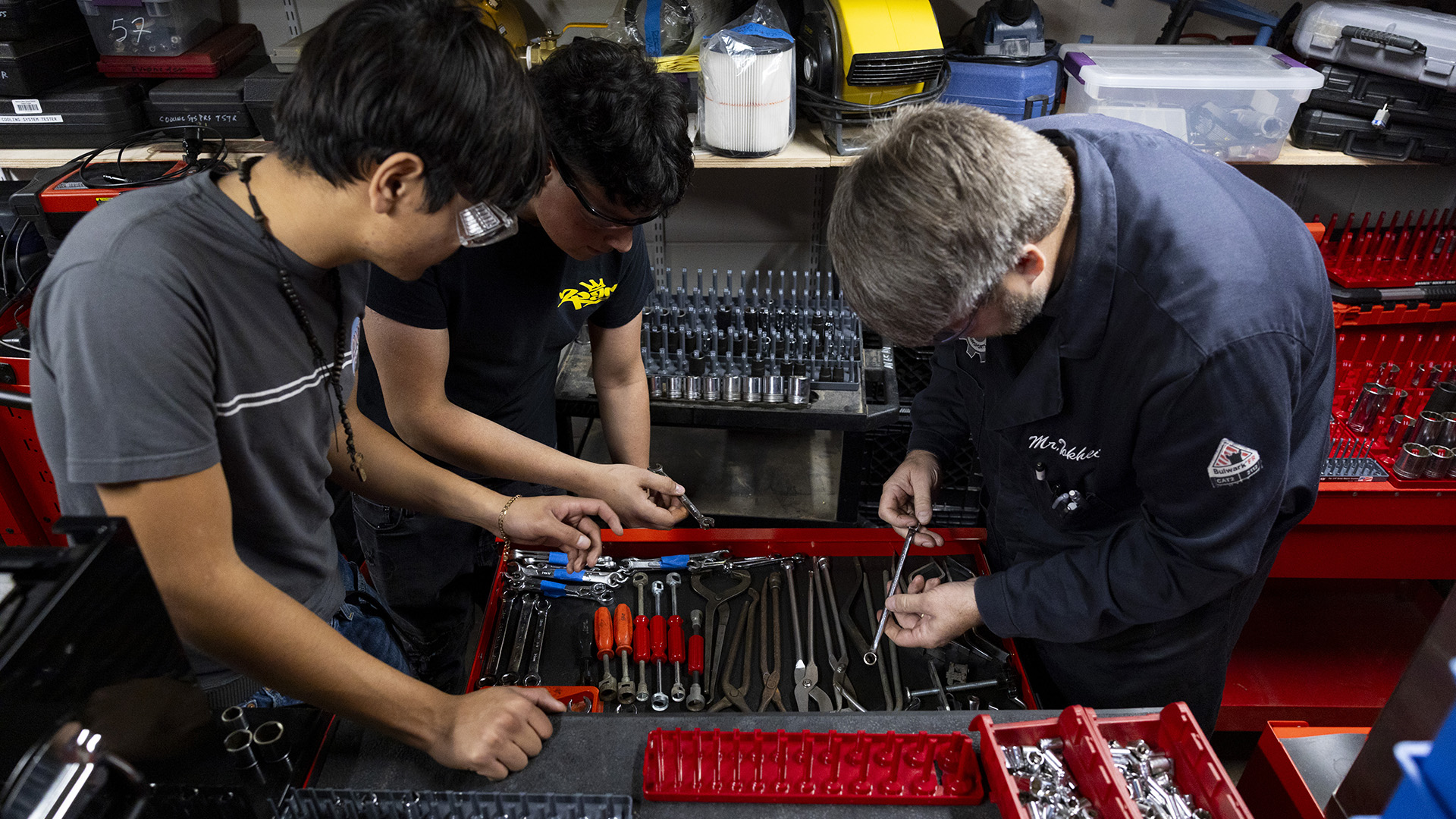
Oscar Haro Rodriguéz, left, and José Ruiz, center, look for a tool with their teacher, Miles Tokheim, during an Auto 3 dual enrollment class on Nov. 12, 2025. Tokheim met Madison College’s requirements to teach dual enrollment since he is a certified auto service technician with a master’s degree. (Credit: Joe Timmerman / Wisconsin Watch)
Meanwhile, Wisconsin schools have struggled to hire and retain teachers, even without college credit involved. Four in 10 new teachers stop teaching or leave the state within six years, a 2024 Department of Public Instruction analysis shows.
The subject-specific prerequisite is much different from the graduate education K-12 teachers have historically sought: the kind that would help them become principals or administrators, said Eric Conn, Green Bay Area Public Schools’ director of curricular pathways and post-secondary partnerships.
“To advance in education, it wasn’t about getting a master’s in a subject area. It was getting a master’s in education to develop into educational administration or educational technology,” Conn said. For teachers who already have a master’s degree, he said, going back to school just to teach one or two new classes is “a large ask.”
Funding tempts few
When the Higher Learning Commission announced the heightened requirements in 2015, leaders of the Wisconsin Technical College System sounded the alarm. They warned 85% of the instructors currently teaching these classes could be disqualified, whittling students’ college credit opportunities.
Wisconsin education leaders called on the Legislature to allocate millions of dollars to help teachers get the training they’d need — and they agreed. In 2017, lawmakers created a grant program to reimburse school districts for teachers’ graduate tuition.
But of the $500,000 available every year, hundreds of thousands go unused.
“Nobody’s ever, ever requested this funding and been denied because of a funding shortage,” said Tammie DeVooght Blaney, executive secretary of the Higher Educational Aids Board, which manages the grant.
Tuition and fees for a single graduate credit at a Universities of Wisconsin school can cost over $800, putting the total cost of 18 graduate credits around $15,000. For teachers who don’t already have a master’s degree, the cost is even steeper. The state grant requires teachers or districts to front the cost and apply for reimbursement yearly, with no guarantee they’ll get it.
A handful of Green Bay teachers have used the grant, Conn said, but many just aren’t interested in returning to school, even if it’s free.
The district offers 50 dual enrollment courses, but he’d like to offer classes in more core subjects, which help students meet college general education requirements. There just aren’t enough teachers qualified to teach college sciences and math to offer the same options across the district’s four high schools.
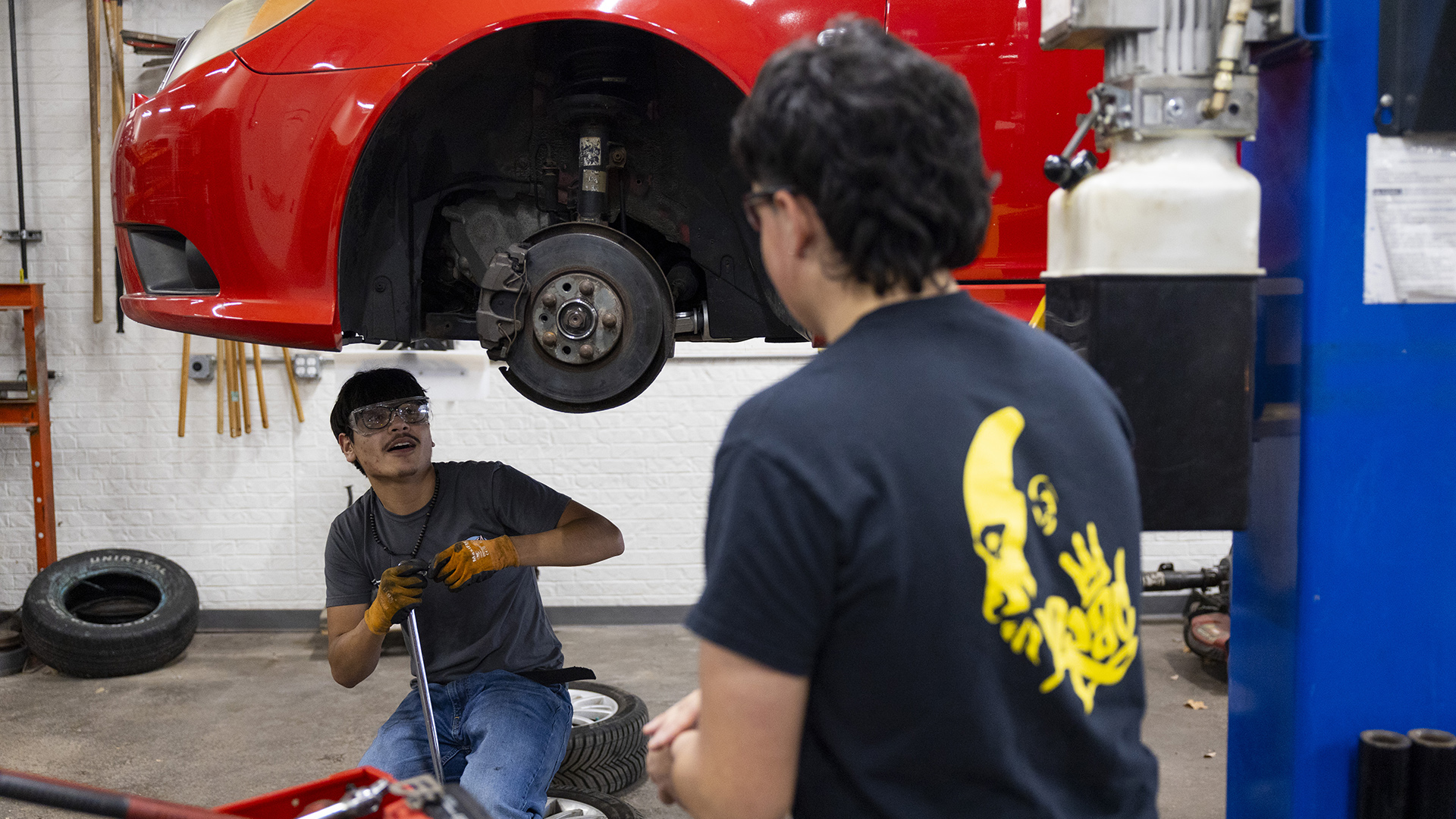
Oscar Haro Rodriguéz, left, and José Ruiz work on a car during an Auto 3 dual enrollment class on Nov. 12, 2025. (Credit: Joe Timmerman / Wisconsin Watch)
Teachers are busy, and not just in the classroom, said Jon Shelton, president of AFT-Wisconsin, one of the state’s teachers unions. Many already spend extra hours coaching, grading or leading after-school activities. Those who do go back to school typically enroll in one class at a time, he said, meaning they could be studying for several years.
Pros and cons
The financial perks for teachers returning to school for dual enrollment credentials are dubious at best.
Some teachers get a salary bump for obtaining a master’s degree, and some earn modest bonuses for teaching dual enrollment. But many teachers make no more than they would have without the extra training.
“There’s no incentive,” said Tokheim, the Madison auto instructor, who receives a $50 yearly stipend for teaching the college course. In contrast to his standard classes, his dual enrollment class required him to attend two kinds of training.
There’s little incentive for schools either. They receive no extra state funding to offer college-level courses. Plus, the classes don’t factor into their state report card score, which measures students’ standardized test performance and graduation preparation, among other things.
Leaders at Sheboygan’s Central High School wish it did. At that school, where the majority of students are Latino and almost all are low-income, 1 in 3 students took dual enrollment courses in the 2023-24 school year. Still, the state gave the school a failing grade.
“It’s an afterthought in our report card, and it’s always the thing that we can celebrate,” Principal Joshua Kestell said.
So why would a teacher take on the added schooling?
“It’s good for kids,” Tokheim said. “That’s why they get us teachers, because we care too much.”
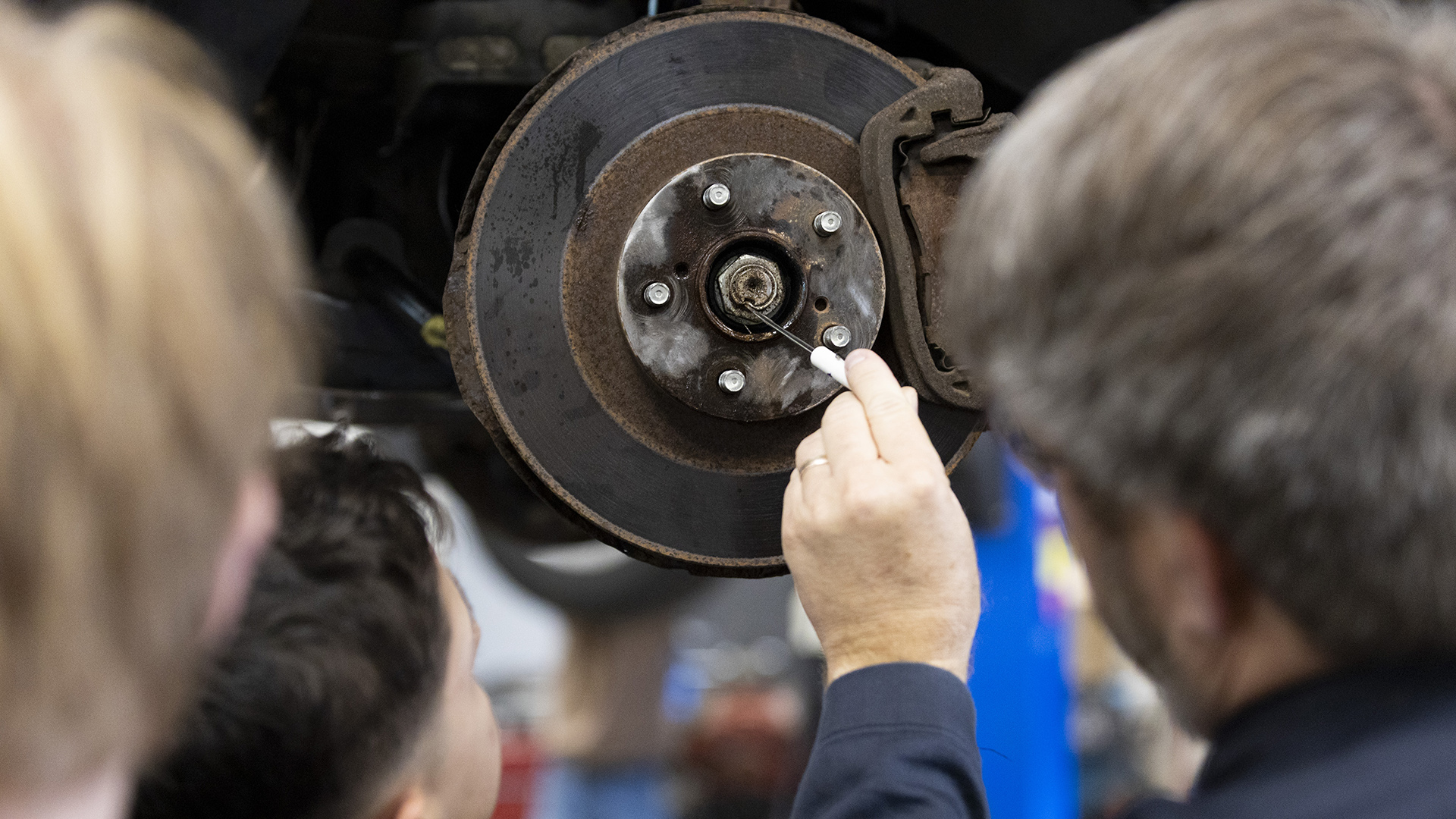
Miles Tokheim, right, helps his students work on a car during an Auto 3 dual enrollment class on Nov. 12, 2025. Small, urban or high-poverty schools are least likely to offer dual enrollment classes, a Wisconsin Policy Forum analysis shows. (Credit: Joe Timmerman / Wisconsin Watch)
Other potential draws: the challenge of teaching more rigorous courses or the opportunity to collaborate with college instructors.
Heather Fellner-Spetz retired in 2023 from teaching English at Sevastopol High School in Sturgeon Bay. She taught college-level oral communication classes for 10 years before she retired. When the Higher Learning Commission set the heightened requirements, she was allowed to continue teaching dual enrollment while she studied for more graduate credits.
“There wasn’t much I didn’t enjoy about teaching it. It was just fabulous,” Fellner-Spetz said.
She especially liked having a college professor observe her class, and she said it was good for the students, too. “When they had other people come into the room and watch the lesson or watch them perform, it just ups the ante on pressure.”
Rules remain controversial
Meanwhile, the jury is still out on whether it’s necessary for dual enrollment teachers to have the same credentials as college professors.
“Folks running these programs generally would say that teaching a quality college course to a high school student requires a unique skill set that blends high school and college teaching, and that is not necessarily captured by the traditional (graduate coursework) standard,” Fink said.
Wisconsin educators are divided on that question. Fox Valley Technical College has kept the higher standard, limiting the number of Appleton teachers who qualify. McQuade, the Appleton leader, questions those “restrictions,” saying he believes his teachers are well qualified to teach college-level courses. A different standard tied to student performance, for example, could let his district offer more classes across each of its schools.
Schauna Rasmussen, dean of early college and workforce strategy at Madison College, said the answer isn’t to lower the standard, but to help more teachers reach it.
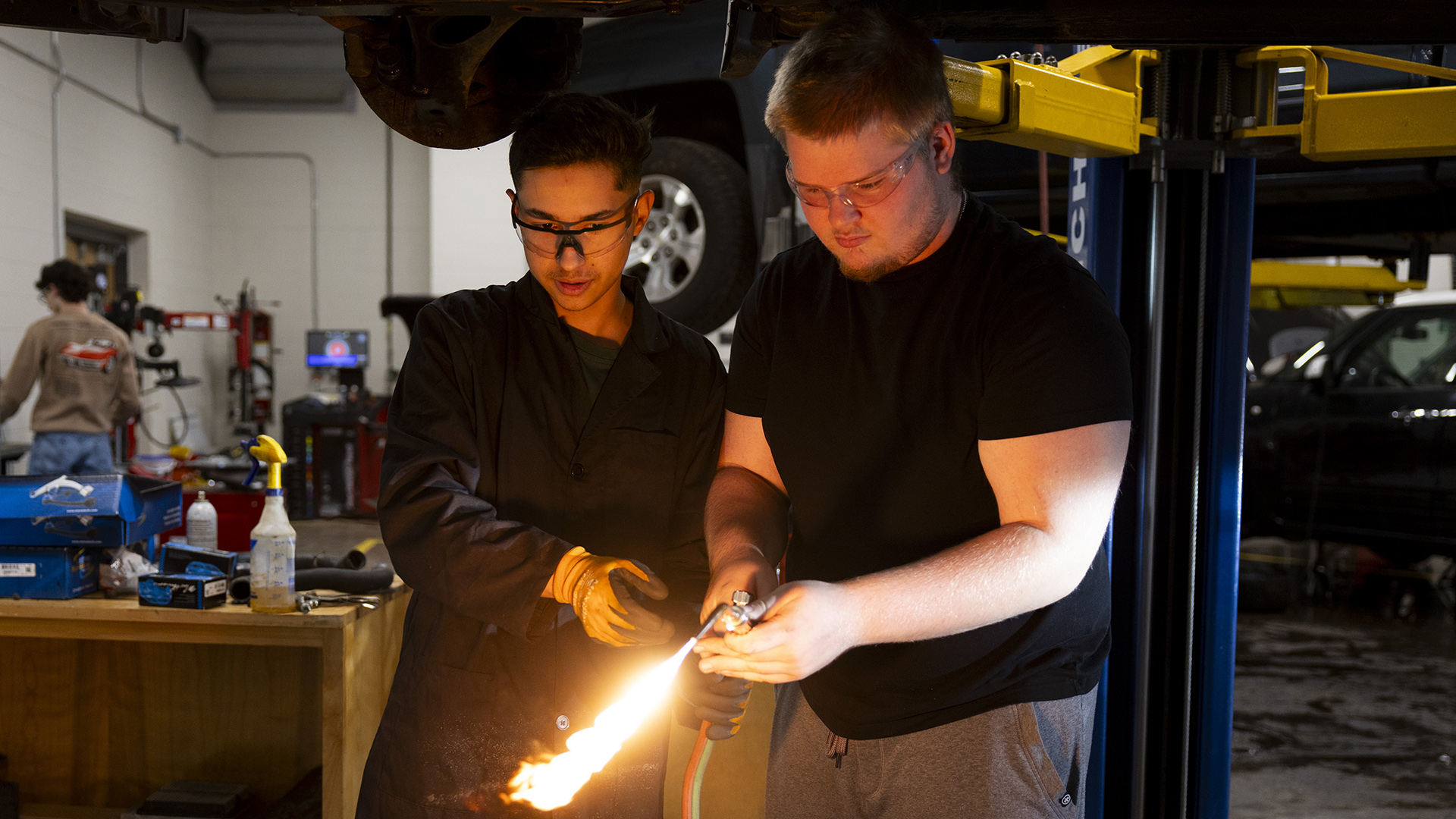
Edduar Beperec, left, and Lucas Pearl adjust the valves of an oxygen-acetylene torch while working on a car during an Auto 3 dual enrollment class on Nov. 12, 2025, at Vel Phillips Memorial High School in Madison. (Credit: Joe Timmerman / Wisconsin Watch)
In October, a group of Republican Wisconsin lawmakers introduced a bill aimed at making it easier for students to find dual enrollment opportunities. It would create a portal for families to view options and streamline application deadlines, among other changes.
It doesn’t address the shortage of qualified teachers.
“Separate legislation would likely have to be introduced addressing expanding the pool of teachers for those programs,” Chris Gonzalez, communications director for lead author state Sen. Rachael Cabral-Guevara, R-Appleton, wrote in an email.
As of Dec. 1, no such legislation has been introduced.
Miranda Dunlap reports on pathways to success in northeast Wisconsin, and Natalie Yahr reports on pathways to success statewide. They work in partnership with Open Campus.




Follow Us