

 Passport




It's a crowded Republican race for Wisconsin's 7th in 2026
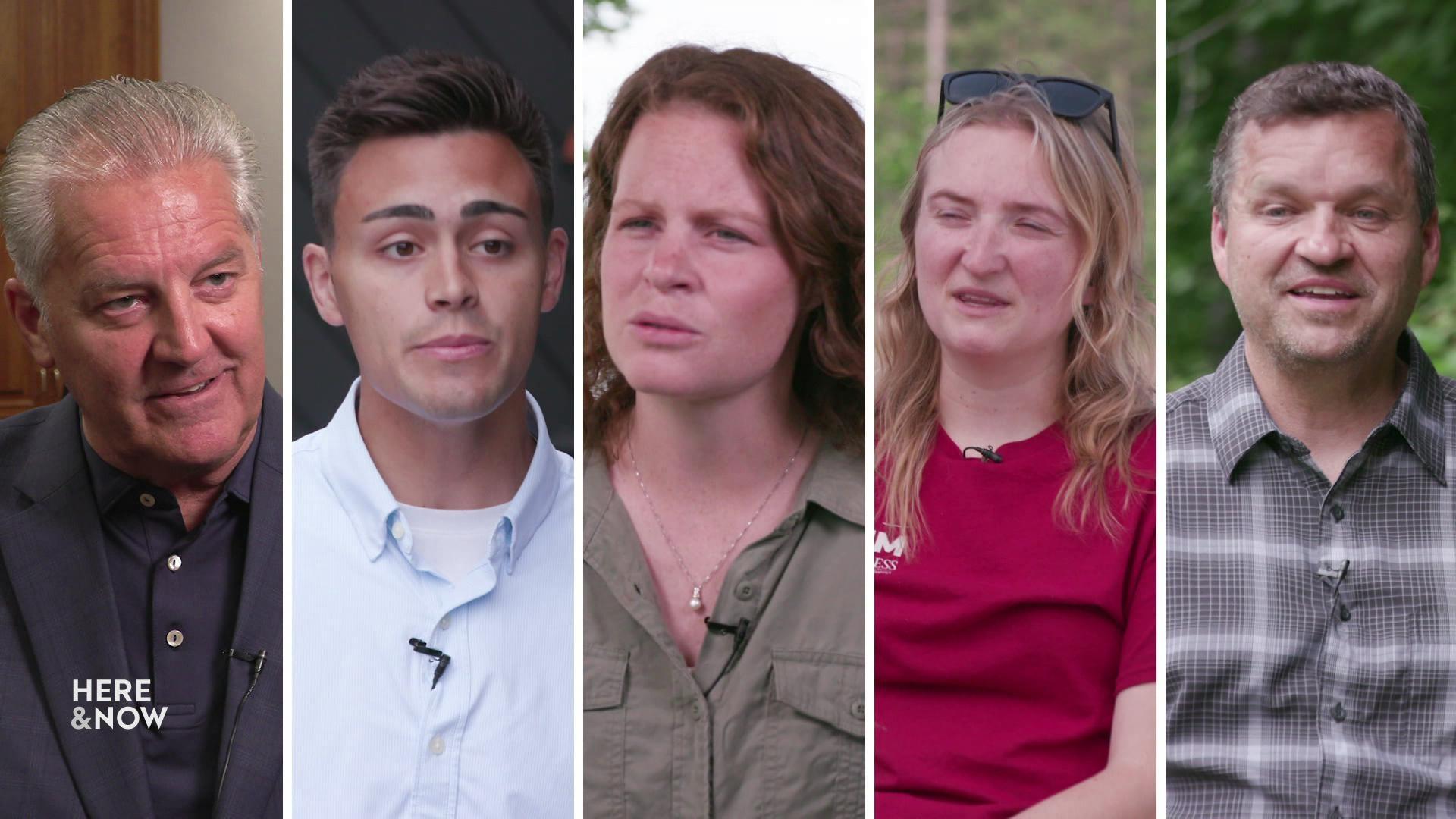
Wisconsin's 7th Congressional District is deep red, and its 2026 Republican candidates – Michael Alfonso, Niina Baum, Jessi Ebben, Kevin Hermening and Don Raihala — are making their cases to voters.
By Steven Potter | Here & Now
July 17, 2026 • Northern Region


Wisconsin's 7th Congressional District Republican candidates make their cases to voters.
“There’s a lot of motivation to elect people in the 7th District that will be Make America Great Again Republicans,” said Jackie Weissenburger, chair of the Republican Party of Rusk County.
The great North Woods of Wisconsin is known for many things: vast forests, abundant farmland, and some of the best lakes and rivers that the state has to offer. It’s also known as a very thinly populated region.
But there is something that’s become far more crowded than usual in 2026 — the ballot in a Republican primary for Congress.
In all, there are five candidates on the party’s ballot for the 7th Congressional District, which is on Aug. 11. The candidates include a financial planner, an accountant, a public relations executive, a marketing specialist and a home builder. They’re all after the seat being vacated by U.S. Rep. Tom Tiffany, who’s running as a Republican candidate for governor.
While they’re all Republicans, each of the five congressional candidates has different reasons for why they say voters should choose them.
Kevin Hermening — a financial planner from Wausau — was one of the U.S. Marines taken hostage for more than a year during the Iran Hostage crisis in 1979. He’s one of the better-known candidates in this race.
“I’m a grandfather. I’m a business owner, a school board member, a community volunteer. So there are a lot of reasons why I’m the best qualified to represent the voters here,” Hermening said.
Another well-known candidate is accountant Michael Alfonso, who lives in Hayward. He’s the son-in-law of U.S. Dept. of Transportation Sec, Sean Duffy, who held the same congressional seat from 2011 into 2019.
“I’m just an average kid from northern Wisconsin. I grew up in Land o’ Lakes,” he said. “I bring the energy of a 26-year-old. I’m at every single county in the district. I’m representing every voter.”
Then there’s public relations executive and Stanley resident Jessi Ebben, who has farming roots in the district.
“I am a Christian conservative, a Trump Republican, a proud seventh-generation Wisconsinite who’s committed to getting the government off our back, out of our way of life so that we can flourish and prosper right here in rural Wisconsin,” she said.
Also on the ballot is Rhinelander resident Niina Baum, who owns a marketing agency and was born and raised in the North Woods.
“I grew up in the district in Price County on a dairy farm, a small farm with about 25 milking cows. And there were a lot of small farms in my community when I grew up and they all disappeared,” she said.
And finally, there’s Don Raihala, a native and resident of Superior. He works in home construction.
“This is my fourth time running for Congress. I did it in 2010, 2014, 2016,” he said. “I have this time and all this energy still. I’m 58 years old, but I just know I can get out there and represent people,” he said.
The 7th Congressional District stands out for a few reasons. First is its size. As the state’s largest congressional district, stretching across 20 counties and nearly 19,000 square miles of northern and central Wisconsin. The economy in the region is anchored by agriculture as well as forestry, manufacturing and tourism.
Politically, however, the area has seen significant change in the last couple of decades. Driven largely by redistricting, the district is now among the most reliably Republican strongholds in the state.
“They’re very Republican,” Weissenburger said of her fellow residents. “People here really appreciate the values of hard work, having individual freedoms, being able to live their lives as they see fit.”
She said the race for the state’s 7th Congressional District has national consequences.
“There’s a very big risk at midterms that the House will turn blue, and I think that it’s this particular race itself in the 7th District will be, it’ll be somewhat of a barrier against that happening,” Weissenburger said.
While it’s certainly possible that the district’s voters could elect a Democrat — and there are three of them on that party’s primary ballot — elections experts say that prospect is fairly unlikely. In the 2024 election, voters in the 7th Congressional District chose both Tom Tiffany for U.S. Representative and Donald Trump for president by a 20-point winning margin.
The candidates have been working hard to get voters’ attention — and letting them know they understand the issues that are important to them.
According to polling, Alfonso is leading the pack. He also has the endorsement of Trump.
“We’ve seen kind of this mortgaging of the middle America, the manufacturing jobs, so that we can benefit the coastal elites. I don’t like that,” Alfonso said. “When we talk about rising costs, maybe the tariffs contribute to that. But President Trump understands that this is a short-term plan. We’re going to be working to bring back the jobs we lost overseas, right back here to northern Wisconsin, and then we can start removing the tariffs.”
Number two in the polls is Hermening — who has given about $1 million dollars of his own money to his campaign.
“When people decide to call central and northern Wisconsin their home, they’re saying to the rest of the state, ‘We’d like you to be involved, but we don’t need you to control our lives.’ And so, it’s a big reason that I love living up here, because of the individuality and the willingness of people to pull themselves up by their own bootstraps,” he said.
Ebben says her priorities center on land, wolves and jobs.
“A lot of the issues here are a battle of our way of life. So it’s everything we’re seeing right now with solar panels and windmills being targeted to be put on our farmland and the fight that we have to save our rural landscape, our family farms from bad energy, bad energy policy,” she said. “There’s really a big battle to delist the gray wolf. We need to make sure that that hunt can be localized right here in our state.”
Ebben also stressed employment needs.
“And I work in manufacturing — so, making sure that we have good manufacturing jobs that the government isn’t the barrier for keeping those manufacturing jobs, keeping the manufacturers here in the rural communities,” she said.
For Baum — who’s riding a bicycle around the district to meet voters — she worries about the country’s financial future and wants regulation changes.
“The Social Security Trust Fund has been projected to be insolvent in a few years. And if nothing’s done about it, it’s automatic cuts of about 23%. That is going to have a — if that happens — that’s going to have a huge negative impact on our North Woods economy,” she said. “I’d like to see more zoning deregulation, making it easier, more attainable for people to actually build homes and more cost-effective and not all these barriers, like minimum square footage requirements or outdated zoning regulation.”
Raihala wants to make sure local residents maintain local control.
“I’m a big believer in referendums,” he said. “And referendums stop data centers dead in their tracks. If a city — let’s choose Wausau or Superior — if the citizens want to get together and put out a referendum and stop it, it stops right there because the state has given the power to local municipalities to do that.”
Just like names on the ballot, there’s no shortage of issues in this race. Among the issues these Republican candidates believe are important range from health insurance to immigration, housing costs to drug prices, job loss to manufacturing, farming to the Iran war, and tariffs to the Epstein files.
But there’s one topic that’s on the top of mind for all voters: the increased cost of everything. Republicans running for the 7th Congressional District are careful about how they discuss the economy and inflation, and what can be done to bring down costs.
Ebben said it’s all about energy.
“The cost of energy is really the baseline that starts a lot of the inflation,” she said. “So the best thing we can do is have good energy policy to really start this — and that doesn’t mean solar or wind.”
Alfonso blames problems within government programs.
“Inflation, it’s a scary one. It’s caused by government overspending. I think the easiest thing to cut from the federal government is fraud, waste and abuse,” he said. “So much fraud in our system, so many people making money off of American taxpayers scamming them. If we want to shrink the spending, the easiest place to do it is get rid of the cheats.”
Hermening also blames the federal government, but in a different way.
“The government has a spending problem,” he said. “Government should not be borrowing for its ongoing costs of operation. When you do that, you run into, in our case, a $40 trillion debt. And so the government needs to understand that these are dollars that are intended for our communities. These are dollars that are best spent by the people who live here, who earn them, and that could play a big role in bringing down inflation.”
Baum said pricing problems start with the White House.
“Something we’ve been seeing happen a lot more with the current and past administrations is that a lot more has been passed through executive order, and I think that creates a lot of volatility, which affects the affordability in the economy.”
Raihala said he’s not sure what can be done about inflation, but residents need to do what they can for themselves.
“If you’re going to build a home, be your own contractor — be your own general. You’re going save 15% right off the bat. It’s going to take a couple phone calls and maybe a weekend here or there, but be your own contractor.”
With five candidates in this primary, they will be splitting the Republican electorate, and voters are spread far and wide across the rural district. The crowded race means it may come down to just a few percentage points — or maybe even just a few hundred votes — with each campaign having many miles to cover before the election on Aug. 11.




Follow Us