

 Passport








'Here & Now' Highlights: Kurt Kotenberg, US Sen. Ron Johnson, Chairwoman Elizabeth Arbuckle
Here's what guests on the April 17, 2026 episode said about developments in the Iran war, early spring weather emergencies, and a challenge to the reroute of the Line 5 pipeline.
By Frederica Freyberg | Here & Now
April 20, 2026


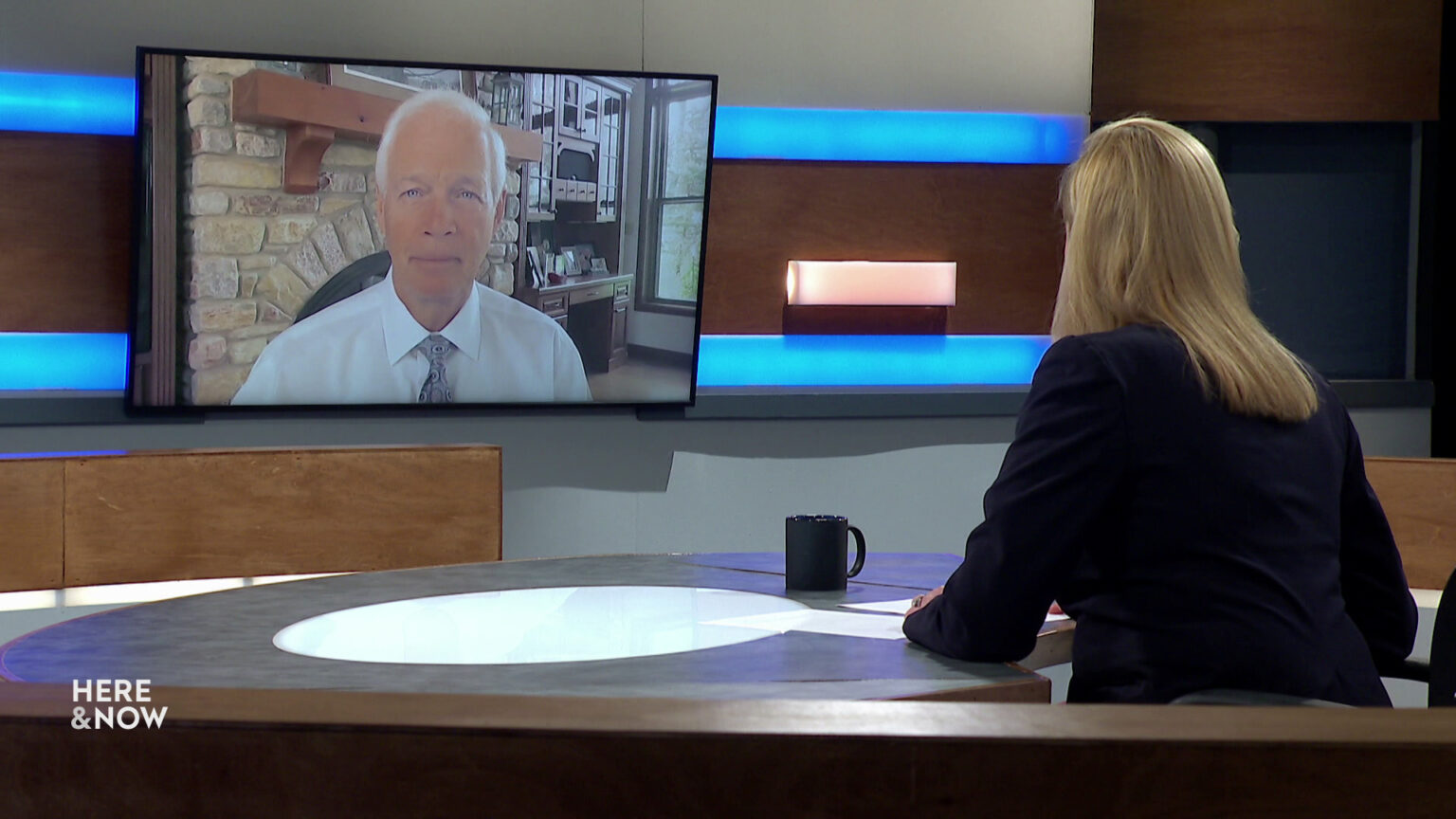
Frederica Freyberg and U.S. Sen. Ron Johnson (Credit: PBS Wisconsin)
Kurt Kotenberg, a meteorologist and regional director with the National Weather Service , said an early spring string of stormy weather toppled many records. U.S. Sen. Ron Johnson said he doesn’t like war but supports the actions of President Donald Trump toward Iran and elsewhere. Bad River Band of Lake Superior Chippewa Chairwoman Elizabeth Arbuckle said preventing more construction related to the Line 5 oil and gas pipeline in northern Wisconsin is a keen priority.
Kurt Kotenberg
Regional director, National Weather Service
- On April 15, Gov. Tony Evers declared a state of emergency in Wisconsin following a series of severe storms, tornadoes and flooding that started two days earlier, causing damage around the state but particularly in its eastern areas. Flood warnings were issued for multiple areas, with another round of severe weather accompanied by multiple tornadoes struck western and central areas of the state on the night of April 17. The National Weather Service reported that many records fell across the state. Kotenberg described the historic nature of the weather pattern.
- Kotenberg: “It’s wild. So this past Tuesday the 14th, statewide we issued 78 of those severe warnings, tornado warnings, flash flood warnings. That’s the fifth most active day in state history period for us issuing warnings. So that includes June, July, May — like the fifth most active they happened here in the middle of April. And then yeah, the flooding, especially the Wolf River in Shiocton and New London — those are record highs. So going back to 1922 was the previous record. In any of our lifetimes, we have not seen this type of flooding across east-central Wisconsin. I was working with someone or talking with one of the emergency managers there, and they said that the Wolf River is so high — there’s lots of sturgeon in the Wolf River — that there’s actually sturgeon in people’s front yards. And so we’re going to have to coordinate with the DNR once this is all done and the water starts receding, like there’s going to be sturgeon that needs to be netted out of people’s front yards. Like, you know, just unprecedented things in any of our lifetimes. So yeah, just terrible, terrible flooding and terrible weather here across Wisconsin.
U.S. Sen. Ron Johnson
R-Wisconsin
- Fragile ceasefire agreements between the U.S. and Iran as well as between Israel and Lebanon led more recently to Iranian officials declaring that the Strait of Hormuz was once again open for ship traffic. Barely a day later, though, Iran once again declared the waterway was closed and fired on ships. The day-by-day of the war and posturing by President Donald Trump led U.S. Rep. Mark Pocan, D-2nd Congressional District, to call the war with Iran “chaos piled on top of chaos.” Johnson responded to that characterization.
- Johnson: “it is war — messy. Is it chaotic? Sure. I don’t like war, but we had to act before we weren’t able to act, before they became a nuclear power, before they had so many missiles and so many drones that taking this action would have devastated the region. It’s been destructive enough. But again, so I support President Trump’s very difficult decision. This is good news. I think, you know, we have dramatically degraded Iran’s capability to be a state sponsor of terror, to develop a nuclear weapon, to hold the Strait of Hormuz hostage. And I think this latest blockade is certainly proving its worth in bringing Iran finally to the negotiating table and forcing to — force them into what should be as close to, you know, unilateral disarmament and just, you know unconditional surrender as possible.”
Chairwoman Elizabeth Arbuckle
Chairwoman, Bad River Band of Lake Superior Chippewa
- On April 16, an Iron County Circuit Court heard a motion to reverse state permits issued for construction to reroute the Line 5 oil and gas pipeline across northern Wisconsin. The first work on the reroute was started in February, even as the Bad River Band and environmental groups brought the latest challenge. The pipeline is slated to be rerouted around the reservation, but Arbuckle said environmental concerns remain.
- Arbuckle: “There’s lots of reasons to be worried or concerned, and one of them is when they do the construction, they are going to be stirring up mercury deposits from acid rain from decades past, and those have settled. So when they come through to do that, that’s going to stir up these deposits, which are then going to go directly into our waterways. You know, they are just hugging our reservation. It’s not like they went miles and miles away. It’s literally a stone’s throw from our land, reservation boundaries. And that is going to stir up these mercury deposits that have been in our wetlands and go into our water and go in the Lake Superior. You know, we’ve already got — we already have mercury deposit warnings and can only eat one walleye a week or a month, depending on your age and gender. And that’s problematic. So if we get more mercury, that’s going to affect our fishing industry. It’s certainly affecting our Ojibwe culture, because walleye, for example, is a major part of our culture. So that’s what we worry about — the mercury upsets. We also worry about the blasting they’re going to do in the reroute, which is in the Penokee Mountains, just off the reservation. That’s another thing that we don’t know what we don’t know.”
Watch new episodes of Here & Now at 7:30 p.m. on Fridays.









Follow Us