


Jon Henkes on funding for and the future of WisconsinEye
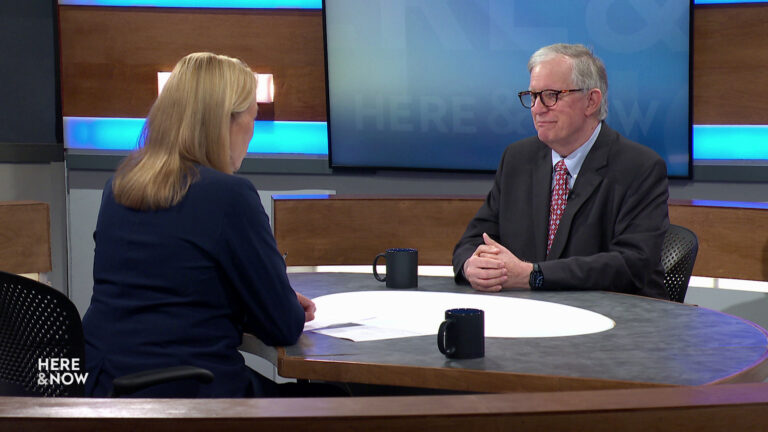
WisconsinEye CEO Jon Henkes considers how a funding shortfall led to the public affairs network presenting video of state government proceedings to go offline and options for any future operations.
By Frederica Freyberg | Here & Now
December 19, 2025
Jon Henkes on a funding shortfall causing WisconsinEye to go offline and future options.
VIDEO TRANSCRIPT
Frederica Freyberg:
The Wisconsin version of C-SPAN has gone dark. WisconsinEye now shows this message on its website saying it is off the air. The private nonprofit service started in 2007, providing live and archived online and cable TV coverage of state government, but money to run the operation ran out. WisconsinEye CEO Jon Henkes joins us now, and thanks very much for being here.
Jon Henkes:
My pleasure. Thank you.
Frederica Freyberg:
So what has been the reaction from the WisconsinEye audience to the fact that it went off the air?
Jon Henkes:
Different audiences have slightly different takes on the reaction. On the positive side, we have seen an outpouring of small gifts made via online, the likes of which we've not seen. So, in a period of about two weeks, we've generated almost $60,000 in gifts ranging from $5 to $1,000. That's been very encouraging, and it says that citizens at large really do care about WisconsinEye's future. Disappointing to a degree has been we've not heard from those larger donor philanthropist types who are capable of supporting WisconsinEye, and we know that they value it. From the perspective of elected officials, they are anxious for WisconsinEye to light up the archive, which can happen very soon, as well as return to full coverage of live events. So, there are discussions going on behind the scenes right now. Our credit goes to the elected officials and the Legislature and the governor's office. These are the folks who, over time, different people, but the same bipartisan sentiment, have said unequivocally that an independent approach to state government coverage is the Wisconsin way. And so while we have run out of money from our main and primary funding source, which is private philanthropic dollars, we believe there's a solution that is embedded in the set aside money that the government has made available in a dollar-for-dollar matching campaign. So, we're optimistic. There are conversations going on behind the scenes right now, and I believe that that same sentiment of support will express itself in a solution that is viable for WisconsinEye to carry forward.
Frederica Freyberg:
Because I know that you were hoping for $10 million in state funding, but that had to have those matching funds, as you just talked about, from donations. But was that ever a realistic goal? And how are you working around that? Are you able to get some of that state funding without having to do the match?
Jon Henkes:
Well, to answer the first question, looking back now, obviously, hindsight is 20/20 vision, but we did not anticipate the difficult philanthropic environment a year-and-a-half ago when we first began to solicit funds for the endowment. That was a failure, frankly. The competition for large dollar gifts was not in the cards for WisconsinEye. We made almost 50 requests — well-cultivated, well-developed proposals to individuals, businesses, and foundations — totaling $9.2 million, and all were declined. So that was a huge setback for us. Now, looking forward, the hope is that by state action, those dollars that had the match requirement can be released in some portion, in whole or in part, to help WisconsinEye move forward. And the ideal situation would be this. If the state were to take those dollars and peel off one year of operating budget for WisconsinEye — which is less than a million dollars — take the remaining amount and invest it, and then the earnings would then flow to WisconsinEye. So, let's run some numbers real quick here. There's $10 million or thereabouts in that account. If you take a million out to support our operating budget for a year, get this back on track, not have to worry about raising donor dollars and focus on our delivery of product, and those remaining dollars would earn, say, 7% — well, that amount would cover about two-thirds of our operating budget going on, and we know that we can raise that remaining amount through two reliable and predictable revenue streams, one of which is sponsorships, not unlike what public broadcasting does, and the other is this, what we've discovered more recently, is an ongoing desire for smaller gifts to be made to the network. So, to summarize, if the governor and Legislature were to step in in a way that would help us from our perspective as the best course forward, it would be cover our operating budget for one year, invest the remaining amount, flow the income earned to WisconsinEye, and then WisconsinEye is responsible for raising the remaining amount. To give it a little perspective, Frederica, you know, we operate bare bones. Our budget is less than a million dollars a year, and we're modeled after TVW in Washington state. When we first envisioned WisconsinEye nearly 20 years ago, we visited Washington state's channel several times, and their commitment to an independent approach was what really fueled our desire to follow in that lead. But that network has now grown to become a state-funded network. I mean, their annual state allocation is $6 million. They've got 36 employees. We've got five employees and a budget of less than a million, and we're producing on a busy day in the Capitol up to 10 or 11 events, five of them simultaneously live. So, we can make a very strong argument that this is a lean operation that delivers quality at a very affordable price.
Frederica Freyberg:
How close are you to sealing the deal of which you speak, where you get that million dollars from the state to go forward?
Jon Henkes:
Yeah, I don't want to be presumptuous. I mean, that is what our board has expressed to leadership in the Legislature and the governor's team. So those conversations are, I would say most accurately, at the beginning stage. I mean, the goal here is to be on the air in January when the Legislature comes back in full session. Our goal would be with a really good sense of direction on this, and a shared commitment — next week, we could turn the archive back on. So, with some simple assurances of forward progress, I believe we can achieve both, reactivate the archive quickly, and be on the air in January.
Frederica Freyberg:
What kind of bipartisan signals are you getting that this will work?
Jon Henkes:
Well, we know in meetings with Democratic leadership in the Assembly and Senate, there have been conversations with the Republican Assembly Speaker, and they are all in unity about we've got to do something to keep the network moving forward. Conversations with the governor's office are similarly positive right now. I'm not going to predict what the final outcome of that state involvement would be, but all signals are right now that there's an interest in keeping WisconsinEye moving forward as an independent entity. So, I mean, a little perspective here. From the start of WisconsinEye to build it out through today — WisconsinEye has raised, non-state dollars, we have raised $26.1 million. The state's investment for the 18 years we've been on the air has been $1.2 million, or about 4%, 4.5%. We think we've delivered one heck of a bargain to the people of Wisconsin through those philanthropic dollars that for 18 years has provided this continuing service of public access to the Capitol. So we're proud of our record. We just hit a significant philanthropic shift in donor preference, in donor competition, and it's not a sustainable model moving forward. So, with those $10 million already earmarked, we're not asking for new state money. These dollars have already been allocated toward WisconsinEye, we just need to find a way to get that match requirement reshaped or removed in order to release those dollars.
Frederica Freyberg:
So in your mind, is the Democratic legislative proposal to kind of embed WisconsinEye into a state agency not on the table for you?
Jon Henkes:
No, I mean, that created a bit of a frustration for us, because there are some donor asks out in the field right now to help bridge this short-term gap. The last thing we needed was that messaging to go forth. In fact, in conversations with leadership, there was a level of disappointment expressed that that came out of nowhere, and leadership was not engaged in that conversation. So, I'd say that is not something we're worried about.
Frederica Freyberg:
And so once again, we could potentially expect in coming weeks to see that webpage go from, "We are off the air," to, "We're back, watch us now"?
Jon Henkes:
Correct. Absolutely.
Frederica Freyberg:
All right. Jon Henkes, thanks very much.
Jon Henkes:
Thanks.
Passport


Follow Us