This week on "Wisconsin Life": Meet a professor digging into the past, an artist with a refreshing perspective, an organist hitting all the right notes, and a competitive judge of cheese. It's all ahead on "Wisconsin Life". Funding for "Wisconsin Life" is provided in part by Alliant Energy, Lowell and Mary Peterson, and Friends of Wisconsin Public Television. -I'm Angela Fitzgerald. Welcome to "Wisconsin Life". I'm at the extraordinary Dells of the Eau Claire County Park, only there are no waterparks in these dells, only waterfalls. And we're nowhere near the city of Eau Claire. Rather, this 190-acre park is in Marathon County and got its name because of the dells that were shaped by glacier melt water and now the Eau Claire River. Visitors have the opportunity to enjoy the scenic overlook or take a close look at the dells with rocks that are more than 1 billion years old. This park is designated a State Natural Area and earned a spot in the National Register of Historic Places.
birds chirping
The park also offers campsites, beautiful hikes along the river, and a quiet swimming spot created by a dam upstream. I'll save the swimming for another trip and explore a bit more today on foot. But first, we travel from the great outdoors to a Madison music hall where an organist is pulling out all the stops.
"Guillaume Tell: Overture (William Tell)" Gioachino Rossini
My parents had a rule in the household that whatever the kids picked as a hobby they had to do until the end of high school, which puts a lot of pressure on a five-year-old. Both my sisters chose to play the piano and were terrible at it. I used to listen to their piano lessons. And after they were done, I would go and sit down and play whatever they were playing sort of by ear. Now I'm 26 and people are surprised that I play classical music. I look younger than I am and I think my age is younger than people would expect. I need to try to grow out a beard, but nothing happens!
"Die Kunst Der Fuge: Contrapunctus 1" J.S. Bach
multi-layered ascending and descending notes
I'm Greg Zelek and I'm the Principal Organist of the Madison Symphony Orchestra and the Curator of the Overture Concert Organ.
classical pipe organ music
It's a very physical instrument. It's not just your hands, it's also your feet.
accelarated classical music
This particular organ, it's very unique to Madison. The console's moveable, so we can put it anywhere we want on the stage. So you can really see the organist doing his thing. The facade of the pipes and the design are meant to look like the rolling hills of Wisconsin. When people come in, they're in awe of it.
classical organ music
Inside of the organ chamber, there are 4,040 pipes. And the reason that there are so many is that per each individual stop, or sound, on the organ, there is a pipe for each note of the keyboard or pedalboard. They all reside in this moveable chamber and the whole thing weighs 174 tons. It is believed to be the largest moveable object in any theater in the world. Most of the time, the only experience people have with the organ is the "Toccata and Fugue in D Minor" at Halloween...
suspenseful music, "Toccata and Fugue in D Minor" J.S. Bach
...and baseball games.
Da da da DUT da DUH "Charge" fanfare
And yet, the organ has some of the richest repertoire in all of classical music. So, how do we get people to come and hear what that is?
crowd murmurs
You will actually be going just past the bar over there.
beep
Announcer
Ladies and gentleman, on behalf of the Madison Symphony Orchestra, welcome! Thank you for joining us and enjoy the concert.
applause
Announcer
I feel extraordinarily fortunate to be in the situation I'm in, to be able to share this music with people. And to be the curator of an organ in a space like this is unbelievable.
classical organ music
Announcer
There's nothing more engaging to an audience than their sense that you're having an incredible time doing what you're doing. And I feel like I have a responsibility to express that this music is worth listening to.
"Die Kunst Der Fuge: Contrapunctus 1" J.S. Bach
wondrous and haunting melody
Announcer
I mean, I feel proud. And I want to show everyone around this country what an incredible thing that 250,000 Madisonians have at their disposal all the time.
final punctuated notes of "Die Kunst Der Fuge: Contrapunctus 1"
cheers and applause
Announcer
Connecting with the world around us can inspire us to create something extraordinary. That's true for an artist in Ripon.
paint spatula clicks and scrapes
Announcer
The best art criticism comes from the proper perspective. These were the issue we were talking about that the flags are not-- They work, but they don't work. You need to understand where the artist is coming from, but you can't be so close you don't see the flaws. Rafael Francisco Salas understands that. I sit in this chair and I'm staring at the work and trying to imagine myself as a viewer who has never looked at the work before. As an art professor at Ripon College and an art critic for the Milwaukee Journal Sentinel, he knows criticism is a part of the process. Some of this stuff is an error and I have to fix it. But good criticism requires some distance, an outside perspective.
So I ask the same questions
What's working? What isn't working? What's pretty? What's not pretty? Is it smart? Is it really stupid? He uses a chair in his studio for reflection and even uses a chair in his latest installation to allow the audience to gain the proper perspective. So the idea is that one is sitting here watching TV at one in the morning. All those beers belong to the sitter. Rafael understands not everybody will get the message in his artwork and he acknowledges that by painting in pixelization. Everything we see is mediated by screens so any time I use this and I use it a lot in my work, I'm acknowledging the fact that paintings in our life and our viewpoints are kind of glitchy. Rafael was seemingly born with an outsider's perspective. He just had a different way of looking at the world. Barb Salas remembers her son as mostly happy, growing up on a farm outside Ripon. He was always living in his own... very much living in your own world. Yeah, I always felt very internal. I was always thinking about something else. Rafael takes much of his inspiration from rural America but it's not about sunsets and wheatfields. His artist's statement talks about a "dream continually beyond reach." My own moods and my own outlook on life is often-- There's a darkness there. And so my art work has always sort of reflected an element of bleakness or sadness. Rafael explains that with a white mother and a Mexican-American father, he struggled to find his identity. But I have to say a mixed race identity is hard. It's hard to sort of know. Do I have an authentic view of Mexican culture? Do I have an authentic view of rural white culture? And the answer is 'yes and no'. I don't assume that the rural white community gets what I'm doing necessarily. And I don't assume that the Mexican-American community gets it either.
country music
So I ask the same questions
He found comfort in the country music his father listened to.
country music
So I ask the same questions
As a five-year-old kid, I'd be listening to murder ballads by Johnny Cash and Waylon Jennings. So, I'm using them. I'm kind of recreating album covers. So this is Willie Nelson's "Red Headed Stranger" kind of redone. I always liked country music. My work always had a certain kind of darkness and I realized at some point that these country music artists were trying to describe a rural experience and I was trying to describe a rural experience. Musicians are a recurring motif. If a barn could sing or if the sheep could sing or if the country or the landscape could sing, what would be the song or who would be singing? So these are kind of archetypes for the land and rural culture in general. After high school, Rafael needed to leave rural Wisconsin to gain the proper perspective. So, it was in New York City that Rafael started painting barns. I started to reconnect with Wisconsin while I was in the middle of Brooklyn, New York, and that creative distance, I think, was really good for me. Eventually, life led him back to Wisconsin and to Ripon College. It's something I tell my students as well. I think it's really important to leave a place of comfort and to find a way to remove yourself from what's known.
woof!
So I ask the same questions
Rafael still returns to his mother's sheep farm to help out.
baaaa
So I ask the same questions
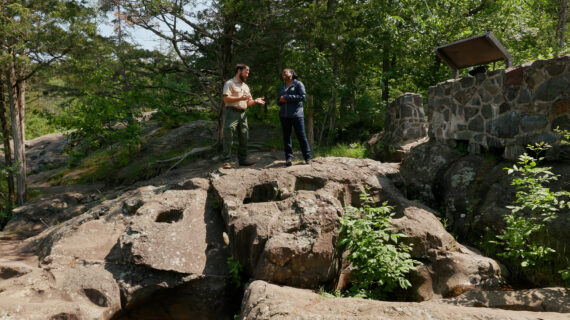
I'm still inspired by the landscape and its moods. Immersed in art, Rafael is comfortable with who he is and his own perspective. My work just sort of comes from this world view and it's how I see it. You know, I try to make work that is truly beautiful but I also understand that that's not -- it's not going to necessarily reach everybody. I'm in Marathon County enjoying the sights and sounds at Dells of the Eau Claire Park. In order to gain a deeper understanding of the special geology found in this park, I met up with Dr. Keith Montgomery, a glacial geologist and professor of and geology and geography at UW-Marathon County.
playful music
So I ask the same questions
Sometimes you have to get off the beaten path to discover a place's hidden history. The Dells of the Eau Claire provides a perfect path to the past. We're standing here in the south unit of the park. It's very quiet. We're sort of inside the bend of the river here. But the rocks here tell us of a much more violent past. The rock type here in the first instance was a lava. And a very explosive lava. The type of lava you would find in some of the more explosive earthquakes on earth such as in the northwest United States. And then, subsequently, as continents collided in this part of the world, well, 1.8 billion years ago, the continents were in very different configurations. This part of the world was in a different latitude and longitude. The continents did collide here and when they did, they ground up that rock. And so they created a type of metamorphic rock called a mylonite. And so, instead of having the minerals randomly distributed throughout the rock, as they would be in a granite, the minerals have been ground up, and you can see, they're all aligned in one direction. Just to the north, the Eau Claire River runs. The river has shaped the land as it is today. Tens of thousands of years ago the river did cut through here and what we see just over here is a bluff that one time was actually bore during the river, just as we find in the main channel today. So you can physically see remnants of that history that you referenced. - Oh yeah. You can see it in the rocks. The rocks tell us of the history. A history that many visitors are unaware of, but that doesn't stop them from enjoying the area. The Rust family has come to the park for a number of years. A lot of good memories here and I wanted to share it with my daughter. Aw... We like coming to the county park too because it's a little bit easier to get in, as well as the beauty of the Eau Claire Dells. And if you're camping, your camping site is very secluded from those around you. There are trees all around you. They have electric hook-up and there's some paved bike trails. And there's a beach just upstream, as well as the dells where the falls are. There certainly are trails for families like the Rusts to enjoy but as Dr. Montgomery reminds us, there is so much more to gain when you know the history. If you understand a little bit about geology, you can actually enlarge upon your appreciation of the environment if you can think of the processes that shaped the environment in the past. This park has a lot to offer and is worth experiencing in person. Next, we head to Appleton and continue our geologic exploration with a professor whose classroom is right under her feet. The local rocks, the Dolostone, tend to be bigger and blockier. I do love rocks. They have mysteries to share with us. And I don't think we'll ever get down to the bottom of all of them. We're in the Lawrence University Geology Department. So, everybody good? We put a big emphasis on field-based learning. And then all of a sudden, we have this hill that's very well drained. It's kind of dry-looking. It has much sparser vegetation on it. So, this is where students who have generally no background in geology may first encounter what I call "geologic logic." This thing's at least 15 meters high, which would put it at around 50 feet high. We try to instill in students a curiosity about what these rocks signify. I think the glacier sedimented all this stuff here from other places. They're not just inert objects. They're records of events that affected this part of the world as well as the entire globe. What kind of sediment did you encounter? Sand. Ok, there's definitely sand. These are all observations that will constrain our hypotheses about what formed this thing. I can't help myself. It's just an intrinsically interesting thing to be able to look at a landscape and read what happened in the past. It seems like a wild hypothesis; a deposit left by a sub-glacial river. But it is almost the only way to explain all the observations. Congratulations, you did figure it out and the name of this feature is an esker. Most of the people, including myself, who do end up in geology are kind of accidental geologists. They found it taking a required science credit and then stuck with it. I had grown up interested in landscapes and spending a lot of time outdoors. I did grow up in western Wisconsin, in an area where Cambrian Sandstones were exposed. I do remember going out with my father looking for trilobite fossils. Every day I'm grateful that I found my way into this field because it does have such explanatory power. Suddenly, it was like learning the etymology of a word. It was, "Here's the etymology of landscapes around us." We're up here on Cactus Rock. I would guess this is about red granite age, so that would put it at about 1.75 billion years old, the rock itself. This was either a high on the bottom of the sea floor or possibly even an island at the time that the Cambrian Seas came in. There are so many distinct chapters. There's the original formation of the rock. And then, it's probable burial during the time when we had marine sedimentation. Then it's unburial. Even before the Ice Age, it was probably being exhumed by rivers and other forces of erosion. We can also see evidence that the glaciers were here just the other day. And I can feel how incredibly smooth this is. The glaciers scoured off the landscape of Wisconsin. These crescentic fractures, too, are records of glaciation. They're called chatter marks. This is a classic, glaciated outcrop in Wisconsin. Any place has that sort of story if you just look a little deeper. All parts of Wisconsin have interesting and different stories. The northern third of the state, or so, are the oldest rocks ranging in age from about a billion years old all the way back to about 2.8 billion. We can see the guts of these ancient mountain belts and volcanoes. We have, in fact, a longer record of geologic time here in Wisconsin than all of the Grand Canyon. The rocks in the bottom of the Grand Canyon are relatively young compared to the oldest rocks in Wisconsin. These are ripple marks that formed when the sand was being laid down. I'm interacting with ancient waters that flowed over these sediments before they became rock. We can tell even the direction of water flow. It does take an active imagination. I think that's something interesting about geology is that it takes spatial visualization and it takes a certain capacity for imaginative thinking to think back to a time when the landscape was utterly different, and yet, it's tangibly still with us. You see how high this is. Imagine how much ice was over us to be a tunnel underneath a significant amount of ice. Geology is such an amazing lens through which to see the world. Wherever you are, there's something geological under your feet. It's reminding us that landscapes are ephemeral. They come and they go. That there have been other versions of this place and the globe, but we are also part of this immensely long story. So it doesn't diminish us. It should enhance our sense of wonder and connection to the natural world. For our final story, we're off to Plymouth to catch up with a judge of a delicious competition. At Masters Gallery Foods in Plymouth, Sandy Toney is the vice president, or "big cheese," of corporate quality and development.
phone rings
So I ask the same questions
Hey. I started at Masters in 1989 and then I was in quality. And after a while in quality, I decided I wanted to move on to the grading. At that point, the gentleman who took me under his wing was going to retire. So I started in the grading department, and I just... I loved it. Grading means tasting cheese from dairy producers every day. It's not as creamy, either. You're evaluating the product to see if you can run it in your facility, basically. It's a cheese lover's dream. It's a pleasant flavor. Sandy's skills come in handy here at the Biannual U.S. Cheese Championship. It's the American "Super Bowl" of cheese. So, it's appropriate that the 2017 event took place at Lambeau Field. Sandy's been a cheese competition judge since 2007. I think a good cheese judge has to have an open mind. They have to have extreme knowledge of the cheesemaking. Twisted, braided, a little everything. They have to be able to make a decision. That's because there are more than 2,000 entries competing for the title of United States Cheese Champion. Judges have to taste dozens of samples over two days. If you're a good judge, you can do 60, 70 samples and you can pick the winner out of those, easily. So, what makes a championship cheese? It's good. It cleans up in your mouth. You have no off flavors. It melts perfectly. There's no bitterness. I want a balance between all these flavors. And then at the end, I want it to clean up. And that's the key, where you don't have any aftertaste in your mouth. The key to every cheese is balance and cleaning up once you spit the product out. Regular judges wear white hats, but a select group of distinguished chief judges get to wear red hats. In 2014, Sandy got the call. One day I got a phone call and they asked me if I would join the "red hats." And it was an honor. It was exciting. How do you say "no" to that? Sandy's the first woman to ever wear a red hat. She serves as an assistant chief judge for both the U.S. and World Cheese Championships. She advises the other judges and makes sure the competition runs smoothly. Pepper. High heat. High heat. Good luck. I found out really fast that judging is a breeze compared to being a "red hat." It's exhausting.
chuckles
So I ask the same questions
You should be OK. Let me get you set up. It's... you work. Yeah. Sandy spends so much time around cheese, it'd be easy to get bored with Brie, sick of Swiss, or even fed up with Feta. That's not the case. No. In fact, when I go on vacation, I buy cheese, because I have to have it every day. They say there's an addictive thing to it and I agree, there is. I eat it every day. Spoken like a true Wisconsinite. Sandy's proud to play her part in one of the cheese industry's biggest events. The 2017 U.S. Champion came from where else? Wisconsin. When they hold up the championship cheese and the feeling that it expels from these people to walk up there and win. Out of 2,303 samples, they're the best. It's a great feeling. And it's fun. Wow! This park and area of our state is like nothing I've experienced before. Another hidden gem. If you would like to learn more about the people and places you've seen today, including the Dells of the Eau Claire Park, visit WisconsinLife.org. As always, we'd love to hear about your "Wisconsin Life," so send us your ideas at [email protected]. I'm Angela Fitzgerald and this is our "Wisconsin Life". See you on the trails.
birds chirping
mosquito buzzes loudly
So I ask the same questions
And it seems as though during our time together that you've built up an immunity to mosquitoes. A little bit. Yeah. So, is that a unique trait of a geologist?
laughing
So I ask the same questions
It has to be. Mosquitoes and horseflies. Thank you so much for having me, Dr. Montgomery. You're very welcome. Funding for "Wisconsin Life" is provided in part by Alliant Energy, Lowell and Mary Peterson, and Friends of Wisconsin Public Television.


 Passport

















Follow Us