Okay, get us blood flowing. Nekot... Nekot. Nis...
Nis. David Turney was not raised to do this. Suasek... Suasek.
Sakaew... Sakaew. Is that you? Yep, that's me.
He was born in Keshena, on the Menominee Indian Reservation. But as a child, he was not taught how to count to ten in his own language. He wasn't taught any words in Menominee. Everything he learned was from listening to the elders that still knew the language.
I knew some words. You know, I knew some little phrases. And sometimes I would, you know, I would try to speak it and some of my friends said, "Oh, don't talk like that. We don't need that." A generation earlier, the U.S.
government had forced Indian children into boarding schools where their native language was forbidden. So, you had them boarding school people that were scared to speak the language. Even today, during important public events, like the opening of the Menominee Cultural Museum, the old language is barely used. Okay, I'd like to get started.
speaking Menominee
A very historic day for the Menominee people. There's 9,000 Menominee. There's probably seven fluent speakers, First Language speakers. And they're in their late 70s.
speaking Menominee
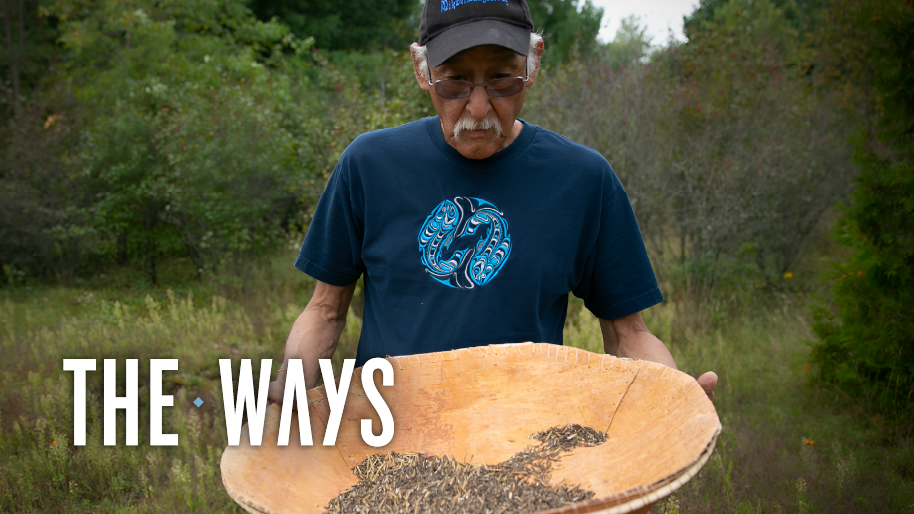
That history makes this summer school class on the Menominee language all the more remarkable. David Turney is known to these middle school students as Napos, his Native name. This grass, this reed grass, a long time ago, was used a lot by the Menominee people. On this day, they've made a field trip to the side of a highway to pick reeds for a class project.
Well, we use this for many things. One of them is for tying, making ropes. Napos was approached by the Green Bay Public School District a few years ago, to work as part of the cultural support staff. The district wanted to do a better job of engaging their large population of Native students.
One of the first things I came across was a misunderstanding in ethics of Native culture. Many of the teachers told the kids, you know, "Look at me when I'm scolding you." And in our culture, that's a no-no. You don't look at someone older when they're talking to you. You put your eardrum and you look away.
And so, they think that they're not paying attention, but that's our culture. Soon, Napos was teaching a small language class. [saying and repeating words in Menominee] That expanded into this summer school class. Napos says every student of his has some Native blood, but feels little connection with their Menominee heritage.
And overwhelmingly, it was language. You know, "I want to learn my language." But language by itself is not enough. Culture and language can't be separated. Which is why this class spent their time with Napos building a wikeum, known in English as a wigwam.
Napos knows what it's like to grow up without a connection to his heritage. He went to high school off reservation and then joined the Navy. There was always that thing that, about being Indian. 'Cause back in them days, it wasn't good.
By age 40, he was back in Keshena. That's when his mother's cousin came into his life. He came to me, and he was looking for someone to so-call "learn our ways." He took me under his wing and started teaching me, formally adopted me as his nephew. It was this uncle that gave him the name Napos, which means First Rabbit.
He told me, "Now's the time I'm gonna teach you how to teach." So really, his first lesson was about listening. [saying and repeating words in Menominee] Over the years Napos had learned bits and pieces of the language, but his uncle was expanding his mission. I sat there for a long time that day and just listened to him talk about the culture, the ways, the language, how important it is to take what you learn, to share it. He said, "It's not for you.
It's for everybody."
teaching in Menominee language
Napos knows the Menominee language will never be as widely used as it once was.
teaching in Menominee language
But that won't stop him from teaching those who want to learn. As for being too late, maybe, but let's not focus on that. Let's focus on what we can do. You all learned something?
teaching in Menominee language


 Passport









Follow Us