This week on "Wisconsin Life": Meet a renowned African playwright living in Wisconsin, an artist who seems to bring wood to life, a pair of archaeologists exploring past secrets in the Driftless region, and a college student taking extreme sports to the extreme. It's all ahead on "Wisconsin Life." Funding for "Wisconsin Life" is provided in part by Alliant Energy, Lowell and Mary Peterson and Friends of Wisconsin Public Television. Hello, and welcome to "Wisconsin Life." I'm your host, Angela Fitzgerald. I've got something fun in store for you today. Instead of going back to the future, we're gonna head forward to the past. Forward through the gates of Jurustic Park. You heard it correctly, Jurustic Park. A free sculpture garden located off the beaten path in the town of Marshfield. Every sculpture has a story and every visit comes with a one-of-a-kind personal tour from the artist himself. We'll get a chance to tour with Clyde in a bit, but first we introduce you to an internationally-acclaimed African playwright. Find out how life led her to make Eau Claire her home. Her name is Osonye Tess Onwueme. And Osonye means "If you like me, accept me the way I am. If not, leave me alone."
chuckles
Born into African culture, your name, your family, and your sense of place are highly valued. The food is part of the culture. It's a culture Tess brought with her when she arrived in Eau Claire. My children were very young, my five children. And I was a single parent trying to raise them. At the time I came, Eau Claire was... much less diverse.
chuckles
And the curriculum even more so. The position of Distinguished Professor for Cultural Diversity was created specifically for Tess. She also brought with her clout as a prominent African playwright. My work, my plays, my writing take me all around the world. And so, in a way, I'm like a culture ambassador for the UW-Eau Claire and for the UW System and for Wisconsin and for America. Her plays are infused with the rhythm of social justice. My heart hungers for peace. My eyes thirst for equity, social, political, you know, and racial and gender and just... harmony in the world. On this night, she's teaching a course on women in African literature. So I guess we can start now.
speaking Ebu
Osonye Tess Onwueme
Kweneu.
Class
Ayy.
Kweneu. - Class
Ayy. She offers a glimpse into her work called "The Reign of Wazobia." "The Reign of Wazobia" is about women in Africa. She begins to question why women are held back while, you know, men are privileged to do that "and that." "Wazobia" defies all tradition and, you know, goes...
chuckles
Kweneu. - Class
goes to town and organizes, mobilizes the women to rebel against the men. Tess's compositions come from the heart and the heartache of a personal narrative that fuel her writing. My mother ran away when I was six years old. I knew that I had no parents to care for me. I know what poverty is. And I also know what it is to experience abuse and violence and oppression and suppression. Maybe that's why I'm much more passionate and I have a very keen eye for... justice and for... equity. In colonial Nigeria, she was one of the few from her village to attend a Catholic boarding school taught by Irish nuns. I had a notebook. Every thought that came to me, I started writing it. That's how I started writing. Then on to college at the University of Ife in Nigeria where one of her professors was the first black person ever to win a Nobel Prize for Literature. One day I was writing, and then I began to feel the voices. It's like a new door was opened. I wrote a play. I said "Oh." And I was really happy, so happy, overjoyed, from then on, I started writing plays. By her late 20s, Tess would achieve greatness as an African playwright. Her name is now etched alongside other contemporary writers she is proud to call her friends. I was in a very privileged league with the older generation of women writers like Maya Angelou, Alice Childress, Sonia Sanchez. The big-name writers in African-American and Africa. It's a nice league to be in.
jovial laughing
Kweneu. - Class
All the accolades and accomplishments couldn't prepare her for one more surprise. It felt like... I was struck by thunder,
laughs
Kweneu. - Class
a thunder bolt. But the time that just provokes joy, ignites joy and terror at the same time because I quivered inside. In 2016, Tess learned in an email she had been nominated for the Nobel Prize in Literature, the most prestigious literary award in the world. I felt... very humbled. I felt... elated... and a heavy weight of responsibility as well. In the end, Tess did not win but another famous writer did. Bob Dylan, who is also an idol. I grew up in high school when we studied learning you know, and listening to music from the west. I... I... I loved his music. So he won it. And... To God be the glory. I'm happy. A collection of Tess's lifeworks are now housed in the UW-Eau Claire archives. In recognition of her accomplishments, the state of Wisconsin passed a proclamation in her honor.
I remain me
I'm simple... rootsy...
chuckles
I remain me
rootsy... striding... walking tall in my African identity anywhere I go. Before we take a close look at the sculptures located here at Jurustic Park, like these guys, let me share the story of how this Wisconsin wonder came to be. Clyde worked as a lawyer before creating his first metal sculpture. He fell in love with the art form and quickly taught himself the craft. Clyde is now 83 and retired. Clyde's wife, Nancy, is also an artist. She works with glass in her studio or as she likes to call it, her "hobbit home." Before we head inside for a demo on glass art, let's head to Niagara to check out the work of another artist in this next story.
soft guitar music
I remain me
In 1998, '99 I attended a couple local wood carving shows here in our area. And the first show I went I was attracted to the fish carvings. And I decided right there, "I have to give this a try." My name is Roger Newhouse and I'm a fish carver from Niagara, Wisconsin.
jig saw whirs
I remain me
In the beginning, it was very challenging for me. But, now that I've been doing for a while I'm confident that, you know, I can carve just about any fish in the sea. I go out and I catch real fish and I make patterns off of those. All of the techniques I have, they're kind of classified material. Nobody's seen 'em before. I didn't have a teacher or anybody around here that carved fish. It was up to me to learn how to do this on my own.
high pitched sanding sound
I remain me
I didn't get started 'til I was 55 years old. I'm kind of a walking, living, breathing miracle. I was abused a lot when I was younger and I found out alcohol was something that worked at the time for killing the pain. So I became addicted to that. I was in the U.S. Army during Vietnam War. I had a... I had a hard time after the service. I was homeless for a number of years. And then... I went and got myself sober at Alcoholics Anonymous on October 10th, 1977. And I haven't had a drink since and that's been 40 years ago. I don't have to sit here and lick my wounds and say to myself, "Boy, it's a lousy day. I'm hurting today."
soft grinding
I remain me
I keep busy from the time I get up till the time I go to bed.
soft string music
I remain me
I just enjoy the thrill of the creating things out of wood.
soft music
I remain me
It's really kind of nice that I can go out into any lake I want, catch a fish out of that lake, bring it home and replicate it in a piece of wood. After about 13 months of carving, I got bold to go to the World Fish Carving Championships that year held in Springfield, Illinois. And I ended up winning eight world ribbons including a first in the world for "Best of Category." And when I look back on all that, it's just like, "I can't believe all of this good has happened to me."
soft guitar music
I remain me
If people are struggling like I did in the beginning, and struggled for quite a few years on their own, my best advice is, "Get some help for yourself." There's strength in numbers. Never give up. Always look up. Never look down. The answer isn't down, it's always up. Look up. The grounds of Jurustic Park might feature large metal sculptures but in this hobbit house, there are much more fragile art forms being crafted by artist Nancy Wynia. Thank you for having us today, Nancy. Thanks for being here. This is fun. Let's put on our safety glasses and see what you have to show us. I'm going to light the torch and this is burning oxygen and propane. And it's burning at about 3,000 degrees. Wow. So staying far away. Yeah. Right. I'm going to get that warm but it doesn't have to glow. My glass I'm going to melt-- this is my coolest part of the flame, but it's the hottest right here. Right in the center? Yeah, just above those little candle parts there. Now it is molten or liquid and I'm going to catch that drip on there. Ok, now I just have a blob of glass on here, no special shape. So if we love that shape, then we're done? Well, if you love the shape.
laughter
I remain me
I'm gonna get it really, really hot. This is called a marver. I'll roll it on there and get the hole pretty much in the center. Let's do something fun with it. That's looks a little bit prettier than the original version that I was going for.
laughing
I remain me
This is called a stringer. It's easier to decorate the bead. I'm going to use lines. Tell me how you got into bead making, or just glass blowing in general? I needed buttons for a sweater. Oh, really? - Yeah. That's what got you to this whole process? That's right. Look what happened.
laughter
I remain me
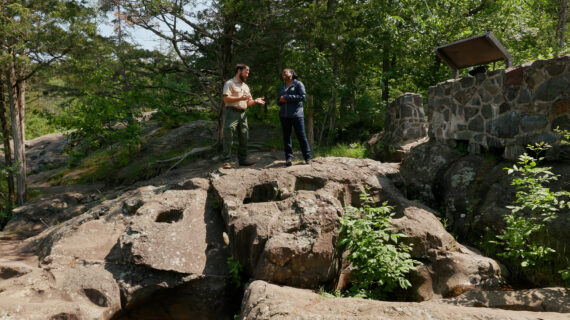
Yeah. I had-- you know, you go and shear the sheep and then you process the wool all the way through to the finished product. And I wasn't going to put plastic buttons on it. Okay, now we have the bead is made. It's hard. And now, I'm going to put it in the vermiculite so that the heat can equalize in the glass and cool down slowly. We'll have a finished bead. Yes, we will. Indeed. Wonderful. Thank you so much for the demo, Nancy. Thanks for coming. Speaking of discovering new things, the Viroqua couple in this next story showed our "Wisconsin Life" team the work that goes into restoring a native prairie to its past glory. So this was all burned this past year. You see all the green coming up now. In early spring, there's an amazing view from this hill, overlooking a valley in the Driftless region in Vernon County. We get more and more prairie grasses down here. But whenever Jim Theler and Suzanne Harris climb "the mound," as they call it, they are constantly looking down, looking for new plant species that have emerged from the past. There are some 250 known species of plants on that hill, native plants. And so if we see a flower or something we don't know, then we'll have to research it and find out. Garter snakes and milk snakes won't bite. Abbie only got bit once. For that kind of help, they often turn to Abbie Church, the director of the local conservation group working with Jim and Suzanne. This is a classic hill prairie or goat prairie. Jim bought the mound from a neighbor in 2003. It was overrun with red cedar and prickly ash, but Jim knew it contained a secret past. It was once a hillside prairie and an oak savanna. I could see the remnant prairies in there. They're really quite small, but I thought if we could open it up, it would allow those to spread.
breathing with exertion
I remain me
They started with a chainsaw and sweat. We started clearing paths and paths turned into fields and fields turned into prairie. And it was great. Soon burr oaks emerged from the forest to stand guard over the hillside. This tree we cored in 2003. It had 185 rings. So today that makes this tree just about 200 years old. This tree began growing 30 years before the first European moved to this township. Then this old oak saw something else
it likely hadn't seen since before the first Europeans
fire. Eventually we started getting some very small burns. And now we can do pretty large burns. Controlled burns cut down the woody vegetation and allowed new plants to emerge from the seed bank buried in the soil. We brought in no seed. It was just the natural area. And it's literally spread out on its own. That seed bank was probably all there. As spring moves to summer, new plants emerge. The area up above here, you can see, is all full of the pretty yellow Puccoons and Birdsfoot Violets. And there will be just a changing season of flowers all throughout the year. But the seed bank is not the only buried history on the mound. People did occupy this briefly. On the eastern face, there's a rock shelter. There's more than a meter of deposits from ancient native peoples that lived here. This goes back about at least 3,500 years based on the style of artifacts we found. Jim and Suzanne are both archaeologists. These are about 5,000 years old. These are 3,000. They believe the shelter was used as a hunting camp by many different Native American groups over thousands of years. Right here is where we get the introduction to the bow and arrow. The projectile points, pottery, tools, elk bones... Fifteen or eighteen hundred years ago, these particular bones here....added with the native plants and animals make this mound something Jim and Suzanne felt they must preserve. So it has both warm plants from 5,000 or 6,000 years ago that nobody brought in. They were just there on the south face. We can go to the north face and we have small animals, snails that are from the Ice Age. So you think about one hill having all of those factors. Then you have Native Americans living on this hill in rock shelters for the last 3,000 or 4,000 years. And it's really an amazing place. We hope people in the future will take over when we're not here. We'll be here but when we're not here to do it. I'll be here. I know that. Eventually, this mound will contain even more buried history. So this is where I'll be when I'm gone. Where Suzanne will be when she's gone. My mother's already here. Say hi mom. Jim and Suzanne have spent so much time unearthing this mound's past, they want to be part of its future. I feel at peace with being there. And to be up there and to be part of that landscape forever, because that's how beautiful it is up there. That's how special it is. No stop at Jurustic Park would be complete without a personal tour by the artist and creator of this sculpture garden, Clyde Wynia. Thank you for having us Clyde. Well thanks for coming. So what's the first stop on our tour? This dragon clears the marsh of riff-raff. That's riff-raff up on his four-pronged trident. That looks like one of the frogs. Yeah. Riff-raff frog. So all those frogs that are here are troublemakers. No, not all of them are troublemakers. I'll show you some pretty decent frogs around here. Of course, you know where all these came from originally. Where did these come from? Well we live on the edge of big McMillan Marsh out here. Stretches for several miles. These were actually the extinct creatures that used to inhabit the marsh during the Iron Age. I just dig them out and put them back together. Oh, hence the name, Jurustic Park? Yeah, absolutely. Tell me about this every-bearing pregnant turtle. Well, it's all made out of bearings and she's pregnant. She's got a little turtle down in there. I tell ya the first one I made was 24 years ago. You see that bird that hangs in the tree. So that was the very first discovery? Yeah, and if you pull on the rope, it flies and if you snap it, it sings. It's got a nine-foot wingspan. And I never intended to make any more until the neighbor came by one time. He says, "Where you ever get something like that?" Well the first thing that came to my mind, I said, "Well I dug it out of the marsh out here. It inhabited the marsh during the Iron Age but they're extinct now." I couldn't stop with one. I've been digging them out and welding them back together ever since. Wow. That was 20 years ago. Thank you so much for the tour. Gee whiz. So happy to have you here. Happy to be here. The work that Clyde and Nancy do is very creative. A word that could also definitely be used to describe the hobby of a college student we caught up with in Madison. See for yourself. As a senior studying marketing at UW-Madison, Andrew Philibeck spends most of his time studying and working as a resident assistant. But he's also working towards becoming an extreme athlete.
fast rock music
it likely hadn't seen since before the first Europeans
I've been a competitor my whole life. In high school, football, wrestling, track, I did pretty well. Andrew graduated from a Green Bay area high school in 2013 as an accomplished athlete. Always looking for a new challenge, he decided to try to become a college athlete. My sophomore year, I tried to walk on the wrestling team. Ended up not working out so well. I got a pretty horrible concussion which actually ended my wrestling career. That's what brought me to Ninja Warrior training.
rewind sound
it likely hadn't seen since before the first Europeans
That's what brought me to Ninja Warrior training. I had been watching the show since I was younger, when it was Sasuke, with my family. And I told my parents, "I think I could be really good at that show." "American Ninja Warrior" features hundreds of athletes competing on an obstacle course designed to challenge contestants' physical and mental abilities. Fortunately, Andrew was prepared to face any challenges the obstacle course threw at him.
splash
horn blowing
it likely hadn't seen since before the first Europeans
Oh, he grabbed the wrong hold! So before the show I knew that I needed to be confident. I needed to trust in my faith with God. So I decided to create my own headband,
Mark 9
Verse 23, which means "All things are possible to those who believe." Andrew decided to form a Wisconsin team for an upcoming college edition of the Ninja Warrior competition. He recruited fellow Badger students, Zack Kemmerer and Taylor Amman, to compete on the show with him.
uptempo music
Mark 9
To prepare for the competition, Andrew also converted his dorm room into a mini-ninja obstacle course so he could train every day before the competition in August of 2016. I used to be a pretty big weightlifter, but that's something you don't do in Ninja training. It's a lot of pull ups. A lot of hand grip so you do cliff hangers. You need to be trying out the salmon ladder. You need to be trying out cannonball alley. You need to just be trying out all different kinds of things. Otherwise you're not going to be ready for the actual show. After months of training, Team Wisconsin was ready to take on the competition. Standing at that start line, it was a lot of adrenaline. I knew I had to go fast because I knew the kid next to me had been training for quite a while. Once Andrew took off, there was no looking back. I knew I won when I hit the buzzer, but I was a little bit disappointed because I had told the team before the race we cannot get our feet wet. We cannot do that on the warped wall. I was relieved I was able to get the win to help our team get some confidence going in, even though we had a slip up. Despite the water mishap, Team Wisconsin continued their dominant run and landed in the championship race against MIT. I turned on the burners. And I went as fast as I possibly could. And I made up a ton of time. Despite falling behind early, Andrew and Team Wisconsin went just fast enough to get the win. So it took until Zack came down and they announced over the speakers, "Wisconsin had won by 0.9 seconds." So then, we're like, "Wow, we just won the entire show." With one Ninja Warrior victory under his belt, Andrew now hopes to continue his success on the individual "American Ninja Warrior" show after college graduation. Personally, this sport means a lot to me. It means showing off my faith. I think that's the biggest thing. I'm able to show off my faith on a national competition. And showing that with my beliefs, I'm able to compete at a high level. And I'm not just on the level where I can make it on the show, I'm on the level where I can win the show. I've had a great time touring Jurustic Park today. If you plan to stop by, make sure do it during the warmer months of the year when tours are available. You can find out more about the park, and all of our stories, by visiting WisconsinLife.org. And remember, we'd love to hear about your "Wisconsin Life." So send us your ideas at [email protected]. Until next time, stay creative. I'm your host, Angela Fitzgerald, and this is our 'Wisconsin Life." See ya! Funding for "Wisconsin Life" is provided in part by Alliant Energy, Lowell and Mary Peterson, and Friends of Wisconsin Public Television.


 Passport















Follow Us