Prairie History
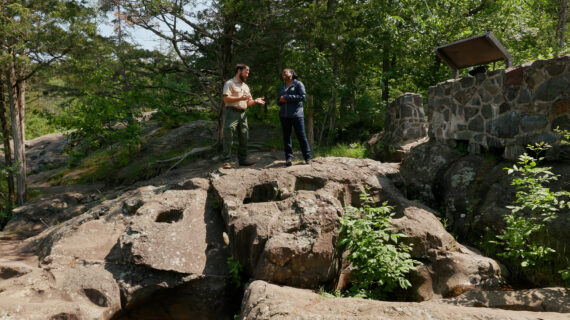
So this was all burned this past year. You see all the green coming up now. In early spring there's an amazing view from this hill, overlooking a valley in the Driftless region in Vernon County. We get more and more prairie grasses down here. But whenever Jim Theler and Suzanne Harris climb "the mound," as they call it, they are constantly looking down, looking for new plant species that have emerged from the past. There are some 250 known species of plants on that hill, native plants. And so if we see a flower or something we don't know, then we'll have to research it and find out. Gartersnakes and milksnakes won't bite. Abbie only got bit once. For that kind of help, they often turn to Abbie Church, the director of the local conservation group working with Jim and Suzanne. This is a classic hill prairie or goat prairie. Jim bought the mound from a neighbor in 2003. It was overrun with red cedar and prickly ash, but Jim knew it contained a secret past. It was once a hillside prairie and an oak savanna. I could see the remnant prairies in there. They're really quite small, but I thought if we could open it up, it would allow those to spread. They started with a chainsaw and sweat. We started clearing paths and paths turned into fields and fields turned into prairie. And it was great. Soon burr oaks emerged from the forest to stand guard over the hillside. This tree we cored in 2003. It had 185 rings. So today that makes this tree just about 200 years old. This tree began growing 30 years before the first European moved to this township. Then this old oak saw something else it likely hadn't seen since before the first Europeans... fire. Eventually we started getting some very small burns. And now we can do pretty large burns. Controlled burns cut down the woody vegetation and allowed new plants to emerge from the seed bank buried in the soil. We brought in no seed. It was just the natural area. And it's literally spread out on its own. That seed bank was probably all there. As spring moves to summer, new plants emerge. The area up above here, you can see, is all full of the pretty yellow Puccoons and Birdsfoot Violets. And there will be just a changing season of flowers all throughout the year. But the seed bank is not the only buried history on the mound. People did occupy this briefly. On the eastern face, there's a rock shelter. There's more than a meter of deposits from ancient native peoples that lived here. This goes back about at least 3,500 years based on the style of artifacts we found. Jim and Suzanne are both archaeologists. These are about 5,000 years old. These are 3,000. They believe the shelter was used as a hunting camp by many different Native American groups over thousands of years. Here is where we get the introduction to the bow and arrow. The projectile points, pottery, tools, elk bones... Fifteen or eighteen hundred years ago, these particular bones here....added with the native plants and animals make this mound something Jim and Suzanne felt they must preserve. So it has both warm plants from 5,000 or 6,000 years ago that nobody brought in. They were just there on the south face. We can go to the north face and we have small animals, snails, that are from the Ice Age. So you think about one hill having all of those factors. Then you have Native Americans living on this hill and rock shelters for the last 3,000 or 4,000 years. And it's really an amazing place. We hope people in the future will take over when we're not here. We'll be here but when we're not here to do it. I'll be here. I know that. Eventually, this mound will contain even more buried history. So this is where I'll be when I'm gone. Where Suzanne will be when she's gone. My mother's already here. Say hi mom. Jim and Suzanne have spent so much time unearthing this mound's past, they want to be part of its future. I feel at peace with being there. And to be up there and to be part of that landscape forever, because that's how beautiful it is up there. That's how special it is.


 Passport


















Follow Us