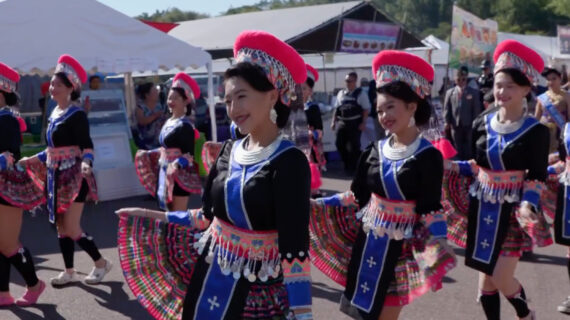
This week on "Wisconsin Life": A rock star who lives the small town life, a metal artist who forges culture into his craft, a coach who turned his passion into a profession and a group strumming up tunes. It's all ahead on "Wisconsin Life!" Funding for "Wisconsin Life" is provided in part by Alliant Energy, Lowell and Mary Peterson and Friends of Wisconsin Public Television. Hello and welcome to "Wisconsin Life." I'm your host, Angela Fitzgerald. Today we're exploring the rhythm and sounds of the Oneida Nation at the Music from our Culture Camp. The camp is located in the arts cottage in the Oneida Nation, which is just west of the Green Bay metropolitan area. Each year, the Oneida Nation Arts Program holds the Music from our Culture Camp, where children get hands-on experience learning about tribal and hymnal music heard in their community. The experience culminates with the campers putting on a live performance in traditional regalia. I can't wait to get started. But before I do, let's head to Germantown where another member of the Oneida Nation is fusing his heritage into his art.
torch fuel flows, lighter clicks
My grandfather was a blacksmith.
flame whooshes
My dad was a pipefitter. So there was always a torch in the garage. We're heating it up to about 1,200 degrees. Any time I have a stressful day or have a bad day, I go weld something together. It always makes me feel better. I've always done this, ever since I was a little kid. My grandfather taught me how to do this... and my father. And it's-- I'm going home. I'm relaxed. I'm with my family. Even though they're both dead and gone, I still feel like they're here and helping me. Or I'm helping them.
combustion
My mom's family moved from Green Bay where the reservation is to Milwaukee. And a lot of Natives did because of the jobs. My mother's an Oneida. And my father's actually German Jew. My mom had us registered at birth. She was well-known on the reservation. And she wanted to make sure that we all knew that we were Native. Where you come from, I always wrote "Red." At the time, it wasn't too cool to be Native. It was kind of a rough time as a child. Picked on and teased a lot and that sort of thing, about being Native American. But it just made us tougher. Our symbolism... And this is the symbol of my tribe. It's a Iroquois flower pattern. It has fiddlehead fern hair, and it's a shawl dancer. She's out dancing her heart out and showing everybody that she's an Oneida. I'm from the Turtle Clan; the poets, the prophets, and the artists of our community. This is my turtle teacher. It's a self-portrait. I'm a former educator. He's got the talking stick and a book. This is the old way and the new way. The turtle has all its students. It has all the babies around him wanting to hear the story. Every piece that I make tells a story. And that's how most Native American art is done. It's not just a beautiful piece. It tells a story. The oldest piece I have is... probably the long boat. This is a symbol of our tribe. We are "the people of the long boat." We were originally from New York. I'll start working on a pattern or a design and sometimes it'll sit on my bench for months. And all of a sudden, I'll be inspired, "Oh yeah, I should do this or this and that'll really make it beautiful." I'm thinking of making a wolf out of this one. And it'll have legs so that it actually sits on the edge of the table. Just leave them sit on the table until you're inspired on what would really be the nicest piece I could make. And then we're going to put the top of the shell on. You go around and attach it to each leg. Probably it was in my forties
laughs
before I started. I'm 60 now. Most of the stuff I just kept in my yard. On the weekends, I'd get people pulling in my driveway, walking through my yard. I'd go out there wondering what people were doing in my yard going, "How much is this one?" thinking I'm a gallery or something. That helped influence me to go into the field 'cause people were stopping and liked it and wanted to purchase it. Either do this or become a greeter at Walmart.
laughs
So we had to make it work. The story is very important. Once I do come up with a design, for instance, if I do a Bear Clan pattern that represents our nurses, our doctors, our firefighters and policemen and our veterans. And all of our protectors are Bear Clan. I'll tag a little story onto it that actually tells about this piece and what it means to us. I would say less than 10% go to other Natives. It's usually to non-Natives that want to learn more about Natives. And they like the way I teach it. I think it's so neat that so many people are interested in the original culture of America.
power sander vibrates
Yeah, I like beautiful things and I like making beautiful things. But I'm just as intrigued when someone comes up and falls in love with it. I've had it many times where they come in and see my life-sized bison and say, "Oh, my God" and tears start rolling. I mean you really feel that heartfelt message. Its name is "Ancient Dignity." But it's all hand-pounded. Heated up and pounded with a hammer to form the body. Then I put on 5,000 feet of hair which came out to about 30,000 individual hairs on the body itself. I tried to make the eyes aware, so that wherever you walked around it, the eyes were following you. The nose, being big and soft and cushiony, the children just love to come and touch the nose. That's why I do it is I like making beautiful things and I like making things that touch other people. -I figured the best way to learn about the Oneida arts culture is to see and hear it yourself. In a bit, campers from the Music from our Culture Camp are going to play on the powwow drum with their instructor, Harold Katchenago.
Powwow drum music and singing
What a wonderful experience and there's still so much more to see. Before we check out more, let's keep the tunes rolling with a stop in the city of Durand to meet a rock star who's got a famous band of friends. Mark Healey is as comfortable in a recording studio as he is in the small west-central Wisconsin town called Durand. You know, I know everybody and it's kinda nice.
car rumbles by
Here you can still find a barber, a bar, and a bakery, all on the same street. There's this mindset that's a little bit different than other places and it turns out to be my mindset.
rock guitar music
And Mark "is" a little bit different because not everyone is part of a legendary rock band. People know the songs but they don't know the name of the band.
performing "Baby Blue"
The band is Badfinger. Back in the 70s, long before Mark was a member, their songs were bona fide Billboard hits. "No Matter What", "Day After Day", "Come and Get It", "Baby Blue." If you want it Here it is Come and get it Ooh, ooh, ooh, ooh, ooh Make your mind up fast If they sound a bit like the Beatles, that's no coincidence. They were a protg band that followed in the wake of the Fab Four. And the first group signed by the Beatles' Apple Records.
Paul McCartney wrote the first song for the band
"Come and Get It." Then George Harrison produced the "Straight Up" album. The Beatles and Badfinger were often intertwined. Around that same time, Mark Healey was a teenager growing up in Wisconsin's capital city. Oh, man, it was fantastic. I grew up on the west side. It was definitely an exciting time. I mean when the riots were going on. The Mifflin Street block party, I think the police gave everybody 30 seconds to disperse. And then within no time at all, they were just shooting tear gas in. It was against that backdrop that Mark found his musical footing. I know when I was 14, I got in this band called "The Fine Young Men," except we had a girl singer. We had an agent. We played on the weekends. I had to wear glasses, because I was 14 and we're playing in these bars. I didn't want to be rich or famous or anything. I just wanted to play. And play he did. Mark found his way to Los Angeles and into recording studios, engineering music for television shows like "Magnum P.I." Did some music for a show called "Gilligan's Planet." Did a lot of Hanna-Barbera stuff. Did a lot of cartoons that never went anywhere. The group Badfinger wasn't going anywhere either. Trying to overcome the suicides of two original band members and financial problems, lead singer Joey Molland had an idea.
Joey Molland speaks with a British accent
Paul McCartney wrote the first song for the band
Decided to put the band back together and take it on the road. So we started looking for players. Mark was recommended to us. He came to my house and I thought, "Yeah, this guy's it. Yeah." It's now been more than 30 years and Mark is still performing the hits with Joey Molland's Badfinger.
rock guitar music
performing "No Matter What"
Paul McCartney wrote the first song for the band
No matter what you are The songs still stand up today. I'll always be with you Doesn't matter what you do, girl Ooh girl With you When he's not touring, Mark is usually here in his recording studio. I went looking for the middle But all I could find was the edge The studio keeps me busy all the time. I just produced a guy named Ben Brooks, who's from Portsmouth, England. This one that I did for Ben, he's got Michael Bland playing drums. Michael was Prince's drummer. Gregg Inhofer, who worked with Bob Dylan, is the keyboard player. I'll do anything Anything Mark also engineers his own music. I've got a solo record out. It's getting played in 55 countries between 20,000 and 30,000 air plays, every three months. I know what I want I know what to do
Molland
He brings energy. He brings his heart. I'll do anything He brings his voice, which has improved greatly over the years, I gotta say. And...
laughs
Molland
A voice that takes lead vocals on an original Badfinger hit featuring the Beatles' George Harrison. I remember finding out about you Keep your ears open for him 'cause he'll always be around and he'll always be doing something and it'll always be something good.
performing "Day After Day"
Molland
My mind is all around you Looking out of my lonely gloom Day after day I've found this path to make my living and to get through life. I think things worked out quite well for me. You know, I'm very happy.
closing notes
Molland
Thanks a lot, everybody. Good night to 'ya. Hope you enjoyed it.
applause
Molland
I'm here with Kal<na Niko Lee Daniels, camp co-founder and Yuntle'kala McLester, camp director who are going to tell us more about the Music from our Culture Camp. How are you ladies doing today? - Good. - Great. Thank you for having us. So our first question is how many people does it take to run the camp? Our camp started in 2005. And now we, 2017, we have grown to four different genres. In the beginning, it was just one or two, which was the Oneida Longhouse Singers and the Oneida Hymns. And now we have grown to the contemporary music, which we take contemporary songs from the radio and we implement the Oneida language into the songs. And then we also have powwow, which comes from the Menominee Nation. Harold is one of our teachers. And then we have the flute with Wade Fernandez. And so we are up to five different genres now. Wow, it sounds like a lot of staff may be needed to help teach all those different genres. Of all ages too. Why is this camp so important to children in the community? We found that the importance of this is more than just music and language. It's actually-- We sit on the reservation in seven different school districts. So we have a lot of kids that don't have any exposure to their culture or any exposure to Oneida in general. So aside from the music and bringing the hymns and the Longhouse, we're incorporating the language into it which is very vital for us. So what is your absolutely favorite part about working for the Music from our Culture Camp? So my favorite part is how the kids start out very young and then they develop into these young men and women. They show gratitude through singing. They show gratitude through the Kanehelatksla Thanksgiving address. There are, I think, 45 to 50 kids that we have now in this summer camp. And so they come eager and ready to learn. They are, I guess, grateful in all different ways. And they really mature into young men and women and are displaying and advertising for us. Recruiting, they're recruiting now kids to come, which is awesome for the program. That is so good. Being immersed in their community and their culture but also building community at the same time. Yeah. - Thank you so much, ladies. Next up, we meet a Madison coach who took his team and favorite sport to the big leagues. Many kids in Green Bay grow up dreaming of one day playing at Lambeau Field. That was certainly true of Tim DeByl. So I grew up probably two miles from the stadium and my family's had season tickets. For me, it was amazing. Me and my brother used to go to all the games. But in college,
Tim discovered a whole new game
Ultimate Frisbee. You've probably seen it played like this on a sunny day in a park. It's a simple game. Connect on a pass to a teammate in the end zone to score. It's unique to sports I think, in that it always requires two people to have a score. There's no way to run it in. There's no way to throw it to yourself. There's seven guys. They all touch the disc. Everybody needs to work together to get a score. I think that's one of the compelling things about the sport. That cooperative spirit goes back to Ultimate's origins in the 1970s counterculture. An era that also inspired the name
for Madison's professional Ultimate team
the Radicals. That's right. Ultimate, the mellow pastime, has gone pro. And Tim is playing a huge part as manager, head coach, and co-owner of the Madison Radicals. Look at the coach-owner setting up the sign. I don't think that we ever really thought that it was a great business decision. You know really this is much more about having a passion for the sport. A passion that is being shared by hundreds of fans who show up at games, and through live streaming video coverage.
Announcer
We are live at Breese Stevens Field. And it really took off. There's highlights all throughout the game. People are diving for the Frisbee. Come on. - Let's go. They're making great catches, great throws. And while the Radicals are a passion project for Tim, it helps that his day job is running a marketing firm. Having marketing skills in this was a huge advantage to our franchise. The Radicals have been one of the league's most successful franchises, both on the field and in the stands. Fans obviously want to come out and watch a winning team. And I think without that, they might not be as interested as they are. Tim has provided the hometown fans with a winner. Going into today's game against their division rivals, Pittsburgh Thunderbirds, the Radicals are unbeaten at home. A 30-game home win streak is somewhat unheard of in sports. It's kind of an amazing streak in itself. And we want to keep it going. The streak is all the more impressive considering Madison is, by far, the smallest city in the league, giving Tim a much more limited talent pool to draw from. There's a bit of a bias towards the bigger cities like San Francisco and Dallas and Denver where there's a lot more players. I think our guys just want to prove they want to be in that conversation. Like many sports teams without superstars, the Radicals have found success by emphasizing defensive play. Something Tim learned from basketball, especially from legendary UW-Green Bay Coach Dick Bennett. My high school coaches in basketball were Dick Bennett fundamentals. One against four. Knocked away. So he was always about defense. But it was a hard sell to get an Ultimate team to work on defense. When I would ask, "Hey, what's our defensive strategy?" It generally would be, "Well, stand near your guy." We focused half of our practice on defensive principles. And I think that was a big surprise to everybody. But it proved to be really successful. We've been the number one defensive team every year in the league. Tim's coaching success is even more impressive considering that even having a coach is new to the game. We're back, okay, if it goes in the end zone. Coaching ultimate players is really hard. So most of them didn't have a high school coaches. Most of them didn't have college coaches even. But coaching has become Tim's real passion. When I started the AUDL team, I wanted to be the general manager. I thought, "Well, for the first year, I'll coach until we get things going." And I just, I remembered how much I love coaching. I love working with players. I love the interaction between coach and players. And those relationships that you build. I think being a coach is something that I don't want to give up anytime soon. Ra-Ra-Radicals! And it even lead to something Tim never imagined growing up in Green Bay. Let's play Frisbee, gentlemen. Ultimate being played at Lambeau. The Packers invited the Radicals to play Ultimate at halftime on the Frozen Tundra. Eighty-thousand people. The biggest Ultimate game that's ever been played. For me, coming out of the tunnel was the best part. The team got to run out of the tunnel and it was like, "Wow! This is Lambeau and it's packed. And the fans were really into it, which was cool too. It was amazing. While Tim didn't get to play at Lambeau, he's now done something even fewer people have achieved. He got to coach a team there. Being able to see them out there on the field playing, for me, was as good as playing. I knew how much it meant to the guys. Earlier today, I got the chance to spend some time with young adults and children attending the Music from our Culture Camp. Here are a few of the highlights.
Oneida singing and drumming
Announcer
Now this is the type of camp I wish I had gone to when I was a kid. So fun! Just as fun as the group of women our team caught up with in Milwaukee, who bring island tunes to the big city. Hello, everybody!
Group
Hello. Everybody, let's hear your first pitch. Doo, doo, doo, doo This group started and evolved out of a chorus that I directed. So what we're going to do now is we're going to do a few of our songs. About eight years ago I said, "Look, we have to do simpler music. "We have to still have fun "but we really need to do something "at a little easier level. How about I teach you the ukulele?"
performing "Walk Right In"
Group
Walk right in Sit right down Hi, I'm Mary Backus. I am the director of the Ukuladies.
singing "Those Were the Days"
Group
Those were the days my friend We thought they'd never end We're located in Milwaukee and we're a very open group. La, la, la, la, la-la, la, la, la, la, la-la Five years ago, I would have said, "We are a group of older or even elderly women." I mean I'm 76. Now we're attracting younger women as well. Remember it's very "legato," everything smooth. I'm a retired music teacher but I am still teaching.
singing "Hanalei Moon"
Group
When you see Hanalei The ukulele is-- It's a very easy instrument to play. You will be In heaven The sound is nice. We are able to harmonize. Every breeze Every wave I'd say more than 50% come in and have never sung in a chorus, never played an instrument.
ukulele music and singing
Group
Get over It's very attractive to women who want to participate, have fun, make some fun music. It's a very democratic group, and do some performing. We are so happy to be here. We are so thrilled to be invited by Summerfest Seniors to be here. This year we went to Summerfest.
singing "Walk Right In"
Group
Walk right in, sit right down Daddy, let your mind roll on Walk right in Summerfest was pretty much a ball. We really had a good time. Roll on I think we kind of represent a group of women that are kind of fearless. They're learning something new. So if you like to sing and you're willing to purchase a little instrument for $20 to $40 and you want to practice, you probably qualify for our group. And that's how it is. Love me do Love me true But you gotta love my ukulele, too Oh, yeah You gotta love my ukulele toooooo
closing notes
Group
Whoo! It's been a blast learning about the arts of the Oneida Nation, here at the Music from our Culture Camp. If you'd like to learn more about the Oneida Nation, visit WisconsinLife.org. And as always, we'd love to hear from you! What's your "Wisconsin Life?" Tell us by sending an email to [email protected]. I'll leave you now with some highlights of the community performance from the campers we met today at the Music from our Culture Camp. I'm your host, Angela Fitzgerald and this is our "Wisconsin Life." See you next time.
singing in Oneida Iroquoian language
applause
Group
Funding for "Wisconsin Life" is provided in part by Alliant Energy, Lowell and Mary Peterson and Friends of Wisconsin Public Television.


 Passport

















Follow Us