crickets chirping
Thomas Meyer
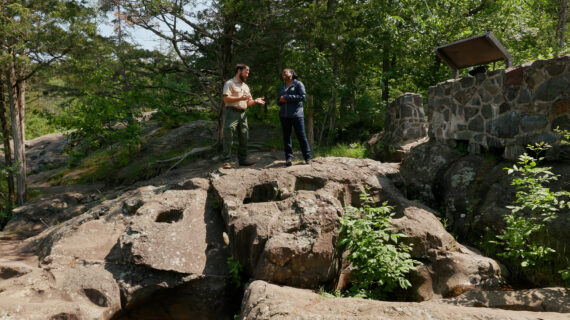
When you pull your car up to the roadside, and you look across, this big giant wetland is that "I'm not going there. I don't want to go into that." But then, when you throw on the rubber boots and start moving on through the landscapes, say, "You know what? This is not that hard, and it's just drop-dead gorgeous." For going on 30 years or so, I've been with the State Natural Areas Program. And we have a mission that we haven't wavered from in over 71 years, and that is to protect these things called natural communities, these native landscapes that cover the entire suite of plants and animals, and all the functions that go along with them. Its root system down here is still frozen. How does a plant deal with the stresses of being super warm up on top and then having frozen feet? It's pretty interesting stuff. You come to a state natural area, oftentimes, all you have is a... maybe a gravel parking lot and maybe a trail. Generally speaking, you find your own way into nature by just taking a hike. I started at the Department of Natural Resources as a student intern back in 1984, and I've been there ever since. And this is true for other positions in conservation. When folks get into them, they don't leave. They stay for a very, very long time because they just love the work that they do. The Thomas field trip. Ready? - Ready. I love taking people to unique natural communities that they wouldn't otherwise go into on their own. Alright, this is the native cranberry, Vaccinium. I can also expand on that. The pleasure that I've had working with PBS Wisconsin and other-- Ohh, gosh... - Well, okay, I better cut that out.
laughing
Thomas Meyer
Ben Meyer,
WXPR-FM
Thomas Meyer is a DNR conservation biologist based in Madison. He helps select natural areas for a documentary series called Wisconsin's Scenic Treasures.
Thomas Meyer
I'm not kidding. Working with creative people to showcase these wonderful places has been really one of the highlights of my career. To be able to go out with videographers, and field producers, and sound people to explore these wonderful places. Whoa-ho-ho!
laughing
Thomas Meyer
And to capture them so that they can be shared with people around the state, it's just really been a lot of fun, really just a joy. Fifty years from now, who knows what kind of media they're going to be looking at, but I like to think that at least it's captured for future generations so that, "Hey, you know, look back, and people cared about this stuff." So, we're going to go in and find stands of these bigger hemlock trees, and I'll just point them out. - Cool. What's next for me? I'm looking forward to continuing to be a lifelong learner. Look, I've been around the block a lot. I've been at a gazillion state natural areas. I've held nature in my hand, plants, animals, and what have you, but every time I go out into the field, every single time, I learn something new. If you can model that kind of lifelong learning that, look, you don't know it all, that would place young people in good stead to just be humble when you go out into nature and know that there's a heck of a lot more to learn every single day.
piano music


 Passport


















Follow Us