






PBS Wisconsin Passport
Watch this video with
PBS Wisconsin Passport
Become a member of PBS Wisconsin, support your local community, and get extended access to PBS shows, films, and specials, like this one.
Meet Me at the Fair
05/23/26 | 26m 46s | Rating: TV-G
Richard Wiese dives into Maine’s biggest fall party, the Fryeburg Fair, and tries his hand at the fair’s many activities -- from sheep shearing to milking a goat to making kettle corn. Meanwhile, Amy Traverso is on Cape Cod learning to surf cast with U.S. Surf Casting Champion Ron Arra, then explores the history and food scene of the town with her friend, Johnny Gibbons.


Copy and Paste the Following Code to Embed this Video:
Meet Me at the Fair
NARRATOR: In this episode of Weekends with Yankee, Richard dives into Maine's biggest fall party... (cheering) The Fryeburg Fair.
He tries his hand at the fair's many activities, from sheep shearing to milking a goat, and tastes his way through the fair's many signature treats.
RICHARD WIESE: Mm!
NARRATOR: On Cape Cod, Amy learns the art of surf casting from U.S.
surf casting champion Ron Arra.
- Very good.
AMY TRAVERSO: Ah!
NARRATOR: Later, she explores the history and food scene of the nearby town of Sandwich with a local.
- To have a place like this is a true gem.
TRAVERSO: This looks amazing.
This is extraordinary.
I have a new favorite restaurant.
NARRATOR: Finally, Richard visits Sherman Farm to learn how they make their delicious kettle corn.
WIESE: You claim that this is world class.
This is really good stuff.
Mm, don't go away with that.
- Okay.
NARRATOR: So come along with us for a once-in-a-lifetime journey through New England as you've never experienced it before-- a true insider's guide from the editors of Yankee magazine.
Join explorer and adventurer Richard Wiese and Yankee senior food editor Amy Traverso for behind-the-scenes access to the unique attractions that define this region.
It's the ultimate travel guide from the people who know it best.
Weekends with Yankee.
- Major funding provided by... ♪ ♪ - In Maine, spring isn't just a gift.
It's an achievement.
This is Maine.
Forged by nature.
- New Smyrna Beach, Florida.
Relax already.
- Kloter Farms-- from outdoor structures to solid hardwood furniture for over 45 years.
- On an American Cruise Lines journey, you can explore historic New England.
- Country Carpenters.
Handcrafted barns and homes for over 50 years.
♪ ♪ WIESE: We're in Maine at the Fryeburg Fair.
This isn't any fair.
This fair's been around since 1851.
And while it has its roots in agriculture, it's long on great food and plenty of family fun.
♪ ♪ So tell me a little about the history of this fair.
- Well, I've been working here since I was 12.
WIESE: Oh, my gosh.
- In 1851, here in Fryeburg, at the end of the harvest and before winter kind of struck with major blizzards, all of the farmers brought their animals and their vegetables and their crops.
And it was really for bragging rights and just to get together and maybe have a party of sorts.
Well, we've grown and grown and grown, and made the party pretty big now.
And-- but it's the same exact mission, which is agricultural education, letting the public know about how things are grown, where they come from, the people who grow them.
And it's just a wonderful thing here at Fryeburg Fair.
WIESE: And so give me a little of the evolution of how the fair has changed over the years.
- Well, I think the thing is that a lot of it hasn't changed, and that's what people really appreciate about the fair, is the tradition.
There are many people who come here who are now bringing their grandchildren and their great-grandchildren.
And they were kids when they first came here, and it's the beauty of the fair.
It's the heart of the fair.
And also it's a very sensory fair.
You walk in here and you smell the smells, you feel the feels.
It all mixes together into this thing that, every fall, everybody needs to come to Maine to go to Fryeburg Fair, and we just love it.
WIESE: What are some of the highlights here?
What are things you like?
- The other things I really like are giant donuts and sausage on a grill.
And I really like meeting the people that when you go to their booths and you get to find out where they're from, how long they've been doing this kind of life, and everybody just kind of saunters.
No one's in a big hurry.
Everybody's out to just be in the moment and to be real.
(playing bagpipes) WIESE: Hello, hello.
- Hi, how are you?
WIESE: Wow.
- Hi, Megan.
How are you?
- Hi, I'm doing well.
And yourself?
- This is Richard.
- Hi, Richard.
WIESE: The recommendation, the glazed donut?
- Glazed is the most popular.
- Yeah, I think so.
- You want one of those?
- That sounds good.
- Awesome.
WIESE: I'm gonna try this, and I will give you my honest opinion.
- Okay, perfect.
WIESE: All right, okay.
You, you know what you're doing.
- (laughs) - She does know what she's doing, yeah.
And her whole family knows what she's doing.
WIESE: This is great.
Oh, my gosh, this is so great.
Whatever you're doing, keep doing it, it's great.
- Thank you, thank you.
WIESE: You were right.
- Thank you, Richard.
WIESE: Okay, on to the next spot.
- Thanks, Megan, very much.
- Thank you!
- That's a good timing.
WIESE: Yes, a fried Oreo.
Here we go.
NARRATOR: Richard decided to wash down the donut with a fried Oreo before trying his hand at a game.
WIESE: Mm!
- There it is!
WIESE: Here we go.
- We got a big winner here, guys.
Big, big, big, big, big winner.
(cheering) WIESE: The moose!
(whoops) NARRATOR: Next up at the fair, an annual favorite, the pie eating contest.
- So, ready, set, go!
Start eating.
WIESE: Uh-oh, she's got a late start on it.
Here.
- Look at them go.
Yeah, they're really eating those pies down.
Doing a good job.
WIESE: This is where, I think, the real contest is, this end of the table.
Keep going.
- Wow, look at that young man, I think the most dangerous place in the world is between him and a hamburger.
WIESE: That's okay.
- Look at him go.
WIESE: Oh, my God, we got someone, she's on there, too.
- Yep, these young people are really going at it.
WIESE: Okay.
That's all right.
- Excellent, keep going.
WIESE: Here.
-Don't worry about the audience, just keep right on going.
You're doing great.
He's got a napkin right there.
Good job.
WIESE: Okay.
Don't worry about it.
- Good job, buddy.
WIESE: This is very competitive over here.
- At this point, it's save yourselves.
They are almost there.
Yep, once the pie is completely gone, they'll be in good shape.
WIESE: Okay!
- All right, look at that.
WIESE: We have a tie.
- A tie!
(cheers and applause) WIESE: We have a tie over here.
Yep.
- The others, you can keep eating.
NARRATOR: It's time for a snack.
So Richard heads out and is lured by the smell of grilled drumsticks.
WIESE: Ooh, okay, if you come to the Fryeburg Fair, you will not go home hungry.
There is more food than you could possibly eat in a lifetime.
♪ ♪ Mm.
NARRATOR: Richard heads to the Woodward Show Arena for a sheep shearing demo.
- This gentleman Richard said that he has shorn sheep at different places all over the world.
He's loving up on this ram pretty nice there, so essentially, it's like 26 pair of scissors.
There are 13 teeth, but they cut on both sides.
So I have 26 little pair of scissors running back and forth real fast as I'm shearing the sheep.
I want him to be comfortable.
I will flop him from side to side.
If he gets uncomfortable, he may start to wiggle on me.
And it's my job to try to keep him as calm as we can.
(shears buzzing) This is where I get to hug a sheep every day.
♪ ♪ You want to start right down here?
No, you want to start here and make a pass directly across that way.
Now come back.
Let the blades ride on the contour of the body, and you're just guiding them along.
All right, come back here.
(shears whirring) We want to get that all off on the first pass.
There you go.
So Australia will tell us it takes ten years or 10,000 heads to get good at shearing.
I've surpassed both of those numbers.
But I'm not ashamed to tell you that I'm still learning.
All right.
WIESE: Okay.
- Good job.
Let's hear it here.
(applause) And he's not harmed at all.
WIESE: Looks fabulous.
Are you a local Mainer?
- I am.
Born and raised in southern Maine.
My family's been coming to the Fryeburg Fair since the early 1900s.
There you go, sir.
WIESE: Oh, wow.
Okay.
- Yes.
- Butter, cinnamon, and sugar is all done at the end of the trailer.
WIESE: This is definitely a guilty pleasure.
NARRATOR: Re-energized, Richard heads to the goat barn to meet Ray Levitt.
WIESE: What does this fair mean to you?
How long have you been coming to it?
- I was born in 1954 and I've been here every year since.
WIESE: No kidding!
- So I was here as a baby and I've never missed a fair.
WIESE: What do you think the best part of this fair is?
- The animals.
You know, it's truly a true agricultural fair where the animals are the spotlight.
WIESE: Okay.
- And whereas, and the carnival is kind of an addition to it.
WIESE: So I'm, you know, believe it or not, I'm not an experienced goat milker.
- Yeah, I could see that.
(laughter) WIESE: You could tell my look by, like, which end?
- Yeah.
WIESE: Okay, so how do we do it?
- So it's pretty simple.
So release it.
So what you're doing... WIESE: Oh, I have to pull down a little.
- Yeah.
Okay.
WIESE: Okay.
And this isn't hurting?
- Nope.
WIESE: She doesn't seem to care.
- Nope.
I wish I had some coffee or something to put it in.
- (laughs) WIESE: What's the best thing about goats?
- Oh, personality.
WIESE: Yeah?
- Oh, yeah, goats are really intelligent and they'll, I mean, as you, you know, you walk down, they can tell their owners and are very vocal.
WIESE: So do you, do you ever find yourself just talking to your goats?
- Oh, yeah, sometimes the goats are a lot smarter than the people that you talk to.
WIESE: Okay, well, just, I'll be nervous if they actually talk back, but.
- They do in a way, you know, in their expressions.
They-- so if they've done something wrong and you speak to them, they know.
They'll look at you and kind of tip their head back and say, "Oh, oh, I-I'm sorry."
WIESE: Thank you very much.
- I appreciate it.
Anytime.
WIESE: Yeah.
NARRATOR: From grasshopper farm goats to raw horsepower, the Fryeburg Fair truly has something for everyone.
Over in the natural resource area, Richard gets to burn off some calories the old fashioned way with a crosscut saw.
(sawing) History is never far from the midway-- from timber framing to the animals that were once more prevalent than tractors in these parts.
WIESE: Oh, my gosh.
So, who is this?
- Levi.
WIESE: Levi.
Levi is huge.
- 12 years old.
WIESE: But he seems awfully friendly.
- Yeah.
WIESE: And so how many years you been coming to this fair?
- I started pulling horses when I was 12 years old and I'm 72.
WIESE: Oh, my gosh, that may be your secret to staying young.
- (laughs) WIESE: So what do you love most about coming to this fair?
- The competition and the people, they're just so nice and... WIESE: What can you tell me special about Levi?
- One year he was here and he won seven blue ribbons.
WIESE: Normally, I'd say I'd like to take him home, but I don't even know how I'd get him home.
This is such a gentle horse, huh?
- Yeah.
WIESE: All right, well, I think, uh, I'm just going to enjoy my moment here with, uh... - Levi.
WIESE: Levi.
What a, what a gentle horse.
This is really great.
♪ ♪ NARRATOR: As the sun dips down over the majestic landscape surrounding the fair, Richard finds room for one last culinary delicacy: a blooming onion.
-Here's that for you.
WIESE: Oh, my gosh.
Look at this.
This is blooming art.
- Blooming art.
WIESE: Yeah, look at, yeah, my thing, all right.
♪ ♪ ♪ ♪ Oh, well... (kids screaming) What's up, guys?
Am I taking a shot?
One shot?
- There it is.
- You get the baby duck just like that, boss.
WIESE: What an amazing day.
And without being cliché, this literally is the end.
♪ ♪ TRAVERSO: Welcome to Cape Cod.
I'm in East Sandwich, Massachusetts, and I'm about to have an ultimate coastal day.
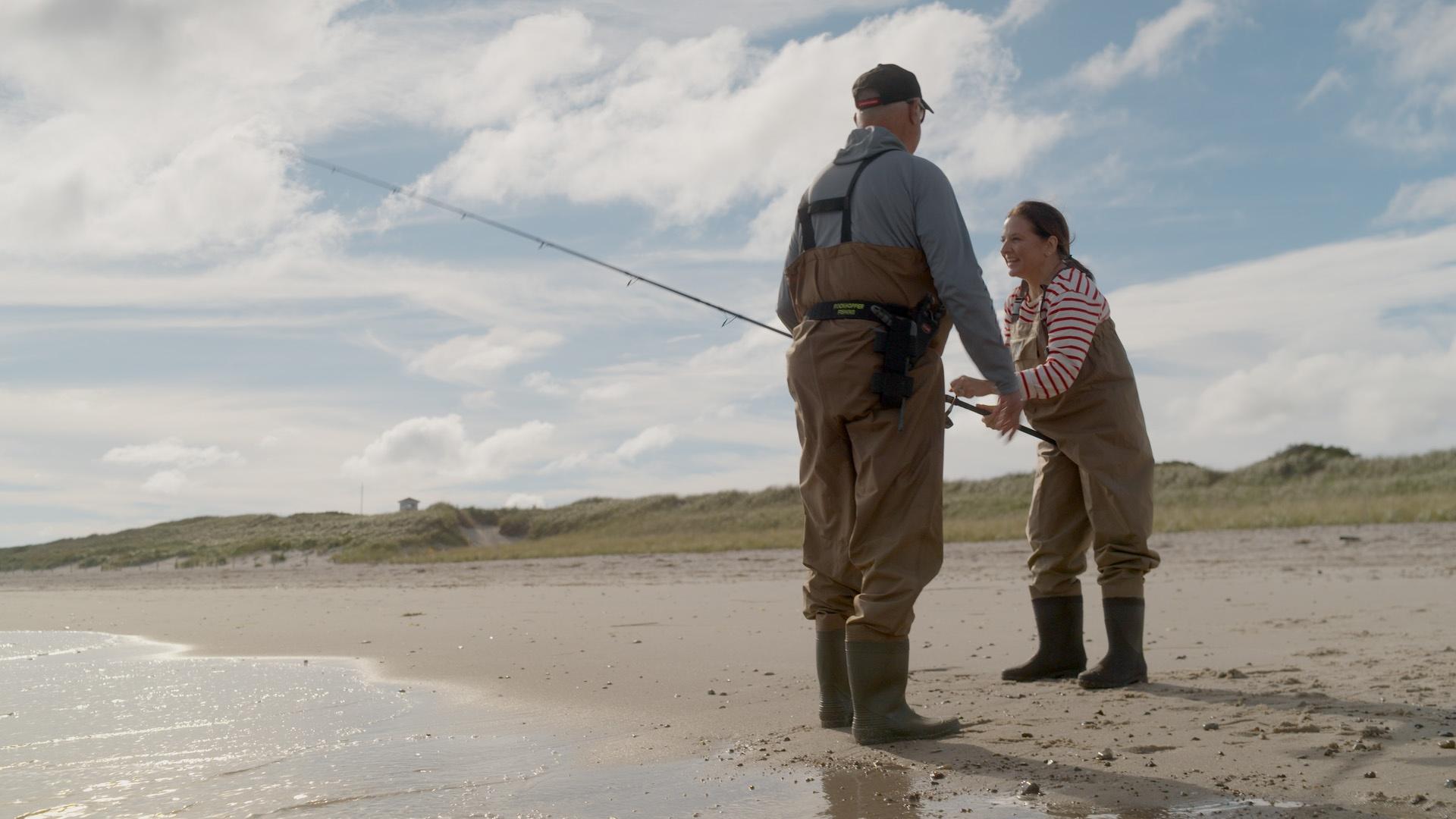
I'm going to take my very first surf casting lesson with champion angler Ron Arra.
And then I'll meet up with my friend Johnny Gibbons to taste some fantastic seafood.
NARRATOR: Ron Arra is a five-time national distance casting champion and world record holder, with a personal best cast of 758.44 feet.
He's also an author, having written "The Ultimate Guide to Surf Casting."
Suffice to say that Amy will be learning from a true Cape Cod legend.
TRAVERSO: Good morning.
- Good morning.
Nice to meet you.
TRAVERSO: Nice to meet you.
- Yeah, looking forward to your casting lesson today.
TRAVERSO: All right, well, I gotta tell you, I'm a complete novice, so I hope you can work with what I got.
(laughs) - Oh, yeah, definitely.
I've had plenty of novices over the years.
TRAVERSO: Really?
- I've been teaching casting since 1975.
TRAVERSO: Wow.
- Some people have never cast in their lives, and that's the best students.
TRAVERSO: Really?
- I don't have to get rid of any bad habits.
TRAVERSO: Okay, well, I definitely bring you no habits.
(laughs) - So you're gonna do go today.
All right, well, let's get started.
I'm ready to learn.
NARRATOR: Amy and Ron head out onto Sandy Neck Beach with rods, reels and lures in hand.
Sand spikes will keep the rods upright and the reels away from the sand.
- I've been checking this out during low tide, and this is a good spot right here.
TRAVERSO: Oh, okay, great.
- That's the best time to check a beach out is low tide.
TRAVERSO: Low tide, that makes sense.
- Yeah, exactly.
Right here is fine.
TRAVERSO: Okay.
- I'm gonna put the sand spikes up, out.
♪ ♪ (waves crashing) NARRATOR: With the fishing rods secure, Ron shares a few of his favorite fishing lure designs, some of which he created using his skills as a carpenter.
He has turned pieces of wood into objects fish find irresistible.
TRAVERSO: So this is where your carpentry background and your fishing passion come together.
- Exactly, yeah.
If they're feeding on small bait, you go to the smaller lure.
TRAVERSO: Okay, right.
- And if they're feeding on larger bait.
TRAVERSO: Oh, I see.
- Obviously, we try to match the hatch like fly fishing.
TRAVERSO: Right.
- They'll hit the bigger bait.
TRAVERSO: Ooh, look at that one.
- A sebile.
A swimming lure that imitates a mackerel.
TRAVERSO: Oh, my gosh, look at that.
So it'll just kind of move like a fish.
- Yeah.
Yep.
Interesting color.
Fluorescent.
Attracts the bass at night, stripers at night.
And that used to catch a lot of fish.
TRAVERSO: Okay.
- It still does.
NARRATOR: Before adding any hooks to her line, Ron has Amy practice how to make the right kind of movements first.
He explains it is similar to throwing a baseball.
TRAVERSO: So you're really, you're really facing forward... - Like throwing a baseball.
TRAVERSO: Yeah.
- You probably played softball as a kid, right?
TRAVERSO: A little bit, yeah.
- Okay.
TRAVERSO: Did I graduate from T ball?
I don't know.
- You probably developed.
You probably developed some motor skills.
TRAVERSO: Yeah.
(laughs) - And, uh.
Dancing, just like a dance.
You danced the tarantella, right?
TRAVERSO: Yeah!
(laughs) - Okay.
(chuckles) TRAVERSO: All right.
Okay.
- Right on!
Bend the knees, now, bend at the knees.
TRAVERSO: Okay.
- But gracefully.
No power.
TRAVERSO: Okay.
- See that?
See?
TRAVERSO: Yeah.
Head up for good balance.
Swing into it.
TRAVERSO: Wow.
♪ ♪ - Oh, much better.
TRAVERSO: That was better!
- Hey!
TRAVERSO: Yay!
- See, I told you.
TRAVERSO: I'll keep trying, But I think, you know, it's kind of like any sport, right?
There's, like, there's a whole sequence of movements that you got to get used to doing.
- Okay, right angles to the rod.
TRAVERSO: And coordination.
- Right angles to the rod, the lure.
TRAVERSO: No way I'm gonna hit that boat, right?
- Just don't, yeah.
TRAVERSO: Okay.
- Very good.
TRAVERSO: (laughs) - Congratulations.
TRAVERSO: Thank you.
- Now... TRAVERSO: I think I'm starting to have some, like, sense of it.
- Yeah.
Exactly.
TRAVERSO: Basic.
- It helps a lot with me showing you, right?
I hope.
TRAVERSO: Yeah.
NARRATOR: As Amy gains some confidence with her surf casting, it's Ron's turn to send out a few lures.
TRAVERSO: Oh, my gosh.
Wow!
That's so far!
(laughs) - You didn't see where it landed, did you?
TRAVERSO: Yeah, I did!
It was so far out, okay.
♪ ♪ I really do feel like I at least got the essential start to casting.
- The technique.
TRAVERSO: The technique.
And I want to come back and keep learning, and maybe one day I'll even try to catch a fish.
- Great.
TRAVERSO: (laughs) I think-- thank goodness you'd had me with no hooks today, because if a fish had accidentally landed on my line, I wouldn't have known what to do with myself!
(laughs) - It's all timing and technique.
TRAVERSO: Right, right.
- Yep.
TRAVERSO: Well, I really appreciate it.
- With less effort.
TRAVERSO: I want to, I really, I feel like this is a new hobby for me.
I want to improve.
I want to come back.
♪ ♪ NARRATOR: Sandwich, Massachusetts, the oldest town on Cape Cod, was settled in 1637.
Amy's going to get a tour of this tiny, picturesque town with one of the locals-- her friend, Johnny.
TRAVERSO: Johnny!
Hi.
- Hey!
TRAVERSO: So good to see you.
- How are you?
TRAVERSO: Good.
- Good.
TRAVERSO: I'm so glad I got to come visit you.
- I'm thrilled that you're here.
Welcome to Sandwich.
TRAVERSO: Thank you.
- Cape Cod's very first town.
TRAVERSO: It is sort of the ultimate New England town.
It has everything that you would imagine, including, what is this mill here?
- So there's a grist mill and the freshwater pond.
TRAVERSO: Right.
- Right in the very center of town-- if someone says, meet me in the center, this is it.
TRAVERSO: Okay.
- And not only does the water provide fresh-- does the pond provide fresh water, but it also is connected to a spring that's really, really popular.
TRAVERSO: Oh, I heard about-- I brought a bottle because I heard that the spring water here was really good.
- Good.
Let me show you.
TRAVERSO: Okay, great.
- This is probably the most popular spot in town.
This is our natural spring.
TRAVERSO: Wow.
- It's probably the epicenter of town.
TRAVERSO: Really?
- But it is super popular with residents here.
We get four, five, sometimes seven cars deep with people bringing jugs in.
TRAVERSO: Mm!
It's soft, like-- I can't believe I'm doing this like wine, but it's like Evian.
(laughs) - That explains why everyone lines up.
TRAVERSO: Mm!
- You know, we're really, really rich in colonial history, but one of the fun facts about Sandwich... TRAVERSO: Right.
- ...is actually this church.
TRAVERSO: Oh, really?
- It happens to be connected to Elvis.
This is the church they used on his 1967 gospel cover, "How Great Thou Art."
TRAVERSO: Oh, my gosh.
TRAVERSO: Elvis never slept here.
- Exactly.
But I think we could say we're probably the only town on Cape Cod that has some kind of Elvis history.
TRAVERSO: Oh, my God, that's so funny.
I love that.
That is so good.
- Right here on Main Street in Sandwich, this is one of the oldest residential homes still being lived in right now.
Um, 1693.
TRAVERSO: Wow.
- They're currently renovating it, but it gives an idea of what the whole Main Street looked like.
TRAVERSO: Beautiful.
Wow.
- Just like any good Main Street in America, this has a great library.
I'm in there often.
And so-- and as history tells us, the Earl of Sandwich did not like eating food with his fingers.
TRAVERSO: Right.
- And always would eat between two pieces of bread.
Hence we have the sandwich.
TRAVERSO: That's great.
(laughs) There's so many places in New England that are named after, you know, English towns or Native American names.
- Absolutely.
TRAVERSO: Yeah, yeah.
- And the Cape is a good mix of both.
TRAVERSO: Right, right.
- We have a lot of English and Native American Wampanoag names.
TRAVERSO: I had beach time in the morning.
- Mm-hm.
TRAVERSO: Now I've gotten my dose of New England history.
Thank you.
- Absolutely.
TRAVERSO: I feel like the only thing I need now for a perfect Cape day is some seafood.
- Great, why don't we head down to the Canal?
TRAVERSO: Okay.
Perfect.
♪ ♪ So you don't know this, but this is such an amazing location for you to take me.
My family has a real connection to the Cape Cod Canal.
- Really?
TRAVERSO: So my great-grandmother, Severina, was born in northern Italy.
She worked on an estate and learned how to cook.
And when she came here, they said, what can you do?
She said, "I cook."
And they sent her up here, and she cooked for the men who dug the Cape Cod Canal.
- Really?
TRAVERSO: So every time I cross the canal, I just feel this connection to, like, my great-grandmother, you know, making it possible for us to be here.
- That's amazing.
TRAVERSO: Isn't that great?
- Obviously, we're in Sandwich, first town in Cape Cod.
TRAVERSO: Yeah.
- But what a lot of people don't realize when they come, while they're looking across the canal at land that is not part of Cape Cod.
TRAVERSO: The mainland.
- It is the mainland, as it were.
It's still part of Sandwich.
TRAVERSO: Wow.
- And a lot of people wonder, why would you create a town on both sides of the canal?
TRAVERSO: Right.
- They created a canal through a town.
TRAVERSO: Right, right.
- The canal came after the town was created.
TRAVERSO: Right, that's so interesting.
- So this little piece of Sandwich is not on Cape Cod at all.
TRAVERSO: (gasps) Wow.
- Oh, this looks amazing.
TRAVERSO: Oh, my gosh.
This looks so good!
(laughs) Oh, my gosh, wow!
- Wow-- don't take anything away.
TRAVERSO: Yeah, it's so beautiful.
- Have a good meal.
TRAVERSO: Oh, my gosh.
- This is no mistake.
This is my favorite restaurant in Sandwich.
TRAVERSO: Wow.
- And folks that own and run this place are born out of a fishing family.
TRAVERSO: Wow.
- A fisherman first, comes from that to this restaurant.
TRAVERSO: Wow.
- The quality's in the food.
I mean, whether we're talking about the lobster or the Jonah crab or obviously the sushi.
TRAVERSO: Oh, my gosh.
It keeps coming!
(laughs) Thank you.
- I mean... TRAVERSO: What are your favorite things here?
- I come here for sushi a lot.
It's all really good.
TRAVERSO: Wow.
- Obviously, iconic.
TRAVERSO: Yeah.
Lobster.
- You're well acquainted with a lobster roll, I know that.
TRAVERSO: I've had my share.
- So what do you think?
TRAVERSO: This is extraordinary.
I have a new favorite restaurant.
Everything we did today, I just feel like I had the perfect Cape Cod day.
Thank you so much.
- Good, good.
I'm glad you enjoyed.
We have a long way to go.
TRAVERSO: I know.
Let's keep eating!
(laughs) ♪ ♪ ♪ ♪ WIESE: Kettle corn is such a family favorite.
Today we're at Sherman Farm in East Conway, New Hampshire, and we're gonna learn to make it so it's... ...world class.
What is the secret to making great kettle corn?
- First, we take it and put in our corn oil.
We heat that up, put a few kernels in, let those kernels start to pop, and then we turn on our stirrer, we pour in our popcorn and our sugar, and we let it do its thing.
(machine whirring) ♪ ♪ WIESE: Okay.
All right.
Michelle, Kathy.
Mother, daughter duo.
You claim that this is world class.
All right... - It's pretty good.
WIESE: All right.
It's not world class-- it's all solar system.
This is all universe-- this is really good stuff.
Mm, don't go away with that.
- Okay.
WIESE: Just want to take a few.
Mm!
- (chuckles) NARRATOR: For exclusive videos, recipes, travel ideas, tips from the editors and access to the Weekends with Yankee digital magazine, go to weekendswithyankee.com and follow us on social media @yankeemagazine.
Yankee magazine, the inspiration for the television series, provides recipes, feature articles and the best of New England from the people who know it best.
One year for $20.
Call 1-800-221-8154.
Credit cards accepted.
Closed caption funding provided by... ♪ ♪ (seagulls squawking, waves crashing) Major funding provided by... ♪ ♪ - In Maine, spring isn't just a gift.
It's an achievement.
This is Maine.
Forged by nature.
- New Smyrna Beach, Florida.
Relax already.
- Kloter Farms-- from outdoor structures to solid hardwood furniture for over 45 years.
- On an American Cruise Lines journey, you can explore historic New England.
- Country Carpenters.
Handcrafted barns and homes for over 50 years.
♪ ♪ ♪ ♪
Search Episodes

Donate to sign up. Activate and sign in to Passport. It's that easy to help PBS Wisconsin serve your community through media that educates, inspires, and entertains.
Make your membership gift today
Only for new users: Activate Passport using your code or email address
Already a member?
Look up my account
Need some help? Go to FAQ or visit PBS Passport Help
Need help accessing PBS Wisconsin anywhere?

Online Access | Platform & Device Access | Cable or Satellite Access | Over-The-Air Access
Visit Access Guide
Need help accessing PBS Wisconsin anywhere?
Visit Our
Live TV Access Guide
Online AccessPlatform & Device Access
Cable or Satellite Access
Over-The-Air Access
Visit Access Guide




Follow Us