







PBS Wisconsin Passport
Watch this video with
PBS Wisconsin Passport
Become a member of PBS Wisconsin, support your local community, and get extended access to PBS shows, films, and specials, like this one.
Harvest Time
05/09/26 | 26m 46s | Rating: TV-G
Amy Traverso explores Indigenous and early American food traditions with chef Marc Sheehan and Wampanoag culinary expert Malissa Costa of Plimoth Patuxet Museums. On Cape Cod, Richard Wiese goes clamming with the family behind The Clam Man fish market. And in Maine, Amy visits legendary Red’s Eats to learn the secret behind their famous lobster roll.


Copy and Paste the Following Code to Embed this Video:
Harvest Time
NARRATOR: In this episode of Weekends With Yankee, Amy gets a behind-the-scenes look at one of New England's great food traditions.
She visits a corn mill with Northern Spy's executive chef, Marc Sheehan, to collect ingredients for their northern succotash recipe.
And Amy also tours Plimoth Patuxet to learn more about the Native Wampanoag culture.
- Cooking for me is a sign of resilience, especially in my community, whether it's getting the herring from the river, whether it's going out to forage.
NARRATOR: On Cape Cod, Richard visits the renowned family-owned seafood market the Clam Man, and visits the family and the Clam Man himself, Matt Rocheleau, to go clamming.
RICHARD WIESE: Oh, my gosh, this is, like, incredible.
NARRATOR: And in Maine, Amy drops in at the legendary food shack Red's Eats to learn the secret behind their world-famous lobster roll.
- I love watching the magic that happens in this tiny restaurant.
AMY TRAVERSO: Wow.
NARRATOR: So come along with us for a once-in-a-lifetime journey through New England as you've never experienced it before, a true insider's guide from the editors of Yankee magazine.
Join explorer and adventurer Richard Wiese and Yankee senior food editor Amy Traverso for behind-the-scenes access to the unique attractions that define this region.
It's the ultimate travel guide from the people who know it best.
Weekends With Yankee.
Major funding provided by: ♪ ♪ - In Maine, spring isn't just a gift.
It's an achievement.
This is Maine.
Forged by nature.
- New Smyrna Beach, Florida.
Relax already.
- Kloter Farms, from outdoor structures to solid hardwood furniture for over 45 years.
- On an American Cruise Lines journey, you can explore historic New England.
- Country Carpenters, handcrafted barns and homes for over 50 years.
♪ ♪ TRAVERSO: I'm in Plymouth, Massachusetts, home of the Plimoth Patuxet Museums, one of our most important historic sites, and we're going to be talking about corn, New England's most ancient grain.
I'll be meeting with chef Marc Sheehan, who is a New England food history buff.
And then we'll head over to the museum to meet with Malissa Costa, a Wampanoag culture expert, to talk about how her people have been preparing corn for centuries.
NARRATOR: The Plimoth Grist Mill is a working mill in Plymouth, Massachusetts.
The mill burned down in 1837, and 80 years later, was rebuilt on its original site.
The fully functional mill uses water power to engage two grooved millstones, which grind corn.
Amy and Chef Marc head into the mill to meet up with the miller, Matt Tavares.
- ...there's no more perfect place than the gristmill.
TRAVERSO: Wow, I can't wait to see it.
- Yeah, after you.
- Hi, Amy, I'm Matt.
TRAVERSO: Great to meet you.
- Good to meet you.
TRAVERSO: So today we're learning about corn and the role it sort of played in New England life and... Even before the Europeans came.
What are you doing today?
Are you grinding corn?
- Yeah, we're running the mill here today.
TRAVERSO: All right.
- We're grinding some Narragansett white-capped flint, and we're making cornmeal, and we're making samp, which nowadays everybody calls grits.
TRAVERSO: Is this the same corn variety that you use?
- It is, and it gives you this sort of nutty, almost peanut buttery, popcorn flavor that I think is really quite surprising.
And to, for many of our diners, the fact that they, that we had our own grits is like this, this brand-new piece of information that they were unaware of, yeah.
TRAVERSO: Wow, now, how much does this variety resemble the corn that Indigenous people were growing so long ago?
- We think it's pretty darn close.
This is coming from the Davis Farm down in Connecticut, and they've been growing this same corn and saving the seeds for 13 generations.
TRAVERSO: Wow, that's amazing.
- Yeah.
For me, there's the great milling skill set that they have, but it's the fact that, like, I know where the product comes from, they know where the product comes from, that built this relationship that really, I think, adds to, you know, what you're experiencing when you eat it.
TRAVERSO: For visitors who come here, what else is there to see?
- Yeah, we like to show off the millstones up here and the milling process.
Downstairs, we have the gears, and we talk about how the power is literally taken from the falling water to power all this.
- So later today, we're going to be cooking back at Northern Spy.
Any chance there's some extra cornmeal we could grab?
- We can definitely get you some.
- Awesome.
TRAVERSO: All right, well, I'm headed over to Plimoth Patuxet Museum to meet Malissa, but I can't wait to see what you're cooking.
- Great, well, I'm going to head back and get prepping.
TRAVERSO: Okay, I'll see you later.
- See you later.
NARRATOR: A few miles from the mill is Plimoth Patuxet.
Amy is heading to its historic home site to meet with Malissa Costa.
Together, they will make a classic Wampanoag recipe made with corn and prepared over a fire using all of the traditional ingredients.
TRAVERSO: So did you grow up knowing all the skills that you demonstrate here or was it something that came later?
- It's something that was taught to me, but also came later, so a little bit of both.
Every day is a learning experience.
For me, coming from Mashpee, it's something that I grew up with, so learning how to cook, forage, make dyes, all that is instilled in my community.
TRAVERSO: Can you tell me a little bit about the, both the food and the cooking methods that were key to Wampanoag food ways?
- Yeah, you know, cooking for me is a sign of resilience, especially in my community.
It's something that we still do today, whether it's getting the herring from the river and then corning them or salting them, whether it's going out to forage, it's something that's still in the homes today.
TRAVERSO: How about the role of corn in Wampanoag cooking?
- Corn is a staple in the diet.
It's one of the things that really changes the lifestyle of Wampanoag people, makes us go from nomadic to semi-nomadic, and really has us hunkered down for more months out of the year.
TRAVERSO: Now, we were over this morning at the grist mill in Plymouth, which obviously reflects the sort of English tradition.
Can you tell me about how you cook with corn, how you process it, grind it, all those things?
- Yeah, for Wampanoag people, you just use what you need for the day, so for us, a mill would be way off.
TRAVERSO: Yeah.
- But we do have mortars and pestles and grinding stones where you crush enough corn for the day.
One of the dishes that I would love to prepare with you is a nasaump, which is a dried, crushed corn dish.
So we have blue corn, if you'd like to add that to our traditional clay pot.
TRAVERSO: Gosh, that's beautiful.
- That is.
And you can just pour it in, if you like.
TRAVERSO: Okay.
- And to that, we're going to add in some water, which we have in our jug there.
TRAVERSO: Okay.
- Now we're going to add in some nuts of your choice.
TRAVERSO: Okay.
Do you have a favorite?
- Walnuts are one of my favorites.
TRAVERSO: Okay.
- But a lot of people like the pumpkin seeds and the sunflower seeds.
It's up to you.
TRAVERSO: This is you.
I'm gonna do walnuts-- I'm gonna take your, your advice.
- Good choice.
And most importantly, our berries.
We have some strawberries, blueberries, and raspberries.
I'm not mad if you use all three.
TRAVERSO: Okay.
(laughs) - And we're just gonna mix that around so nothing sticks to the bottom of the clay pot.
TRAVERSO: Oh, that looks so good.
Ooh!
Yay!
- Yes!
Good job.
(both laughing) TRAVERSO: Victory!
(laughs) - Yes.
And then we place our, our clay pot right back on there.
TRAVERSO: And how long will it take to cook?
- If you do it properly, about 30 minutes.
TRAVERSO: Wow.
That, you could do that for breakfast, right?
- Exactly-- you know, for Wampanoag people, we eat this throughout the day.
TRAVERSO: Mm-hmm.
- It does make a good "breakfast," but you can eat it at night, too.
TRAVERSO: Yeah.
(laughs) - Yeah.
TRAVERSO: I mean, it's already blue corn, right?
But then it's even bluer with the berries.
- We enhanced it.
(laughs) TRAVERSO: Yeah, oh, my gosh.
That looks so good-- so would you eat it just like this?
- I would, but today we have our maple syrup.
So you can add some of that on there.
TRAVERSO: Lovely.
That's just gorgeous.
Thank you.
- Yeah, you're welcome.
TRAVERSO: Mm, and then in the winter, you make it with dried fruit?
Is that... - We do, yeah, dried berries.
TRAVERSO: Wow.
Mm, that's so delicious.
So fresh.
- It's something that we still make today, where the kids love it.
TRAVERSO: Mm, so good-- I grew up... My family's Italian American, so we grew up eating polenta.
And so for me, it... - There it is.
TRAVERSO: There's a really lovely, homey, cozy connection there.
Thank you so much for introducing me to these Wampanoag traditions with corn.
I want to add these to my repertoire now.
- It's something that we want to instill in our community, but also pass on, so just like foods today.
TRAVERSO: Yeah, all right, well, I'm going to go meet up with Chef Marc now, but this has been an absolute delight.
Thank you.
- Yeah, thank you for coming.
NARRATOR: Northern Spy restaurant features New England cuisine inspired by Chef Marc's love of history.
Today, he and Amy are going to cook one of his favorites, northern succotash.
- Northern succotash is about the beans and it's about the corn, and... TRAVERSO: Mm-hmm.
- And so we have our four different types of beans.
We have our grilled sweet corn.
We have nixtamalized, all right, so dried corn that's been soaked in lye.
TRAVERSO: Mm-hmm.
- And then boiled, so it gets very puffy.
Other name for it is hominy.
TRAVERSO: Mm-hmm.
- But it's the white corn that was milled into the samp.
So all the vegetables that were dried were cooked in that same smoked corn stock, all right?
And then we have some of the fresh beans that were just quickly grilled, the sweet corn that was grilled, and then we have a little bit of mirepoix, okay?
TRAVERSO: This is the perfect-- it's September.
This is September in a bowl.
It's, like, the dried beans, the fresh beans, the fresh corn, the dry corn-- it's amazing, yeah, yeah.
- Little bit of tomato.
- It's sort of, like, go to the farm stand, you can make this dish.
TRAVERSO: Yeah.
- Then here we have brook trout, right?
One of the great native New England ingredients.
What we don't want is too much of the liquid.
All right?
TRAVERSO: Okay.
- So the liquid's really there to bring all of our flavors together.
And to help heat it up gently, because we don't really want to scorch it.
TRAVERSO: Mm-hmm.
- All right, and you notice this is really where that ring is doing me a favor, all right?
TRAVERSO: Mm-hmm.
So this is interesting, because I think a lot of chefs would have the succotash under the trout and the tomato, making the protein the most important thing on the plate.
- Right, and I've even had cooks look at me when I've shown them how to plate dishes like this and ask, like, "Why are we hiding that beautiful little salad that's underneath?"
TRAVERSO: Right.
- And to me, why is what was underneath more beautiful than all these beans, these different textures?
Because that's what we're showing off.
We're showing off our beans, we're showing off our corn.
And then really, what we're going for is how the dish is gonna eat.
And then our last little flourish here.
TRAVERSO: Mm-hmm.
- All right?
Is, we're just gonna take a little bit of this butter.
TRAVERSO: Mm, always better with butter.
- Herb-infused butter that now has a little bit of flavor of the smoked trout... TRAVERSO: Wow.
- ...in it.
All right, nice and bright, but we're not gonna drown it.
TRAVERSO: Mm-hmm.
- Right?
We're gonna just dress it over the top.
♪ ♪ TRAVERSO: Gorgeous.
- All right, and then just a little bit of flaky sea salt.
And that's our dish.
TRAVERSO: I can't wait to taste it.
- Me, too.
TRAVERSO: Well, I have the forks.
- Oh, thank you very much.
TRAVERSO: Oh, my gosh.
- The room smells like corn, you know?
TRAVERSO: Right, yes, it really, really does.
And it, it's corn and herbs and aromatics and smoke and, oh!
Mm!
(gasping) ♪ ♪ Wow.
- Mm.
TRAVERSO: It's just an explosion of flavor and texture, which I know was intentional.
- Yep.
TRAVERSO: It's got a creaminess and a crunchiness and, oh, so good.
Feeling like I'm not just eating something delicious when I have your food, but I'm really learning something.
- Oh, good.
TRAVERSO: And I think you totally knocked it out of the park with this one.
- Thank you very much.
TRAVERSO: Thank you so much for having me here today.
- Absolutely, thanks for coming.
♪ ♪ ♪ ♪ WIESE: We're in Falmouth, Massachusetts, which is on Cape Cod.
People have been coming right here for thousands of years not for the ice cream stands or even the lobsta rolls, but for the clams.
And we're gonna meet a guy called the Clam Man and his family.
NARRATOR: The Clam Man is a bustling family-owned seafood market in Falmouth, Massachusetts.
What started in the '80s with owner Matt Rocheleau hauling fresh shellfish to Boston's Fish Pier has grown into the beloved market it is today, supplying over 170 of Cape Cod's top restaurants with a wide variety of fish far beyond just the clam.
WIESE: I'm looking for the Clam Man.
- Clam Man right here, also known as Matt.
WIESE: Matt, how are you?
Richard.
- Good, nice to meet you, Richard.
WIESE: I'm so excited, I am such a big seafood lover, and everybody who comes to this area said this is the place to get seafood.
- Guarantee this is the place to come get your seafood.
WIESE: So your whole family's involved, I understand.
- My whole family's involved-- this is my son Marc.
Marc is actually running the business at this point.
Marc does all our systems, he's into growth of the business, he does all my numbers for me.
He's really taken it to the next level, which I'm so thankful for.
WIESE: So what's the big seller here?
- So our cocktail shrimp right here.
I'll give you one to try.
WIESE: Oh, wow, look at this.
- We sell about 800 pounds Christmas week.
WIESE: 800 pounds for Christmas week?
- Christmas week, and New Year's, about 400.
WIESE: Mm.
These are really good.
- They're very good.
WIESE: They're really good.
Not this kind of good, this kind of good.
Yeah, wow-- so is it fair to say that clams are in your blood?
- Yes, I've been eating clams since I was a baby.
I still do all the time.
- I love what I do, even after 31 years.
I love when people come in here, they tell me how fresh our fish is.
I just love that, just makes me want to do the best I can every day.
My wife Sue's been my business partner for the last 31 years.
WIESE: Sue, how are you?
- Nice to meet you.
WIESE: Wow, what an operation.
- I know.
I couldn't imagine not having my son working next to me, and my husband, and I have my nephew in the office now, too.
So big clam fam here.
WIESE: The clam fam.
- It's great, the clam fam.
And here we are, 31 years later, in a building that was boarded up when we moved in in 1994.
We're a big part of the community here.
- It's just a great community to be part of.
- Yeah.
WIESE: Well, I'm excited to go out actually clamming with you, so... - Yes.
WIESE: To go clamming with the Clam Man.
- Right?
- The basics is going clam digging.
And I think that's what we're going to go do right now.
WIESE: Yep, okay.
- So let's go down to the pond and do some clam digging.
WIESE: Okay, great.
Obviously, we didn't come here for the weather.
Where are we on Cape Cod?
- We are at a spot I've been digging clams for over 40 years.
We are in Great Pond in Falmouth, Mass.
WIESE: Okay, so when I was a kid and when, when I first started going for clams, I'd literally have sneakers, sort of wriggle my feet, you'd feel something hard, and you do it.
Now, I notice that not only do you have nets, but this is a first for me.
- Oh, yeah, this is quite the tool here.
This is a clam, a soft-shell clam digging rig for areas that don't go dry.
Someone came up with this contraption on how to plunge the bottom of the, of the earth, and then form a hole, and then scoop the clams.
And I'd love to show you how I use this.
WIESE: I would love to see it, because I'm expecting the tide to go out with that.
- (laughs) So what I'm going to do is, I'm going to start my plunge.
What I'm actually doing is, I'm almost just, like, nicking the bottom of the sea floor.
So I'm just kind of, like, displacing the sand with the water.
WIESE: Are you now waiting till you feel something that's a little hard?
- No, I'm trying to get, like, a ten- to 12-inch bowl going.
So I'm gonna dig my bowl, and I'm gonna dig down about ten to 12 inches.
And then I'm gonna show you how I scoop the clams.
♪ ♪ And this here... WIESE: Yeah, here we go.
- ...you can just throw them in there.
It's okay for now, and then we're gonna measure the clams.
This is a two-inch ring.
The clams have to be two inches in order to keep them.
WIESE: That's two inches.
- So that's a keeper.
But this is a seed.
It goes back.
That's a keeper.
Keeper.
WIESE: That's keeper, keeper.
- Keeper.
Keeper, so not bad.
WIESE: Keeper.
Not bad.
- So when you plunge, you want to dig a bowl.
And once you dig the bowl, Richard, then you want to kind of trench forward, because there's only so many clams in one spot.
So... WIESE: Oh, my gosh, look at this!
This is, like, incredible-- look at this.
I know that's big enough.
- Just a great method of harvest.
WIESE: Oh, my gosh, that is pretty impressive.
I'm just amazed on how fast you got this, and if you don't mind, I wouldn't mind trying a little.
- Oh, yeah, try it out.
WIESE: These are all shells.
- That's all just shack, yeah.
And I'll just kind of get you on the basic movement.
So you want to, want to feel it like this.
Hold right on.
WIESE: Yeah.
- Kind of like that.
WIESE: I got it.
Like you're trenching, okay.
- Yeah, just like that.
Hit right in the bottom.
See the clams flowing up?
WIESE: I can see some pop up, yeah.
- Yeah.
All right.
Look at this guy!
- (laughing) WIESE: This is why you are the Clam Man and I am not-- I have, like... Okay, but I... - That's a good start, though, for your first time.
So you want to get your scoop, like, more natural, so... Oh, there's another one.
WIESE: You know, there, to me, there is a great joy of eating something you caught.
- Oh, it's amazing.
WIESE: Or you picked or you caught.
- And I can feel the clams hitting my feet, too.
WIESE: Yeah.
- They're flying up.
- Wow, look at the clams, huh?
NARRATOR: There are many varieties of clams.
Steamers are soft-shell clams, while cherrystones and littlenecks are different types of the same hard-shell clam, the quahog.
The primary difference is their size and how they're prepared.
WIESE: So, Matt, what do you think?
Do we have enough?
- I do.
I think we have enough to go home and have a nice little clam bake.
WIESE: All right.
- Cherrystones.
And we have a variety of... WIESE: Steamers.
- ...steamers, Richard, and some littlenecks, and... With a few basic ingredients at the house, we can really have ourselves a great lunch.
WIESE: That's a, you know, again, always amazed by the abundance of Cape Cod.
♪ ♪ - Okay, we're gonna make a New England clam boil.
We have linguiça, Portuguese sausage.
I use chouriço because it's a little bit spicier than the linguiça, so it gives the broth a nice flavor.
WIESE: Okay.
- And then on top of that, I put in my potato, red bliss.
You can use any potato.
Make sure you cut your potatoes up nice and small, because if you don't cut them up small, they're not going to cook as quick as your shellfish are.
WIESE: Right.
- And then I use my Vidalia onion, which is a sweet onion, and then on top, we put our steamer clams that we dug with the toilet plunger.
WIESE: Yes.
- With the rig on top.
WIESE: Definitely memorable.
- You have about a half-an-inch of water.
The littlenecks and the steamers have natural liquid in them.
WIESE: Okay.
- So they have a natural juice of sea water and whatever else is in there with them.
So as they cook, they're going to release water into the pot, also.
WIESE: Okay.
- So we'll put our littlenecks in.
Space them out nice and evenly in there.
WIESE: Right.
- Make sure everybody's looking happy in there.
WIESE: Well, they're not going to be so happy when you turn the heat on.
- (laughs) And then we're going to put our linguiça in.
WIESE: Okay.
- Next step, we're going to put our steamers on.
WIESE: Oh, I love steamers.
- I do, too.
These are going to be delicious.
- Those look like really good steamers.
- Yeah, these are beautiful pearl whites.
These are, like, right out of the sand.
Beautiful clams.
Here we have our family's secret ingredient.
WIESE: Okay.
- Sprinkle a little of that on there.
WIESE: Okay.
- And then the final ingredient... WIESE: Which is really the secret one.
- Really the secret one.
(can opens) WIESE: This is the Cape Cod flavor of it.
- A nice light beer.
Turn our burner on high.
Put it on our stove.
Richard, we're gonna cook this off for 15 minutes, and then we're gonna check it, and then, when it's ready, we're gonna actually let it sit there for five minutes covered, and let everything just relax.
♪ ♪ WIESE: This you've done more than a few times.
- So we're going to get that broth out.
WIESE: Wait.
- That's all the flavor.
WIESE: Ah, look at that.
And as they say, these clams aren't going to eat themselves.
Perfect-- you cooked it absolutely perfect.
And you can really taste some of the flavors from the sausage in there.
It's perfect.
To me, this is a perfect New England day.
Went out there, harvested food, got to cook with a great couple, and now we're eating it, so thank you so much.
- You're welcome.
- Yes, thank you.
- Let's try the broth.
WIESE: Cheers.
- Thank you.
WIESE: Mm.
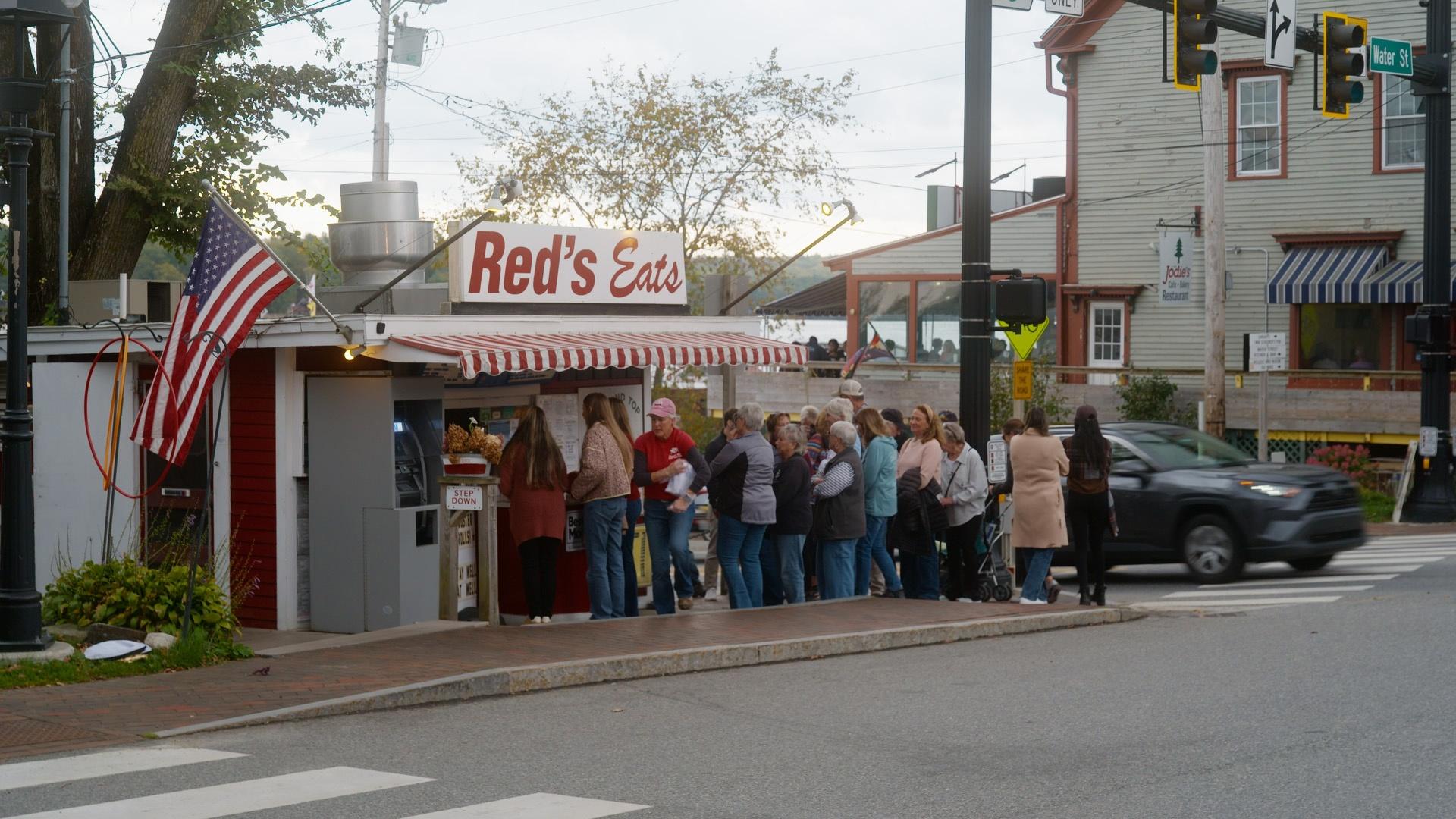
♪ ♪ TRAVERSO: If you've ever traveled in coastal Maine, you know Red's Eats in Wiscasset.
This iconic little red shed serves some of the most delicious lobster rolls you can have in Maine, and people line up by the dozens to have them.
I'm going to meet with owner Debbie Gagnon to talk about what makes this restaurant so special.
First of all, people know Red's for the incredible, delicious, bountiful lobster rolls.
The other thing people know is the incredible line of people who want those lobster rolls.
- Oh, my goodness, it's so humbling.
It never gets old hat to me, Amy.
It's so exciting to serve our guests and have them make their way back up to the window and say, "That was a piece of heaven."
TRAVERSO: Aw.
That's so great.
- "It was worth the wait."
And that just makes us so, so proud.
TRAVERSO: The line is almost all you have to do for advertising, because when people see, like, "Oh, people really like this place"... - Well, you know, my favorite search engine is word of mouth.
TRAVERSO: Yeah!
- It has always been word of mouth, okay?
TRAVERSO: Yeah.
- And I have guests, actually, we have, I think, four or five on the deck right now who come all the time.
TRAVERSO: Wow.
- Yeah.
They're, they become regulars.
TRAVERSO: Yeah!
- And our locals, like, our local merchants, they'll come to the side door, we'll get them their meal quick so they can go back to their storefront.
TRAVERSO (laughs): That's great!
- So it's just, we love doing what we do.
TRAVERSO: Right.
- And just having a lot of fun.
Hi there, welcome.
- Can I have a side of scallops?
- Yummy.
TRAVERSO: What makes your lobster roll so special?
- Oh, my gosh, so, remember, we eat with our eyes first.
TRAVERSO: Right.
- Okay?
So it has to be beautiful-- I'm very fussy.
TRAVERSO: Right.
- And it has to taste amazing.
So it's the freshest lobster you can get.
And what we do is, we don't measure.
Amy, I pile it high, you get an entire tail on the top.
And what I serve, I leave it totally plain.
Serve it with Kate's Maine butter on the side, extra-heavy mayo on the side.
Let our guests do what they want.
TRAVERSO: I have to say, we are here in the fall, you have done an incredibly busy summer season, and you still have this much energy, it's amazing.
(laughs) So this is very much a family business.
Can you tell me about that?
- Yes, it is.
My dad bought Red's in '77.
It was defunct at the time.
And I remember the local merchants asking my dad-- it had been for sale for a couple of years.
TRAVERSO: Right.
- Local merchants said, "Al, why do you want to buy Red's?"
He goes, "I'm going to turn it around."
TRAVERSO: Wow.
- And he did, but it took a number of years because... TRAVERSO: Wow.
- We used to play cribbage in the window waiting for guests.
TRAVERSO (laughs): Oh, my gosh.
- But Dad stayed true, Amy, to what he believed in-- that was, give people the freshest food you can... TRAVERSO: Right.
- ...plenty of it, and they'll be back.
TRAVERSO: Wow.
So what do you do when the line is long and people are waiting?
Do you entertain them?
How do you keep them happy?
- Well, we pass samples out down through the line.
TRAVERSO: Oh, nice.
- Ice-cold water, umbrellas for shading from the sun or rain.
I play-- we play games with them.
(talking softly) All the way from Kansas today.
Whoo!
Welcome.
That's awesome, I hope you're having fun in Maine.
- Oh, yeah.
TRAVERSO: So tell me about... That does not look like a big kitchen, but a lot of food comes out of it.
- That is like a clown car, okay?
It is teeny tiny, but I'll tell you what-- there's a magical dance going on in there.
TRAVERSO: Wow.
- Every one of us, it's so tiny, but we all know our movements.
TRAVERSO: Right.
- They know when I'm on the window, they know exactly when I'm gonna go put the order up.
And they'll slide in with a lobster roll and out.
But everyone knows their movements.
Everything in there has its place.
It really is a dance in there.
TRAVERSO: Yeah.
- And it's magical.
I love watching the magic that happens in this tiny little restaurant.
TRAVERSO: Wow.
- I have the best job in the world.
TRAVERSO: I love that.
- Love it.
- For exclusive videos, recipes, travel ideas, tips from the editors, and access to the Weekends With Yankee digital magazine, go to weekendswithyankee.com and follow us on social media, @yankeemagazine.
Yankee magazine, the inspiration for the television series, provides recipes, feature articles, and the best of New England from the people who know it best.
One year for $20.
Call 1-800-221-8154.
Credit cards accepted.
NARRATOR: Closed caption funding provided by... ♪ ♪ Major funding provided by... ♪ ♪ - In Maine, spring isn't just a gift.
It's an achievement.
This is Maine.
Forged by nature.
- New Smyrna Beach, Florida.
Relax already.
- Kloter Farms, from outdoor structures to solid hardwood furniture for over 45 years.
- On an American Cruise Lines journey, you can explore historic New England.
- Country Carpenters, handcrafted barns and homes for over 50 years.
♪ ♪
Search Episodes

Donate to sign up. Activate and sign in to Passport. It's that easy to help PBS Wisconsin serve your community through media that educates, inspires, and entertains.
Make your membership gift today
Only for new users: Activate Passport using your code or email address
Already a member?
Look up my account
Need some help? Go to FAQ or visit PBS Passport Help
Need help accessing PBS Wisconsin anywhere?

Online Access | Platform & Device Access | Cable or Satellite Access | Over-The-Air Access
Visit Access Guide
Need help accessing PBS Wisconsin anywhere?
Visit Our
Live TV Access Guide
Online AccessPlatform & Device Access
Cable or Satellite Access
Over-The-Air Access
Visit Access Guide




Follow Us