WILSON: At the onset of the invasion it was shock and horror.
KOMONKO: When it started, nobody could play.
NAUMOV: We stopped playing for three months.
KOMONKO: Because music comes from inside, and inside was pain.
WILSON: I thought to myself, "“What a beautiful idea it would be to form an orchestra.
STEFKÓ: We try to give, with the music, all those feelings which I think matters in this time.
NAUMOV: Such feelings like pain for my country... STEFKÓ: It'’s very emotional.
NAUMOV: But also hope.
Hope for a new world.
STETS: We are doing our fight in the cultural way.
WILSON: And for the cause of supporting their beautiful country Ukraine, it'’s people, it'’s heroes, and those who have died.
STETS: This is our way to fight.
♪ ♪ ANNOUNCER: This program is made possible in part by contributions to your PBS station from viewers like you.
Thank you.
WILSON: The history of humanity is littered at every turn with the violence and oppression of rulers and tyrants who would stop at nothing to get what they wanted.
From the terrors of Nazi Germany to the ongoing conflict between the Israelis and the Palestinians, to the militant Taliban rule in Afghanistan, and now to the horrific war that Russia has waged against Ukraine taking innocent lives and threaten the very foundation of democracy.
With each new aggression, brave men and women have always fought for what was right with weapons and sometimes with music.
♪ ♪ The Israel Philharmonic Orchestra, originally called the Palestine Orchestra, was founded in 1936 by the Polish-born, Jewish violinist Bronislaw Huberman.
Huberman understood what was about to happen in Europe, so he convinced 75 Jewish musicians to immigrate to Palestine and today the IPO is one of the leading international orchestras.
In 1999, pianist and conductor Daniel Barenboim joined forces with the late Palestinian scholar Edward Said to form an ensemble that included an equal number of Israeli and Arab musicians, breaking down what seemed to be insurmountable barriers between these two groups.
The West-Eastern Divan Orchestra has been breaking down barriers ever since.
♪ ♪ Zohra, Afghanistan'’s first all-female orchestra was formed in 2015 as part of the Afghanistan National Institute of Music to empower women and musicians in the face of the Taliban'’s efforts to silence them both.
Now in exile in Portugal, Zohra provides a lasting glimmer of hope.
(applause).
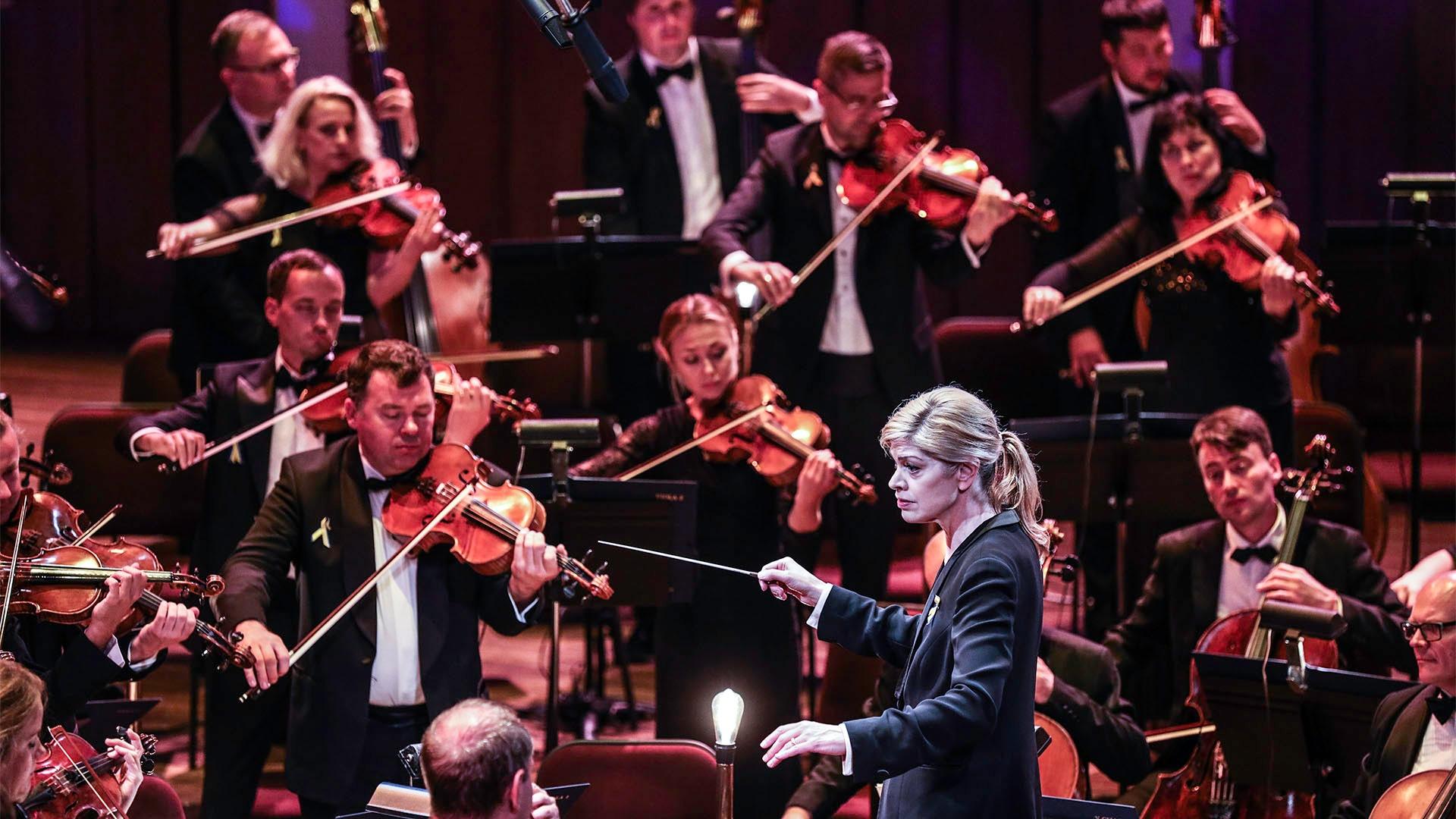
My name is Keri-Lynn Wilson, I'’m the conductor of the Ukrainian Freedom Orchestra.
The latest in the history of ensembles that fight tyranny with culture.
I grew up in Winnipeg, Canada.
My great-grandparents Pyotr and Oksana Olnyck were from Chernivtsi.
When I was a child I heard my great-grandmother speak with my grandmother only in Ukrainian and I was fascinated by the language, fascinated by the culture.
We celebrated Orthodox Ukrainian Christmases, Easters.
So Ukraine holds a very special place for me.
At the start of the invasion, I was watching the news constantly.
I went to rehearsal, that morning, the day of the invasion, with these images of my family and friends being bombed in Ukraine and found it the most shocking, horrifying moment of my life.
And that is when I thought to myself, "“What can I do?
"” It'’s not enough to play the Ukrainian National Anthem with the orchestras, it'’s not enough to say speeches, it'’s not enough to text my friends in Ukraine.
So I was seeing these images of refugees pouring into Poland and I thought, "“What a beautiful idea it would be if I could put these musicians together to give them a chance to play together, to make music, to form an orchestra.
"” The Metropolitan Opera and the Polish National Opera joined forces to bring this idea to life.
So the Orchestra is made up of course, of all Ukrainians and the majority of them are still in Ukraine.
Many are living in Kyiv, Lviv, Odesa, Kharkiv.
Other members of the orchestra were already living abroad or fled Ukraine at the start of the war, spreading out across Europe as refugees wherever they could find help or work.
It'’s a continual process, an ongoing day-by-day struggle to put down their arms, their weapons, pick up their instruments and fight for their country in a different way, in a cultural way.
We all came together for the first time as an orchestra for 10 intensive days of rehearsals and our inaugural concert in Warsaw, before embarking on our tour of Europe and the United States.
Throughout these weeks of performing together we found our collective voice so that together we can be a voice for the people of Ukraine, those who have fought to defend their country and those who have lost their lives.
Together we are soldiers of music fighting for Ukrainian culture.
STETS: Because cultural diplomacy is very important now.
NAUMOV: We want that the people will not stay indifferent to our situation.
KOMONKO: We have to, we have to fight.
WILSON: Ultimately this is one fresh, new, passionate, brave, determined orchestra.
♪ ♪ (audience applause).
♪ ♪ ♪ ♪ ♪ ♪ ♪ ♪ ♪ ♪ ♪ ♪ ♪ ♪ ♪ ♪ ♪ ♪ ♪ ♪ ♪ ♪ ♪ ♪ ♪ ♪ ♪ ♪ ♪ ♪ ♪ ♪ ♪ ♪ ♪ ♪ ♪ ♪ ♪ ♪ ♪ ♪ ♪ ♪ ♪ ♪ ♪ ♪ ♪ ♪ ♪ ♪ ♪ ♪ ♪ ♪ ♪ ♪ ♪ ♪ ♪ ♪ ♪ ♪ ♪ ♪ ♪ ♪ ♪ ♪ ♪ ♪ ♪ ♪ ♪ ♪ ♪ ♪ ♪ ♪ ♪ ♪ ♪ ♪ ♪ ♪ ♪ ♪ ♪ ♪ ♪ ♪ ♪ ♪ ♪ ♪ ♪ ♪ ♪ ♪ ♪ ♪ ♪ ♪ ♪ ♪ ♪ ♪ ♪ ♪ ♪ ♪ ♪ ♪ ♪ ♪ ♪ ♪ ♪ ♪ ♪ ♪ ♪ ♪ (playing quietly) (playing quietly) (silence) (audience applause).
(audience applause).
GELB: When my wife, Keri-Lynn first suggested the idea of an orchestra of Ukrainian refugees, I embraced this idea because I felt it was a perfect next step in the Metropolitan Opera'’s efforts to defend Ukraine, defend its cultural legacy and to fight back against Putin.
We discussed the program and uh, most of the programming ideas of course are hers, but one idea that I felt very strongly about was including this aria "“Abscheulicher"” from Beethoven'’s "“Fidelio"”.
Beethoven wrote this opera, "“Fidelio"” um, as a message against tyrannical rule and about freedom of the people.
♪ Abscheulicher!
♪ MONASTYRSKA: Abscheulicher!
Wo eilst du hin?
Was hast du vor, was hast du vor in wildem Grimme?
GELB: I thought that the words of the Rezitative portion of it which directly addressed the tyrant as "“monster"” could very aptly be thought of as a message to Putin himself.
MONASTYRSKA: (speaking in Ukrainian).
GELB: When choosing the soprano the first and most perfect choice was Liudmyla Monastyrska.
She is from Ukraine, she has family who live in Ukraine who are suffering from the war.
And I felt that she not only would have the perfect dramatic voice for this part, but also the drama of the Ukrainian situation seething inside of her and that she would want to express it through the words of this music.
MONASTYRSKA: (speaking in Ukrainian).
GELB: The human voice can express in words what an orchestra cannot.
In this case, the words that are being expressed from the aria from "“Fidelio"” are words against tyranny and oppression.
MONASTYRSKA: (speaking in Ukrainian).
(audience applause).
♪ ♪ ♪ MONASTYRSKA: Abscheulicher!
♪ ♪ Wo eilst du hin?
♪ ♪ Was hast du vor, was hast du vor in wildem Grimme?
♪ ♪ Des Mitleids Ruf.
♪ ♪ Der Menschheit Stimme.
♪ ♪ Rührt nichts mehr deinen Tigersinn?
♪ ♪ Doch toben auch wie Meereswogen.
♪ ♪ Dir in der Seele Zorn und Wut.
♪ ♪ So leuchtet mir ein Farbenbogen.
♪ ♪ Der hell auf dunkeln Wolken ruht.
♪ ♪ Der blickt so still, ♪ ♪ so friedlich nieder.
♪ ♪ Der spiegelt alte Zeiten wider.
♪ ♪ Und neu besänftigt ♪ ♪ wallt mein Blut.
♪ ♪ ♪ ♪ Komm, Hoffnung.
♪ ♪ Lass den letzten Stern.
♪ ♪ Den letzen Stern ♪ ♪ der Müden nicht erbleichen!
♪ ♪ O komm, erhell' mein Ziel.
♪ ♪ Sei's noch so fern.
♪ ♪ So fern!
♪ ♪ Die Liebe, sie wird's erreichen.
♪ ♪ Die Liebe, sie wird's erreichen.
♪ ♪ (singing in German) ♪ ♪ Komm, Hoffnung.
♪ ♪ Komm, Hoffnung.
♪ ♪ Lass den letzten Stern.
♪ ♪ Die Liebe, sie wird's erreichen.
♪ ♪ (singing in German) ♪ ♪ (singing in German) ♪ ♪ Ich folg' dem innern Triebe, ♪ ♪ Ich wanke nicht, ♪ ♪ Mich stärkt die Pflicht ♪ ♪ Der treuen Gattenliebe!
♪ ♪ O du, für den ich alles trug, ♪ ♪ Könnt ich zur Stelle dringen, ♪ ♪ Wo Bosheit dich in Fesseln schlug, ♪ ♪ Und süssen Trost dir bringen!
♪ ♪ O du, für den ich alles trug, ♪ ♪ Könnt ich zur Stelle dringen, ♪ ♪ (singing in German) ♪ ♪ Ich folg' dem innern Triebe, ♪ ♪ Ich wanke nicht, ♪ ♪ Mich stärkt die Pflicht.
♪ ♪ Der treuen Gattenliebe!
♪ ♪ (singing in German) ♪ ♪ (singing in German) ♪ (music ends) (audience applause) (audience applause) SHMAHAYLO: My name is Artem Shmahaylo, I play cello, I'’m a cello principal in the Ukrainian Freedom Orchestra.
NAUMOV: My name is Aleksandra Naumov.
I'’m from Kyiv and I play bassoon.
STEFKÓ: My name is Mihaly Stefkó, and I am a violinist.
First violin.
NAUMOV: When the war began, we stopped playing for three months.
SHMAHAYLO: When everything started I was in Belgium.
NAUMOV: And I went to Germany so I, because I was scared and, scared of the rockets.
STEFKÓ: Yeah, I'’m sad because of my, my parents are still there.
SHMAHAYLO: My mom lives there, in Kryvyi Rih still.
My brother lives there.
Many friends, my grandmother lives in Mykolaiv which is severely bombed since the beginning of the war.
STEFKÓ: It'’s very emotional to, to feel that, like my, in my country, I, I cannot go, go back yet.
SHMAHAYLO: I tried to understand what can I actually do for this, in this situation.
Shall I go fighting?
What, what can I do?
What are my steps?
STEFKÓ: With the Ukrainian Freedom Orchestra we can deliver the message somehow of those people who needs very much the support.
NAUMOV: We were nervous because like 75 people that never played together and the first rehearsal was not so good.
But now I feel like we are, we are a real orchestra, yes.
Dvorák.
I have a little sentiment to the Dvorák, to the symphony, because that was the very first symphony in my life which I performed in professional orchestra from the beginning until the very end.
STEFKÓ: We try to give with the music all those feelings which I think matters in this time.
SHMAHAYLO: I feel that I have to give away everything I can emotionally.
NAUMOV: While playing, playing, I have such feelings like pain for my country, and I feel proud of our defenders.
And of course sadness.
But also hope.
Hope for a new world.
STEFKÓ: Somehow we can imagine in the future that we will get that new world, peacefully.
♪ ♪ ♪ ♪ ♪ ♪ ♪ ♪ ♪ ♪ ♪ ♪ ♪ ♪ ♪ ♪ ♪ ♪ ♪ ♪ ♪ ♪ ♪ ♪ ♪ ♪ ♪ ♪ ♪ ♪ ♪ ♪ ♪ ♪ ♪ ♪ ♪ ♪ ♪ ♪ ♪ ♪ ♪ ♪ ♪ ♪ ♪ ♪ ♪ ♪ ♪ ♪ ♪ ♪ ♪ ♪ ♪ ♪ ♪ ♪ ♪ ♪ ♪ ♪ (music stops) ♪ ♪ ♪ ♪ ♪ ♪ ♪ ♪ ♪ ♪ ♪ ♪ ♪ ♪ ♪ ♪ ♪ ♪ ♪ ♪ ♪ ♪ ♪ ♪ ♪ ♪ ♪ ♪ ♪ ♪ ♪ ♪ ♪ ♪ ♪ ♪ ♪ ♪ ♪ ♪ ♪ ♪ ♪ ♪ ♪ ♪ ♪ ♪ ♪ ♪ ♪ ♪ ♪ ♪ ♪ ♪ ♪ ♪ ♪ ♪ ♪ ♪ ♪ ♪ ♪ ♪ ♪ ♪ ♪ ♪ ♪ ♪ ♪ ♪ ♪ ♪ ♪ ♪ ♪ ♪ ♪ ♪ ♪ ♪ (music stops) (audience applause) ♪ ♪ ♪ ♪ ♪ ♪ ♪ ♪ ♪ ♪ ♪ ♪ ♪ ♪ ♪ ♪ ♪ ♪ ♪ ♪ ♪ ♪ ♪ ♪ ♪ ♪ ♪ ♪ ♪ ♪ ♪ ♪ ♪ ♪ ♪ ♪ ♪ ♪ ♪ ♪ ♪ ♪ ♪ ♪ ♪ ♪ ♪ ♪ ♪ ♪ ♪ ♪ ♪ ♪ ♪ ♪ ♪ ♪ (music stops) (audience applause) ♪ ♪ ♪ ♪ ♪ ♪ ♪ ♪ ♪ ♪ ♪ ♪ ♪ ♪ ♪ ♪ ♪ ♪ ♪ ♪ ♪ ♪ ♪ ♪ ♪ ♪ ♪ ♪ ♪ ♪ ♪ ♪ ♪ ♪ ♪ ♪ ♪ ♪ ♪ ♪ ♪ ♪ ♪ ♪ ♪ ♪ ♪ ♪ ♪ ♪ ♪ ♪ ♪ ♪ ♪ ♪ ♪ ♪ ♪ ♪ ♪ ♪ ♪ ♪ ♪ ♪ ♪ ♪ ♪ ♪ ♪ ♪ ♪ ♪ ♪ ♪ (music stops) (audience applause) (audience applause) KERI-LYNN: Tonight's concert was in honor of Ukrainian culture.
Slava Ukraini!
(applause) And now in solidarity with the brave people of Ukraine, we will play an arrangement by Yuri Shevchenko of the Ukrainian national anthem.
(applause) ♪ ♪ ♪ ♪ ♪ ♪ ♪ ♪ ♪ ♪ ♪ ♪ ♪ ♪ ♪ ♪ ♪ ♪ ♪ ♪ ♪ ♪ ♪ ♪ ♪ ♪ (music ends) (audience applause) (audience applause) (audience applause) (music plays through credits) ♪ ♪








 Passport








Follow Us