Change, it's part of life. As sewers and quilters, our projects progress just as all other aspects of our lives change. For my guest today, her quilting over the past 30 years evolved from traditional patterns to something that's a style of her own. I'd like you to meet Mimi Damrauer.
Mimi, you're a textile collage artist and you didn't start out that way. That's right, I started out as a really traditional quilter. My sister taught me how to quilt. I was always a sewer, so it was fun to look at more art projects rather than clothes.
My first fabrics that I used were solids because at the time I was really interested in Amish quilting and I took my direction from those. I love the solid patterns and how contemporary they still looked. They are very structured patterns, though. I used a lot of templates.
I was drawn to solid fabrics instead of calicos. There weren't a lot of fun prints out back then. 30 years ago, certainly not! You brought an early piece of yours, an art piece which I think is fun to look at.
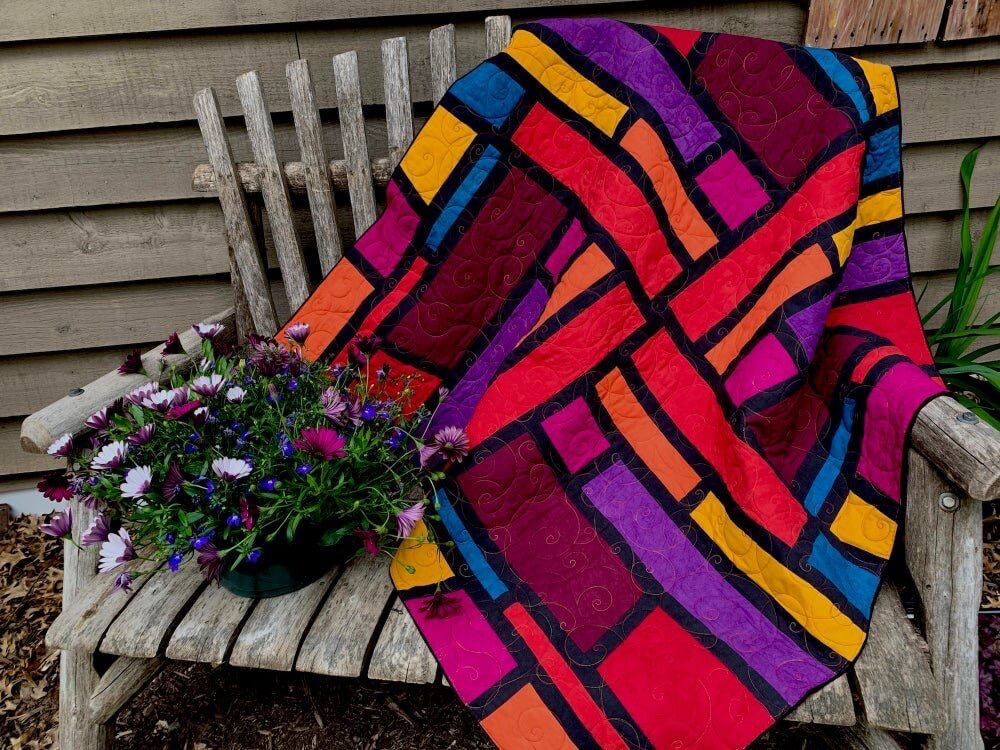
Yes, it's my earlier style. I started painting fabric after I met some other textile surface design artists and took classes from them. Then the prints that I was making the patterns were really busy and I was still buying solid fabrics to use with that. So these were some of my earlier pieces.
It's a Log Cabin pattern which I still make but have changed that over time, as well. Now, I mentioned change and evolution of how we sew and quilt. And yours has taken quite an interesting change because now this is your full-time job. It is my full-time job.
I've been making, I call them textile collage because I do feel it's different from quilting now. I've been hand painting my own fabric. This has evolved from the real busy patterns into a simpler way of doing my fabrics. I paint big pieces of fabric and then I hand cut all of the pieces.
So it's more wobbly and kind of improvisational. One of the reasons I wanted our viewers to see these pieces is that you mounted them on foam core and then will frame them. What a great way of doing art. It's a great presentation.
I think a lot of people are still not seeing textiles as real art. So when it's in a frame it looks more important to them. You mentioned this had a fieldstone as inspiration. I travel all over the world.
I'm starting to use my travels as inspiration. I picked up a stone in Positano, Italy, on the beach and it had these lines in it. Actually, the next piece as well is from the other side of the stone. So, you can find inspiration anywhere and design ideas, as well.
So really, from a modified Log Cabin to this contemporary collage your work has taken a total deviation. It has, and I think it's mainly using fabrics that I make myself, these are hand-dyed fabrics. Not only do I paint fabric, but I hand-dye fabrics. Here's another piece.
These are my "drunk" circles. I'm doing circles, lines, and squares are really the series that I'm doing. So, not detailed sewing the seams together just appliquing one layer on top of the other. Yes, and I zigzag my backing.
Sometimes I'll do a back sheet of one color and then I appliqu the squares on first so there's color peeking through. Then these I also scrunch together and I zigzag them. It's always inspiring for me to see how other fiber artists sewers, and quilters interpret their work. You started out by working with dying your own fabric in a really expensive vessel.
The vessel! "You use big vats?" I do it in plastic bags. What I do, is I take natural cotton muslin. I buy the 50-yard bolt and I dye 300-400 yards of fabric at a time.
I wash the piece. I probably do bigger pieces, about one-yard pieces. I wash it to get the sizing off, and really high tech I scrunch it and put it in a plastic bag. This is how I learned.
I kind of modified it a little. I mix my powder dyes. I buy powder dyes mainly in primary colors some mixed colors, but I mix the colors myself. My color wheel is my own, and my palette.
Then I pour the dye with water, mix it and I let them sit in the bag. Because it's scrunched there are a lot of peaks and valleys. My fabric is so much fun to work with in my studio. I have piles.
When I dye a color, I do 50 greens and 50 blues so they're just beautiful. This is my favorite color. It is more of a "chartreusey" green. I think it's a neutral.
It looks great with everything. You can see there are some peaks and valleys a little bit mottled it looks a little tie-dyed in this area. I probably didn't mix the powders together real well so the yellow popped out a little bit more. So it's fun, I love raw edges.
You know you can see in my work the raw edges. I really don't bind anything. It's really contemporary. How inspiring to learn how you dyed fabric.
Mimi, thank you for sharing that with us. You can find out more about Mimi's Web site by going to sewingwithnancy.com click under "Nancy's Corner". And under the 2400 series, you'll find the information on Mimi's great work and her textile art. Well, thank you for joining us on this first program of "Sensational Scarves." Donna Fenske will be back next time on our second program of this two-part series where we'll have many more ideas for you.
As always, thanks for joining us. Bye for now.


 Passport











Follow Us