Pati, voice-over: My friend Carlos is taking me to a haunted pink mansion.
Carlos: The neighbors, they could hear this woman screaming.
Pati, voice-over: Want to come?
No.
Pati, voice-over: Then we're off to Sorbeteria Coln to enjoy some French sweets.
Am I in Paris?
No.
Pati: It tastes so richly coconutty.
Pati, voice-over: This is Mrida, the capital of Yucatn, a city exploding with flavors and a fusion of cultures that creates some of the most exciting eats in Mexico.
Pati: Very generous tacos.
Look at that.
Man: Uh-huh.
Pati, voice-over: Like the most popular breakfast stand in the city that has its own spin on the American chili bowl.
El chile habanero.
Pati, voice-over: And I'm meeting an old friend, who's cooking up a Yucatn classic.
Very, very good.
Back in my kitchen, I'm combining the flavors of Mrida in a smooth and easy-to-whip-up pea soup with basil and mint crema.
[Birds chirping] [Child shouts] [Speaks Spanish] Mm-hmm, mm-hmm, mm-hmm.
Super sweet.
-[Woman speaks Spanish] -Yeah.
[Pati speaks Spanish] So breathtaking.
Announcer: "Pati's Mexican Table" is brought to you by... Announcer: La Costea.
por sabor!
Men: Avocados from Mexico Announcer: Stand together.
Helping every person rise.
More information at standtogether.org.
[Acoustic guitar plays Nationwide jingle] Announcer: Here, the typical arroz con pollo or not.
Unfollow la Receta.
Mahatma Rice.
Announcer: Levenger-- nearly 40 years of craftmanship for readers, writers, thinkers, and doers.
Pati, voice-over: Yucatn's, capital of Mrida is a unique blend of Spanish and Mayan influences.
In the 17th century after Spain colonized the land ruled by the Maya, it became a strategic hub for Spain in the New World.
Today, it's a thriving city with a distinctive culinary scene that I find myself returning to time and time again... but Mrida is not only rich in flavor.
At one point during the turn of the 20th century, more millionaires per capita lived here than anywhere in the world, all because of this plant, henequen, used for so many things, including ropes, ships, and bags, and this was their playground, Paseo de Montejo, a street lined with little palaces in the heart of the city.
Carlos Sosa is an expert in Yucatn history.
Pati: They were the biggest landowners.
-The biggest and the richest.
-Mm-hmm.
On those days, the only material that existed to make ropes and bags-- thread, ropes Thread, rope for the ships, the big ones, they were made with henequen, and as the hacienda owners, for them, it was easier to travel to Europe and France.
They were moving back and forth from France to Yucatn, and they were bringing all what they wanted to-- furniture, architects that would design the houses to build them.
Pati, voice-over: Built in 1904, this mansion was designed to replicate a French castle.
It was abandoned for years, and when Carlos was a little kid, the game was to see how long he and his friends could stay inside without getting scared.
Pati: And I've heard there's a legend of a ghost in here, right?
Carlos: This is something that has-- many of these places have legends.
The legend of this one is that a couple who came here in the 1980s that rented the house.
She was bit by a bat.
Pati, voice-over: When the woman became ill with rabies, her husband locked her in a room until her death.
Afterwards, the neighbors reported hearing her cries through the walls.
Miguel Peniche manages the property.
[Speaking Spanish] No!
No--[Speaking Spanish] Pati, voice-over: I'm not convinced there's no ghost, but nevertheless, the original owner, Miguel Pen, who lived here for 20 years, might have an even more tragic story.
[Speaking Spanish] Pati: No!
[Speaking Spanish] Pati, voice-over: The current owners have renovated and restored much of the home to its former glory.
[Speaking Spanish] Pati, voice-over: I can't help but wonder if this is the room where the woman from the legend cries at night.
[Speaking Spanish] Pati, voice-over: Sorbeteria Coln, only a few blocks away, started in 1907, just 3 years after the pink mansion was built.
Their wide variety of French pastries and frozen treats offer a brief reprieve from Yucatn's famously hot, humid days.
[Speaking Spanish] Carlos: This is one of the most iconic places in Mrida.
Pati: So it's not ice cream?
-No, it's not ice cream.
-It's sorbet.
-It's sorbet.
-Which means it's water-based.
It's water-made with seasonal fruit.
[Speaking Spanish] That's crema Morisca.
[Speaking Spanish] Mmm!
[Speaking Spanish] It's, like, so light... [Speaks Spanish] it tastes so richly coconutty.
Yum.
So the mix of cultures and flavors in the Yucatn is very different from the rest of the country because also you guys, like, are kind of isolated geographically from the rest of-- We were isolated.
In fact, Yucatn was a country.
Pati, voice-over: The Yucatn Peninsula, which is now separated into 3 states, Yucatn, Quintana Roo, and Campeche, has declared its independence from Mexico twice.
The final attempt was in the 1840s, but a brutal Maya uprising known as the Caste Wars cut the effort short.
Carlos: But the War of Castes was so strong.
Mayans were winning the war, so the Yucatn government was trying to get help from different countries in order to fight against the Mayas.
They proposed to the U.S., to England, and to Spain and France.
None of those countries accepted, so they had to go back to the government in Mexico.
Nowadays, for many years, we were called the sister republic of Yucatn, and we make jokes about "You're coming to Yucatn, "but you're from Mexico, you need a passport.
You don't have a passport you cannot get in here."
Going back to sorbets and the pastries that are so French but rooted in Yucatecan flavors, do you think people are still as obsessed with French influenced foods?
Some.
Now we have a diversity of cultures coming into the place that some of them, which are not really strong, are kind of melting.
Mm-hmm.
But people are still flocking this place.
It's a tradition to find in the bakeries.
Mmm.
[Speaking Spanish] -Mm-hmm.
-It's so good.
-[Speaking Spanish] -Mmm.
Pati, voice-over: Sorbeteria Coln also bakes French-inspired sweets, but there's another place that has been baking Yucatecan cookies for generations, and you can smell it on the streets.
[Speaking Spanish] Pati, voice-over: Since 1905, Dond has produced the buttery, flaky crackers, Globitos and Bizcochitos that grace the breakfast tables and coffee mugs of thousands of Yucatecans every morning.
Marion and Fausto let me behind the counter of their stand outside the original factory to get a taste.
[Speaking Spanish] Mmm!
Pati, voice-over: Jorge Domingo is a production manager at Dond and wants to show me the Yucatecan way of eating these crackers, but for safety, we have to follow this yellow paved road.
No veering.
In fact, we're sitting on the front steps because we're not allowed to film inside for safety reasons.
It's not a bad idea since I've been known to get in trouble with large machinery.
[Speaking Spanish] OK. Mm-hmm!
Pati, voice-over: These crunchy crackers aren't just for coffee.
Yucatecans use them in many ways, including creamy vegetable soups.
Today, we're gonna make a pea soup with mint and basil crema, and I got inspired to make this soup because of two reasons.
One, people in the Yucatn use peas so much, and I think it's a very unappreciated ingredient, and the other is I was amazed by how much people in the Yucatn love to use those Dond crackers in the soups.
So I'm starting off by chopping half of a white onion.
and it doesn't have to be finely chopped because we're gonna puree everything anyway.
I'm turning my heat on over high.
OK.
I'm adding the two tablespoons of butter in here, and then I'm adding two tablespoons of olive oil.
Once you see that the butter starts bubbling into the oil like this, you want to add your vegetables, and then I'm gonna keep my heat at medium because I don't want the vegetables to burn or brown.
I don't want to have that toasty flavor.
I want to have a very subtle, gentle flavor all around in this soup.
So now leeks in Spanish go by the name of puerro, and it's super common to combine leeks and onion in vegetable soups.
It gives it an amazing flavor.
So we need about two cups.
[Sizzling] Oh, it smells like soup already.
The moment the leeks start cooking, they let out this sweet scalliony aroma.
OK, so once they soften, I'm gonna add my chicken broth.
6 cups.
And then I'm gonna add 4 cups of peas.
To complete the pot, I need one teaspoon of salt, 1/2 teaspoon of black pepper and one cup each of fresh basil and mint.
And these were two herbs that I was very surprised to find and to be so thoroughly used in Yucatn, but they have their own kind of basil, and the basil you find there, like many of the ingredients in the Yucatn, is very aromatic, very fragrant, very sweet.
It needs a few more minutes.
It needs to simmer.
It needs to cook.
So as this cooks, we're gonna make the crema, or cream, that's gonna top it, and I'm just using one cup of Mexican-style cream.
It's thicker than heavy cream, and it's tangier, and then I'm just gonna chop some basil.
Add it in here.
And a little bit of mint.
A tiny bit of salt and pepper in here.
OK.
So mix.
Let me see.
Mmm!
Yum!
Our final step is to puree our mixture to silky smooth, then return it to the pot, and it's practically done.
Let's try that.
It is so soothing and has that sweet taste and that lingering coolness from the mint, and now I'm gonna top it with the crackers.
I'm just gonna do a few at a time.
Mmm!
Mmm!
And peas are found year-round, and then you can do it with crackers, without crackers, in mugs, in bowls.
Whichever way you want to try it or whichever way you want to eat it, I hope you give this pea soup a try.
Mmm!
[Indistinct chatter] [Speaking Spanish] Pati, voice-over: Continuing my quest through Mrida's tasty treasures brings me to one of the best tacos in the city.
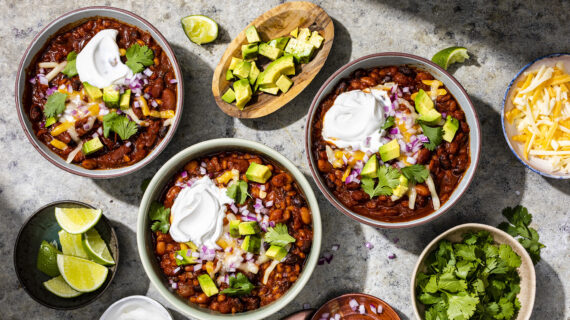
Mauricio Lira and his family are the owners Wayan'E, a taco stand in Mrida that definitely deserves a place on the most distinctive food list with their spin on the cheesy, delicious castacn taco and the smoky, saucy chili buul, a taco version of the popular United States chili bowl.
[Speaking Spanish] Uh-huh.
Aha!
Pati, voice-over: They now have more than 30 stews but are famous for two, and I have a secret.
The best thing to do is mix them together.
Very generous tacos.
Look at that.
Mauricio: Uh-huh.
[Speaks Spanish] Mmm!
Pati, voice-over: The castacn taco is made with crispy slices of pork belly and melted queso, a dish that Mauricio made his own by using Manchego cheese.
The chili buul is a bean and chipotle sauce taco.
Mauricio found inspiration at the airport in Miami.
[Speaking Spanish] Pati, voice-over: Each one of Wayan'E's 4 locations is managed by one of their kids.
This one, the original, is run by their son Guillermo.
[Speaking Spanish] Pati, voice-over: There are so many good options, there's no way I can leave without trying one more taco, and Mauricio won't let me leave without trying his personal favorite, cilantro chicken.
Mmm, mmm.
Mmm!
[Speaking Spanish] Pati, voice-over: It's impossible to talk about the flavors of Mrida and Yucatn without mentioning xtabentn, a sweet, aromatic liquor made with fermented honey and anise seeds with notes of licorice and fennel.
[Speaking Spanish] Pati, voice-over: Fernando is one of the longest tenured employees at Casa D'Aristi, the first company to sell xtabentn commercially in 1935.
[Speaking Spanish] Pati, voice-over: Almost 100 years later, the recipe remains unchanged, thanks in big part to this man Manuel Gomez... [Speaking Spanish] Pati, voice-over: their head distiller.
[Speaking Spanish] I'm just gonna stay here.
It smells so nice.
[Speaking Spanish] Pati, voice-over: The drink is inspired by an ancient Maya fermented drink called balch made with Melipona bee honey and tree bark.
The Spanish came and removed the bark but introduced anise seeds.
[Speaking Spanish] -Yum.
-[Manuel speaking Spanish] -Yum.
-[Fernando speaking Spanish] [Pati speaking Spanish] sticky, tangy, sweet.
Ay.
Like, deliciously sticky.
Yum.
Pati, voice-over: They ship tens of thousands of bottles a year, hand-inspected, cleaned, and packaged.
[Speaking Spanish] Pati, voice-over: The bottles are rinsed.
[Speaking Spanish] Pati, voice-over: filled-- [Speaking Spanish] Pati, voice-over: not as easy as it looks-- [Speaking Spanish] Pati, voice-over: and finally, bottled and shipped.
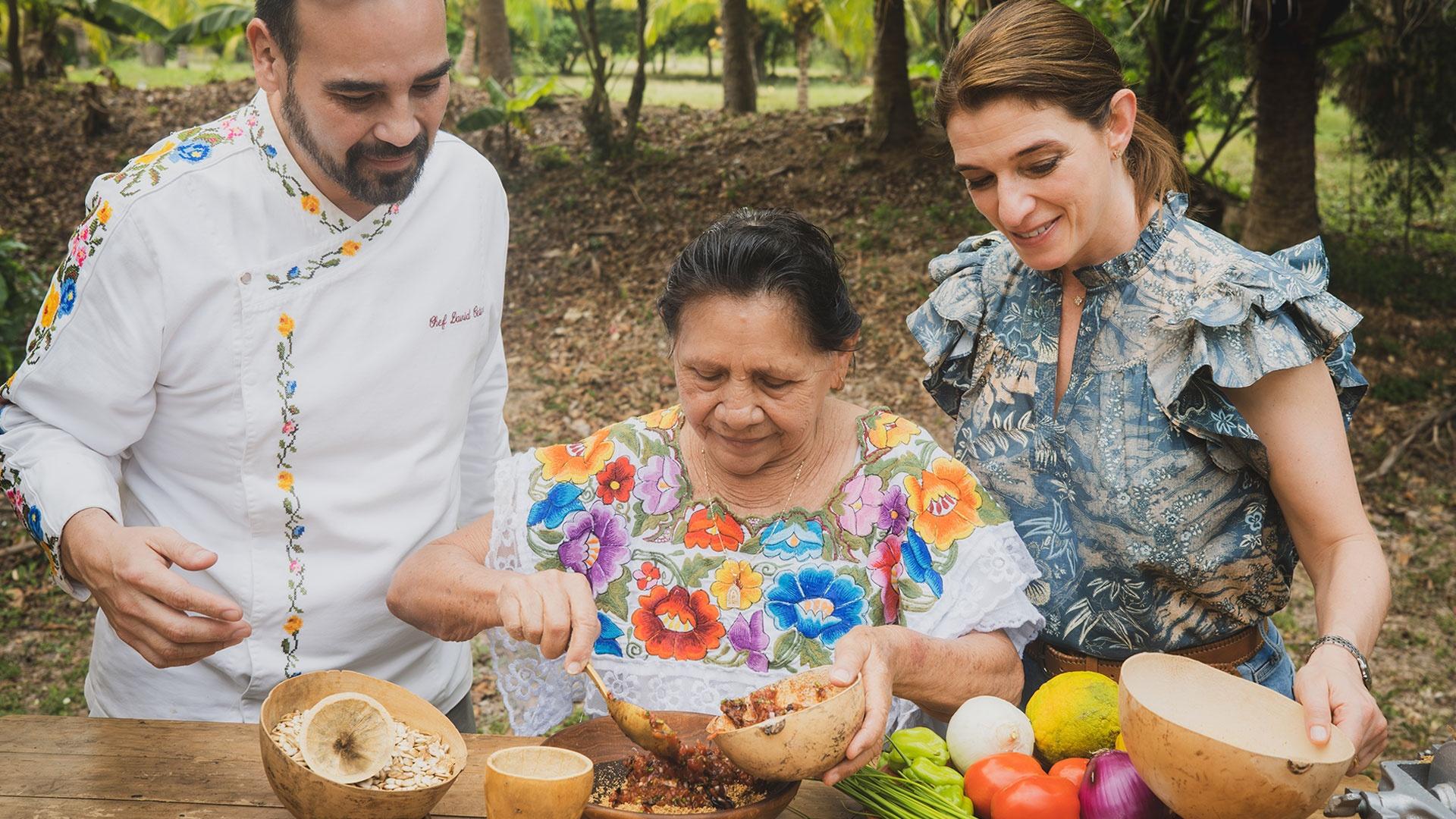
Of course, no one should drink on an empty stomach, and luckily, one of the most accomplished chefs in Yucatn has plans to open a restaurant here on the hacienda grounds-- Chef David Cetina.
[Speaking Spanish] Pati, voice-over: David and his assistant Olga surprise me with a Yucatn classic Sikil Pak, a smoky Maya pumpkin seed salsa.
[Speaking Spanish] Pati, voice-over: Pumpkin seeds are the star of the dish, giving it the smoky flavor along with crushed roasted tomatoes, chives, and cilantro.
Nothing is complete without Yucatn's most ubiquitous chile.
[Speaking Spanish] No.
I'm not going there.
[Speaking Spanish] He's saying the tip is not spicy, but I don't believe it.
[Speaking Spanish] Why?
[Speaking Spanish] No, no.
[Speaking Spanish] Chiles are capricious.
Like, what can I say?
No?
Pati, voice-over: Sikil Pak is such a fun, easy-to-make dish that's perfect as a nutritious light snack, and it's already ready.
[Speaking Spanish] OK. David: Mmm.
[Olga speaks Spanish] Pati: Mmm!
David: Very, very good.
Mm-hmm-hmm.
Mm-hmm, mm-hmm, mm-hmm.
Mm-hmm-hmm.
[Speaking Spanish] Pati, voice-over: The flavors of Mrida are a complex tapestry of new and ancient, Spanish, Maya, and even French.
Yucatn never ceases to leave a long-lasting impression on my palate and in my heart.
[Laughter] [Indistinct chatter] Pati: For recipes and information from this episode and more, visit patijinich.com and connect.
Find me on Facebook, TikTok, Twitter, Instagram, and Pinterest @PatiJinich.
Announcer: "Pati's Mexican Table" is brought to you by... Announcer: La Costea.
por sabor!
Men: Avocados from Mexico Announcer: Stand together.
Helping every person rise.
More information at standtogether.org.
[Acoustic guitar plays Nationwide jingle] Announcer: Here, the typical arroz con pollo or not.
Unfollow la Receta.
Mahatma Rice.
Announcer: Levenger-- nearly 40 years of craftmanship for readers, writers, thinkers, and doers.
Announcer: Proud to support "Pati's Mexican Table" on public television.









 Passport












Follow Us