











PBS Wisconsin Passport
Watch this video with
PBS Wisconsin Passport
Become a member of PBS Wisconsin, support your local community, and get extended access to PBS shows, films, and specials, like this one.
OSIRIS-REx: Countdown to Launch
07/18/19 | 26m 46s | Rating: TV-PG
OSIRIS-REx: Countdown to Launch is a half-hour AZPM original documentary providing an in-depth look at the science and scientists behind the asteroid sample return mission, OSIRIS-REx. It reveals the personal and scientific challenges overcome by the scientists responsible for the Asteroid Sample Return Mission.


Copy and Paste the Following Code to Embed this Video:
OSIRIS-REx: Countdown to Launch
(dramatic music) -
Narrator
Could asteroids crashing into Earth have brought life along with them? To answer that and many other critical questions, a team of scientists and engineers are on a crucial mission to bring back a piece of asteroid Bennu before it possibly crashes into Earth. (dramatic music) It's a first for the United States, the chance to touch what might be the origin of life on Earth. In the Spring of 2011, NASA put up nearly a billion dollars for the nation's first space mission to visit, study, and collect samples of an asteroid.
NASA awarded the 14 year long OSIRIS-REx Mission to the University of Arizona in Tucson under the direction of Principal Investigator Michael Drake, a space exploration veteran. This is a sample return mission. The really holy grail is to return, and we promised NASA at least 60 grams. We'll probably return a lot more than that to Earth in the year 2023 in September.
The team is multi-generational. So I have young people, Dante Lauretta, my Deputy P.I. is 25 years younger than I am. And then we'll have grad students, undergraduates, maybe as many as hundred undergraduates employed by the project.
We're gonna work for the next five years to build the spacecraft, to build the instruments, to get the ground system ready. We're gonna strap it onto a giant explosive and send it off into space. And that is a hold your breath moment because it's completely out of our control. We show up in Florida with a spacecraft, stick it on the top of that rocket, and trust the rocket team knows what they're doing.
And they do, they're professionals, and they will get the spacecraft off the ground. But there's always the chance that something's gone wrong or something, a valve has stuck or something and the system malfunctions and your spacecraft gets dropped into the ocean or explodes upon launch. So that's the really big one. Once we're in space, we're much more comfortable.
That's the environment the spacecraft is built for to operate. -
Narrator
The OSIRIS-REx team has a mere five years to design, build, and deliver their instruments for the launch, scheduled for September, 2016. Just months into the mission, the principal investigator, Michael Drake, dies suddenly. Obviously the team suffered a major setback in September when we lost our leader, Mike Drake. And I was then asked by NASA to step up into the role of principal investigator.
So a new leader changes the team dynamics substantially, so it took a while for us to regroup, mourn, and to focus on our objectives and get the team back up to operations. -
Narrator
Designing and building the instruments will take the first five years of the mission. The spacecraft will then spend two years chasing down its speeding target and a year and a half mapping and studying the asteroid before grabbing the sample and returning to Earth. After the two year journey, the sample will land in September of 2023. The biggest hurdle for me has been assuming the leadership position.
There's a saying that it's lonely at the top, and for the first time in my life I understand what that means because the buck stops here. When I say something, even if it's an offhand remark in a hallway, the team will take it as direction and guidance and the next thing I know they'll be redesigning the project because of some crazy thought that I expressed out loud. So I need to be very careful about what I say. I cannot often think out loud unless I make absolutely clear to the team that that's what I'm doing and I'm not giving them guidance.
So we're building test units of all of our instruments, all of our key spacecraft components. And we are testing them in flight-like environments. So we'll shake them harder than the rocket will shake it. We'll bake it hotter than the Sun will bake it.
We're going to shock it, we're going to throw all kinds of electromagnetic interference at it. We're gonna make sure it can perform in the harsh space environment. That gets us a qualified engineering unit that we can then go and assemble the flight unit based on the experience. -
Narrator
The OSIRIS-REx name is an acronym of the mission's concepts and goals. Origins, spectral interpretation, resource identification, security, regolith explorer. Five instruments on the deck of the spacecraft will explore the nearly half mile diameter asteroid. These instruments will include cameras to see the surface, spectrometers to identify minerals, chemicals, and elements, altimeters to map the asteroid, and an arm with a collector to gather the sample.
One of the most most critical of these instruments is the set of three cameras, called OCAMS. I think that every single problem that you find is something that could have failed the mission at some point in the future. Or dramatically reduced your ability to be successful. Basically, I've noticed, and it's probably a subjective observation that's not really objectively based, but I noticed that a lot of problems seem to happen on Friday afternoons.
So it's just something you live with. We have one mission, it's gonna go there, it's gonna figure out how to operate around that asteroid, it's gonna figure out the asteroid itself, it's gonna decide where we want to go, it's gonna go there, it's gonna grab that sample, it's gonna come back to Earth. All of those things, any one of which have been a really complicated thing to do. We're gonna do them at all once.
This camera system is meant to enable that whole fete. -
Narrator
The four and half billion year old asteroid Bennu was chosen in part because it may have organic compounds thought to be the origin of life on Earth. It's also one of the most potentially hazardous, with a one in 2,700 chance of colliding with Earth late next century. The main partners in the mission are NASA's Goddard Space Flight Center outside Washington, D.C. and Lockheed Martin Space Systems in Denver, Colorado.
Lockheed Martin is tasked with designing how to grab two ounces of surface material, called regolith, and get it safely back to Earth. It's at Lockheed Martin that all the team's designs will get a final review. My name is Ed Bayshore, I'm the Deputy Principal Investigator, and I'm gonna be talking with you. This is our last presentation of the day.
And we're gonna talk about science operations on the ground data processing. It's been a long couple of weeks. We've been here now seven days. It's been very thorough and intensive, but I think it's going really well.
The kind of review like this critical design review is essential for the success of OSIRIS-REx or any other spacecraft mission. This is a chance for the team, which has been very narrowly focused on what they need to get done, to have a chance for people to come in with a fresh set of eyes, scrub all of their assumptions and all of their plans and really provide important guidance to make sure no mistakes are overlooked. It's actually NASA's chance to come in and give us a assessment of how well the design is done. Do you have enough confidence in the design that they should pay to have it built?
Is the site going to be safe for the flight system? That's another key question that we need to answer. And if you're lucky, will you find sufficient sampling material there? So you've got a deliverable site, you've got a safe site, but will you actually find sample material?
-
Man
Lockheed Martin had developed something called the TAGSAM. It's Touch And Go Sample Acquisition Mechanism. It's something we developed to actually do a sample without needing a scoop or needing to be attached to what we're sampling. Once we're sure we have the sample, the SRC, this is a Sample Return Capsule, is opened up like a clam shall.
The arm articulates, puts the sample into the SRC. It's latched down passively in the SRC. We cut the head loose then, back the arm out, close the lid to the SRC, and are ready to come home. The capsule, its main purpose is to protect the sample on its way back to Earth and then Earth entry, especially Earth entry.
The PICA and the heat shield help us get through the initial high intensity heating coming through the atmosphere. The next step is we start building a spacecraft. So real flight hardware starts coming in here at Lockheed Martin and starts getting assembled into a vehicle that we're gonna launch into space. -
Man
Three, two, one, ignition main stage. (explosion) -
Narrator
NASA's first successful launch of a spacecraft was in 1958. They've been doing space exploration ever since. We have been involved in I believe ever single NASA mission. We haven't led every one of them, but we've been involved in every single one of them.
We may be the only university in the world that can make that statement. The U of A has always been involved in planetary science, and when I say always, I really mean always. You have to go all the way back to the beginning when President Kennedy made his announcement that we were going to send people to the Moon by the end of the decade. So the NASA engineers kind of looked around the country and there was no one who knew anything about the Moon.
The only place that really had any of the expertise they needed was here in Tucson. Gerard Kuiper was making the maps of the Moon here, and then he was invited to be an experimenter on the Ranger missions. -
Narrator
Unlike OSIRIS-REx, the Ranger missions weren't designed to return to Earth. They weren't even designed to survive a landing. The Ranger probes hoped to send back a few pictures of the Moon before crashing onto its surface. But they kept failing.
They finally brought Gerard Kuiper onto the team and a handful of other scientists, including Ewen Whitaker, who was also here in Tucson. And together this small team of scientists came up with a way to succeed at that mission and to get some photographs back so that we knew what we were headed for, we knew what the astronauts were going to land on. So I was just one of the peons (laughing) with a knowledge of Moon mapping in the background of my head. To pick someone like me, a rank amateur, more or less, to put me on this team of people telling NASA where they can put their camera on the Moon.
Anyway, we took it all in our stride and did our very best. This is a great day for science, and this is a great day for the United States. We have made progress in resolution of lunar detail by a factor of a thousand. (applause) -
Man
Two, one, you now have liftoff! -
Narrator
After the Moon, it was our neighboring planets on which NASA's space exploration focused next. One of the biggest breakthroughs came in 2008 when the Phoenix Mars mission successfully landed on Mars. It was the first mission to be run by a public university, and it's not a coincidence that that happened here in Tucson, where for 50 years we have been building up the expertise in order to do a mission like that. It was a great moment when NASA and Caltech passed the reins to us for running the ground operations of this mission, which operated on Mars in 2008.
The road to OSIRIS-REx was a long one. It didn't happen overnight, it didn't happen instantly. There were a lot of tries and fails before Mike Drake and Dante Lauretta got that mission accepted, but I think Phoenix was key in getting that acceptance. -
Narrator
William Boynton, OSIRIS-REx Mission Instrument Scientist, has been exploring planets for 40 years. Some of the differences between this mission and others is the fact that the scientific objectives are all geared towards one particular thing, and that is to choose the best site for collecting our sample. So all of our measurements are used for collecting the data we need. And the best site doesn't just mean the scientifically most interesting site, it also has to be a site that we can go to safely and it has to be a site that has a lot of small grains that we can collect with our sample collector.
We have to avoid areas of the asteroid that might be covered mostly with large rocks since we can't really collect those large rocks. We only get one shot to do it, so this is why it's very important we lay it out and study it very, very carefully and make sure that we don't have any goof ups. I believe that this nation should commit itself-- -
Narrator
Space exploration has long been an international priority. More than 50 countries have an active interest in space. Canada, one of the first countries with a satellite, is supplying the laser, OLA, which will be used to measure and map the asteroid. This would be Canada's first sampler return, and some of the things that we will learn in dealing with this little portion of the sample that comes to Canada is very important for both the OSIRIS-REx science objectives but also learning how to handle samples from Mars in the future, which has long been a goal of the Canadian science community.
There are challenges in terms of how our systems work, really our funding systems. I think the goals of Canada and the Space Agency and the goals of the United States and NASA are pretty well aligned on this mission, but we have different funding systems and the timelines of those funding systems, they work quite differently. And when we're in a very constrained time window to get a mission together, they sometimes aren't the most compatible and they can be as challenging or more challenging then some of the technical problems that we deal with on a day-to-day basis. Just to give you a sense of how this is done, this is a wall at MDA, near Toronto.
The Canadian Space Agency is a very important partner for OSIRIS-REx, but that team ran into a lot of political roadblocks. They were going to Canadian Parliament for the next few million dollars to build the flight unit for OLA. And that process got really delayed. And they were starting to get to the point where any more delay was gonna mean they just simply could not build the instrument and deliver it to us on time.
So we got good news on June 12 of 2014. The Treasury Board approved OLA for flight hardware fabrication. So they have a new schedule, they're gonna show up late, but we've already looked at it, we're gonna figure out how to get them into the flow. They're coming in November of 2015.
They were supposed to come in July of 2015. So they're gonna be there well after everybody else, but we'll be waiting for them. They're gonna have to play a little catch up in terms of the system level testing, but we've got a plan to do that and we look good. We can get them on and get them out to the asteroid.
-
Narrator
Unexpectedly, geopolitical events are having a critical impact on the OSIRIS-REx mission. This job always surprises me, and I had no idea how international headlines could have a direct impact on this mission. It turns out recently Vladimir Putin and Russia decided to invade Ukraine and annex Crimea. It was big news, in the newspapers, it's what everybody was talking about for a long time.
And I didn't realize it but a Russian company is building the main engine for our launch vehicle, for the Atlas V, for the main stage. So there was an embargo first, and it looked like we might not be able to import that engine and get it onto our launch vehicle. So that's a huge risk for us. I'm not directly responsible for the launch vehicle, but I can't get to Bennu without it.
They're still in Russia, so we're watching the situation very closely. I've been told they'll be here in August. So that'll be a great day when they arrive. -
Narrator
Scientists throughout the world have prioritized returning a sample from an asteroid. Japan plans to bring back a sample from beneath an asteroid surface by dropping a bomb on their target. (explosion) The Japanese are kind of like our competitors, but also our allies, in science especially. So the Japanese space agency, JAXA, is getting ready to launch Hayabusa2 in November of 2014, this year.
And they're going to a carbonaceous asteroid. They're gonna try to get a sample from its surface and bring it back to the Earth for analysis. So they're very similar science objectives to what we are doing. So the good news is that there's been a lot of good will and dialogue between the Hayabusa2 team and the OSIRIS-REx team.
The Japanese have a very different strategy for their mission than we do, and it's fascinating to watch it play out. They have a very ambitious mission. They have a lower budget and a leaner team. So they've incurred a lot more risk as a result of that.
They're gonna get out to their asteroid and they're gonna figure it out when they get there. They don't even have a baseline plan for how to approach the mission other than some very high level observing strategies. -
Narrator
Back on the OSIRIS-REx mission, planning and strategizing turned from talking into action. -
Dante
It's a very exciting time for us. We're moving into fabrication of the actual flight hardware. The variety of problems that start to emerge on the flight hardware, first of all, you'll get performance issues. You run an environmental test like the vibration test where you need to try to simulate the rocket engine and the vibration that it'll have on the instrument or the spacecraft.
For example, on the OCAMS they saw some particles getting on the detector being shaken off from some other component, which would degrade your image quality, so they gotta get rid of all those last little design issues that they discovered on their engineering qualification models. We do have a large budget. Our mission profile is, including launch vehicle, is just over a billion dollars. OSIRIS-REx is a P.I.-led mission.
NASA headquarters is obviously the funding agency, and we have a partner, Goddard Space Flight Center, that helps us with the project management on a day-to-day basis. But the overall responsibility of delivering the mission within the promised budget and on schedule is the responsibility of the University of Arizona and the P.I., Dante Lauretta. When are we most active, what's happening? You can see here our most active day on Fridays.
Schedule management is actually more important than cost management at this point. We're in very healthy cost posture, but you simply can't buy more time for certain things. We've got a fixed launch date. We're going when we're going.
-
Narrator
As the launch date draws nearer, the completed instruments are sent to Lockheed Martin for installation onto the spacecraft. Five years of meeting, designing, planning and building are drawing to a close. Our spacecraft assembly is complete. We've been through our environmental test program, and we are getting ready to ship down to Florida to start integrating with the launch vehicle.
We will be packaging the spacecraft up into its shipping container. We will load the spacecraft onto an Air Force C-17 cargo jet. We will fly from Buckley Air Force Base in Denver, Colorado to Kennedy Space Center, where we will go into our payload handling facility and begin final preparations of the spacecraft. Once we're in Florida our prime objectives are to do a final characterization test, like the center of balance on the spacecraft, making sure the solar rays deploy, and then a few last minute checkouts and we'll fuel it up and we'll encapsulate it in the fairing, or the nose cone, of the rocket, and lift it on top of the second stage and get ready to launch.
-
Narrator
Though seven years remain before a piece of Bennu will be here on Earth, all eyes are focused on the launch. Unfortunately, concerns voiced five years ago proved true. There's always the chance that something's gone wrong, there's something, a valve has stuck or something and the system malfunctions. -
Narrator
Less than six months before OSIRIS-REx's scheduled launch a possible hitch arises. The Atlas V rocket propelled by those recently delivered Russian engines, is once again center stage. On a March, 2016 mission to the International Space Station, an RD-180 valve had malfunctioned, shutting down the engines too early. Luckily, that mission was still successful.
We're certainly tracking the progress of the RD-180 main engines for the Atlas V. We do know there was a problem with the control valves on the launch for the last space station resupply mission. I'm very confident in the Atlas V team. They are very diligent in going through all of the components of that system.
And they believe they've identified the root cause of that anomaly. We also have two launches on the schedule in front of us, so we'll be able to see the Atlas V perform a couple more times before we have to get into that ride. It's important to note that we are fixed at September 8th as our launch date and the team at ULA is doing everything they can to make sure we hit that date. -
Man
Status check. -
Man
Go Atlas. -
Man
Go Centaur. -
Man
Go MOUS-V. -
Man
RD-180's performing well for the set MR. All supertures look good. -
Narrator
With the engines working as they should for both the June and July launches, one unexpected risk is minimized. But the possibility of thousands of others remains. Momentum and apprehension now build for their own launch, which seemed so far away a decade before but is now days away. It's not a small thing to work so hard on something and then have it all come down to a single launch a single day, a few minutes.
That's what it comes down to in this as in life. We're very, very excited to be about to witness the launch and we're ready. It's really wonderful to be here this morning in so many ways. This is a major milestone on a long journey.
This week's been a circus in Florida, for sure. Lots of cameras, lots of media attention. We've done everything possible to make sure this goes right, so we're in the hands of the universe now. I am really, really excited about this.
I mean, it's something we've been working at a long time. I've been involved in a fair number of launches, but they're always exciting. -
Narrator
The origin of life on Earth is one of the biggest mysteries every pondered by humans. To answer a question of that scope and complexity requires a special group of highly-skilled people who are up to the task, the OSIRIS-REx team. The greatest hope really is we're gonna bring back a sample which is really gonna be a gangbusters sample. It's gonna have wonderful organic molecules in it and things like that that we perhaps have never seen in meteorites or some very complex molecules.
I think that's gonna be really an exciting sample when we get it back and actually get it in our laboratories where we can analyze it well. I'm hoping that we find something we actually can't explain and it really causes us to stop and pause and come together as human beings to unravel and understand what those signatures really are. There's a lot of instruments on the-- I can't think of a better legacy for Mike to have. Mike always wanted to ask the difficult questions.
And I think the mission is really a fitting tribute to his habit of asking those hard questions. I can't think of a better way for him to be remembered than to be one of the original folks who conceived this mission. -
Speaker
Crowds are gathering in anticipation of lift off of the Atlas V rocket and OSIRIS-REx. -
Man
Spacecraft to internal power. -
Man
Roger. -
Man
Status check. Go Atlas. - Go Centaur. Go OSIRIS-REx.
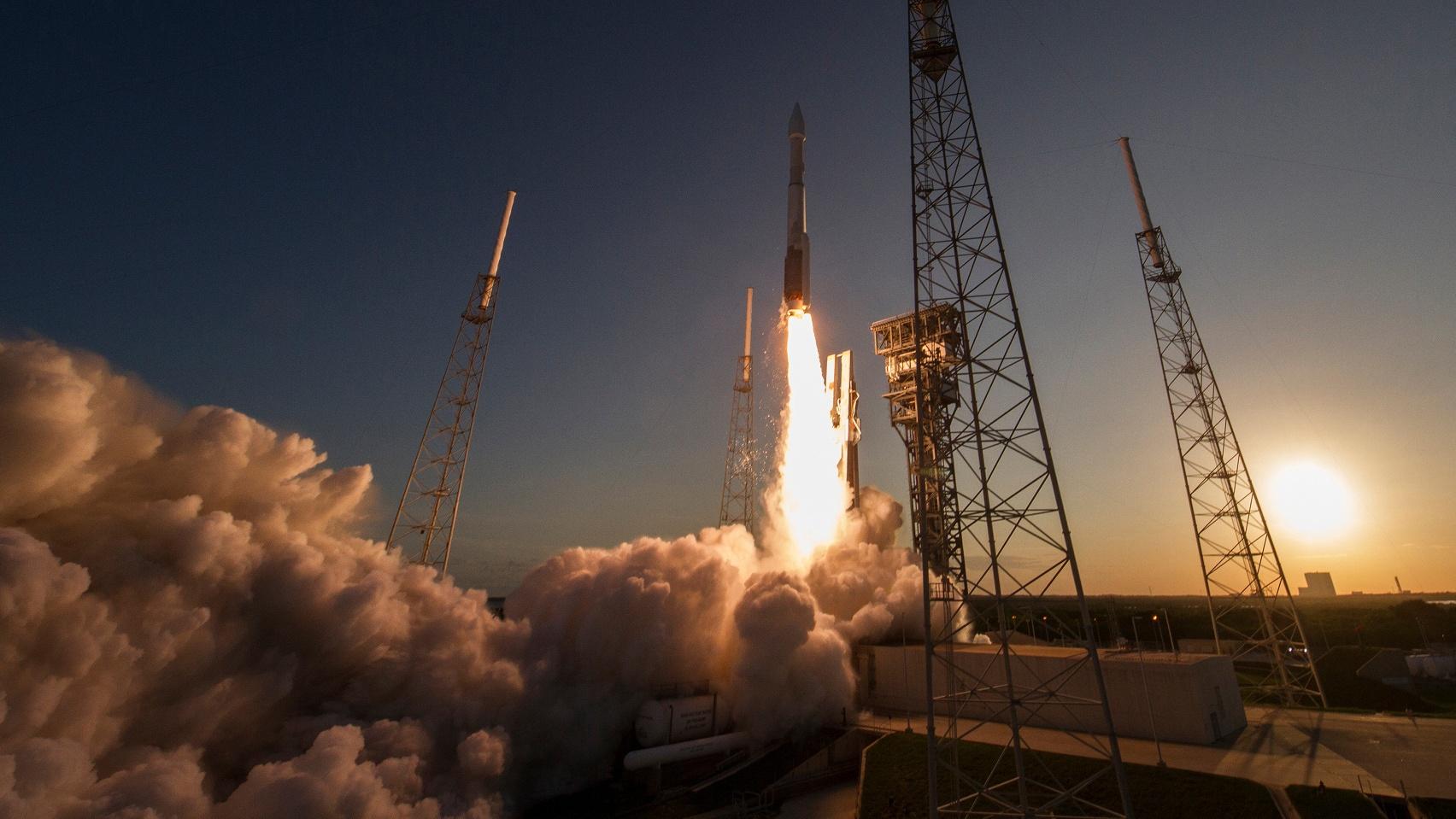
- Everyone is go. Standing by for launch, 10 seconds. Nine, eight, seven, six, five, four, three, two, one! And liftoff of OSIRIS-REx.
(cheers and applause) -
Dante
The emotional roller coaster was incredible, thinking about everybody who's poured their heart and soul into this program, those who are with us, those who are not with us. The moment of lift off was like a dream come true. We just nailed it, and it felt amazing. (dramatic music) Now Dante Lauretta, the OSIRIS-REx Principal Investigator.
Well, ya'll be real glad to know we got everything just exactly perfect. (applause) It was an amazing evening for me and for this team. We've worked hard to get to this point. The best times are ahead of us.
We are going to get to asteroid Bennu. We're going to map it, we're going to pick that site, we're gonna get that sample and we're gonna bring it back to Earth in 2023.
Search Episodes

Donate to sign up. Activate and sign in to Passport. It's that easy to help PBS Wisconsin serve your community through media that educates, inspires, and entertains.
Make your membership gift today
Only for new users: Activate Passport using your code or email address
Already a member?
Look up my account
Need some help? Go to FAQ or visit PBS Passport Help
Need help accessing PBS Wisconsin anywhere?

Online Access | Platform & Device Access | Cable or Satellite Access | Over-The-Air Access
Visit Access Guide
Need help accessing PBS Wisconsin anywhere?
Visit Our
Live TV Access Guide
Online AccessPlatform & Device Access
Cable or Satellite Access
Over-The-Air Access
Visit Access Guide




Follow Us