








PBS Wisconsin Passport
Watch this video with
PBS Wisconsin Passport
Become a member of PBS Wisconsin, support your local community, and get extended access to PBS shows, films, and specials, like this one.
Parrot Confidential
11/13/13 | 53m 10s | Rating: NR
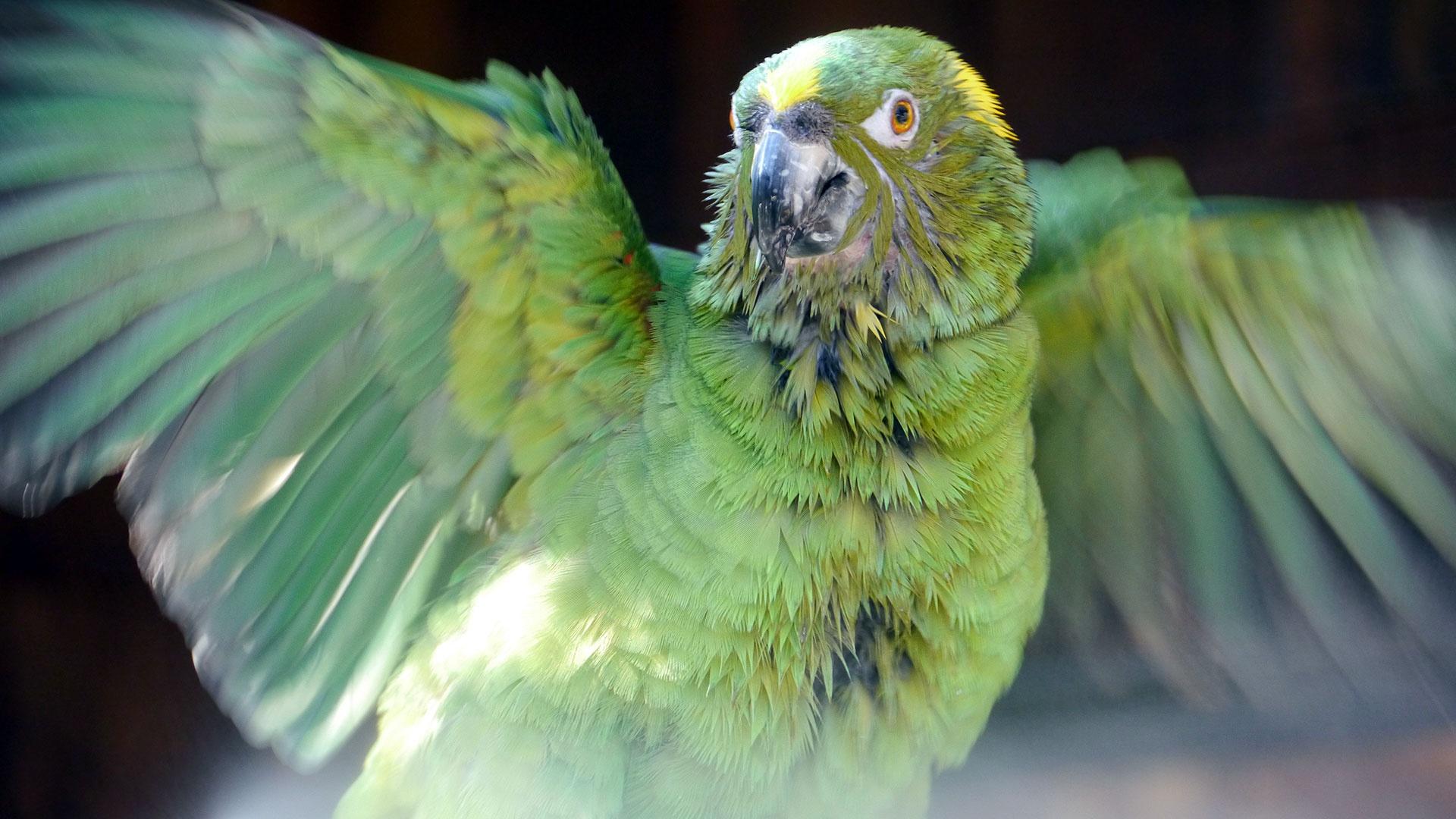
From the wilds of Costa Rica to suburban America, a lovable, quirky cast of parrots will reveal their unforgettable tales and the bittersweet world they share with humans. Nature explores the difficulties of raising parrots.


Copy and Paste the Following Code to Embed this Video:
Parrot Confidential
NARRATOR
With huge brains and hollow bones, they navigate the canopy. Every cell is engineered for flight. They speak a language all their own and form lifelong bonds that can last for 80 years. Their wings can carry them 50 miles in a day. This is a creature who lives without borders, in a world we can hardly fathom, and yet millions live among us. This is their story. As day breaks over Santa Barbara, a cockatoo named Dolly calls to her flock.
WOMAN
Oh, Dolly. Good morning pretty bird, good morning pretty bird, pretty girl, you're just up and all sparky, huh?
DOLLY
I'm a pretty bird. -Hi!
30 or 7
00 in the morning. Want some breakfast?
DOLLY
Hi, pretty bird! -Hi, pretty bird. Hi, pretty bird! -Hi, pretty bird. I rush to get her before she wakes up all the neighbors. They're very nice people and I want to keep it that way.
Dolly squawking
NARRATOR
With voices designed to each across the forest, cockatoos can be a challenge for the average homeowner.
MICHEL
The screaming is really hard. I finally got gun range earphones.
Squawking
MICHEL
And that doesn't completely deaden it. You can still hear it, it just doesn't make your eardrums hurt. Dolly was in a bird collection, and the gentleman just wasn't really ready to deal with a Moluccan cockatoo. She was sort of damaged when I got her, emotionally. I had a friend that took me over there to see if I wanted to adopt Dolly. And I just took one look at her and she took one look at me and I knew I had no choice, you know. She was gonna be mine. She was three when I got her, it'll be 16 years in March. She is going to live to be 80 or 90. And I am 74, so, that's -- we don't have many more years together. And I'm for-- That's my biggest concern. I take Dolly everywhere I can. She loves going in the car. I think it's an experience probably like flying. You know, they see the scenery rushing by.
Dolly chattering
NARRATOR
Dolly's headed to a local sanctuary, where she boards a few days each week. This is Lavanya's survival tactic. When Dolly is at home with Lavanya, it's all about Dolly. There's no talking on the phone, there's no having company. And after about three or four days of that, poor Lavanya has to take care of her own needs, as well. Watch you head!
MICHEL
So I can go to appointments and get things done and have a little time to do some of the things I like to do, visit friends. -We're gonna go bye-bye!
DOLLY
Bye-bye, pretty bird.
MICHEL
Bye-bye, pretty bird! Hey, Jamie, we're back.
NARRATOR
Jamie McLeod founded the Santa Barbara Bird Sanctuary nine years ago, when she noticed there was a problem with unwanted parrots. -I'll see you in a couple days. -All right. Good morning, Dolly! She began to realize many of the birds she was selling were being re-homed.
McLEOD
I was a breeder for more than 30 years. Amazons, Macaws, Cockatoos. When people typically would keep the birds two to four years, it became apparent that not everybody's cracked up to own one. They live 80 years -- crunch those numbers out and there's a lot of unwanted parrots out there. Hi, guys! I felt I was contributing to a problem, and started focusing on re-homing all the unwanted ones.
MAN
There we go!
McLEOD
We currently have more than 60 birds and we're beyond capacity. We're turning people away. Okay, you ready for your breakfast? Let's go, girl! People abandon them on our porch, they threaten to euthanize them if I don't take them. Many of the birds that we have now have been adopted out numerous times, and they come back. It's a huge problem. People don't always understand that when a bird forms a bond with you, it's actually a mate bond. They're not just part of your life, they become your life. I rarely go away on vacation -- they literally are my life. People will come in and they'll say, "I want a bird that talks, that's quiet and that doesn't bite," and that species has not yet been discovered. Come on over here! Come on! Come on! Come on over here!
BIRD
Come over here! Come over here! -Come on over here. -Come over here. -Come on over here. -Come over here. Her original owner taught her most of her vocabulary. Everybody loves the Amazons cause they sing and they talk, but nothing can bite you harder than an Amazon parrot. One day you're cuddling it, and the next minute you're missing part of your face. Squeeze those little birdie legs!
KONA
Squeeze those little birdie -- Squeeze those little birdie legs! Squeeze! Scary bird, roar!
Kona roars
KONA
Kona, who has such a wonderful vocabulary and is so animated and everybody wants to adopt her, actually removed this part of her owner's nose. KONA
singing
KONA
: I love you true dear
McLEOD
Once they start to hit sexual maturity they have drastic behavioral changes. You're not gonna bite me right now are you? Up you go. Let's go, up up up. Oh, yeah, you are!
KONA
Goodbye! Goodbye!
McLEOD
Being injured by a parrot, you can't be angry with them. If you take them into your life, that's one of the things that you need to accept. It's still a wild animal.
NARRATOR
In a cage or soaring above the canopy, parrots are still considered wild. Unlike dogs and cats, they haven't been domesticated over thousands of years. Captive bred parrots are just a few generations from their wild cousins. They have complex social lives and large brains, like primates. Dr. Tim Wright from New Mexico State University has discovered their language skills are remarkably advanced, and they learn to speak much as humans do.
WRIGHT
Learning how to sound like others seems to be very important for these parrots. If you sound like others, you're a member of their group. They are very tightly bonded with each other. Here in captivity, they're trying to recreate that bond with whoever's around.
NARRATOR
Wright's research has revealed that they speak in regional dialects -- and some are even bilingual. But human encroachment is making it increasingly difficult to study these birds. Yellow-naped Amazons are not doing that well in the wild. There's been a very rapid decline. The parrots often nest in lone trees on ranches. Sadly, this is a risky place to raise their young.
WRIGHT
They're not recognizing the danger posed by these new human predators. The ranch hands often will poach the parrots. They're out in the fields every day, they watch the parrots, they know what they're doing and have a good sense of where they're putting their nests, and they know when there might be chicks there. These birds are certainly touchy around their nest, so we just try to keep our distance. Oh yeah, she's going back, she's going back down now. Yeah, she's going in, tail first.
NARRATOR
Wright has been studying nest cavities in order to learn how parents teach language to their young.
WRIGHT
Okay, hold it!
NARRATOR
He tries to keep his contact with the birds to a minimum.
WRIGHT
If we do climb up, we do it quickly and get out of there. Oh, it's a deep one. Ah, there are two eggs in there. The female will sit on these eggs for about three weeks and then the chicks will hatch, and that's when the rough time comes. It's hard to say whether these chicks will be left in the nest and fly free, or become pets. I've been trying to study their nesting behavior, and I can't do that if people are taking the chicks out of the nest, so it's -- it's sort of a double, uh, a double heartbreak for me. We were visiting a night roost to record the vocalizations there, and I heard a strange sound. Hola! It wasn't quite human, someone was saying "hello," or "hola." Permisso!
Lorita talks back
WRIGHT
In fact, it was a parrot. Look at you! Hi! You are a yellow-naped Amazon. I talked with the manager of the ranch, and he told me a little bit about her history.
Manager speaking Spanish
WRIGHT
So, they've had it about 9 months, it's a -- it was a chick taken from the nest this year, um, from a nest a little bit south.
Manager speaking Spanish
WRIGHT
He said, you just have to climb up the tree and stick your hand in and take it out.
Speaking Spanish
WRIGHT
I asked how much a chick like this would sell for, and he said, well, when they're very young, just out of the nest, they might sell for $30 or $40. A bird that was a little bit older and in good health like Lorita would sell for about $100. She has learned a lot of human language words, Spanish words. She laughs, she calls "hello" or "hola," but when there are other parrots in the area, she'll also call to them. Normally, one parrot might fly over and join the flock. But Lorita can't do that. She's in a cage.
Lorita squawking
NARRATOR
Baby parrots like Lorita have been taken from the nest for thousands of years. But today, nearly one third of wild parrots are endangered. The illicit trade in exotic birds has become a multi-billion dollar business. In 1992, the U.S. banned the importation of wild birds. But before then, it was wild parrots that filled our pet stores. For many parrots, this is how life began. Jimmy Gentile opened his pet shop in 1975.
GENTILE
We kind of specialize in what I call "no pets allowed" pets, or unique companion animals -- we don't do dogs or cats.
NARRATOR
Liz Hartman moved to Boston in the '80s to attend vet school.
HARTMAN
I worked part-time for Jimmy at the pet shop, I really was just a cage cleaner. There was a bird there, a yellow-naped Amazon, that I thought was so cool. I thought, "Oh, man, I really want to take this bird home, I really want to own it." And Jimmy said, "You really should get a baby and hand feed it, because that's how you bond with them."
GENTILE
I had ordered a bunch of baby birds, taken from the nest in Honduras. A day came when they called me and they said, "Your chicks are available." So, I went to the airport, picked up the box.
HARTMAN
I was so excited, I couldn't wait, I was beside myself. I packed up that bird and went home with it.
MAN
When she brought him home, I remember. We had discussed it, and at first I was totally against it, because I knew how long parrots lasted. He was totally into it, he thought it was great. They're messy, I've been in the pet stores. In the beginning you had to wrap him up in a towel, cause he would try to bite you. It was our first experience at parenthood.
RUSS
I eventually warmed up to the idea, and we couldn't help but sit there and just look at him, it was so amazing to see this wild bird in our house.
NARRATOR
Basil's early years were trouble-free.
YOUNG LIZ
Good morning, Basil.
LIZ
The first four years were lovely and blissful. I would come down in the morning and open Basil's cage. Whenever we were home, he was basically free to crawl around, and he mostly stayed on his cage.
RUSS
The quickness at which he could pick up anything, he was so amazing. I think he was wicked smart. He loved the interaction.
Young Russ and Basil imitating explosion
RUSS
We thought, "We're gonna love this bird to death, and we're going to do whatever we need to do to make this bird happy for the rest of it's life."
NARRATOR
Parrots usually bond with one person. For Basil, that person was Russ.
LIZ
He was so bonded to Russ. Russ traveled overseas a lot for business, and he'd been gone for about a month.
BASIL
Hi!
YOUNG LIZ
You must be exhausted.
LIZ
He got home at night and we went to bed.
YOUNG LIZ
Good night, Basil.
LIZ
Everything seemed fine. We woke up the next morning and... Hello! Basil had plucked all of the feathers off of his chest.
Basil squawking
LIZ
Like, just plucked it bald. He'd never plucked before, ever. It was devastating to us because we didn't know what was going on. We later determined he was so angry that he was willing to go through the pain of pulling his own feathers out. It wasn't down to the skin, but just the grey down. I mean, there had to be some sort of emotional response to Russ coming home. I think he was making a point. You have to be there for them. They are social animals. I can't even imagine anything more complex. They're up there with the apes and the humans.
NARRATOR
If Basil was still in the wild, he would already have found a mate by now. They'd rarely be apart. Their mated bond would nurture the next generation, ensuring the survival of the species. A wild parrot is seldom alone. Even in flight, a mated pair is almost never out of earshot. For a wild parrot, solitude is rare. In a Boston suburb, a parrot has been left behind.
WOMAN
The family lost the home, the bank had taken possession, and I received a call.
Lou squawks
WOMAN
The bird had been left behind for approximately four days. It was four days since anyone had been last seen coming or going from the home. It did have water, it did not have bird food available, there was other pet food in the home. To just be left behind in a cage, it has to affect them -- they're not stupid. I've heard the stories that these animals go through and for me it's utter heartbreak. Did you give me a call earlier? I did, it's been three or four days since I've seen anyone here and I've heard some bird noises. Okay, I'm gonna go take a look and see if I see anything. Guys I can't, I just need you to stay outside if you don't mind for now.
Squawking
MAN
Thanks, Lisa. Ah, an umbrella cockatoo, our favorite species. This is the only animal we found in the house. Aw, hey.
CULLITY
So, you can take care of him for us, Marc? -Thank you. -Sure, no problem. Thanks. Bye, little guy!
MAN
Part of the evaluation process when we get a bird, if we don't know his name, we wait for him to tell us. He'll say hello, and then usually say his name. In this case the bird never told us. So, we just named him after a good friend of ours, Lou. He seems really nervous with me, maybe he'll be better with you, wanna get him out?
NARRATOR
Marc Johnson and Karen Windsor have devoted their lives to rescuing parrots.
WINDSOR
Every bird has a story. Every bird has a history, especially an emotional history. They carry their baggage. I think there are probably a lot of forgotten birds in a lot of dark corners of the world. Hey, hi. Hi. It's hard economic times and our animals sometimes pay the price.
WOMAN
I spoke to you on the phone last week about putting my parrot, Max, up for adoption, he will be ten years...
MAN
...friends who could not keep them. The blue and gold is very aggressive...
WOMAN
and due to a divorce I am being forced to move into an apartment which will not allow...
MAN
I've been in contact with the vet and I'm planning on euthanasia if there is no...
JOHNSON
Everyday we get e-mails, and that's the hardest part of our life now. We have to say no a lot.
WOMAN
...as I want to make sure they don't end up suffering or being mistreated......she's driving my husband and children crazy...
MAN
I cannot live like this anymore, I hope to hear from you.
NARRATOR
Johnson has witnessed the proliferation of parrots over the years. It all began with a want ad.
JOHNSON
In the 1980s I had a small pottery studio. I had a deep admiration for the rainforest and I wanted to get a pet, AND I thought something exotic would be fun, so I bought a parrot in the Want advertiser for $900. Wally was a blue and gold macaw. He was a wonderful bird. People would come in and see I had a parrot and they would say, "Oh, I have a cousin that's got one of those," "My brother's got one of those," "I've got one of those that I don't want anymore, would you like my parrot?" Not knowing how big the problem was, I thought, well, this is great, because people were giving parrots that were worth lots of money. We were being besieged by birds. Before I knew it I had 30 of them with more coming every day. It turns out, people were giving me their parrots because they're very difficult pets. And I was the only game in town. Nobody else would take unwanted birds, so people came to visit me. Before I knew it I had outgrown the pottery studio, and I had to figure out some way of dealing with it.
NARRATOR
Johnson closed the studio and moved to a house in the suburbs.
JOHNSON
From that point on it was, if you build it they will come. The birds took over the house. Every single room had half a dozen birds in it. The pantry, the spare rooms, the bedrooms.
WINDSOR
When I first came to volunteer, I found parrots in the kitchen, parrots in the living room, parrots in the bathroom.
JOHNSON
Within no time we had over 300 parrots.
NARRATOR
The house had become a sanctuary. With more requests each day, Johnson ran out of space -- again.
Rooster crowing
JOHNSON
As luck would have it, we came across this abandoned chicken farm. I kind of stumbled on this place by accident. It's a wreck but I think it's what we've been waiting for.
WINDSOR
This is gonna be an enormous amount of work. It's too much.
JOHNSON
It scared the hell out of Karen, but I saw it as a golden opportunity.
NARRATOR
Within two years, they had tripled the size of the sanctuary. But in no time, even the new facility would be bursting at the seams. Where were all these unwanted parrots coming from? From South America, Africa, Asia, Indonesia, parrots were streaming in from the wild. When it became illegal to import wild birds to the U.S., domestic breeding filled the void. Today, the practice of breeding parrots is not without controversy.
WOMAN
Anybody with $40 can walk into any Petco and buy a parrot. There are no regulations. Anybody can have as many of them as they want, they can breed them, they can sell them. I'm not one to talk, because I did it. Hand feed everybody. This was a long time ago, there wasn't any such thing as a rescue or a sanctuary, there was no need for it.
NARRATOR
Phoebe and Harry Linden were once highly respected breeders. It all started nearly 40 years ago.
HARRY
In 1971, I saw in the paper somebody was advertising they had to get rid of a parrot. And I basically rescued him from this guy. And then I started finding out that they were bringing in birds from the wild. You could go down and you could buy at wholesale price just about any bird you'd want. I got another parrot, and another parrot. Before you knew it, we had so many birds in the house we couldn't live there anymore, I had to get another house.
NARRATOR
40 years ago, if you purchased a parrot, it would almost certainly be a parrot from the wild. Capture and transport took a terrible toll. It's been estimated that more than 70% of wild-caught parrots died before ever reaching the pet store.
HARRY
I felt bad about these wild caught parrots, and I thought, if we bred these birds, then people would not need to pull them out of the wild. I named the business Santa Barbara Bird Farm.
PHOEBE
When we started to breed parrots, I quit my job and just hand-fed birds. Harry and I decided not to have human children, and I just found that I could like zip open my heart and pour it into these baby birds.
HARRY
We wanted to keep every single one of them.
NARRATOR
The Linden's had an excellent reputation and a long waiting list. They were hands-on with the chicks, and carefully screened potential buyers. But in the late '70s the landscape began to change. A TV series came out called "Baretta." This detective had a medium sulfur-crested cockatoo that made it look like the coolest pet you could have, they don't scream, they don't pick their feathers, they do what you tell them to do. Go look in that window and tell me if somebody's getting stabbed.
PHOEBE
The word got out there, how charming, how companionable parrots were. The phone started ringing off the wall. Demand bloomed overnight. All of a sudden, you could get one anywhere. In the beginning it wasn't like that. We started to hear about rescues and sanctuaries. And we started to realize that, wow, there are unwanted parrots. When we saw that there was going to be a tremendous amount of fallout from that, we decided to stop breeding. We shut breeding down forever.
NARRATOR
The Linden's decided to close the business and instead focus on building the best facility they could for the birds they still had.
HARRY
This new aviary can actually have foraging potential with the trees and the grass.
PHOEBE
We're in the position now where we want to take back any baby who we raised who needs a home. So, they get to live a life where they can make their own decisions, exercise, have access to fresh air, fresh food.
HARRY
A lot of breeders like ourselves just stopped breeding, but we still have some of the parrot mills out there that produce a lot of babies every year, and so there's still going to be parrots out there who are gonna run into problems in the future and have to be put up for adoption.
PHOEBE
People who really care about parrots don't buy birds -- they adopt. We need to take care of the parrots who are here, the best way that we can, and conserve the parrots in the wild.
NARRATOR
It is the paradox of the parrot. As numbers dwindle in the wild, the number of rescues in captivity continues to increase. With sanctuaries struggling to stay afloat, the fate of unwanted parrots is becoming more precarious every day.
WOMAN
The step-father died, and the daughter called up and asked us to take Fagan. -Hello? -Hey. -Here he is. -Okay, thank you. 'Kay, thank you.
NARRATOR
In a Detroit suburb, a parrot named Fagan has found his way to Marie Crowley. Good boy, good boy.
CROWLEY
When I took Fagan out of the carrier, it was pretty obvious that he had a big self-mutilation wound on his abdomen. You really chewed yourself up buddy, huh? I noticed that he smelled heavily of nicotine. You smell, you stink. He obviously hadn't been bathed in a long time. Did they smoke, hmm? He was just covered in goop. You are a dirty, dirty bird. Need a bath. There you go. I noticed my hands were just disgusting. They were covered in nicotine, my hands were stained for two days after. I gotcha, there you go. It's all done.
Purrs
CROWLEY
Yes, the yuckies are over, there you go. I knew that the conditions that he was coming from were really, really poor. Good boy. Shh.
NARRATOR
After living in a smoke-filled house for nearly 25 years, Fagan presented a challenge for Dr. Orosz.
WOMAN
Let's listen to the chest, can you let me listen?
OROSZ
When Fagan walked through the door, I saw a bird in crisis. His feathers were greasy with nicotine. He had a large patch where he had been mutilating on his chest. He was basically a mess. -Back of his throat, see that? -Ah, okay, mm-hmm. He's from a home where the lady smoked all the time, right? It was those little dime-store cigars. Oh, great.
CROWLEY
It became pretty clear that he was actually physically addicted to the nicotine. He started having seizures. We had to detox him from the nicotine, and then he had this large area where he's been mutilating his body. Those are very difficult things to overcome in birds, very difficult. In discussions with psychiatrists, the closest thing I can think of is that it could be something like cutting. When they do physical damage to themselves, it's a kind of a release effect. We had to help him with his stress. Here, buddy, come put this collar on, okay? Good job. Fagan has been in a collar so long that he is okay with putting a collar on, he doesn't really argue or fight about it. Fagan was really malnourished his whole life. It took weeks to get him to eat properly. There are no sanctuaries for parrots in Michigan, there's just some people like me who try and take them in as best they can. They don't have anywhere else to go, so they end up in this little suburbia neighborhood where you'd never expect to see a parrot -- in my basement!
Birds squawking
CROWLEY
I have 26 birds here. The situation is less than ideal. But we do everything we can -- we've put up air filters, full-spectrum lighting, and then I keep palm trees down there 'cause I figure if the palm trees stay alive, then the lighting is at least adequate. Every bird here has to be fed and watered three to four times a day, their cages have to be cleaned. It's a labor of love.
NARRATOR
Like most parrot rescues, Crowley's non-profit, Feathered Friends of Michigan, barely scrapes by. Most sanctuaries and rescues across the United States are full, so we all make do with the bad situation as best we can. Come here. Come here. Let's take your collar off, huh? It's important Fagan gets some time out of his collar every day, so that he can work on preening his feathers and flapping his wings and climbing. He's been in a collar so long, he falls a lot. Because he can't open his wings to catch himself like a bird should. So, we're gonna work on building those muscles back up over time. Would you like to dance? Yeah? You would like to dance?
Laughs
Playing reggae music
NARRATOR
My head up to the sky Ooh, la la, la la, la la I'm going to keep my head up to the sky Won't let life pass me by 'Cause after the rain comes down The sun will always come back around And I'm going to keep my head up to the sky Yeah, we gotta read this one. This is a long one, man. Fagan isn't comfortable with other birds yet, and with his health issues, Marie needs to keep a close watch. So, he lives with the family.
CROWLEY
My son was learning his colors. What's red? Good job, Fagan! And whenever we went over a color, Fagan would go up and tap it with his beak, so, we brought these out and -- What's green? He does like to differentiate between the colors. Good. What I'm trying to do is give his mind a way to exercise, it's another form of enrichment that's been shown to reduce anxiety in parrots. What's yellow? It's a non-sexual way for me to interact with him. That will kind of break the cycle of the mated bond that he's trying to create with me. If Fagan was in the wild, he would have a flock, he would find a mate and they'd crawl up into a tree cavity and build a nest and have babies. But in captivity, that causes a lot of frustration for birds like Fagan. What's red? Good job! Yeah. What's yellow? Unfortunately for the African Grey's, their intelligence level ended up being somewhat their undoing in captivity.
MAN
What toy?
ALEX
Truck.
MAN
That's right!
WOMAN
Good birdie. -What is it?
ALEX
Key chain. Good boy!
NARRATOR
In the '90s, Alex showed the world that parrots are capable of more than just mimicking.
WOMAN
What toy?
ALEX
Nail.
NARRATOR
Irene Pepperberg's work with Alex was seminal.
PEPPERBERG
Tell me what color, what color?
ALEX
Yellow. -Yellow, that's right.
CROWLEY
When the work with Alex came out, everybody wanted to buy an Alex. The breeding of them skyrocketed. But Alex isn't your everyday African Grey, he's a bird that was trained for hours a day for years on end. Most African Greys don't talk. They mostly love to make really obnoxious microwave sounds, and phone sounds -- stuff that people find hard on their ears. So, they end up getting surrendered a lot. I think as long as Alex is at the top of the YouTube charts, he's gonna be at the top of my surrender charts.
NARRATOR
In the wild, Fagan's intelligence would be put to task. In flight, his large brain would measure space, wind and speed. He'd calculate distance and sources of food. If confronted, he'd take flight. These wild instincts are still very much intact for birds like Basil. The first four years, like I said, were wonderful. Kiss kiss! He was sweet, he was handleable, he was lovely, and then adolescence set in. He just became progressively more aggressive. I'd be sitting at the dinning room table Sunday morning reading the paper, and he would seek me out. It got to the point where I could not leave the cage open at all. If I were in the house and the cage was open, he would immediately climb down the cage to attack my feet. He just decided I was the person he hated. He would lunge at her, he would fly out of the cage at her.
LIZ
One morning I got up, I opened the door to his cage and then I turned around to open the window, and he just flew at me, he was hanging off my ear. You just didn't know, he could be all sweet and happy, turn around and bite you. When we had the kids, Basil wasn't quite ready to have these foreigners. They didn't know any better, they thought they could walk up just like I did. My daughter was four years old at the time and she was feeding him a cracker, and he nailed her.
Screaming
LIZ
I heard the screaming, I came running down the stairs. It was awful.
RUSS
That was when we started to realize that perhaps Basil wasn't going to warm up so much to the kids. I didn't think I could keep this animal as a pet anymore.
NARRATOR
No one knows the number of parrots in captivity. Estimates range from 10 to 40 million in the U.S. While many live in stable homes, thousands are surrendered each year. What happens to the parrots who fall through the cracks? Abandoned for four days in an empty house, Lou is one of the lucky ones. At Foster Parrots, Lou's next chapter is about to begin. With no clues about his past, providing the right care will be a challenge. No one knows how old he is, how many homes he's had, or if he's ever seen anther parrot.
Birds squawking
NARRATOR
How must it feel for a bird like Lou, entering a sanctuary for the first time? Thousands of sounds, hundreds of birds, each calling out with its own story.
BIRD
Hi. Pretty bird.
WINDSOR
When we walk through the facility, it's important that everybody understand that what they are seeing is a tragedy. What we are looking at is the failure of humans as companions to parrots.
NARRATOR
Any new arrival gets a full physical. It's especially critical for a bird with no medical history, like Lou.
JOHNSON
Was left in an abandoned home.
MAN
Was there food and water? There was a bag of dog food. Dog food? Nice. Poor Lou. Okay, buddy. Let's look at your plumage, Lou. Sounds like you had a tough life, huh? Any avian vet realizes that the stress our captive parrots are under is immense. There you go. Pretty good weight for his species. We take these birds into our homes and we cut their wings. This guy's pretty scared, his heart rate's off the chart. Probably over 300 beats a minute. We house them in cages and we don't allow them to be with their own species. You can imagine the stress on these animals.
Lou squawking frantically
NARRATOR
Stress is known to lower the immune system. Clipped wings and cages guarantee a sedentary life, and avian vets are finding that heart disease is all too common in captive parrots, especially those with poor diets. Parrots can also carry infectious diseases. Lou will stay in quarantine for 30 days, to make sure he's not contagious. His test results will determine his future. With over 550 birds, Foster Parrots is well beyond capacity.
JOHNSON
If we take another bird, my volunteers would kill me.
WINDSOR
35 volunteers and a staff of six. That's not enough humans to meet the needs of really human-bonded birds. Are you gonna step up? Good girl. We cannot integrate these parrots with their own species. And yet they don't fit into a human society either. What are we to do with these birds? 'Cause they don't even know they're birds.
JOHNSON
Peepers exhibits an unusual feather picking profile. She pulls the feathers out of her head and neck with her foot, giving her that vulture-like appearance, that if she only knew what she looked like, she might not do so often. You're still beautiful. Being a domestically raised bird, she identifies with humans and she also wants to mate with humans. That's not good peepers. You just wants to be loved, is that so wrong? We received a call from a woman whose neighbor was keeping peepers in an unheated porch in the middle of winter. You're a good girl. Right now we take in birds when it's a life and death situation. I mean, you have to take that bird in. The care requirements are so huge you can never feel like you've been successful.
WINDSOR
Is that for you?
JOHNSON
From the very first day I got Wally, the blue and gold macaw, my resolve was to make his life better, every day, and... God, sorry... Give me a sec. I mean, when people ask me what is the right size cage for a macaw, there is no right size cage for a macaw, it's 35 square miles, you know, it's like, it's huge, and it's the sky, it's...
WOMAN
The owner is an older gentleman whose wife passed away about four years ago, and the bird has been pecking away at himself...
MAN
Hey, Marc, my mother died three weeks ago and I need to find a place for a cockatoo...
WOMAN
It's killing me writing to you like this but I must find a new home...
JOHNSON
When I first started Foster Parrots, I thought we could take every single bird that needed a home. But of course, the numbers were staggering, to a point now where we have over a thousand calls a year for surrender.
NARRATOR
How wonderful it would be if these parrots could be released to the wild. But it's unlikely they'd have the skills to survive like their wild cousins. And the risk of spreading disease would be too great. With populations so low, every parrot matters. In Costa Rica, a scarlet macaw is calling to his mother.
Baby bird squawking
MAN
I knew Geoffrey was special from hatch. He had a very cute peep. They communicate with mum well before they've hatched. So, the babies will actually be talking to mum through the egg. They hatch open and they're so helpless, they're all wet and they still have the little umbilical cord attached to the egg. We leave them about 12 hours, to allow the yolk to be used up. So, little Geoffrey hatched out and he was just so cute. I could tell Geoffrey was a smart one from hatch.
NARRATOR
The ARA Project is breeding rescued macaws in order to release their offspring to the wild. The parents, who are former pets and rescued birds, don't always know how to raise their young.
CASTLES
Geoffrey's mother was an ex-pet, and his father was poached from the wild. His mum is not a very good mum. His parents abandoned him, unfortunately. So, for the first two months of Geoffrey's life, he had to live in an incubator. Geoffrey started off like a little plucked chicken, and then he started getting his pin feathers coming through, you'll get a little bit of a tail come through, and then you normally get a little bit of a Mohawk. They put on about 10% of weight every day. Takes three months of hand rearing. And then on top of that, you've got up to a year of looking after them. Geoffrey came out beautiful red, beautiful, beautiful deep red.
Baby-talking
CASTLES
Geoffrey? Are you Geoffrey?
NARRATOR
Geoffrey's species of Macaw is in trouble. The wild population is only a fragment of what it once was. Costa Rica is one of the last strongholds. ARA hopes to stop the extinction by repopulating the wild with birds like Geoffrey. They recently released a group of seven macaws. Geoffrey will be next.
Indistinct conversation
CASTLES
We've released over 100 scarlet macaws, and we've had over 85% survival rate. Part of the process of them learning how to survive in the wild is teaching the birds what to eat. The biologists Rachel and Charlie are going round and they're collecting things like beach almonds, finding coral pods, all of the foods the birds are going to have to learn to survive off. You'll see them put whole branches in the aviary, and that's so the birds can recognize, "Oh, this leaf means this food." They start chewing on things, finding out what part of the fruit or the seed tastes good. A lot of it's instinct, so a lot of them actually will pick up an almond for the first time and go, "Oh, yeah, I know how to crack this, that's fun." It's boot camp, basically. Macaw boot camp.
LIZ
We were going on vacation and I was trying to figure out what to do with Basil. I have a friend who also has a yellow-naped Amazon. So, I offered to take him. Basil had never seen another yellow-naped Amazon in the 15 years I'd owned him.
Birds groaning
NARRATOR
Liz and Holly decide to take a gamble with the birds. By the time the Hartmans returned from vacation, Basil and Koko were tightly bonded.
LIZ
We loaded him into his travel cage and started to walk out of the house with him, and her Amazon just starts pacing back and fourth going no!
Koko squawking, "No! No!"
MILLER
You could hear Koko calling like he was losing his best friend. We were in tears, we said, oh, we can't have this happen, this is heartbreaking. I starting talking to Holly about whether she would adopt Basil. So, she said yes. You can't just give away a friend. You just can't do that.
LIZ
I had a huge amount of guilt. You take on this living creature, it's your responsibility.
RUSS
It's not that we wanted to give up Basil, the kids were having a hard time.
LIZ
He's just being a normal, wild bird. They're not pets -- you can call them a pet, you can put them in a pet shop, you can dress it up all you want, they're not pets. Now, when you go over there and see them, they're best buddies.
Birds cooing
LIZ
I definitely would not have a parrot again. I would never do it again, no, for my own mental health, and the mental health of the parrot. No.
NARRATOR
After a month in quarantine, Lou is given a clean bill of health.
WINDSOR
Then we begin the process of trying to integrate him with other birds. In the wild they have an entire rainforest, they can choose their own mate. You put them together with birds that are not of their choice, and it just doesn't always work.
NARRATOR
They start Lou outside a large aviary. From here, he can watch the other cockatoos from a safe distance. After three weeks on the outside, it's time for Lou to move into the aviary. Without knowing Lou's past, they can only guess, and watch, and hope.
WINDSOR
Lou, he's a little on the quiet and reserved side, we had to very carefully pick his aviary mates. He needed non-aggressive, you know, kind of docile aviary mates, and so that's what we set up for him, an aviary with five other cockatoos.
NARRATOR
After two weeks inside the enclosure, they feel it's safe to take Lou from his cage. Hi, buddy. You're okay! Here you go, buddy! Oh! Oh, good boy! And then the unexpected. Another lone cockatoo, Princess, a parrot with an injured foot and a hazy history, takes a chance. In Costa Rica, Geoffrey's big day is finally here.
CASTLES
Being able to see animals that you've raised, free and wild, this is the ultimate. You do have that worry in the back of your mind, what happens if it doesn't go well and he doesn't survive? See? That's where you're going soon. It's not likely that all of them are gonna survive. Predators, accidents. You can't predict what they're gonna do and it's always the favorite ones that you think are gonna get lost. Come on Geoffrey, Geoffrey! Come on, Geoffrey! Once the birds have lived in the cage for x-amount of time, it can be two months or it could be six months, depending molts, depending on how quickly they adapt, the time of year, the food availability. When all those factors are right, that's when we begin the release. We release the birds individually, so we can make sure each bird has an equal chance of survival. They're gonna let Geoffrey out, they're gonna tempt him into the box, or try to -- he's quite cunning. Geoffrey, this is your chance at freedom, mate. It can take at least a few hours to get the right bird in the box. I'll put a pile of food in there. And once they have Geoffrey in the box, they'll let him eat his food in peace and quiet. He's ready to go! He's eaten all his almonds. That's when they'll let the outside door down. Quite often we find that the birds outside come in, and there's a big scrap. This is gonna be interesting. Geoffrey has now got the advantage of having these outside birds established. They show off quite a bit and they're actually teaching the birds in the aviary, "look what I can do," you know, "you're going to be able to do this soon." They're going to be able to help show them where to eat, teach them what to do, show them how to fly. Geoffrey, I'm hoping will, just fit into the flock and everybody will think he's awesome. We'll have to hope for the best, and that's all you can do. Good luck mate, this is your big shot. He's a good flyer. It would be far worse for him to live 45-50 years in captivity than to have a chance at living life in the wild. I hope he has a nice missus and lots of babies -- a long happy life in the wild. And that's what I wish for all of them, not just for Geoffrey. This "Nature" program is available on DVD. To order, call 1-800-336-1917. To learn more about what you've seen on this "Nature" program, visit pbs.org.
Search Episodes
Related Stories from PBS Wisconsin's Blog




Donate to sign up. Activate and sign in to Passport. It's that easy to help PBS Wisconsin serve your community through media that educates, inspires, and entertains.
Make your membership gift today
Only for new users: Activate Passport using your code or email address
Already a member?
Look up my account
Need some help? Go to FAQ or visit PBS Passport Help
Need help accessing PBS Wisconsin anywhere?

Online Access | Platform & Device Access | Cable or Satellite Access | Over-The-Air Access
Visit Access Guide
Need help accessing PBS Wisconsin anywhere?
Visit Our
Live TV Access Guide
Online AccessPlatform & Device Access
Cable or Satellite Access
Over-The-Air Access
Visit Access Guide




Follow Us