NARRATOR
How does a horse bred for war end up performing ballet in the court of kings? The answer is found with this magnificent creature, one of the oldest horse breeds in the world, the Lipizzaners. Here at Vienna's Spanish Riding School, stallions train for years to become top athletes -- but not every student has what it takes. Success relies on one of the deepest animal-human bonds in history -- a tradition that has been passed down for centuries. Each year, a new generation aspires to join this elite group of perfectly choreographed performers. But beneath all the refinement and grace, there still beats the willing heart of a war horse.
Theme music playing
NARRATOR
Vienna, Austria, once the seat of European culture, of Hapsburgs and Mozart, of minuets and waltzes, of ballrooms gleaming with brilliant chandeliers. Even now, in the 21st century, much of its classical elegance remains. And at its very center, a palace where time stands still, where the royalty it was built for continues to grace the world with a vision of timeless perfection.
Horse whinnies
NARRATOR
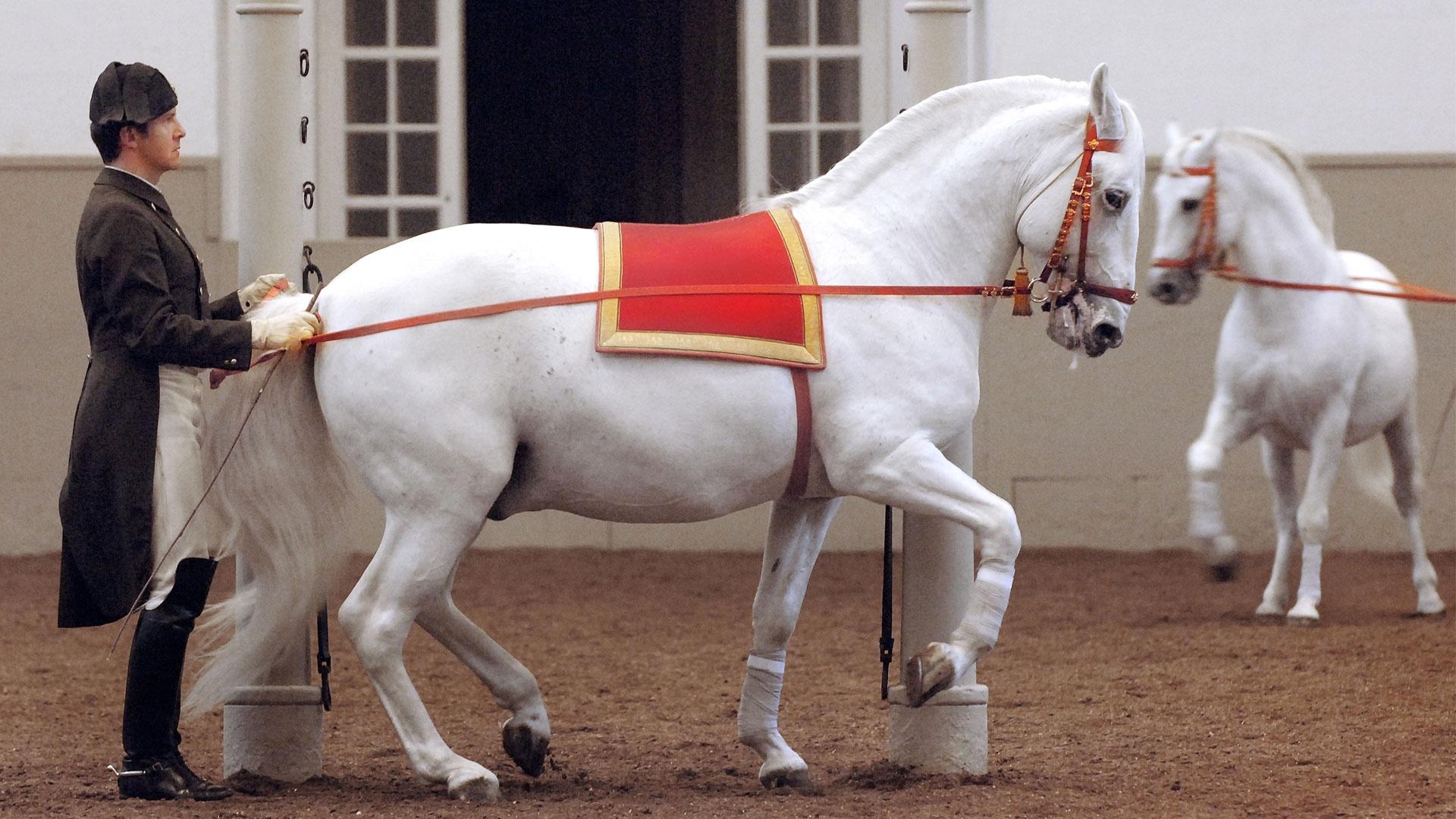
Alabaster horses. Legendary white stallions that for 450 years have turned what was once a weapon of war into a living work of art. It's man and horse in perfectly choreographed harmony. These elegant, intelligent horses are the Lipizzaners of the Spanish Riding School of Vienna, and they've been keeping audiences in thrall for centuries. Behind the polished performance, of course, are real horses of flesh and blood that give their all in response to their training and their trust in the humans they work with. Their faith is well placed. In the Spanish Riding School, everything revolves around the stallions. Each stallion is a horse of strong character with likes and dislikes, a personality all his own. The man in charge, the equerry, is responsible for the daily routine of all 73 stallions that perform in Vienna. As the undisputed master of the stable, he prepares detailed plans for the care of each one... taking into consideration a stallion's preferences and sensitivities as well as his lovable quirks. All Lipizzaners at the Spanish Riding School
are descended from just six stallions
Favory, Siglavy, Conversano, Neapolitano, Pluto, and Maestoso. But it's personality that determines where a horse is stabled. To avoid friction, good-natured stallions are placed next to alpha males and the more extroverted next to the more introverted. Some of these stallions have known each other all their lives and have friendships that began when they were foals. The formality and tradition of the Riding School is still presided over by Emperor Charles VI, who completed this beautiful baroque arena as an extension of the Imperial Palace in 1735. This is a unique and elite university for horses. But there are no books here. None of these training techniques has ever been committed to writing. All the knowledge and skill, refined over centuries, of a riding style known as high classical dressage is passed on orally from one generation to the next. This is the responsibility of the director of the riding arena.
Man speaking German
INTERPRETER
The traditional methods at the Spanish Riding School must always be observed. Classic horse-riding is pure beauty and harmony. A balance of body and mind.
Speaking German
INTERPRETER
The rider is the artist, the horse his medium. Together, they become a work of art.
ABRAHAM
To achieve such a level of perfection, the riders must build an extraordinary rapport with their horses. Christian Bachinger is the son of the director of the riding arena, and horses are a central part of his life. Like his father and his father's father, he had always dreamed of being a rider at the Spanish Riding School. But even a third-generation horseman must earn a place in the school with his own excellence. Long-reining the horse is one of the most difficult tasks. The stallion must execute the entire routine without the aid of a rider. It's teamwork without fear or pressure, and it demands complete concentration and an intimate touch. It's as if there were a gossamer thread between the rider's and the horse's minds, a subtle connection for communication and gentle control. As prey animals, horses have an innate fear of attack from the rear. But the stallion has complete confidence in his human handlers -- a confidence that began at his birth. Far from the formal traditions of the Riding School in Vienna, Lipizzaner foals begin life with their mothers in the idyllic green hills of western Styria. This is the Federal Stud Farm in Piber, where all the Lipizzaners of the Spanish Riding School are born and bred. Surprisingly, the famous white horses are born dark brown, even black. It will take six years or more for them to turn as milky white as their mothers. On these carefree meadows, the mares and foals live much as wild horses do -- in a natural society of friends and family. And childhood lasts a long time. They will run and play for years before finally going to school.
Church bell ringing
ABRAHAM
The herd in Piber is comprised of around 70 mares. Every year, between 30 to 50 of them will bear a foal. From the day Lipizzaners are born, humans are an integral part of their lives. Their constant presence is fundamental to a special relationship between man and animal. The horses are so gregarious they simply learn to accept humans as members of the herd with a higher social rank. The horses are looked after in three shifts around the clock. Not only are they fed, groomed, and cleaned, they are also whispered to, shown affection, encouraged, or calmed down. This personal touch is what makes even the stallions such friendly, good-natured creatures. Lipizzaner mares and their foals spend every minute of the day together. But then, these horses are never alone. Even indoors, they live in a natural herd, a comforting community they know all their lives. This stallion is Siglavy Garba. He is 15 years old and highly skilled in all the steps and movements at the show in Vienna. But this season, he has been sent to Piber on a special mission -- one of two stallions selected each year to sire a new generation of foals.
Speaking German
ABRAHAM
As befits imperial creatures, this is a highly ceremonial affair. The chosen mare is brought in and presented to the stud. He is allowed to briefly smell her -- but that's as far as foreplay goes. The succession of Siglavy Garba's superior genes is assured. His character traits will be passed on to the next generation. Careful breeding has resulted in these magnificent white horses... But Lipizzaners once had coats of many colors. It was only in the 18th century that the imperial court decided to selectively breed for white. Now, a dark Lipizzaner is an exception -- and something special. Every tradition has its superstitions, and they say at the Spanish Riding School that as long as there is a dark stallion in Vienna's stables, the riding school will prosper. Favory Aquileja is one out of a hundred Lipizzaners that never turns white. And this impressive stallion doubles the good luck -- he is Pluto Bellornata. We owe it to the Austrian Empire's bureaucracy that we can trace the lineage of Lipizzaners back for hundreds of years. For stud director Max Dobretsberger, this knowledge is an invaluable treasure.
Speaking German
INTERPRETER
The Lipizzaner horses are the world's best-documented breed of horses. What I am holding here is a stud book. It tells me the name of the stallion and what age he started breeding. It describes the individual parts of his body so I can picture what he looked like. It also describes his character. For us breeders, this is an exciting story -- sometimes as thrilling as a crime novel.
ABRAHAM
But the history of the Lipizzaner horses begins long before the book -- in the Atlas Mountains of North Africa. This was home to a special variety of horse. They were used to life in both the hot, barren desert and on ice-covered mountain slopes. In this harsh environment, only horses with a sensible nature, extraordinary stamina, and surefootedness could thrive. It was with these horses that the Berbers -- also known as Moors -- set out to build an empire, invade Spain, and conquer the entire Iberian peninsula. While the Europeans were wearing suits of armor and riding slow, heavy horses, the Berbers were able to outmaneuver them. With light weapons, they ravaged the country in small, mobile task forces. The Berbers and their horses epitomized perfect harmony. As they galloped over the land, seeming hardly to touch the ground, horses and riders appeared to become a single creature. The Berbers owed their military superiority to their horses. They were tough, agile, and brave -- just what warriors needed for brisk engagements in hand-to-hand -- and horse-to-horse -- combat. The Moors conquered Spain in the year 711. And they took their horses with them -- horses that were said to have the hearts of lions. The next 700 years became the golden age of "Al Andalus -- the land of the Vandals," as the conquerors called Spain. Favored by a climate of religious tolerance, culture thrived in Andalusia. It was rich with universities, libraries, and medical schools. Mathematics, astronomy, and the arts flourished. Architecture reached new heights. Cordoba was the center of "Al Andalus," and by the 10th century, it was the intellectual capital of Europe. It would take the West fully 700 years to regain control of Spain. It wasn't until 1492 that Isabella of Castile and Ferdinand of Aragon finally completed the "reconquista," uniting Spain under the cross. Spain was now firmly on the way to becoming a Catholic world power -- and an empire of its own. A cathedral was erected right in the middle of the big mosque of Cordoba. This is the famous Mezquita, a combination of mosque and cathedral, that became a symbol of the fusion of two worlds -- still a defining feature of Andalusia's culture today. Another product of the successful fusion of Moorish and Iberian cultures was a new breed of horse -- the Spanish horse. Apart from influencing architecture and music, Arabic culture had left its mark on the art of horse-breeding.
Flamenco guitar playing
ABRAHAM
Spanish horses set a new standard for beauty, refinement, and power. Europe's princes and kings would soon crave this magnificence for their own stables. The horses became highly coveted luxury items. As the Renaissance began to flourish in the 16th century, classical riding was rediscovered -- an ancient art form that celebrated man's ability to transform nature was reborn. For the sovereign, the horse became a symbol of his own prestige. An Imperial stud farm was needed to showcase the absolute rule of the Austrian Hapsburgs. Archduke Charles therefore decided to develop his own noble breed of horses based on the Spanish model. This is how Lipica came to be the birthplace of the Lipizzaner horses in 1580. For it was here, in the karst forests near Trieste, that a new race gradually emerged. And still there is an air of nobility about them, a special mystique... as though they are unicorns that have just stepped out of a sacred tapestry, missing only their magical horns. It's autumn in Piber. The foals have spent all summer at their mothers' sides. Now the mares are pregnant once again, and the day of separation has arrived. The grooms harness the mothers and lead them two by two. Some of the more experienced horses already know what will happen next. Once they have arrived in front of the stable, the young horses boisterously jostle past the stable doors as usual. But this time, the mares are held back. All of a sudden, the youngsters realize they are on their own. They are frightened.
Neighing
Neighing
ABRAHAM
It's the first, and hopefully the last, real moment of trauma in their lives. But weaning is a natural process, and they will get over it before long. The youngsters still have their friends and distract one another from their loss. And the hierarchy in their new herd must be established.
Speaking German
INTERPRETER
There is frequent contact with the foals. We spend a lot of time with them so that they start trusting us human beings and begin to approach us. The foals must come to us -- they must be curious. This is important for their character. After we have reared them, at the age of years, the young horses start undergoing their training. In particular, the stallions we send to Vienna must be calm and want to work with the riders. They must be cooperative and have a firm character.
ABRAHAM
At the end of the year, the mares are preparing for the next birth. To Max Dobretsberger, the mares' stable is the treasury of the stud farm. Among Lipizzaner horses, it is the mares that are the most valuable asset for breeding. Mare Aurica is pregnant for the first time and expects a foal next spring.
Speaking German
ABRAHAM
The foals quickly adjust to life in their new herd. Colts and fillies will remain together until they are yearlings next spring. In the foothills of the Alps, autumn soon rounds into winter. The "teenage" stallions enjoy their freedom in the snow. For some of them, this will be their last winter to run in the mountains of Piber. They have had a long time to become horses of strong character, surefootedness, stamina, intelligence, and courage. They have spent four happy years as almost wild horses. Soon it will be time to select the very best of them for a very different future. While the youngsters play in the snow, the professionals are hard at work. Winter is the public performance season at the Spanish Riding School, and the stallions stay in shape with rigorous practice. Each rider has between five and six horses that only he rides and trains -- a partnership that can last for 20 years. The training of a performing Lipizzaner takes a minimum of six years. The riders will be learning all their lives.
Ernst Bachinger speaking German
INTERPRETER
The biggest challenge about riding is that two living creatures must cooperate. The horse and the rider must work together in perfect harmony. Trying to force something upon a horse with a mind of its own will never work.
ABRAHAM
Step by step, the young stallions learn to execute complex movements. Daily training teaches them to understand the discreet commands and accept the aids. The final ingredient is the horse's eagerness to learn.
Christian Bachinger speaking German
INTERPRETER
A horse is not a machine. Of course there are setbacks, sometimes you don't understand why something will not work all of a sudden. Unfortunately, horses cannot tell us why they will not cooperate in a certain situation. The art is to find out whether the horse does not want to or whether it cannot do something.
Speaking German
INTERPRETER
It is always about the team, about the chemistry between the rider and the horse who spend all these years together. Although we have all passed through the same school, every rider still retains his own personality. The point here is that we want a strong bond between the rider and the horse to develop, because they will stay together for many years.
ABRAHAM
Conversano Dagmar is one of the top performers in Vienna. His solo part, the work on the long rein, is a highlight of any performance. At the venerable age of 26, his career at the Spanish Riding School already spans 20 years. As any true star on the stage must, he concentrates fully during the performance and gives his all every time. And of course he loves the attention and the appreciation of the audience.
Christian Bachinger speaking German
INTERPRETER
We have some horses who are proper stars, who enjoy it when the music is playing. The horses know exactly when the performance is. Oftentimes we try to artificially create a performance situation, but you cannot fool a horse. A horse knows exactly when it is in a performance and when it isn't.
ABRAHAM
At 10 years of age, Conversano Kitty has almost mastered his advanced training. His specialty is the capriole. The horse jumps up with all four legs simultaneously and then kicks out powerfully with the back legs. The body is suspended horizontally in mid-air above the ground. It is the ultimate feat. Once upon a time, riders on war horses used this maneuver to clear the space around them in battle. Only very few horses master these jumps. Like all top athletes, Kitty has that special drive to succeed. One of the upcoming performances will be his premiere. He will jump the capriole in front of an audience for the very first time.
Radnedter speaking German
INTERPRETER
All the exercises in classical dressage are movements that the horse performs voluntarily in nature, of its own accord -- to express joie de vivre, to show that it is stronger than the others. This can all be observed in nature when horses grow up in a paddock for long enough, or when young stallions or young mares grow up in the wild.
ABRAHAM
This is the kingdom of the Lipizzaner horses... in the freedom of the alpine meadows just above the stud farm. Here, at altitudes above 8,000 feet, the young Lipizzaners indulge in their natural desire to run -- building their strength and stamina. This is the herd stallion. Wherever he goes, the rest will follow. Just like horses in a wild herd, Lipizzaners have a well-defined social hierarchy. However, there are constant quibbles about each herd member's rank. An early morning ritual helps set things straight. A special scent is wafting in the air. The young stallions examine each other's droppings for clues to the owner's maturity and fitness. Those with the strongest scent will impress the others and rise in the ranks. Although these young stallions are not yet in their prime, each of them has the stuff to become a supreme athlete. They just need time to develop. The Lipizzaner youngsters spend three carefree summers horsing around on the mountain meadows. But for those that have reached their fourth year, all this is going to change. School is about to begin. It all starts with the bridle and saddle. These are the first lessons the "boys," as their handlers lovingly call them, will have to learn. It is already easy to see how much they trust human beings. Friendly and docile, they undergo their first training sessions. After these initial sessions, they are trained on the lunge line so that they learn to understand and execute the various basic steps. Only then will a rider sit in the saddle for the first time. It's all done with a gentle touch. The young stallion seems mostly to be enjoying all the special attention. Back in the riding hall at Piber, a young mare is also in training. The mares are noble horses in their own right, descending from 17 classical bloodlines. But they too are judged on their athletic abilities... and especially their sweetness of temperament. Only mares with the potential to be fine dressage horses themselves will be admitted to the breeding program. Though her elegant gait and manners will never be part of a public performance, they matter nonetheless. For these are the qualities her foals must inherit -- even more than her beauty. It's midwinter in Vienna, the height of the theater season. Among the modern glass and steel structures of the 21st century, the elegance of a bygone era comes alive with the music of Mozart, Schubert, and Brahms. In the Imperial stables of the Spanish Riding School, it's show time. Today, Conversano Kitty will jump the capriole in front of an audience for the very first time. The preparations are routine, and Kitty has rehearsed this many times -- but a real performance is a very different experience. The white ballet begins... opening with the "School Quadrille." The stallions show highly choreographed exercises that first became fashionable at the height of the Baroque Period. Meanwhile, Kitty waits impatiently backstage. He can hear the crowd, feel the excitement in the air. At last, the finishing touches are applied. The show moves into the second act -- the jumps -- also called "airs above the ground." A levade opens the program. In precise sequence, the other horses perform one jump after the other. Finally, it is Kitty's chance to show what he has learned in six years of tough training. He has worked himself up into the heat of battle -- a war horse turned dancer about to unleash his power.
Cheers and applause
ABRAHAM
His jumps are not perfect yet -- though the audience loves his fiery spirit. Kitty is a rising star... but the real mark of his success will come when he is called back to Piber to make his own contribution to the line of his fathers. Far from the Imperial Palace in Vienna, the headman at Piber spends a sleepless night. The mares are in the last stages of pregnancy. The young mare, Aurica, is due any minute. Lipizzaner foals are born almost always at night. Whenever one of his mares is giving birth, the head attendant stands by, ready to help. Aurica's first foal is a strong, healthy colt, the son of the magnificent stallion Siglavy Garba. Long before he was born, his name had already been chosen. As befits nobility,
he will have two
Siglavy Aurica, the first from the original stallion of his father's line and the second directly from his mother. The newest Lipizzaner can hardly stand on his trembling legs, but in 10 years' time he might be the celebrated new sensation in Vienna. Conversano Dagmar is also in Piber. For the aging star, the times of the long rein are history. After 20 years in the limelight, he has gone into well-deserved retirement and has returned to the place of his youth.
Horses whinnying
he will have two
Cared for lovingly, he will spend his last years on the idyllic meadows of the stud farm. The future belongs to Siglavy Aurica. Only one day old, he follows his mother outside for the first time, eager to greet the world. This "Nature" program is available on DVD and Blu-ray. To order, call 1-800-336-1917. To learn more about what you've seen on this "Nature" program, visit pbs.org.









 Passport











Follow Us