







PBS Wisconsin Passport
Watch this video with
PBS Wisconsin Passport
Become a member of PBS Wisconsin, support your local community, and get extended access to PBS shows, films, and specials, like this one.
The Last Orangutan Eden
02/25/15 | 53m 10s | Rating: NR
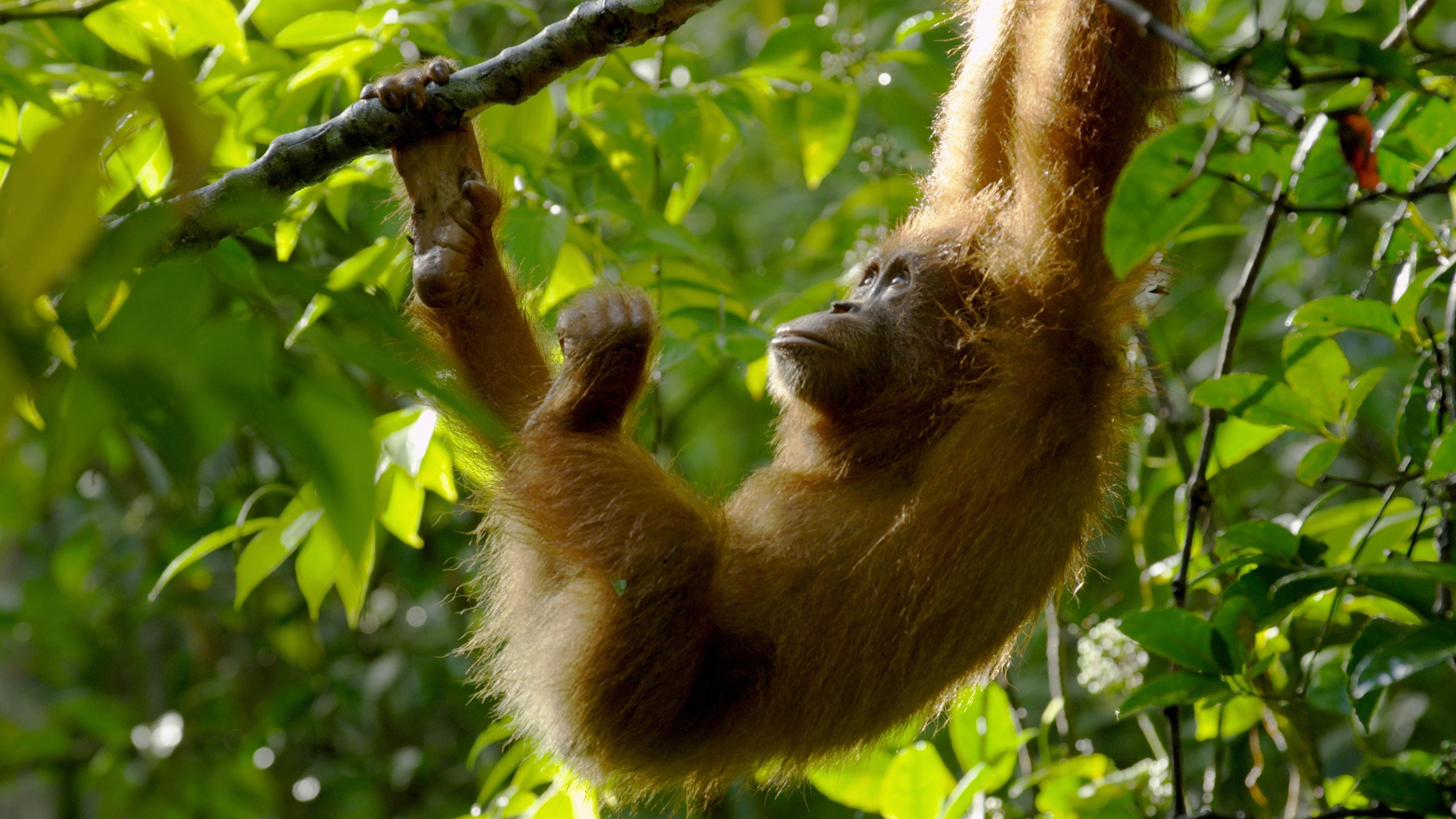
Ecologist Chris Morgan travels to the jungles of Northern Sumatra to document the work being done to save its population of wild orangutans. Asia’s most intelligent ape once roamed across the Indonesian islands of Sumatra and Java, but today, fewer than 7,000 Sumatran orangutans remain in the wild. The film cites rapid deforestation as the chief reason for the species’ declining population.


Copy and Paste the Following Code to Embed this Video:
The Last Orangutan Eden
NARRATOR
In Sumatra, orangutans are losing their last wild home to logging and palm oil farms.
MAN
I always refer to them as refugees.
NARRATOR
Often, these orangutans have also lost their mothers and are too young to make it on their own.
MAN
They're really slow growers, just like humans.
NARRATOR
Some lucky babies get rescued. It's really hard to believe what this little creature has been through at the hands of humans. And they go to school to learn how to survive. Yes, you are doing so well! What a good tree climber. But how do these special jungle schools know what to teach? We watch a family of wild orangutans to find out how they live in the treetops. Wow, look at that! It is like a giant bird nest. And their remarkable ways of finding food.
WOMAN
They produce a tool and then use it to get the seeds out of the fruit.
NARRATOR
But can these refugees learn to survive in the last orangutan Eden? I imagine when we first encountered the red ape, we may have mistaken them for an unusual tribe of tree dwelling people. We even named them "Orang Utan," meaning, "people of the forest." They were mysterious, yet so familiar. They once roamed right across the islands of Sumatra and Java. But today, fewer than 7,000 Sumatran orangutans remain in the wild. They've become the unwitting poster child for the tropics' most endangered animals. In a corner of northern Sumatra a pocket of wilderness three times the size of Yellowstone has become a battleground for both scientists and conservationists. Around 85% of Sumatra's orangutans are found here, in the Leuser Ecosystem. It harbors the most sophisticated orangutan culture on Earth, and it's the last stronghold for the remaining wild Sumatran orangutans. My name is Chris Morgan. I've come to the island of Sumatra to better understand what's at stake for Asia's only great ape. So, we're here. We are over it now. With me is renowned conservationist, Dr. Ian Singleton. He's taking me over a portion of the Leuser Ecosystem that's now at risk.
SINGLETON
Leuser is the last hope for Sumatran elephant, Sumatran rhino, Sumatran tiger, and the Sumatran orangutan. Only here do you find the populations of these species still in viable numbers -- hundreds, if not a few thousand, compared to tens and dozens elsewhere on the island.
MORGAN
Stretching out below me is an ocean of green -- but a lifeless one. The original forest was logged and burned to make way for vast oil palm plantations. Palm oil is found in half of all household products, from perfume to peanut butter, and it's the leading ingredient in biofuel. Indonesia now ranks among the world's top greenhouse gas emitters due to rapid deforestation. The clearing of land for the production of palm oil is the single greatest threat facing wild orangutans.
SINGLETON
When plantations go in, they convert primary forest to palm oil. During that conversion process they end up with barren land and nothing survives that process. It's hard to find a spider or a lizard, you know?
MORGAN
This quarantine center is the temporary home to around 48 orangutans. They've either been rescued from logged land or confiscated from the pet trade. Many have lost their mothers, and all of them have lost their homes. More than half the orangutans at quarantine are under five years old. In the wild they would still be nursing. With such long childhoods, the staff must act as their surrogate mothers.
SINGLETON
People always say that one of the biggest threats to orangutans is the pet trade, but it's not -- the pet trade is simply a byproduct of the large-scale destruction of orangutan habitat -- the killing of many, many orangutans in that process. And the orangutans that end up in the pet trade are actually the lucky ones. They're the lucky survivors of that process. And I always refer to them as refugees, because the definition of a refugee is somebody whose homeland is no longer available to them. And that certainly represents the case for orangutans.
MORGAN
But they don't survive long as pets -- most people are ill-equipped to look after a baby orangutan, and their only chance of survival is to be rescued by centers like Ian's. Surgical masks are worn to prevent the spread of any human illness to the orangutans. How old are these guys?
SINGLETON
Three, getting on four -- still quite young. They're really slow growers, just like humans.
MORGAN
These youngsters still have a lot to learn... And every day they go to school -- climbing school.
SINGLETON
You can see that they're actually more closely attached to each other than they are to Henry. And that's the way we want it.
MORGAN
Hello, hello! Amazing to see. So, I guess the physical interaction... I know I'm not supposed to be touching them, which is the most difficult thing I think I've ever been through. You try very hard to separate them from humans and...
SINGLETON
These guys used to be with their mothers, and their mother was killed right in front of them. They've already gone through this trauma of being separated from their mother figure once, and the last thing we want to do is get them into that situation where they have to go through it again.
MORGAN
Ian's goal is to get these orphans to bond with each other, making their release back into the forest as smooth as possible. These guys are so obviously very connected, aren't they? They know each other well, they're very comfortable. It's exactly what you're looking for, I suppose.
SINGLETON
They're all individuals, and they're all completely different in terms of personality, but also experience.
MORGAN
For an animal that spends its entire life in the canopy, developing their motor skills at an early age is vital. And every day their confidence grows. Little by little, they're figuring out what it takes to be a wild orangutan again. It may be at least another year and a half before they are ready to begin the reintroduction process. But there are no steadfast rules -- every youngster learns at their own pace. Ian introduces me to their most recent graduate, Udin. He's been at quarantine for the past three years, but soon he'll be released back into the wild.
SINGLETON
When we found him, he was only recently captured and he -- his mother had been clubbed or beaten with logs or a machete or something. But his skull was fractured. If we hadn't confiscated him, he would've almost certainly died, you know, where he was.
MORGAN
Right, and how do you feel like he's going to do? Is he a good candidate? I think he is. I mean, he's -- he's been with other orangutans a lot, but he's not seeking interaction too much. I think he'll do very well. And to look at him, he's gonna be a very handsome male. He's gonna be the pick. Udin's time in quarantine is almost over. But for some new arrivals, the road to recovery will be a long one... And I soon find myself eye to eye with two of the cutest orangutans I've ever seen. It's really hard to believe what this little creature has been through at the hands of humans.
Sighs
MORGAN
He was confiscated just this week and brought here just a few days ago -- five or six days ago. You can see he's hiding under this towel. He's not very social and doesn't trust humans, and understandably. They found him in a plastic bag, tied up in a plastic bag in somebody's back yard. And he's totally dehydrated and malnourished. While he was in captivity he's been attacked by a dog, so he's got scars around his neck and on his shoulder blade there. The trauma is unbelievable. In fact, you know what's more surprising, though, is that he trusts people at all. He doesn't -- He must be hungry.
Yeah. -MORGAN
He must be hungry, but he doesn't trust people with food. He's three years old, which is hard to believe because his friend here that he's been socializing with, is six months old, and they're the same size. But sadly, his story is a common one.
SINGLETON
There's no way a mother orangutan will allow you to take its baby without defending it to the death. And so you essentially have to club this animal unconscious or just beat it to death in order to take that baby away. It's those babies -- those very babies -- that end up being taken home, kept alive, in the hope that they might be able to sell it somewhere.
MORGAN
The three year old is still far too weak to climb, but for his little buddy, climbing lessons have already begun. Yes! You are doing so well. What a good tree climber. I have to say, when you are looking at them it is like looking into the eyes of a human being. There's so much going on back there. You can see the intelligence in their eyes. This one's six months old... and as she's climbing through the trees she's taking in this massive information all the time and you really sense that she's retaining it and is going to be able to use it. And it makes you wonder whether they can learn enough during the process of rehabilitation to make it as a wild orangutan on their own. It's difficult to imagine what these orphans have lost. What is home like for a young orangutan in the wild? Where do they sleep at night? What do they eat? To find out, I'm heading to a remote jungle in the heart of the Leuser Ecosystem, a place known as Suaq Balimbing, home to the densest population of orangutans on Earth.
Thunder crashing
MORGAN
It's well before dawn. We're getting an early start in the hopes of setting up camp deeper in the swamp. Researcher Caroline Schuppli is my guide on this expedition. She's been studying the orangutans of Suaq for the past four years. It's a bit eerie. Our journey into the forest starts with crossing the river in the pitch darkness. It's still hot even though it's night. So, we get across the river and start hiking down the trail. There is something really unnerving about being in the forest -- being in a forest that you don't know in the night. And every little sound, and every little leaf drop could be an animal. It feels as if we've been walking in the dark for hours, and as dawn arrives, I'm relieved to finally see what's around me. Much of Suaq's wildlife remains hidden from view. Yet you have the uncanny feeling you're being watched. Thomas Leaf monkeys peer down at us as we slog our way through the swamp. In the distance, the mating calls of an argus pheasant can be heard. And somewhere in the forest, sun bears seek out ripe fruit high up in the canopy. There are many more creatures that simply don't want to be seen. Count yourself among the lucky few if you catch a glimpse of a tiger. But make no mistake, they are here -- perhaps even watching us as we pass by. Many of Sumatra's most charismatic animals are threatened with extinction, including the Sumatran elephant, rhino, and tiger. Even the seemingly common Thomas leaf monkey are found only here, in northern Sumatra. And like the orangutan, they, too, are threatened with extinction. As the day wears on, it's easy to understand why so much of the life here prefers the trees. The swamp is a nasty place to be. Every step you take has to be carefully planned, or you might -- Wow!...get sucked into the mud.
SCHUPPLI
Do you need a hand?
MORGAN
I'll just end up pulling you in. Oh, wow. They call this place orangutan heaven and human hell. Actually, as soon as I arrived on my first day, one of the helpers walking out back to the village just shook my hand and quietly said, "Welcome to hell." It is miserable.
SCHUPPLI
The forest is not an easy forest. You fall, you get hurt, you get stung, you get stabbed by thorns. But it's still -- what you see is so rewarding that, at the end of the day, you don't think about how hard it is.
MORGAN
We set camp on one of the few dry patches of earth in the swamp, and settle in for the evening. Long before I wake up, the peat swamp is already bustling with morning commuters -- thousands of critters starting their day. For Caroline, this is just another day at the office. Every morning she goes out in search of her orangutans. And for the past four years she's been following about 30 different individuals.
SCHUPPLI
When we are searching for orangutans, every couple of hundred meters we wait, listen. That's interesting, you wait and listen, you don't wait and watch. It's easier to hear them? It's so much easier to hear them. It's this --
Whooshing
SCHUPPLI
And it's different from other monkeys, because other monkeys leap and orangutans don't.
MORGAN
Today I'm hoping to get a chance meet one of Caroline's orangutans. And then suddenly, through the thick vegetation, I hear that whooshing sound Caroline described. It's an orangutan! Do you know them?
SCHUPPLI
It looks like Friska. Do you see the baby? That's Friska's two year old son -- that's Frankie. He's a very curious boy.
MORGAN
I was only expecting one orangutan, but it looks like we've stumbled across an entire family. And it's not just Friska's two year old infant, but her adolescent son, Freddy.
SCHUPPLI
And Freddy actually spends a lot of time still with Friska and his little brother. And, interestingly, the mom, Friska, doesn't mind Freddy to hang around. In fact she often takes care of both of them. So, Freddy is allowed to sleep in her nest and she still bridges -- so, helps him to travel between trees.
MORGAN
It was the most surprising thing, seeing my first wild orangutan -- the way they moved through the canopy. There was nothing awkward or clumsy about it like the orangutans back at quarantine. They've got so many characteristics similar to gorillas, you know -- they've got that kind of hunched shoulders and that swagger about them. But then they have things in common with chimpanzees, and they can get around in the treetops, which gorillas can't. And they do it very, very gracefully. Remember this is an animal that weighs as much as your average human being. For an animal that size, their agility is very, very impressive. She poured through the treetops effortlessly. Orangutans are as dependent on the trees as we are on the earth beneath our feet. It's where they sleep, how they get around, and it's their main source of food. And trees provide something else, too... Safety. Avoiding predators may be why orangutans took to the trees in the first place. Unlike other great apes, orangutans don't live in strict social groups. And the responsibility for raising young falls solely on mum. With an adolescent son and two year old infant, Friska has her hands full -- especially at the age of 65. Although we don't really know how long orangutans live in the wild, our best guess is somewhere between 50 and 60 years. And there's a surprising amount we don't know about wild orangutans, which is why Caroline meticulously documents everything they do. And she's particularly interested in how young orangutans learn.
SCHUPPLI
Frankie is now trying to follow her. She's waiting... waiting... and now he can catch up. For a young orangutan, the road to independence is a long one. The orangutan mother-infant bond is one of the most intense and intimate bonds I've ever seen in any animal. They feed together, they sleep in the same nest, they are almost constantly in body contact.
MORGAN
A female orangutan will have a single offspring once every eight to nine years. It's the longest birth interval of any mammal. And their entire world seems to revolve around their babies -- they nurse them, let them take food from their mouth, and help them travel through the canopy. A young orangutan won't be ready to venture out on its own until about nine years of age. And even after that they pay regular visits to mum until about the age of 11 or 12. It's the longest childhood of any ape, aside from us. And this extended childhood gives them time to learn everything they need to know to make it on their own. And a young orangutan has a lot to learn. Termites are one of the few sources of protein in an orangutan's mostly vegan diet, so learning how to get at them is a high priority. But once this youngster gets a hold of her own nest she's got a new problem on her hands. How did mum do this? What's the trick here? Of course, there's a technique to everything. First, you break it in half. And then bang the nest into the palm of your hands. After watching mum a few times, the youngster quickly figures it out. Ah, sweet success! Orangutans use their body weight to swing through the canopy, but for the youngsters this is a bit of a challenge. They simply aren't heavy enough. Fortunately mum is always close by to help out, using her body to form bridges between trees. The majority of an orangutan's diet is fruit, so knowing where and when to find it is pretty important. And eating fruit is not as simple as it looks -- orangutans use their lips and teeth to peel the skin off some fruit, while extracting only the seeds from another. So, infants have to pay particularly close attention to everything mum does. And learning all this takes time -- in fact, it can take up to 12 years before an orangutan knows how to find and process food just like mum. Because orangutans spend most of their time in the canopy, sleeping and resting comfortably in the trees means building a nest. Sumatran Orangutans usually make a couple of nests a day, one for taking a siesta in the midday heat, and the other for sleeping through the night. And it takes a lot of practice to build a nest.
SCHUPPLI
We often see young orangutans investigating old nests, and also taking them apart, and we think that's one way to learn to build a good nest. Sort of like a reverse engineering.
MORGAN
And being a good engineer is essential, especially when your bed sits 50 feet above the forest floor and you weigh nearly 200 pounds. I wanted to get a closer look for myself, so I've decided to investigate one of Friska's old nests. Oh, look at that! It is like a giant bird nest. Here goes -- let's hope it holds my weight.
Laughing
MORGAN
Yes! Yes! It worked! It's not like a bird's nest where they, you know, collect branches and twigs and place them into the nest. The orangutan has actually snapped them back -- can you see that right there? Broken the branch, pulled it, and created a framework that everything else sits on top of. So, it actually feels quite secure. They create these nests in places where they are high but not --
Animal calling
MORGAN
I can hear a long call over there. It's amazing, I'm sitting in an orangutan nest and I can hear an orangutan. The orangutans that make that noise are the big males with these flanges that help them direct the sound -- that's one theory, anyway. But they also have an inflatable throat that helps them really project that sound. Shall I reply? "Ooh" -- oh, I don't know if I can do it...
Imitating call
MORGAN
It's all gone suspiciously quiet! What are the chances of that? Sitting in an orangutan nest and hearing one call while we're up here. That really just tells you something about the density of the orangutans in this forest. And because there are so many orangutans here, these normally solitary apes have learned to be social. And all this social interaction not only changes the way young orangutans learn, but has given rise to a unique culture.
SCHUPPLI
So, what we know from orangutans in general is that the infant learns everything it has to learn from its mother. And what happens in Suaq is that the infant has not just the opportunity to learn from mum, but also from other individuals.
MORGAN
And that's what's different here, that there are so many packed in this area that the infants have an opportunity to watch and learn from others. So, we call it vertical versus horizontal transmission. So, vertical if they learn from their mothers, and horizontal if they learn from other individuals. So, it makes these guys perhaps extra smart, or extra fast learners?
SCHUPPLI
That's exactly what I'm looking at. Because we are thinking that it is the opportunities for social learning that determine how smart you will be as an adult.
MORGAN
If the orangutans of Suaq really are that clever, what exactly are they doing with all those smarts? One clue lies inside this odd football shaped fruit. It's called Neesia, and when it's ripe, orangutans will travel from all over Suaq just to get it. Inside the fruit's tough outer shell are a cluster of fatty seeds surrounded by thousands of tiny, sharp, fiberglass-like hairs. It's not painful, but apparently when this gets under the skin it can be a total nightmare -- it turns into a rash and makes you swell up -- I'll have to take some tweezers to get those out -- oh, I'm covered in them! I'd make a lousy orangutan. But the orangutans of Suaq have worked out an ingenious solution to avoid getting stabbed by the sharp hairs. There he is! Can you see that? The vegetation is thick, and it's difficult to get a clear view. But we can see a large male orangutan, and he's holding a stick between his teeth. Shaved clean of bark, he's fashioned it into a tool. He picks a Neesia fruit and begins to jab the stick into the fruit, loosening the seeds inside. You can see him working the seeds loose with the stick. Then he tilts the fruit, dumping the seeds into his mouth.
SCHUPPLI
They break apart twigs, produce a tool, they might peel the stick, might chew the end of the stick to make it look like a little brush, and then use it to get the seeds out of the fruit.
MORGAN
The orangutans of Suaq are frequent tool users, and they use stick tools to solve a variety of problems. Getting at tasty insects in a tree hole can be a challenge, especially if your fingers aren't quite long enough. And it's no doubt frustrating. But because he's watched others use tools to solve similar problems in the past, he can now draw upon this knowledge to resolve his own dilemma by producing a stick tool that's just right for the job. And it's not something he needed to figure out on his own. And this knowledge is not just passed from one individual to another, but from one generation to the next. Do you feel like she's looking over that way? Yeah, all the time. We spot Friska's son Freddy in a nearby tree. And it looks like he's got a tool in his mouth. It's clear he's been watching others, and he's determined to master the skill. But he hasn't quite got the hang of it yet. And Freddy's little brother Frankie is watching everything he does. Although, if you want to learn tool use, Freddy might not be the best example. This vast repository of knowledge is all part of Suaq's orangutan culture... A culture that may have taken thousands of years to evolve. But the orangutans of Suaq may be the last of their kind. Even as I sit and talk with Caroline, the forest around us is under siege.
SCHUPPLI
Suaq is within a national park, but there is illegal logging going on. Yeah, it's just a very complicated issue because people that cut down trees come from the same village as, for example, the people that work for our orangutans here. So, it's all interconnected, and there are family ties maybe, even. So, it's so complicated, so complex.
MORGAN
If we lose the orangutans of Suaq, we would not only loose a significant population, but an entire culture. My experience in Suaq has shown me that orangutans are far more curious and innovative than I had ever imagined. If the orphans at quarantine are as smart as their cousins in Suaq, then it's likely they can learn new things with ease, not only from the keepers here, but from each other. And a lot comes down to the individual.
SINGLETON
They're all fairly smart, but a few of 'em just seem to be more focused on solving problems. I think like people -- you get people who are tinkerers. And I think some of these orangutans are a bit like geeks as well. You know, they really like to figure out problems and solve them. Mukhlis has been Udin's surrogate mother from the start, and Like a proud parent he often refers to Udin as a genius. Early on Mukhlis began to introduce Udin to foods commonly found in the forest, and could see right away that Udin was a quick study. And the other orangutans picked up on this as well, and watched Udin closely. But Mukhlis' days as Udin's caretaker will soon be over. Today Udin will be moved to a protected forest, and if all goes well, released back into the wild. It's the last journey these two will take together. Udin is headed to the Jantho Nature Reserve at the very northern tip of Sumatra. It's a grueling 12 hour drive to the reserve on twisting coastal roads that take us along the edge of the Leuser Ecosystem. As we approach Jantho the flat coastal plains turn mountainous and the road gets much tougher. The last portion of the journey is the toughest. The road into Jantho is regularly washed away by monsoon rains. And this dirt track is all that remains. This is the worst section of road, so if we can just get past this we'll be okay. But that's easier said than done. Just look at it -- it's unbelievable what these vehicles can get through. But -- oh! Crunch! This vehicle was trying to tow this other one out right now. You can see it's just like a thick, syrupy clay that's just lethal. No one in their right mind would go down this road -- and that's the point. It's Jantho's inaccessibility that makes it the perfect place for orangutans to thrive. And not just orangutans... These tiger tracks are so fresh water is still pooling in the prints. Jantho is only 64 square miles, but it's directly connected to the Leuser Ecosystem. Unlike Suaq, this is a mountainous region with rolling hills and lush meadows. Before we started here, there was no wild orangutan population here, none at all. There are no orangutans for about 150 kilometers south of here, until you get to the Leuser Ecosystem.
MORGAN
The very last obstacle is the river. Just on the other side lies an orangutan Eden. Orangutans don't swim, so the river forms a natural boundary between the human camp and the orangutans. It's been a long road for Udin. He's lost his forest home along with everyone he's ever known. But he is one of the lucky ones... a refugee that has been given a second chance in a new home. Many of the other orangutans have come to check out the new arrival.
SINGLETON
When they travel up to a place like Jantho, they're traveling with their buddies. And when they're released into the forests, they can see orangutans that were previously released, who they already know from the quarantine. So, old mates.
MORGAN
Udin will have a chance to sample the local fruits and insects, and get to know his neighbors. By the time Udin is released, he will already be familiar with the place. But the jungle can be a pretty tough place to make a living, and I sure hope Udin can survive it. Will he know how to make an umbrella out of leaves Orangutans are tolerant of each other, How much does he really know about being a wild orangutan? The Jantho Nature Reserve is now home to about 54 orangutans, and all of them were once orphans, like Udin. But If all goes well today, Udin will become a member of this new community. Orangutans are tolerant of each other, and not territorial like some primates -- and all of this makes them good candidates for release and reintroduction.
SINGLETON
And as long as they can keep themselves alive for long enough, as long as they can maintain adequate nutrition for a few years, they will develop a map of the area that they're released in and have a really good chance at survival. You know, we were talking about some orangutans just seem to have that little bit extra? And Udin is one of those guys. We've seen him using tools, and he's always looking at ways to get the padlocks and get out of different things. The others probably recognize that fact and see him as the smart guy.
MORGAN
It's going to stand him in good stead once he's out in the forest.
SINGLETON
Yeah, yeah, it will do -- should do.
MORGAN
That adventurous spirit.
SINGLETON
I hope so, yeah.
MORGAN
I suppose you never can tell until they are out there doing what they're supposed to be doing. Oh, wow! He knew how to open that! Look at that! Oh, look, look, look.
Morgan laughing
MORGAN
He's not feeling sociable. Aww! Priceless! He's looking over his shoulder and kind of not knowing exactly what he can get away with, but then straight back into Mukhlis' arms. Love it -- what a scene!
SINGLETON
Yeah, let's go and take him in -- hello, mate!
MORGAN
Mukhlis cradles Udin in his arms as he takes him into the forest. He's seen Udin grow from an awkward youngster to confident adolescent. Every parent eventually faces this moment -- the inevitability of growing up, when you send your child out into the world hoping you've given them the tools to survive it. But we're not alone... It looks like one of Udin's good mates has come to see him off. Yusniar was released weeks earlier. They spent time together in quarantine and became fast friends. It's comforting to know Udin is not alone. Mukhlis is looking for just the right tree for Udin's release, so he can begin foraging right away.
SINGLETON
I see a lot of flowers.
MORGAN
There he goes.
SINGLETON
Oh, look at that, straight up, like he never left.
MORGAN
Oh, my goodness! I can't believe how quickly he's gotten up there! If there was ever an example of an animal being given a second chance in life, then this is it right here. Absolutely incredible to watch. You know, when he -- he was like this all the way! He was like this, and I thought he's never gonna let go. And then he saw the tree, and you gave him some encouragement, and, phew, he was gone.
Cameraman gasps
MORGAN
Whoa! Okay, yep. You okay, Joe? -Nope, okay. Think it's all right. I think he's looking for his mate. Oh! Oh, my goodness, that is priceless! Little by little he is shedding the shell of captivity and soaking up the forest around him. It looks like Udin has spotted his good friend Yusniar, and he's heading up to join her.
SINGLETON
But once they get out into the forest here and you see 'em up in the trees and most of 'em seem to have figured it out very quickly, and they're behaving just like wild orangutans do. To see that they've gone from an animal with no future, to an orangutan who possibly has a future as good as a wild orangutan, 50 years in the wild... And these guys will become the founding fathers. You know, the first guys who settled here. If they could write and take notes, you know, they would look back at these guys as the Pilgrim fathers, you know, the ones who -- "Oh, yeah, I'm related to Udin! You know, he was my great-great- great-great grandfather." You know? These are real -- real celebrities, these guys.
MORGAN
It's magic to see this. It's hard to believe that just a few minutes ago he was in the cage down below, and now he's swinging around in the treetops like an orangutan should, and it was such a short leap from the arms of Mukhlis to that tree two feet away, but a profound step to freedom and a whole 'nother world. Exactly where these guys should be... Reunited again, but this time in the freedom of the forest. Witnessing the birth of a new orangutan population gives me hope for the future of the species. I've come to see that orangutans are far more than simple foragers -- they're intelligent, innovative, and capable of developing a rich culture. But if the pilgrims of this new land are to thrive, they will need our help. Their forest home will need to be protected -- not just today, but for generations to come. This "Nature" program is available on DVD. To order, call 1-800-336-1917. To learn more about what you've seen on this "Nature" program, visit pbs.org.
Search Episodes
Related Stories from PBS Wisconsin's Blog




Donate to sign up. Activate and sign in to Passport. It's that easy to help PBS Wisconsin serve your community through media that educates, inspires, and entertains.
Make your membership gift today
Only for new users: Activate Passport using your code or email address
Already a member?
Look up my account
Need some help? Go to FAQ or visit PBS Passport Help
Need help accessing PBS Wisconsin anywhere?

Online Access | Platform & Device Access | Cable or Satellite Access | Over-The-Air Access
Visit Access Guide
Need help accessing PBS Wisconsin anywhere?
Visit Our
Live TV Access Guide
Online AccessPlatform & Device Access
Cable or Satellite Access
Over-The-Air Access
Visit Access Guide




Follow Us