NARRATOR
Lions. Not in Africa... but in India. Asiatic lions. Once almost extinct, they now number over 500 and are claiming back their lost lands. Spreading out from their reserve into rural India, they enter villages and prey on cattle.
Roaring
NARRATOR
It looks like a serious case of lion conflict. But here in India's Gujarat State, lions are forging a bizarre relationship with people.
Conversing in native language
NARRATOR
And together they are making history. A village in Gujarat's Junagadh district awakes to find a carcass in the street. Two lions killed this cow in the night. In a second village, lion footprints. They have killed a calf, leaving only the stomach. In India's westernmost state, this sight is increasingly common. 12 miles from those villages lies the Gir Forest Sanctuary.
Lions roaring
NARRATOR
Recent changes in the forest have led to a big increase in lion numbers and what outside observers might call a predator problem. But here in Gujarat, these dangerous big cats are showing us their true nature for the first time. The Asiatic lion is genetically distinct from others, distinguished by a strange fold of skin under its torso. Once, they covered much of Asia and Europe. Today, they live only here, in this tiny part of India. These cats are the very last of their kind. In many ways, they are similar to African lions. They live in prides. And they cooperate to hunt large animals... such as sambar. Stags can weigh in at half a ton. These two hunters have a strategy. One is the catcher. She will stalk as close as she can, then wait. The other, the chaser, moves in behind the prey and drives it towards the catcher. It's a well-rehearsed move, but there's no guarantee they'll succeed.
Bird squawks
NARRATOR
Life for lions is getting harder here. Their numbers are increasing fast. Competition for space is intense. Fights are frequent. The Gir Forest, at less than 600 square miles, is too small for the long-term survival of the Asiatic lion.
Growls
NARRATOR
As numbers grow, dominant males force other lions out of the reserve and into contact with people. The father of these four adolescents died while defending this territory. If they don't leave, they too will be killed. Many people think this is the only reason for the cow killings, that lions are desperate refugees in search of an easy meal. But the truth is completely unexpected. After sunset, the young lions head out towards the edge of the forest. A thermal camera helps us track the group in complete darkness. A road forms the border of the reserve. They cross it without hesitation. Soon they reach fields around a village.
Dogs barking
NARRATOR
This is a unique glimpse into their hidden world. Sounds of humanity fill the night air. For lions, listening is a crucial part of hunting. Every sound carries vital information. Dogs prowl the village streets. Buffalo rest in their stalls. And stray cattle wander between the houses. With the dogs wide awake, it's not a good time to visit this village. The lions move on. 12 miles away, a large male has entered a village and killed an ox. No one knows if he'll return to the kill. He could still be resting nearby. But the thermal camera shows no sign of him. Yet nobody in the village seems worried. A family eats their evening meal close to the dead ox. A big male lion appears across the fields, heading straight for the village. He surveys the situation. The family is unaware they are being watched by a huge, wild predator. At 11 o'clock, the last lights go out. The lion reclaims his ox. The owner of the house discovers a killer on his doorstep.
Cell phones ringing
NARRATOR
News of the lion travels fast. Villagers rush to the scene. But confronting this killer without weapons would be madness. Still, the people crowd in.
Crowd murmuring
NARRATOR
The lion doesn't seem to care. He shows no aggression, and the crowd returns that respect. There is a dangerous predator in their midst... and people are celebrating. When the lion finally leaves, the excited villagers follow, hoping for one last glimpse.
Horn honks
NARRATOR
The next day, life returns to normal. The ox's owner is surprisingly relaxed.
Speaking native language
NARRATOR
This man watched the lion make its kill. Incredibly, Gujaratis are glad to have lions as neighbors. In other countries, killers of livestock are usually hunted down. Why do these people accept lions so readily? The relationship between Asiatic lions and humans has a troubled history. Once, the big cats ranged over much of Asia and Europe. Today, they survive in just one spot. Hunting royals and pastoral people exterminated lions on a huge scale. By the mid-20th century, they were extinct outside India. In Gujarat, their numbers dropped to just 20 before they received protection from the local prince, the Nawab of Junagadh. Today, there are over 500 wild lions in India. A remarkable recovery. Now the Gir Forest brims with life. And there's plenty of prey for the lions. Wildlife has blossomed because of reduced livestock grazing. Spotted deer have increased tenfold. Sambar, fivefold. Wild boar and nilgai, India's largest antelope, have tripled. This should be a perfect hunting ground, but there's a catch. The abundance of animals can actually make hunting harder. Langurs and spotted deer often forage together. The monkeys provide the deer with an early warning system. The lions also face another problem. Thick cover makes the lion harder to see... but easier to hear. Deer have excellent hearing. She needs to be very cautious. Progress is slow. Getting close enough to strike takes extreme patience and very careful footwork.
Animals grunting
Shrieking
NARRATOR
Her stalk takes too long. Another failed hunt. This is the biggest problem lions face hunting in Gir -- dry, crisp leaves on the forest floor. With just 24 inches of rain per year, the forest is parched for 9 months out of 12, making it hard for lions to move silently. With so few easy hunting opportunities, competition among lions is fierce. Rival prides constantly battle for space. Serious injuries are common.
Roaring
NARRATOR
Leopards are a target, too. Competition from them is not tolerated.
Growling
NARRATOR
Once, leopards had most of this forest to themselves. Now they are often driven out. But the lack of space is just one reason why lions leave the reserve. Not long ago, Maldhari people grazed their herds among the trees of the Gir Forest. Lions hunted the cattle just like wild prey, often picking off the old and sick. For most of the last century, the big cats depended on these cattle for survival.
Rooster crows
NARRATOR
Today, most of the Maldhari have left the forest. They still raise their dairy herds, but they're now part of 21st century Indian life. The Maldhari believe that the lions have followed them out of the forest. And recently, lion numbers have increased the most outside the forest reserve. Today, there are lions all across Southern Gujarat. Here the relationship between lions and people is completely revolutionary.
Laughter
NARRATOR
Lions are valued members of the community. They even get special protection. Forest Rangers left this ox carcass to lure two sisters into the open. They think the second sister may have a broken leg. In Gujarat, sick lions are shot... but only with a tranquillizer dart. Wildlife rescue teams are here to help, 24/7. The crew's aim is to get this lioness back on her feet as soon as possible.
Man speaking native language
NARRATOR
With only 500 wild Asiatic lions on Earth, this injured female is incredibly precious. They assess her condition and decide she needs further treatment.
Conversing in native language
NARRATOR
At the rescue center, the injured lioness joins other patients in various stages of recuperation. Most common are males wounded in fights with other males.
Growls
NARRATOR
This lioness fell down a well and nearly drowned. Some cats are here not for medical reasons, but for public safety.
Man speaks native language
NARRATOR
This lioness has killed a man. She'll remain here with her two angry cubs while the team makes a plan for their future.
Growling
NARRATOR
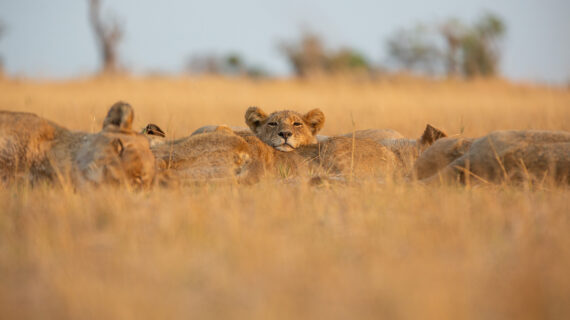
The team doesn't just rescue lions. They also help people adapt to life with these predators. There are signs of lions everywhere. Forest department trackers keep a close eye on lion movements, including tracking their kills. Eyewitnesses describe a commotion the previous night and report two male lions gorging on this cow. Despite people watching just yards away, the lions left peacefully before dawn. There will be no lion hunt, no retribution. But the villagers and the forest department need to know where the lions are and what they might do next. The tracks lead across fields towards a small patch of scrub. Half a mile from the village, the two cow killers are resting in the shade. Lions need to drink after feeding, and this is the only water nearby -- a cattle trough. But there are lions here already with small cubs. The killers move closer. These cubs could be in great danger. Two mothers, both limping from thorns in their feet, bring the defenseless cubs out into the open. These males must be their fathers, or the cubs would be dead by now. They share the water all together. For two lionesses to bring up four healthy cubs is a great achievement. To do it so close to a village is a miracle. People are their neighbors. These lions are not refugees from the forest. This is their home. But how does a pride survive here? And with such small cubs? Like many lions, especially those living near people, they are almost completely nocturnal. Night cameras reveal their strange and unique world. For several hours after sunset, the lions sleep off the heat of the day.
But by 10
00 PM, the cubs can't resist exploring. It's cooler now, and quiet enough to move safely.
Growling softly
But by 10
The mothers call to their cubs to follow. They head towards the main road. Instead of crossing into fields, they turn onto the tarmac towards another village. The lionesses are careful but unafraid. They stop and listen for signs of prey or threats to the cubs.
Horn honks
But by 10
At the sound of an approaching car, they melt into the roadside vegetation. This is the village the lions were headed for, but it's no place for young cubs. Though there are plenty of cattle here, the dogs could target the youngsters...
Dogs barking
But by 10
...and would wake the whole village if they spotted lions. The cattle are safe for the moment. Ironically, the dogs have gathered because they're in danger. Not from lions, but from leopards, their main predator.
Dogs barking
But by 10
Just outside the village, Indian gazelles can graze, unmolested by dogs. Herds of wild boar root through newly sown fields. Nilgai are everywhere. Conditions could be perfect for a hunt. The nilgai are confident and relaxed, and there are far more of them here than inside the reserve. But even here, small lion cubs would be vulnerable. It's a young male from a different pride. In this bright moonlight, the nilgai spot him easily and keep their distance. He's only about 18 months old, too young to know how to use cover properly. Instead of making a kill, he clears the area of wildlife. There's no meal here now for the mothers and their cubs. But scavengers and other predators are here, too. This is an extremely rare sighting of a striped hyena. These normally shy scavengers can sniff out a carcass from a great distance. Old lion kills are an important source of food. He's no escapee from the nature reserve. He lives here. Other residents are out in force. Golden jackals. The cubs gang up on the much larger hyena. Jackals keep a low profile in daylight, but tonight they're everywhere. The hyena seems nervous. He's expecting trouble. Lions often scavenge, too. It's safer for the hyena to take the meal away. The jackals have found a different carcass -- a buffalo. But they don't have long to eat their fill.
Growling
But by 10
Yet another lion. She claims the buffalo as her own. Even though she can eat over 45 pounds in a single sitting, there'll still be plenty left for the jackals and hyenas. Under the cover of darkness, this farmland takes on a whole new character. It's like an Indian Serengeti.
Cow moos
But by 10
Large carnivores behave as if this was their natural home, completely at ease with the human world. Bizarre as it may seem, this is now lion country.
Growling
But by 10
Two weeks after the man-killing lioness was captured, her fate is decided. It turns out that four men accidently surprised her. She attacked to protect her cubs.
Snarls
But by 10
But she didn't feed on the dead man.
Man speaking native language
NARRATOR
They decide she's not a threat. They can release her in a different area with fewer people. In any other country, she would have been destroyed. With the wildlife rescue team looking out for them, the lions of Southern Gujarat can live safely even in densely populated areas. The locals accept they will sometimes kill cattle. Even killing a person is not a death sentence. It may seem like a big sacrifice for these small communities, but the lions earn their keep. Incredibly, people and these wild predators often work together. Outside the reserve, the landscape is a mosaic, which resembles the savannah habitat where lions originally evolved. Complete with similar prey -- antelope... deer... and cattle. Come late afternoon, these herbivores migrate from their hiding places to nocturnal crop-raiding haunts. It's a nuisance for road users, but a huge problem for farmers. Freshly emerged wheat is a favorite. And sesame fields are irresistible. The deer and antelope used to have all this to themselves. But now there are lions on the scene.
MAN
Here.
NARRATOR
Forest department trackers follow the prints of a large pride among fields and villages.
MAN
You see? You see?
NARRATOR
The tracks lead to a hilltop, where 12 lions are waking from their daytime slumber, using the last light to plan their hunt. They are scanning for signs of prey in the surrounding farmland. Or even in the nearby village. As darkness falls, grazers begin to emerge. Farmers head for the fields, ready for a long night of deer scaring. But with no moon, their difficulty is finding the deer. The lions have the same problem, locating prey from a distance in complete darkness. They can only listen. And this is where the farmers can help. The farmer finds the deer by creating a disturbance.
Man whooping
NARRATOR
He can then see their eyeshine by flashlight.
Man whoops
NARRATOR
All he has to do is chase the deer from his fields, and often onto his neighbor's land.
Man whooping
NARRATOR
Even from two miles away, this sound is like a dinner bell for the lions.
Man whooping
NARRATOR
They head towards the farmer's calls. Four adult females and eight cubs.
Man whooping
NARRATOR
The lions know these fields well, and the farmer's calls give them all the added information they need. They approach cautiously and silently. There are no dry leaves here. The deer catch the scent of the lions but can't see far in the starlight... and don't know where to run. The cats spread out to encircle the deer, as if they were on open savannah. Tonight the four adults will be the catchers, and the inexperienced cubs will be the chasers. The females conceal themselves in scrub at the edge of the field, and the trap is set. At this young age, the cubs use no stealth and move directly towards the deer...
Deer shrieking
NARRATOR
...inadvertently driving them towards the concealed catchers.
Deer shrieks, lion growls
NARRATOR
The spotted deer's distress call locates the kill for all the lions.
Growling
NARRATOR
The most powerful mothers make space for their own offspring first. There is barely room for the whole pride. With full stomachs, the pride spreads out on the edge of the field to relax. This is a rare scene, a testament to decades of careful conservation. Soon, the farmers appear, surrounded by lions, yet completely unconcerned.
Men conversing in native language
NARRATOR
The big cats have cleared the area of crop pests. And now the farmers, too, can relax. This relationship is unique. Lions have adapted their natural hunting behavior from the open plains where they evolved to work alongside humans in these rural farmlands. Scenes like this are increasingly common all over Southern Gujarat. After thousands of years of persecution and conflict, lions and people have settled their differences, at least for now. As a result, Gujarat's lions are spreading far and wide from the Gir Forest. Their range now covers nearly 8,000 square miles.
Lion roaring
NARRATOR
Once driven to the edge of extinction, to a low point of just 20 survivors, these big cats have clawed their way back. This time, the people of India are ready to meet them halfway. And thanks to their interesting new partnership, there is hope for Asiatic lions in a once hostile home. Does this look like an animal that can change the world? This program is available on DVD. To order, visit shopPBS.org or call 1-800-PLAY-PBS. To learn more about what you've seen on this "Nature" program, visit pbs.org.


 Passport























Follow Us