







PBS Wisconsin Passport
Watch this video with
PBS Wisconsin Passport
Become a member of PBS Wisconsin, support your local community, and get extended access to PBS shows, films, and specials, like this one.
Life on Earth: Attenborough’s Greatest Adventure
05/06/26 | 54m 7s | Rating: TV-PG
In 1976 David Attenborough embarked on his most ambitious project ever. No-one had ever attempted a natural history series on this scale before. His reputation was on the line. This is the story behind TV’s first wildlife blockbuster, Life on Earth.


Copy and Paste the Following Code to Embed this Video:
Life on Earth: Attenborough’s Greatest Adventure
David Attenborough, voice-over: "Monday, the 16th of January, 1978."
♪ "We had been filming mountain gorillas in Rwanda, Africa."
♪ "The first sign of trouble is a soldier "who tries to flag us down, "and when the driver ignores him and drives past, he loads his rifle and shoots in the air."
[Gunshots] There was a sort of "waarn" like we saw on the feature films, you know, the bullets going by, and I go, "What's happening?"
and we turned round the corner, and there was an armed guard.
"Then 10 minutes later, a Land Rover drives towards us, blocks the middle of the road, so we must stop."
♪ "The driver is enraged that we have no right to be filming.
"We have no permit.
"We didn't check with the park office.
"We'd been filming with dead gorillas.
"Roadblocks by the commandos lie ahead, so we can't escape."
[Distant siren] ♪ Attenborough, voice-over: I have been lucky enough to have had a long career making natural history programs, but there was one series that changed everything-- ♪ "Life on Earth."
♪ Young Attenborough, voice-over: Lake Magadi in the Rift Valley of East Africa is, I think, just about the most hostile environment that I know.
♪ Attenborough: It was the most ambitious wildlife filming expedition ever undertaken, the first truly global natural history series filmed entirely in color.
♪ Nothing on this scale had ever been attempted before.
Man, voice-over: "Life on Earth" raised the bar in natural history filming.
Attenborough, voice-over: It took you to areas in the natural world which you hadn't considered before.
Woman, voice-over: It brought creatures and places into people's homes for the first time in color.
People were amazed.
Man, voice-over: "Life on Earth" was just an absolute revelation.
People just had not seen anything like this.
Everything changed after that.
The South American rainforest-- the richest and most varied assemblage of life in the world.
Attenborough, voice-over: I suppose that what we set out to do was tell the greatest story in all the world.
That was the turning point in my life, really.
♪ ♪ ♪ Attenborough, voice-over: I did, I think, 10 years doing expeditions in natural history and directing a film and so on.
By that time, I was getting quite senior amongst the producers.
I'd been on the managerial ladder of BBC television all my life, really, since the early 1950s, but it wasn't nearly so much fun.
The question was, how could I get out from the BBC in order to make a series in the worldwide?
I wanted to do a series which would tell the development of the history of life, of evolution, starting from the simplest animals and going right the way through until you ended up with monkeys, apes, and humanity, and in between, you deal with birds and insects and so on in their right evolutionary order, and I just yearned to do that, but I couldn't get away.
I also thought that I would like, actually, to present it.
I would like to produce it and present it, but I couldn't do that and run the network BBC Two.
Well, by this stage, actually, I was running both networks as Controller of Programmes.
The only other job higher was of the Director General, and that was about finance and politicians.
I may know about birds of paradise, but I certainly don't know about prime ministers.
I got home quite late one evening, and there was an urgent message to phone Dave.
It was up to the moment I came in.
I had to ring him at once, so I dialed the number.
I said, "Dave, I'm--" "Hang up," he said.
"I'm coming down."
I go, "My God, there's something absolutely terrible happened," so he rushed into the house.
"Dick," he said, "I'm at my wits' end, Dick.
"I don't know what to do or what to say.
"I mean, I'm likely to be asked to be the new Director General," and I said, "So?"
"Well, I can't do that, can I?"
I said, "No, Dave.
I don't suppose you can."
"My God, of course I can't.
Behind a desk?
There's no way in which I'm going to sit and--" "Well," I said, "you're absolutely right.
Are you asking my opinion?"
"Yes."
He said, "What is your opinion?"
I said, "You'll be a bloody fool if you accepted it.
"You should go on doing what you're marvelous at and what gives you pleasure."
♪ Eventually, I announced that I was going to resign, and then I could say the next week, "What about a series about the evolution of animals?"
and so it was that I set off to do "Life on Earth," and so that was the turning point in my life, really.
♪ Attenborough, voice-over: The Natural History Unit in Bristol was the cutting edge of making natural history films for television.
BBC Bristol.
Attenborough: I went down to Bristol to say that we got permission to do the 13-part natural history program, and, of course, it was great news... ♪ So we're on, then.
Attenborough, voice-over: and then to discuss it with the producers concerned, the chief of whom was Chris Parsons, and he headed a team of extremely experienced natural history producers.
♪ The essential part about it was that it had to be worldwide, and, therefore, we would be able to cover every aspect of animal behavior.
It would require the largest team the Natural History Unit had ever put together and would also be the most expensive wildlife series ever made.
It was going to take 3 years to do, and we would travel all over the world.
♪ Oh, wow.
Ha!
It's completely changed.
I think I sat over there.
♪ My role on "Life on Earth" was producer's assistant, basically secretarial, but it also involved a lot of organization, making sure everything was sorted regarding flights, accommodation, meeting up with experts, where we were actually on location.
Well, in those days, of course, there was no email, no computers.
I mean, anybody young today would just simply not believe the way we had to organize things in those days, and we often had to wait weeks for responses to come back.
It took a long time to set things up in those days.
♪ Gosh, brings back lots of memories.
♪ Everything we had was typed.
♪ Scripts were typed.
Filming schedules were typed.
There was paper, paper, paper everywhere.
Jane and myself, we would be constantly on the phone trying to arrange things, and it was busy.
Wales: Working with David was a wonderful experience.
He's a natural communicator.
He's the teacher you wished you'd had at school.
His enthusiasm for the natural world is totally catching.
Hmm, interesting.
♪ How about that?
Oh... I think it was a risk for the BBC.
I don't think they'd done something, certainly not on this subject, as expensive, as long-term.
We were a bit worried because no one had done it before.
Wow, while since I've been in here.
Ha!
Ahh... ♪ There was a terrific buzz when we heard about this series.
It was obviously going to be a big one.
Working in the initial research for "Life on Earth" was-- it was a brilliant opportunity.
It was very exciting, really.
You know, the brain was bursting with all this information.
It was brilliant.
David had this idea of trying to make a point about how different animals had evolved in different parts of the world, but, of course, then we had to track down the examples of what he was talking about, so where can we film this snake that he's mentioned that occurs in both Australia and Nicaragua or somewhere, and so that was our job in the team in Bristol.
Salisbury, voice-over: David wrote full scripts for all 13 programs, but, of course, the producers all had things to argue with David about-- you know, "Should we include that?"
and, "Why hadn't he included this?"
and so on.
From what I gather, it occasionally got a little bit heated.
Is he watching?
Is he listening?
Um, we had our moments.
I mean, you got to remember who he was.
He was number one, numero uno in the BBC.
Now, he could be very charming, but he could be tough.
Attenborough: Morning, gentlemen.
We're waiting for camera, are we?
Ha ha!
Oh, there he is.
Yes, and, you know-- Woman: Yes.
He's not filming indoors, so-- Yeah.
Would you like a pensive one?
I'm very good on that... considering.
Yeah.
Now sit up straight.
Settle down.
I had to write 13 one-hour programs before we shot a foot.
You had to work the entire series out so that you know you wanted all those things, and it was no good going to New Zealand one moment and then going off back to Africa or somewhere and say, "Oh.
Ah, I should have actually filmed that in New Zealand," and that was a very pleasant thing to do, really, because I knew as I sat down with a blank sheet of paper, I put, uh, "Brazil, the Amazon."
"I'll go the Amazon," and I'd got a ticket to the Amazon.
I mean, what a privilege.
♪ Attenborough, voice-over: The time of the big jet aircraft as a passenger aircraft had only just come, and for the very first time, it was possible for you to put down, say, "I'll be in Sydney in November, and then in December, I'll be in Tokyo."
You couldn't have done that much earlier.
Jackson: The first filming trip I went on was to North America, which was fairly terrifying.
It was going to be a trip involving the whole of North America, leapfrogging between producers.
♪ And here, weathering out near the top of this cliff is the skull of one of the most dramatic of all dinosaurs-- Triceratops.
Jackson, voice-over: We had big challenges in actually planning the trip.
Just trying to get a team of people in the right place at the right time was stressful.
♪ Attenborough: In the introductory program, I wanted to introduce the notion of fossils.
I wanted to demonstrate that we were going back in time, and the way you go back in time on this Earth is that you go deeper and deeper into the rocks to the earliest, which were the first to be deposited.
Young Attenborough: The Colorado River, aided by wind and rain, has cut a gigantic section through the sandstones and limestones of Arizona.
So the idea was that we would be filmed going down deeper into-- half a mile or so into the Earth's crust in the Grand Canyon, and for that, we went on donkeys.
♪ Despite all our preparation, we could never quite predict the challenges we would face.
♪ I discovered once we'd started that I was actually allergic to the dust that comes from donkeys' fur, and by the time we got to the bottom, my eyes were almost closed... And here, I'm about 2/3 of the way down, say, about 3,500 feet below the rim.
and Chris Parsons, who was the director, obviously wanted to end it with a piece in which I was going to say, "Well, here we are at the bottom of all this, all these rocks, so these are the earliest--" It was going to be a climactic moment, but by the time we actually got there, I could barely see because of an allergic reaction... Young Attenborough: The rocks here are getting on for 2,000 million years old.
and so we had to end this great climactic moment, couldn't do it in the close-up, so we did it in a rather distant shot, which any filmmaker would say, "Why on Earth is he going in his-- "This is, ever there was a place for a close-up where he could-- "a climax moment, this is it.
They've made a mess again."
For many years, it was thought that all rocks of this great age were without any fossils.
Why was this?
Was it because they were so unimaginably old that they had had all traces of life crushed from them, or did life really begin with creatures as big as a worm?
Salisbury: Working with David, he's an incredible professional in terms of being a presenter because he can learn his lines in a flash, and often he'll get it in one take, and he always had this ability to see the funny side of things, had a wonderful sense of humor, so professional but a delight, as well.
♪ Attenborough, voice-over: One of the aims in our program, telling the story of the development of life, was the first backbone animal that moved from the seas, where life was begun, onto the land, and that had been identified as a strange fish called a coelacanth, and we were very anxious to film that, but a living one had never been filmed, but one of the big sensations in the fifties was that a living coelacanth had been found in the Comoro Islands off the east coast of Africa.
Well, of course we had to have that, so we went off there to try and find them.
These waters out here are the true and only home of this extraordinary and rare fish, and the people who live in that tiny village down there are the world's greatest experts in catching coelacanths.
Man, voice-over: When we arrived there, there'd been a coup, and the new government then announced to David that filming permissions had been refused, but David stepped into this diplomatically with terrific verve.
All his BBC Two training, you know, he was such a smooth talker and so great and also speaking in French and did a terrific job.
Then we were given permission to do the coelacanth thing.
♪ Fortunately, despite there being a political revolution, we still had have Peter Scoones.
Peter Scoones, he's a very brave, slightly crazy underwater cameraman.
We spent a lot of time trying to film this creature which was there, and we failed.
♪ With no luck finding a live coelacanth, we decided to head off to our next filming location, and we all left, but Peter Scoones, the cameraman, stayed on because he had been filming bats, fruit bats, and on the second day that he was there, someone came on, he said, knocked on his door in the hotel, and said, "There is that fish that you're very interested in.
"One has just been brought in by an old fisherman, and he's released it into the harbor waters."
Peter Scoones went down there, and there was this poor, old thing just struggling across the bottom, but it was alive, and it was a coelacanth, and it would be the very first in the history of evolutionary history that this important creature had ever been filmed alive.
Young Attenborough, voice-over: 350 million years ago, fish with fins like these were cruising the seas of the world.
Some living in shallow waters produced descendants which eventually clambered onto the land while this creature's ancestors moved down to the unchanging depths, there to remain unchanged themselves.
♪ I think everyone in the unit, possibly even in Bristol, turned out to see the rushes of the coelacanth because, you know, it was a big thing to film.
That was quite a scoop for David.
I think he saw that as one of the key elements in the story of "Life on Earth."
It was the first time it'd ever been filmed alive, but it was only just.
Ha!
♪ [Indistinct conversation] Attenborough, voice-over: From an early age growing up in Leicester, England, I was fascinated by the natural world.
♪ I was educated as a biologist at university.
Natural history was what I wanted to do... ♪ and I was lucky enough to make wildlife programs from early on in my career, starting with a series called "Zoo Quest."
♪ Young Attenborough, voice-over: This was tremendously exciting for us, our first sight of this magnificent monster.
The first "Zoo Quest" was a joint enterprise between BBC and the London Zoo, and there was a chap called Jack Lester who was the curator of reptiles, and he and I went off to Africa together.
I was there to direct the film.
Unfortunately, after the very first program, Jack became very ill immediately afterwards, but it was in the "Radio Times" that it was, and my boss, the boss of television, said, "What happened?
"Well, you were the only other person who was there.
You'll go and do it," so, quite unintentionally, I appeared on television.
But apart from lizards and chameleons, there were many other smaller, fascinating creatures to be seen in that patch of forest.
Attenborough, voice-over: "Zoo Quest" was hugely popular and ran annually until 1963.
After that, I spent most of the next decade behind a desk at the BBC, but I longed to return to filming wildlife.
♪ When I finally embarked on "Life on Earth," there was one place I was desperate to visit which was a key part in the story of evolution.
♪ Yes.
It was a challenging shoot, and it is a challenging shoot.
I mean, working in the Galapagos, it's on the equator, and it's quite demanding.
It was hard going, but it was very exciting because, of course, for anybody interested in natural history, the Galapagos is an almost sacred place.
It's where Darwin first saw the elements of the story which was the story we were trying to tell.
♪ We tend to think of reptiles as sluggish, cold-blooded creatures, but that's a very mistaken view.
Attenborough, voice-over: The birds were sitting on their nests, seabirds, and you could go up to them, and they would take no notice whatsoever.
The giant tortoises, which we were very interested in, of course, never showed much reaction to anything at all.
I mean, they just, uhh, sit about, but that too was very exciting.
They make tremendous bellowing noises when they're in the breeding season, and the alarm was that these huge things, which weigh several hundred weights, I mean, they are that size, you know, and they weren't familiar with tents, so they were clambering all over the guy ropes, one thing or another, and pulling the tents down if you weren't very careful, but they were marvelous creatures to see.
"Monday, the 7th, February, 1977-- "Charles Darwin Research Centre, Academy Bay in the Galapagos.
"We get down to the mud wallow, "and as we start, it begins to rain.
"Soon, it's raining very heavily indeed.
"We retreat to our drenched camp.
"We have nothing to eat or drink.
"There then follows a miserable night, cramped, wet, and cold in these tiny tents."
We were kept awake by the sound of copulating tortoises-- which were, "Uhh!"
clap, clap, "Uhh!"
clap, clap-- and also braying donkeys, and I shared a tent with David, and I went to sleep, I think, looking at the back of his head, you know, on the side of me.
When I woke up in the morning, I saw his feet, and I said, "Well, David, what's happened?"
He said, "You were snoring so much along with the tortoises, I just had to try and get away from you as far as I could."
♪ Attenborough: We knew that filming around the world to try and cover every aspect of the story of evolution would certainly be challenging.
♪ Young Attenborough, voice-over: By 5,000 years ago, there were great cities like this one--Uruk, and in this very site has been found this-- the earliest known piece of writing.
♪ Of course, the history of life, of evolution, would inevitably climax with humanity, and one of the key things in human behavior was the time when human beings learned to record their own history, so that had to be a sequence, so off we go to Iraq in order to do that.
♪ It was a difficult place to go.
They didn't like the thought of us going filming, and John said to me, "Mike, I think you need to go out first "and just make sure everything goes all right, "and if you're put in prison, it doesn't matter so much as if David is."
My passport was confiscated on arrival, but once it got the right bits of paper stamped, I eventually got it back.
Then David and the team arrived, and their passports were taken, too, but I said, "Don't worry.
It's the process.
It'll be all right," so I went to the offices in the morning.
I said, "I need the passports stamped," and the guy said, "Oh, just a moment.
I've got something to do."
He went off, and, you know, half an hour went by, and he didn't come back, so I surreptitiously looked around, and I got the stamp and stamped one bit and two bits of paper, making sure nobody was looking at the time, and I was thinking, "Oh, God, what will happen if they catch me?"
Anyway, I stamped them all, and off we went.
We then went down to get to Uruk in a terrible, old minibus that we'd hired where the driver kept falling asleep, so we just settled in this quite nice hotel, and a brigade of Saddam Hussein's army turned up and just said, "Out, out.
Everybody out.
We're taking over this hotel."
There was a large battalion of soldiers, all fully armed.
Well, it was pretty worrying, to be honest.
We tried to explain that we'd booked to stay there, but, well, you don't argue with Saddam's army, so we were sort of turfed out.
They suggested we go to a nearby hotel, and a sandstorm blew up, a really bad one.
♪ [Wind blowing] "Monday, the 24th of April, 1978--Uruk."
"There's a great dust storm, and all the lights go out."
♪ "We go to bed, choking in the dust by candlelight."
♪ [Wind blowing] ♪ Salisbury: It blew over, and the next morning, we went to Uruk, and there, we did the sequence with the ancient writing tablet.
Young Attenborough: This tablet was baked over 5,000 years ago.
Now, for the first time, it was possible for an individual to transmit information quite independent of his own existence or presence.
I did feel very anxious in Iraq the whole time because you just didn't know what was going to happen next and, yeah, very, very glad to be on the plane going home.
♪ ♪ Attenborough, voice-over: We wanted to show the natural world as it had never been seen before, but the question was, how would we film it?
Every few months there was a new improvement, a new device that enabled you to get better pictures.
♪ Salisbury, voice-over: We used the latest slow-motion cameras.
This particular one here allows us to go up to a frame rate of 10,000 frames a second.
♪ We had the money to develop macro benches, periscopes, this amazing equipment, fast film stock and fast, long lenses.
You know, we were at a terrific advantage in getting sequences that you could never have got before.
Hello, Peter.
Hello, Su.
And all the equipment we're looking at there, well, what are all those bits and pieces?
Well, a lot of the shiny material there is lighting equipment.
There's a very complicated micro zoom system, and the whole thing is on a piece of equipment which weighs 4 and a half hundred weight, and this was one of the problems on this particular trip.
We were traveling with nearly two tons of equipment.
Attenborough, voice-over: Filming frogs for the amphibian episode was quite a challenge.
Most ambitious of all was capturing the rare event of a male frog giving birth.
I mean, frogs have many, many different ways of getting over the problem of how they're going to look after their young.
Darwin's frog-- called rhinoderma because it's got, like, a little snout, pointed snout-- what happens is, the female lays the eggs, he picks them up, puts them in his mouth, as you do, and then he broods them... Young Attenborough: Each male may take a dozen or so, but he doesn't swallow them.
Instead, they go into his vocal sac that runs down the front of his throat, and there, they develop and wriggle.
and then eventually-- and that's the critical moment-- he pops out a baby rhinoderma.
So the male frog opens its mouth, and this little thing hops out of it.
Well, that's a terrific shot if you get that, so we ask a cameraman, a particularly patient cameraman, whether he could get this, so Rodger Jackman, who I gave this appalling job to, had to be there watching this damn thing just continuously.
♪ I was the new boy that was in town.
I was only 21 years old, so I was asked to film this.
I made a temporary studio in my grandmother's living room.
I then started to wait for the moment.
I had no idea how long it was going to take.
Attenborough, voice-over: So this poor chap sits looking at the frog and saying, "OK.
Well, I'm here.
Why don't you cough it up?"
but it didn't.
By this time, I was getting pretty exhausted, frankly.
I was not getting enough sleep, so, well, I asked some friends, got my brother involved, a few other people, people that would do shifts and just keep an eye on it so that I could get a break.
I think it was the 14th or 15th day, I noticed something slightly different about the frog.
I started filming, and I caught just this one moment.
It's a second or two of film... ♪ and that was it.
It was just, "Whooph."
There it was in an instant, and in the end, I got just one shot.
Young Attenborough, voice-over: And here is that amazing birth once again in slow motion.
♪ ♪ Attenborough: The series took 3 years to film, traveling to over 100 locations across the world, and life on the road was never dull.
♪ Until this time, there was very little footage of lions in the wild, and no one had ever been able to film a full lion hunt... ♪ so we were very keen to be the first to do so.
♪ "Friday, the 27th of October, 1978-- "the Ngorongoro Crater, Tanzania.
"We go out in the evening to look around, "but the lions we film are doing nothing.
"The basic phenomenon is the crater and the vast herds of wildebeest, 20,000 or so."
♪ Salisbury, voice-over: John had sort of put me in charge, in a way, of saying, "Right.
We want to get "the best lion hunt we can for "Life on Earth," "show the cooperative hunting and how different lionesses "did different jobs in getting their kills, you know, really how they're doing it."
♪ I was so excited to be involved with it.
"Life on Earth" had tried twice before to film lion kills and failed, so no pressure, then.
♪ We were a team of 4.
There was John Sparks, a senior producer, driving my Land Rover, and in the other car was Mike Salisbury with Martin Saunders.
♪ Salisbury, voice-over: What happened was, there was a pride of lions, and they were hunting in the same pattern virtually every day.
♪ Miles, voice-over: It was early morning.
the sun had just come up, and the lions all headed down into the long grass and started stalking towards the wildebeest and then stopped, and in the meantime, I'd circled round to the very right.
Salisbury, voice-over: I said, "Do you know, Martin, "if we see her starting a hunt, if I back the Land Rover "so that your camera was facing her, "she'll probably use the Land Rover as a-- like almost like a hide."
And sure enough, one of the females, the lead female, came straight towards us and round, circled round, and started stalking towards the wildebeest from the other side, and the trap was set.
And it was just absolute magic because she did use the Land Rover as cover, and she crept forward and forward.
♪ Martin was drooling.
He was saying, "Oh, my God, this is fantastic," trying to keep focused as she came closer and closer.
I mean, Martin just said, "Mike, that is the shot of a lifetime.
That is just terrific."
And when she felt she'd got close enough, she charged.
The wildebeest panicked and ran straight into the pride of lions, and then all hell let loose.
It was amazing.
Young Attenborough: And the lionesses have time to select their prey.
♪ I remember coming back to camp with them fizzing with excitement, saying, "We've got it."
They were thrilled to bits as, indeed, natural history cameramen can be when they get something which they know is a first, and they knew that that was the best lion hunt, truest lion hunt, that had been on television until that date.
♪ After months of planning, we traveled to Rwanda for one of the last shoots of the series.
♪ We had no idea what we were about to witness or how close we would come to losing everything.
[Birds chirping] There's one ape, however, that spends nearly all its time on the ground.
It lives here, 10,000 feet up on the flanks of the volcanoes of Central Africa on the borders of Rwanda and Zaire-- the gorilla.
♪ There's a lookout sitting on that tree, and he's already seen me.
♪ There is more meaning and mutual understanding in exchanging a glance with a gorilla... ♪ than any other animal I know.
I was responsible for the 12th program in the series, which was about primates, which the story was really about the innovation that primates had with the opposable thumb, which enables a precision grip and also enables monkeys to hang on to branches.
If you can do--hold that, you can grip.
You can grip a tool, and if you can grip a tool, you can hold a pen, so it was one of the key moments in the human development, and John Sparks, who was the director of the program, said, "We'll do it with gorillas, and I said, "But gorillas are very big, you know.
"I mean, how are you going to get close to them?
I mean, what--" and he said, "I've heard of this remarkable woman called Dian Fossey, "who has an extraordinary relationship with gorillas.
They treat her as one of themselves."
♪ Dian Fossey was an extraordinary woman who researched gorillas with enormous patience.
I mean, she just sat alongside them over a period of weeks and months until they eventually got accustomed to her.
We couldn't have got anywhere near them without Dian, and Dian taught us how to behave in their presence.
♪ You don't stare at a gorilla.
That's a challenging thing to do, so you keep your head down and you make these belch vocalizations-- "Urr n'urr"-- all the time... Mmh... Attenborough, voice-over: and that's a sort of conversational acknowledgment that you're in their presence.
♪ Sparks, voice-over: I only had the expectation of filming David with mountain gorillas in the background, and so, in a sense, the situation there was quite unlike what I expected because far from just getting a shot with mountain gorillas in the background and David in the foreground, suddenly you could be in a situation where you're surrounded by them.
[Grunts] And it's very, very rare that there is any violence within them... so it seems really very unfair that man should have chosen the gorilla to symbolize all that is aggressive and violent when that's the one thing that the gorilla is not and that we are.
And John said, "Go over there, and when you get to them, "start talking about the thumb and the forefinger and how it was important to grip things."
"Right you are, John," I said.
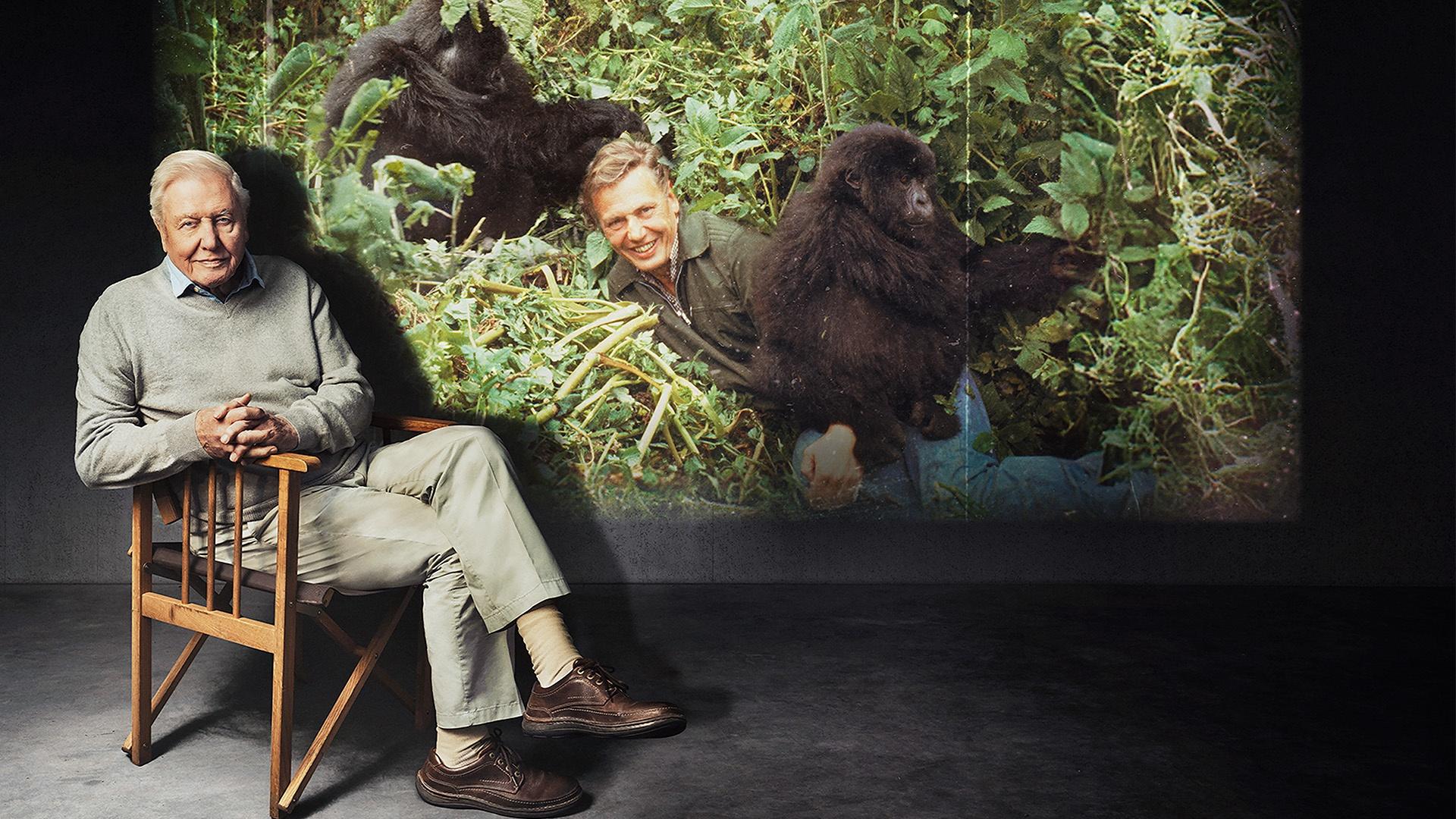
Next thing we know is that her two youngsters come out and actually sit on him.
♪ There was a moment when you could barely only saw the top of David's head, literally, and my jaw dropped.
I mean, everyone's jaw dropped, didn't expect this at all.
♪ Attenborough, voice-over: I honestly don't know how long it was.
I suspect it was about 10 minutes or even quarter of an hour.
I was simply transported.
I mean, you just didn't account for time.
There's the extraordinary acceptance... [Slide projector clicks] ♪ and I was just about to start talking about the opposition of the thumb and the forefinger when I felt a hand come up on my head, and it was this adult female, and she twisted my head so she could look straight in my eyes and looked inside my mouth and put a finger in my mouth, and then made this belch vocalization, so I did my best to respond.
And you saw her look into one of his eye and then into his other one, and I thought, "My God, his head's going to come off, and we haven't finished the series yet," which was a very uncharitable thing to think.
And I left, crawled back through the undergrowth, and I said, "That was one "of the most extraordinary moments of my life.
Wasn't it wonderful?"
He said, "Well, we got a got a bit.
I said, "Only a bit?"
He said, "Well, yes, because I was waiting for you.
"I didn't want to run out of film "when you're in the middle of explaining about the thumb and the forefinger."
♪ Extraordinary, really.
I mean, it was one of the most privileged moments of my life, really.
♪ Once we'd finished our filming with the gorillas, we headed to the airport with the precious film cans, but we suddenly found ourselves in a very dangerous situation.
We ran into a bit of trouble when we came off.
When we got onto our vehicles to take us to Bisoke, we saw quite a lot of army people out on the road while we were driving, and at some point, suddenly there was the crack of rifles... [Gunshots] turned round and find that actually these soldiers were sort of probably firing over our heads.
"Oh," I said, "What's happening?"
and we turned round the corner, and there was an armed guard.
Sparks: The next roadblock we came up against, we had to stop.
♪ This chap said, basically, you know, "You're going to be taken into custody," you know, "We want to see what you've been filming."
So we were held up and then taken to the local police headquarters and interrogated as to what we'd been doing and whether we'd got permission.
We'd got all the permissions that were needed, so it was absolutely OK.
Martin Saunders, the cameraman, was realizing what was happening and realizing too that there was a danger that the film that we had shot-- with which, of course, we were absolutely thrilled to death about-- was going to be confiscated, so he changed the labels on the film cans.
According to the label, they would think they'd got the film that we'd shot, and, in fact, it was just unused film.
Sparks: We were then put in a hotel overnight and basically under kind of hotel arrest, so in the morning, David and I were singled out with the equipment, and we were taken to this army compound in the middle of Kigali, and David and I were told to stand in the middle of this compound in the sun.
We weren't even allowed, I don't think, to go into the shade, and I thought, "Well, I don't know if you can put us up against the wall "and shoot us or something.
I don't know what this--" and at this stage, you couldn't understand what the problem was.
Finally, we were taken into an office.
There was this-- whoever the boss was, the commander, I suppose, and he then sat back and said, "OK.
You're free to go."
Anyway, we got into the aircraft, got all the gear on board, and our little plane took off, and as I saw the runway of Kigali disappear into the distance, heaved a sigh of relief, so...whew.
Ha ha!
♪ Attenborough voice-over: When "Life on Earth" was finally broadcast after 4 years in the making, we had little idea of what the audience would make of it.
♪ Young Attenborough: A new series tracing the story of life on Earth from its very beginnings to the arrival of man.
It's a story that spans over 3,500 million years, the most ambitious project of its kind ever undertaken for television.
♪ Wales, voice-over: When program one went out, I remember coming in the next morning, and we realized that, from what we were hearing, it had been an outstanding success, I mean, beyond our wildest expectations.
♪ Attenborough: We were very gratified.
It did attract a very big audience, and the audience clearly felt that this was something out of the ordinary.
♪ You had a wonderful feeling that when you saw those programs, everybody in the country who had color television sets would be doing it, as well.
♪ One of the most remarkable television series ever produced, the story of "Life on Earth," written and presented by David Attenborough.
[Applause] ♪ Well, like millions of other viewers, I myself have been glued to the television every Tuesday night for the past few weeks to watch Your marvelous "Life on Earth" series.
Ladies and gentlemen, I'd like you to meet the man who made it all possible-- Mr.
David Attenborough.
Thank you.
[Applause] [Clears throat] Well--as you probably heard me say in my announcement, David-- I'd like to thank you on behalf of everybody for this marvelous series of programs.
They've been so beautiful.
Did you enjoy them as much as we did, making them, I mean, you know?
As a matter of fact, I think I did.
Oh, wonderful.
David Attenborough.
[Cheering and applause] Thank you very much, indeed.
I don't think I've received such a nice compliment since I was sat on by a mountain gorilla.
[Laughter] Jackson, voice-over: We had messages to say that pubs were quieter than they normally were because people were staying at home to watch it, sometimes twice a week.
♪ Jackman, voice-over: "Life on Earth" was just an absolute revelation.
It was an eye-opening experience.
♪ People were learning things they couldn't have even imagined, and you have to remember, at that time, the late seventies, that people just had not seen anything like this.
Salisbury, voice-over: I think "Life on Earth" really gave a big boost to conservation efforts.
I mean, it started, for instance, the very big gorilla conservation because of David's sequence with the gorillas, which became, you know, world-famous.
♪ Attenborough, voice-over: When we came to say good-bye, I promised Dian that I would do what I could to get funds to support her and what she was doing.
♪ His sole object in life at the moment is to make quite sure that he and he alone mates with every single one of them, and to that, he must fight.
There!
The blue whale is 100 feet long.
Attenborough voice-over: This little chap was born blind.
Ee mm ee.
Ah-oh.
Attenborough: Enchanting creature.
♪ Ha ha ha!
Wales, voice-over: It was a total privilege to work with David.
He's great fun.
He's got a great sense of humor.
The volcanoes of today a mere feeble flicker of-- Stupid.
Ha ha ha!
Man: 66, take 3, and board.
Well, it was, you know, absolutely and utterly life-changing and life-affirming, actually.
I've always likened it-- it was like being a surfer, and you caught a wave, and that wave just didn't stop for 30 years.
It just kept on rolling, and it was, uh-- ♪ Yeah.
♪ Attenborough, voice-over: Natural history television has produced an understanding in the audience about the importance of the natural world.
[Elephant trumpets] ♪ If an understanding of the part that humanity plays in the way the world operates and the way in which we are totally dependent upon the natural world for every breath of air we take and every mouthful of food that we eat comes from the natural world and that if we damage the natural world, we damage ourselves... ♪ and I think television can claim to have played the part in spreading that kind of awareness.
♪ I mean, what a fantastic privilege.
♪ I dream about it.
I mean, it was a breathtaking experience that anybody could possibly want who was interested in the natural world.
♪ ♪ ♪
Search Episodes

Donate to sign up. Activate and sign in to Passport. It's that easy to help PBS Wisconsin serve your community through media that educates, inspires, and entertains.
Make your membership gift today
Only for new users: Activate Passport using your code or email address
Already a member?
Look up my account
Need some help? Go to FAQ or visit PBS Passport Help
Need help accessing PBS Wisconsin anywhere?

Online Access | Platform & Device Access | Cable or Satellite Access | Over-The-Air Access
Visit Access Guide
Need help accessing PBS Wisconsin anywhere?
Visit Our
Live TV Access Guide
Online AccessPlatform & Device Access
Cable or Satellite Access
Over-The-Air Access
Visit Access Guide




Follow Us