Lavanyaa Surendar
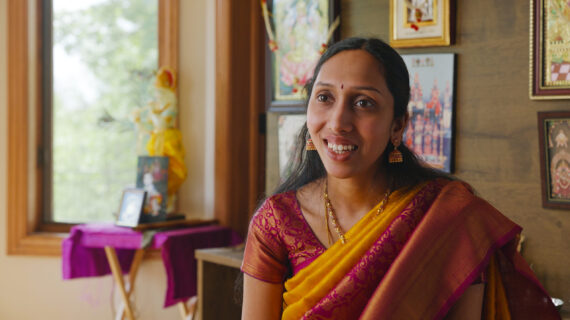
[instrumental music] [humming] Lavanyaa: I think music is a companion to many of us across the globe, and everyone can relate to music.
We listen to music when we are happy.
We listen to music when we are sad.
Music is used to enhance what we are trying to communicate.
[instrumental music and humming] I started learning music because I understood that dance and music and poems are inseparable.
And then, I was able to realize that music actually enhanced my communication.
I was able to emote better on stage when I was able to connect the movement with the music that I practiced.
I instruct Indian classical dance and Indian classical music.
I started learning dance, when I was two-and-a-half years old, from my grandmother and from my mom.
And I started learning music, probably, when I was five- to six-year-old I grew up back in India and I was born into a family of artists, so most of the time I was back in the green room, listening to the concerts and watching the dance festivals.
And it’s– it was more like an epiphany for me when I saw everything come together.
When I saw that there was a live orchestra accompanying the dancer, the dancer was able to convey what he or she wanted to communicate.
It was like a magic which was happening.
Bhaja Viswanatham Viswam Bharam So, Carnatic music, literature says that Carnatic music originated way back.
This can be 2,000, 5,000 years back.
All the stories in the Indian mythology, including Ramayana and Mahabharata, which are the magnum opus of our literature, through Carnatic music, the stories are conveyed in a way that is interesting, and that is relatable by people of all ages.
And from those stories, the poets have started writing their own composition, praising the deity or the Lord of their choice, and they communicate via music.
And that is why it is best used with dance, as well, because the dance form, Bharatanatyam, that I practice, is storytelling, and only the music gives life to that storytelling.
So, for Carnatic music, the musicians are accompanied by a percussion instrument for the rhythm, [drumming] and they’re also accompanied by wind or a string instrument.
[playing string instrument] [plucking string instrument] So, this wind or the string instrument mimics the voice of the person who is rendering the music.
The raga and the tala goes hand-in-hand when you’re singing.
The tala is the rhythm, and the raga is the melody.
There is a lot of mentioning in the Indian classical text that one particular raga can be associated with raining.
One particular raga can be associated with being happy.
One particular raga associates itself with being sorrow.
Being a dancer, you are able to actually bring out the rasa inside the raga, which is the emotion of the raga.
So when you sing, of course, you use your voice to bring out the essence of the raga, but when you dance, you use your facial expressions more and you use more hand gestures and bringing out and you use movements.
So, everything is put together and it is an easier way to understand what the composition communicates.
I think the most important experience that I’ve got from my culture is the rich literature and the values which are embedded in the literature and how our ancestors have formulated the literature in order to better lead a happy life.
When kids start learning about different music, they are directly and indirectly learning about different culture and they learn to accept those culture and you can create a diverse and an inclusive community using music as a tool.


 Passport













Follow Us