








PBS Wisconsin Passport
Watch this video with
PBS Wisconsin Passport
Become a member of PBS Wisconsin, support your local community, and get extended access to PBS shows, films, and specials, like this one.


Cuban Connections
-Funding for "Kevin Belton's New Orleans Kitchen" was provided in part by the L.E. Phillips Family Foundation, Inc. and by the St. Tammany Parish Tourist Commission.
Located 40 minutes from New Orleans, the Northshore's Tammany Taste features the chefs and farmers, brewers and bakers of St. Tammany Parish's culinary scene. Learn more at louisiananorthshore.com. Additional funding was provided by Welbilt -- bringing innovation to the table.
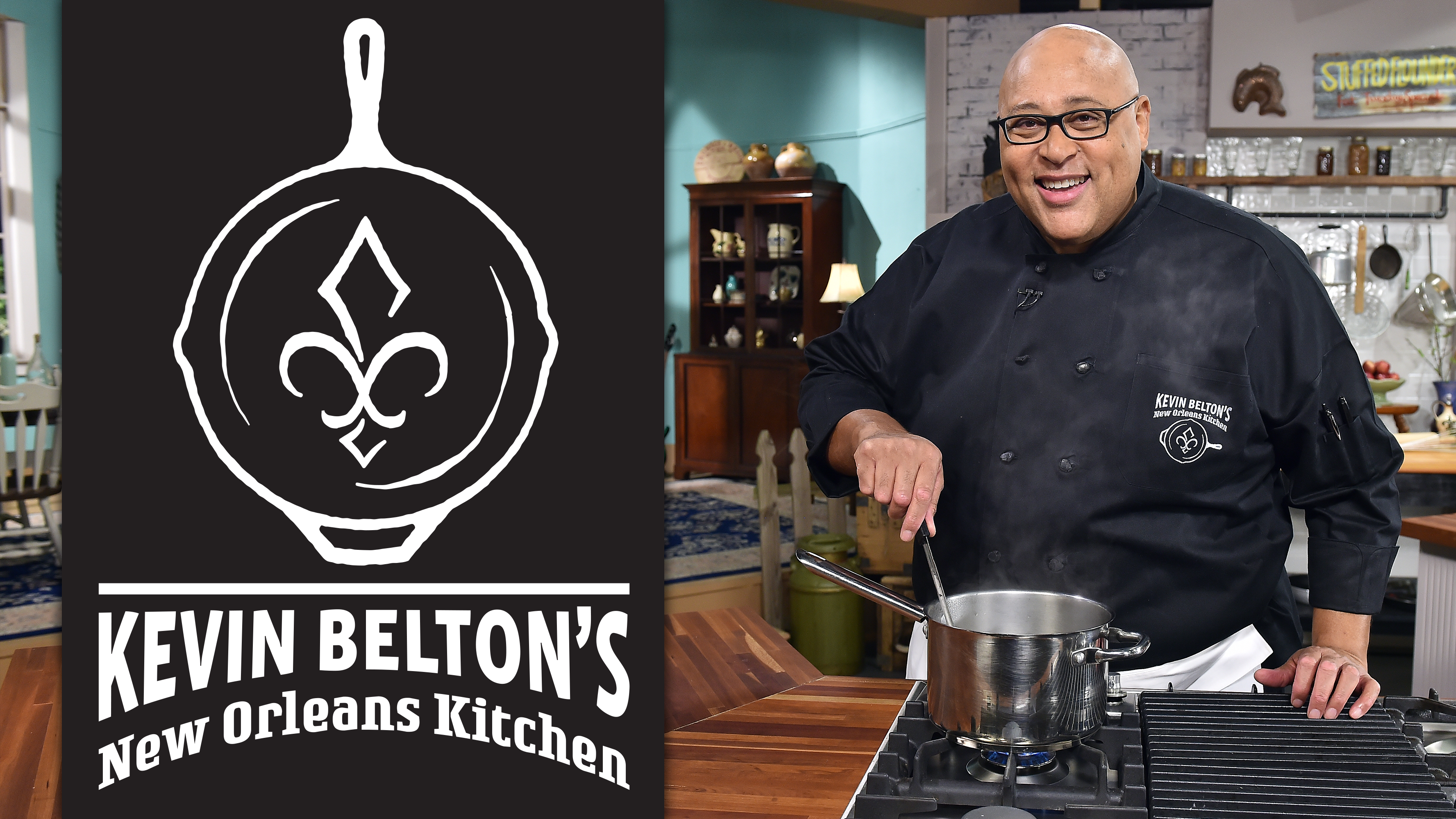
-Hi! I'm Kevin Belton, and today in my New Orleans kitchen, we're going to visit Cuba. My sons' grandmother was born in Cuba, and I want to show you some of the dishes she taught me. We're going to start with a roast pork with plantains.
And you know, in New Orleans, we love rice, so we're going to make a paella. And we're going to finish off with some of my sons' favorite dessert, a nice flan. So let me put you in touch with your Cuban roots.
Smooches
Zing! Whip! Whip! Whip! Sloop!
Gong sounds
iBuenas! Cmo tu ests? Hi. Welcome to my New Orleans kitchen.
Today, we're going to start with a nice pork roast with plantains. Now, my sons were Cuban, and my mother-in-law got to live with me for a while, so there's a sauce we're going to make for our roast called mojo. Now a lot of folks see it as "mo-jo," but it's actually pronounced "mo-ho." So in here, we have a little olive oil. We're going to put in cilantro.
You know, New Orleans is literally an island except for about 5 miles, a 5-mile strip of land. The Cuban influence into our cooking and the island influence, just in most cooking in New Orleans, go hand in hand. A little bit of orange zest, a little touch of orange juice, a little bit of lime juice. We're going to keep going.
Now, one of the things about Cuban cooking, a lot of garlic. A lot of garlic, similar to Louisiana cooking. So I have about eight to ten cloves. So now we have some oregano, and notice, just pulled right off the plant, just kind of rough.
A little cumin. If you've never used cumin, cumin adds such a wonderful flavor. I suggest trying it on maybe a little chicken, just sprinkle it on. And some fresh mint leaves.
You know, mojo is a sauce. It's a flavor. What we're using this for, this is going to be our marinade for our roast. So let's just turn it on, get it chopped on medium.
That's all we want. Basically, what this is going to turn into, this is going to turn into a nice marinade for us. We'll put our roast in a plastic bag. We'll pour this marinade on.
I like to always do it at night so the roast gets to marinate overnight. Now, of course, you know me. I've already had a roast, and I've marinated it already. See how it looks, all of that goodness in there?
So let's take our bag, get it open, and just... It's easy if you just pour it right into a bowl. There we go. Let all of that goodness just drip down in there.
I just have a roasting pan here. We're going to take the roast and just pop it right onto our pan. Now, we're going to cover this loosely, and when we cover our roast, we just want to make, like, a little tent. We don't have to wrap it down on there tight.
That little juice and the olive oil is going to help steam, but this is going to roast this off. Now, we want to place this in our oven. 325 degrees, we're going to leave it in there for 2, 2 1/2 hours. So let's get this all cleaned up and straightened up, and now we'll make our mojo sauce.
Now, I've taken our roast out of the oven, and you can see how gorgeous this is, and you can see, over baking, how it shrinks a little bit because now the bone is exposed. So I poured off all of the drippings that was here on the roast. I've put it in a bowl. Now, we're going to take about 3 tablespoons of our dripping...
Oh, okay, I like a little more. Okay. We'll get this right into our skillet, where now we'll go with lime juice, a little orange juice. Remember, we saved some of our marinade.
We're going to pour in a little bit of our marinade......and we just want this to reduce down. Now, always remember, that meat was raw in that marinade. Never take a marinade and just pour it right back on top of your meat. It has to cook.
So while this is cooking down, now we can go ahead and fry our plantains. If, in the grocery store, you have seen these plantains... Now, some are very, very dark yellow and brown, and you're like, "What in the world is that?" Or some are very green. Basically, plantains that are brown have a lot of sugar in them.
Those are sweet. So if you ever go out and eat Spanish cuisine, and they have those sweet plantains, those are the ones that are very dark. Here, the green ones are very hard. Now, let me show you.
I want to just cut the ends off. And when they're green like this, they're very, very starchy. So we're just going to cut this in about an inch and a half segments. And, you know, take a small knife.
The peel can be a little hard because, remember, they're very, very green. But if you make a little split, now it just kind of unwraps and unfolds. Takes a little work, but I tell you what, it is worth it. The green ones are very, very starchy, and that's what we want for this.
And this is going to fry twice. You know, the first time I watched my boys' grandmother make this, I'm like, "Wow! I've never seen those used before. I've always seen them in the grocery store, but I never saw them used." Look how firm they are because there is a lot of starch in them, okay?
All right. That one came out, too. So our oil is heating up, so let's just take our plantains, drop them into the oil. Now, you can see they don't take that long because they're already starting to brown off.
But by frying them this first time, it softens them up, and that's what we want to do. Now our plantains are ready to take out. Just have some paper towels. Take them out, just set them on the paper towels.
And you notice, if you've watched me before, whenever I fry something and I take it out, I always put a little seasoning on it. But this time, we're going to do it just a little bit different. But if you take a brown paper bag, just take a knife, just split it open. It doesn't have to be pretty.
Oh! Sometimes it works easier that way. Make sure your knife is out of the way. We're going to take our plantain, set it there, put the paper bag over the top of it...
mash! Look at that. Look how that just flattened out and then just goes right into the oil. I always wondered how it got that little round shape on the top, and now I know.
And they cook nice and crispy by mashing them, but that little bit of frying time just softens them up enough for you to be able to do this. Oh. And by the time you get the last one done, the first ones that you put in are ready to come out. You can see the first ones we put in are nice and golden brown.
Give them a little turn just to make sure they cook evenly on both sides. Oh, my. They look so good. So now let's take them out.
We're going to put them back on our paper towels just to drain. And, you know, the thinner you mash them, the crispier they'll get. Or if you take the plantain and slice it fairly thin and then mash them, you can make plantain chips. So, of course, this is the point where we're going to get our salt.
Now we're going to put a little salt just on top of each one. Oh, this is so good. Look, our sauce is reduced. We're going to take our roast, put the roast right onto the platter.
Let's just move this out of the way. That's cooled off. Now let's take our sauce, our mojo... and just spoon right over the top.
Just put that right over the top. My sons' grandmother, when she would serve this, she would get a little extra bowl and put your little extra mojo sauce right on the side of your plate. We can put our plantains here. Just leave that there.
And once this was plated, that's when you hear those lovely words, "iVamonos! Ven aqu," meaning, "Come on. Let's go! It's time to eat!" So here we have our roasted pork with mojo and fried plantains.
Coming up next, paella. You know, if you've gone out to eat and you've seen this dish called paella, what is paella? Well, it's actually pronounced "pie-ay-ah," and I'm going to show you how to make it. If you've seen these wonderful, great-looking pans, this is an actual paella pan.
So I want this to heat up a little bit. Now, I've put a little olive oil in our pan, just about a quarter cup, and, you know, let's get in some onion. Into this, a little fresh garlic, a couple of tablespoons. We're going to do a little bit of green bell pepper.
So, into this, a little andouille sausage. You know, of course, we have to put our little New Orleans touch to recipes, and that's why I'm using a little bit of andouille. I also have taken some chicken, and I've just cubed it. We're going to get our cubed chicken in, and we're actually going to put our rice in now.
This is something that's a little bit different because we're using an arborio rice. You know, in New Orleans, we use a lot of long-grain rice. Aw, baby. Look at that.
Now, let's start seasoning. So in here, we're going to do a little salt. And we're going to get some salt coming out of that andouille. You know, often, folks just use salt and pepper, but I want to put a little bit of our Creole seasoning in that.
So I have some stock, and we're going to go in and start adding a little stock to this now that we're starting to get these little goodies stuck to the bottom of the pan. The other thing I want to go in besides with stock, a little bit of white wine. That white wine adds a wonderful flavor, and we're going to start at about 3 cups of stock into this. You know, I know many of you all have cooked, maybe, risotto.
Risotto is one of those dishes where, as the rice cooks, you keep adding a little more liquid to it until that rice gets totally cooked. This is very similar to that because we're going to keep adding a little more stock as we need it to get our rice cooked, similar to a risotto. So we have some fresh thyme. I just like to take it, sprinkle it all over.
Here is what gives this color. When you see a paella recipe, you're going to hear about saffron. Saffron gives color to this dish. Saffron can also be very expensive, so if you don't have saffron, if you don't feel like using saffron or you can't find it, that's okay.
Use a little turmeric. Turmeric will do that same thing. It'll give it a nice color. See how that's changing colors?
See how we're getting a deep yellow, a deep orange? Now, we want to bring this to a boil, and our rice will slowly cook. Look how our stock has come up, and it's bubbling all around our rice and ingredients. Now, a lot of times, recipes call for haricot verts, which are small green beans.
But you know the Cuban touch did it with peas. So we're going to get in a little bit of fresh peas in this. This is something that my sons' grandmother showed me how to make, and it was just -- It was always so pretty and colorful. We'll get in some tomatoes.
Let's just get our tomatoes in, and you just want to spread those around, but look at these colors. The other thing we're going to put in here are shrimp. Now, you know, shrimp don't take long to cook. The whole idea is for our rice to cook and absorb these flavors.
I've removed the shell from the shrimp and left the head and the tail on. We're going to put our shrimp in, and we can put one more right here. Now what we want to do with this is we want to put a little foil over this. While our rice finishes cooking, our shrimp are just going to re-steam from that heat and get warm.
So I've turned this down really low, so let's cover it to keep this steam in, and as soon as our shrimp get pink, this is going to be ready to serve. It's time to open up and make sure our shrimp are cooked and everything is ready to go. All beautiful. Oh!
See how our shrimp are nice and pink? That's exactly what we want. So now we can just garnish with a few lemon slices. You can do a little bit of lemon or a lot of lemon.
We're also going to take our parsley and sprinkle a little parsley just all over. If you want a little cilantro, that's fine. But here we have... Oh, man!
Cuban-style paella! Coming up next, flan. Maybe you've seen this on menus when you've gone out to eat, but I tell you what, this is a dish that is absolutely fantastic. It's flan.
So I have about a tablespoon of water. I've had our pan heating up, and to this, I'm going to put in a cup of sugar. Basically, we're making a caramelization. We want our sugar to cook so this will caramelize, and that caramel is going to go into the bottom of our pan.
If you notice, I have our pie pan sitting in a larger pan. Basically, we want to cook this in a water bath. A custard. That's what a flan is, is basically custard.
So when this custard is against the side of the pan, if we just set this in the oven, the pan could get hot, and our custard would burn. So we want to make what we call a bain-marie, or a water bath. So I've got some water boiling. I just turned it off.
We're going to put this down into our pan, about an inch. And now place your pan that the flan is going to go to in the water. This is that bain-marie, that water bath, and that allows the custard to cook but not burn against the side of the pan. So, as you look at our sugar, here we're up to temperature, it's starting to melt, and you get that little sizzle, and you're going to notice where, as it melts, it starts to turn brown.
Basically, that's all we're doing is making caramel. Now, this is also something that you can't run away from. You can't leave this when it's going on. While this is cooking, this is something that you really shouldn't leave.
You know, I want to start putting our flan together, but at the same time, I don't want to burn our sugar, because once this burns, we're going to have to start all over again. And can you see how it's starting to brown off? It's starting to liquefy more. And I'm just taking my spoon, and, you know, I'm using a wooden spoon because we do a lot of stirring.
But you will start to see the color change. Once it changes, it changes fairly rapidly. How dark do you want it? How far do you go with your sugar?
Okay. Some people like it really dark. Some people just like it barely caramelized. I like it to go to a nice, dark color.
But look how beautiful that has changed colors. We have turned it into liquid. And now let's turn off our fire. See, this can sit for just a little bit, and off the fire, it'll get a little darker.
Yeah, it gets a little smoky. It gets a little smoky, but that's okay. It's not burning. So now let's take this, and we're going to pour this into the bottom of our pan that our flan is going to go into.
So just take it off the fire, give it a little stir, and just pour that right on in. Look at that nice, dark color. And you can just spread it out. All right.
And, of course, as this sits and cools, it will harden, but that's all right. Because while this is sitting cooling a little bit -- And by the time we pour our custard in, it's going to harden just a bit, but not too much. So now let's take care of the custard that's going to go on top of this. In our bowl, I have some eggs, and we're just going to take our eggs, give them a crack.
I have never seen my son, Kevin, go after desserts like he does after flan. You know, when we would go out to eat dinner, he based his entre on the dessert. Often, he'd look at the dessert menu, he'd ask them for the dessert menu, and as a kid, you know, the waiters would look at me and going, "You want me to give him the dessert menu?" But that's what he based his entre on. A little vanilla.
We'll get our vanilla worked in, and now we have our milk. We're using condensed milk, which is very sweet, and we're using evaporated milk. So let's get our evaporated milk in. See, custard.
That's what we're dealing with, custard. Let's get in our condensed milk, which you know has sugar in it. So this is why we don't have to add any additional sugar to this, because we're using a condensed milk that is already sweet. As a kid, this was my favorite part.
I loved it when mother or grandmother made something using condensed milk, because that means you got to lick the bowl, you had your spoon, you had that spatula. Oh, lemon ice box pie, all of those dishes that included that condensed milk. Oh, it was so good. But look at this, see?
All we want to do is get this well-mixed. So now we'll take this -- Here, fit it right in. We'll take this and pour this into our pan over our caramel. And just slowly pour it in.
As you can see, that has hardened. It didn't move at all when we put it in. that sugar hardened. We have our water bath around it, so now we need to put this in the oven, and, of course, I have my oven preheating at 325 degrees.
So this is where you're careful. Take the time to make sure you get your oven door open first because we're going to be carrying this pan with hot water in it. But just slow and steady. Slow and steady, and I am trying not to splash any of this in.
Come on, baby! You can get in there. Ahh! Ha ha ha ha!
Yes! Success. 325 degrees for 50 minutes. That's what we need.
But you know what? Because I knew you would be hungry, I prepared one earlier. I've taken it out, tossed it over. Look at that brown top with that creamy side from the brown sugar on the top.
Now, I have to tell you, once Kevin first tasted this flan, whenever his grandmother made one, Kevin would take the flan, split it in half, then he'd give the other half to his brother. So my sons love their grandmother's flan, and I hope you try it. So here we have our wonderful flan. My sons, Kevin and Jonathan, their favorite dessert made by their grandmother.
You know, I really appreciate you spending your time with me. I'm Kevin Belton, and remember, the most important place in the house is sharing your table with your family and friends. So I'll see you next time! -The companion cookbook to "Kevin Belton's New Orleans Kitchen" is available for $24.99 plus $6 shipping and handling.
You can also order an hour-long DVD of favorite dishes from the series for $19.95 plus $4 shipping and handling. Both the book and favorites DVD are available for $40.95 plus $7 shipping and handling. To order these items, call 1-866-360-4924 or order online at wyes.org. - You're once You're twice You're everything I need You're the dough that I want to make You're the sun, my moon You're my thick cookie You taste so wonderful I'm not going to share with the crew Because the heat expands, then the cool -- They shrink up.
Picture when we jump into a pool of cold water, how we "Whoo!" All right? That -- Yeah. Br-r-r-r! That's what this shrimp just did.
The shrimp went "Br-r-r-r!" We can not rush a good thing. Do you think I was made instantly? No. I was made over 5 years it took to make and put me together.
Yes. -For more information about "Kevin Belton's New Orleans Kitchen," visit wyes.org. Funding for "Kevin Belton's New Orleans Kitchen" was provided in part by the L.E. Philips Family Foundation, Inc.
and by the St. Tammany Parish Tourist Commission. A short drive from New Orleans, the Northshore offers epicurean experiences, as well as kayaking, cycling, and tours of the Honey Island Swamp. Learn more about the Tammany Taste at lousinananorthshore.com.
Additional funding was provided by Welbilt -- bringing innovation to the table.
Search Episodes

Donate to sign up. Activate and sign in to Passport. It's that easy to help PBS Wisconsin serve your community through media that educates, inspires, and entertains.
Make your membership gift today
Only for new users: Activate Passport using your code or email address
Already a member?
Look up my account
Need some help? Go to FAQ or visit PBS Passport Help
Need help accessing PBS Wisconsin anywhere?

Online Access | Platform & Device Access | Cable or Satellite Access | Over-The-Air Access
Visit Access Guide
Need help accessing PBS Wisconsin anywhere?
Visit Our
Live TV Access Guide
Online AccessPlatform & Device Access
Cable or Satellite Access
Over-The-Air Access
Visit Access Guide




Follow Us