

 Passport







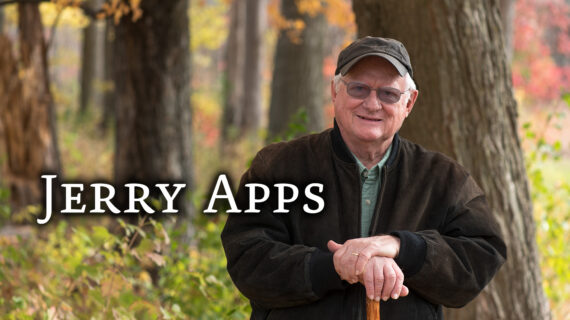
Jerry Apps: Never Curse the Rain
heavy rain and thunder
soothing piano melody
I was probably, I don't know, three or four years old. It was a rainy day, and I wanted to do something else. I don't know what I wanted to do. As a little kid, I had all kinds of projects I wanted to work on, and most of them were outside. I was always an outside kid. And it began to rain. And I was-- Well, I probably did use one of the few cuss words that I knew at the time in saying to my dad that it was raining and everything that I'd planned was now, I couldn't do it. And he looked me right in the eye, and with a very serious look, no smile, "Never curse the rain, Jerry." And I've never forgotten that because I knew later what he meant because our farm was sandy. We never had enough rain. And for the crops to amount to anything, every drop of water that fell on our land was precious. And I grew up seeing water not just as something that helped our crops grow, which it surely did, but something that had to be respected and indeed to see it as something sacred. It is something we've got to cherish. Our very lives depend on water. I am trying my darnedest to help people, through my stories, realize that there's another way of thinking about our relationship to water. And not everybody has had that opportunity that I've had to grow up at a time and a place where water was not in abundance. So water has meant a lot to me. It's been a part of my life all along. I don't do much fishing anymore. I used to do a lot of it, both in summer and in winter. I did a lot of swimming, and I enjoyed it. It's a way to teach my kids something about the relationship of water to nature and the appreciation of it. It's been integral all along. Never curse the rain.
Jerry Apps
Never Curse the Rain
was funded in part by
Greg and Carol Griffin, Ron and Colleen Weyers, Stanley J. Cottrill Fund, Joel and Carol Gainer, Wisconsin History Fund, with support from the National Endowment for the Humanities, and Friends of Wisconsin Public Television.
icy water currents
uplifting piano music
was funded in part by
It was the 31st day of January in 1938, the day after we'd had a considerable sized blizzard that had blocked all the roads. The temperature had dipped down to about 15 below zero. And I was three-and-a-half years old. I didn't know what the heck was going on. I thought my mother maybe gained a little weight. I didn't have this figured out. And lo and behold, my dad hitched the team to the sleigh and headed for the schoolhouse a mile from our farm. And they had called Dr. Beck from Wautoma, who was going to meet him at the school because the road past the school had been plowed. He picked up Dr. Beck, driving across the fields, because you couldn't drive on the road. It was just a mess. And they arrived at the house. Sometime during the night all of this happened. I came downstairs in the morning, and there the stove was red-hot. You could see the cherry red stove. And I came downstairs and there were these two naked babies on the dining room table. Where did they come from and why are they here, was the question I asked. I did not get a decent answer. And so my twin brothers, there they were, Donald and Darrel. Donald was the older one; Darrel was the younger one. Donald was pretty frail. He was a skinny little guy. Well, as the months went along, the doctor was not too sure he was going to live. And my mother was concerned about the fact that none of us were baptized. But Reverend Vevle agreed to come out to the farm on a Wednesday evening in July. They were born in January. Donald was not doing well. And the preacher said, "Get some water from the water pail." And I'm looking at that. What's special about the water pail water? Pours it in a little pan and adds a little warm water, and then he proceeds to baptize my brother, Donald. He says, "In the name of the Father." What father is he talking about, for Heaven's sake? And then he said, "The Holy Ghost." Geez, I don't know anything about ghosts. The only ghosts I know about are at Halloween time. What is going on here? Dribbling a little water on my brother and saying these mysterious things? And at four, I was skeptical of everything. I mean, what little kid isn't? And this stuff made no sense to me whatever. And he said, "Well, what about this other one?" That's Darrel. "Well, do him too." And then he said, "What about Jerry over there? Is he baptized?" "No." "We better do him too." Well, gee whiz. Now, I got the full treatment. They took me over, they just dumped water, almost dumped on my head. It wasn't a sprinkle. It was the full treatment. I'm still curious at this moment about this Father, Son, and Holy Ghost business. I mean, what is happening to me? And then the pastor said, "You realize, of course, that this is holy water?" It seemed like regular water to me, but now we were baptized, and we were all set. And the preacher ended it all by saying, "You are now children of God." I thought, well, good for us. I didn't realize that that was a big deal because I didn't feel any different than a little while ago except now my head seemed a little cleaner.
laughter
was funded in part by
Our pump was powered by a windmill. And all of the water used in the house was provided by the windmill and my two brothers and I, as one of our daily chores was to carry water into the house. And the water pail sat by the sink. And that water pail was the source of all of the water for cooking, for washing, for tooth brushing, everything. And just one-- Well, I don't know how many pails of water we would carry in a day, but not many. It was really kind of interesting. But two times of the week when we had a bath on Saturday night, we had to carry in more water, of course, to fill the washtub. And that was... well, we put up with that because we knew we were going to town afterward, and going to town once a week was a big deal. The other time when we carried way too much water, in our estimation, was on wash day when we had to fill up the old washing machine and the wash tubs and all of that. And the third time, which was, well, we knew it was going to happen about every July when Mabel and George Rancord would come out from Chicago in their big ol' Dodge car, and they would stay with us for two weeks. Why? I have never figured out. We had no electricity, no indoor plumbing, nothing. And George was a very nice guy. He didn't do anything. Sat under a tree most of the time, looking out over the pasture. I guess he just liked to watch the cows in the pasture. Mabel, however, figured she had to help with the cooking, and her idea of cooking was everything had to be scrubbed, and there had to be water in everything. And she, as soon as she arrived, one of the first things she would say was, "Jerry, could you fetch me a pail of water?" Sure. Carry in the water. And 10 minutes later-- 10 minutes later! Maybe 15. "Could you fetch me another?" What happened to the first pail of water, for Heaven's sake? I wanted to ask. I never did. Carry in that next pail of water. And pretty soon Jerry came up missing. Jerry found other things to do when Mabel was around. And my two younger brothers, they were still around. "Donald, could you get a pail?" "Well, yes, of course." And then Donald came up missing, and then it was Darrel's turn, and then he came up missing. And Mabel said, "Where are those boys? We need water." And so, "Herman, could you get a pail of water for me?" That's my dad. And Pa would not be too happy about that because not only we're carrying a lot of water, we were using a lot of water. And he wanted the water for the cattle. He didn't want it in the house. To carry in a pail of water every 15, 20 minutes, half an hour was not only unbelievable, it was almost obscene. My dad would roll his eyes. "What is wrong with this woman?" She could not believe that my mother could get by with so little water. And she did not appreciate, nor understand how precious water was to us and how every drop of it had to come from our well. And in those days, before we had electricity, every drop of water depended on the wind turning the windmill. So my dad was very, very careful about the water that he used. Back in the '30s, we had not only a Great Depression, but we had severe drought in several parts of the United States. The Dust Bowl just raised havoc. The wind would blow day after day, and the fine talcum-like dust from the soil would filter into the house. And it was very, very dry, obviously, with no rain. But as long as the wind blew, the windmill turned. And even though the cows had little to eat, the pastures were drying up, the hay crop was meager, we were getting by, just. And then one day, the wind quit blowing, and the windmill quit turning. And the most pitiful sound in the world is the sound of cattle that are thirsty. They would bellow all night long. I could hear them in my bedroom. And my dad would spend each afternoon looking to the western sky to see if there was any sign of a storm coming, any sign that the wind might start blowing again, but the wind did not blow. We were desperate. We've had 12 - 14 cattle, a team of horses, and Pa was more concerned about the livestock than he was about his family, but we hadn't anything to drink either. And one of our neighbors, Alan Davis was his name, he lived a half a mile, maybe a mile to the north of us, Pa knew that he had a gasoline engine because he lived down in the hollow and the windmill wouldn't work there very well. And so we loaded up a bunch of milk cans, 10-gallon milk cans, put them on a wagon, team of horses, drove down to Alan's farm, filled these cans with water, brought them back, dumped them into the stock tank, and now we've got the cattle and the horses all running into each other, fighting to get a drink of water. It was a terrible time. And we saved enough, a pail of water for the house, so we could have a drink of water and my mother could do some cooking with water. And Pa was just troubled beyond belief that we had to depend on the neighbor. It was about the next day, in the middle of the night, I heard the wind come up. And generally we're not pleased when the wind is blowing because it was blowing dust all the time. But this time I knew what was happening because the wind came up and then you could hear this windmill. It squeaked and squawked, and then it began turning. And I knew the pump was working then. And I knew that Pa would be a lot happier, as was my mother, when I came downstairs in the morning. Everybody was smiling because the stock tank was full, and the windmill, of course, had been turning. But Pa was concerned that another day the wind would stop. And he looked in the farm newspapers for ads. And so he bought a Monitor gasoline engine built specifically to replace a windmill. It looked just like a bunch of cast iron. Hooked this thing up. Took a half a day to get it hooked up. Kaboom the machine went. And then kaboom, a-sheesh, a-sheesh, a-sheesh. Kaboom, a-sheesh, a-sheesh. And the pump rod had been going up and down, and the water began running. Kaboom, a-sheesh, a-sheesh. Everything shook and I thought things were going to fly apart, but now we had water. Dependable water. And we used that Monitor engine until we got electricity, which was a number of years later. The first people that moved into the area would make sure they were by a stream or a lake because life depends on water, and farmers, if you're going to be a successful farmer, water was absolutely critical. Water was precious then. It's precious still today.
running stream
running stream
was funded in part by
Back in the 1940s, when we were in the midst of World War II, and I was, oh, eight, nine years old, the crops by July were drying up. The pastures were slim. They oat crop was not much of anything. The corn was withered. Every afternoon when the chores were done, my pa and I, we'd stand out by the barn and we'd look to the west to see if the weather had any hope of a rainstorm. And my dad was very good at predicting the weather. By looking at the western sky and the weather vane, the wind direction and the cloud formations, he could predict the weather. Well, this particular afternoon, after evening after evening of not seeing any sign of a storm, he saw something I couldn't see. He said, "See those clouds on the horizon?" I could barely see them. He said, "I think it's going to rain tonight." Came into the house, lit the lamp on the table. It was just getting dark. We're all sitting around. Dad reading the newspaper and my brothers and I fooling around with something or other. About nine o'clock, my mother said, "Well, it's time to go to bed." And so that's when we went to bed, generally. Blew out the lamp. Took my lamp, went up to bed. My little room was on the end of the house. The two windows in the bedroom were open and stifling hot in the bedroom. But I had hoped that pa was right, that it might rain.
thunder
was funded in part by
And it must have been about midnight that I heard this growl, this thunder in the distance. That wonderful sound. When it's dry weather, you listen for the growl of the thunder in the distance.
thunder rumbling
was funded in part by
And then I got up and looked out the window. It had awakened me. And I saw a flash of lightning.
thunder
was funded in part by
And another louder clap of thunder.
thunder
was funded in part by
And the sky was a menacing conglomeration of clouds rolling and tumbling and fighting with each other, which I could see with each flash of lightning.
thunder
was funded in part by
And then Pa called up the stairs. He said, "Boys, wake up. Wake up and come downstairs." He did that maybe once or twice a year because he wanted everybody dressed in case the wind did something to the barn or if there was a terrific hailstorm or lightning struck something. The Wild Rose Fire Department remained in Wild Rose, and if there ever was a fire, and lightning fire was not uncommon, we were on our own. And the worst possible thing that could happen to a farmer in late summer when the barn was full of hay was to have lightning strike it and destroy the winter supply of hay. So he was deathly afraid of fire, and lightning was one form of it, of course. And so we were all in the dining room, watching out the window this storm, this menacing storm. And why in Heaven sake did this storm have to be so mean? Why couldn't it just rain? My mother would ask that question. The storm got closer.
wind
was funded in part by
And a gust of wind came, and it shook the windows a little bit. But it wasn't that severe. And immediately, the temperature dropped probably 20 degrees, at least 10. And there wasn't any hail. But it just dumped.
rain
was funded in part by
The rain came down, and we-- If you ever saw a family happy with an event that was as natural as rain, it was at that time because farmers, if they had nothing else going for them, they always had hope. And the hope, in this instance, was for some rain because it would save the crops, it would save the garden. We would have something to eat during the winter. The cows would have some feed again. And Pa said, "You can go back up to bed now." He looked at his watch. "It's three o'clock. You've got a couple of hours yet before you have to get up." Crawled into bed,
and 5
30 the next morning, it all started over again. What we ordinarily did on a rainy day, we'd crawl up into the barn and listen to the rain drum on the barn roof. Wonderful sound. Never forgotten it. The smell of sweet clover and drying alfalfa. I was afraid pa was going to say, "Let's got hoe the potatoes." It stopped raining, just a little drizzle. But he didn't. He said, "You know, this might be a day to go fishing." He didn't say that very often in the summertime. We fished a lot in the winter, but in the summertime there was work to be done. Always work to be done. So I found the six-tine fork and went out back of the henhouse and dug some worms and put them in a can. Found the 16-foot long cane poles that we had tucked under the corn crib eaves, tied them across the top of the '36 Plymouth, piled in the Plymouth, and drove over to Norwegian Lake. And Pa knew the Andersons, who lived at a farm right by the lake. And they rented boats. The boat rental was a dollar a day. And a day was an hour or 12 hours, whatever you wanted to call it. It was one dollar. And so Pa went in the shed and picked up a pair of oars. We drove on down to the lake, and here were these wood-- These were all wooden boats. They were-- I don't know. Somebody made them, I 'spect. And they were sort of half-sunk in the lake, and we looked around to see one that looked like it would be halfway decent, pulled it out, tipped it over, dumped the water out. All crawled in and we rowed out to where the marl hole was. Many of the lakes had marl bottoms. Marl is calcium carbonate thousands of years old from various seashells that have accumulated there. And it was dug out. Farmers used it to fertilize, to change the acidity level of their fields. So there's a big hole in Norwegian Lake, probably 40 feet deep, and the idea was no anchor was big enough, long enough, the chain, the rope, to drop down 40 feet. So the idea was to row right up to the edge of this marl hole because on a hot day in summer the big bluegills and the big Northerns are down deep where it's cool. And pa knew this lake better than we did. And we're rowing, he's rowing, and we're looking. And we see the bottom disappear. And Pa says, "That's it. "We're over to marl hole. Now we've got to back off just a little bit." And we backed off a little bit. We dropped the anchor. And we started tossing our poles, our bobbers, into this deep hole in the marl hole. And we'd hit it. This was the day to catch fish. Soon the bluegills were biting. I mean, my brother Donald's bobber went under and up came a big bluegill. My dad's bobber went under. Another big bluegill. Mine, Darrel's. Soon the bluegills were accumulating. What we did not pay attention to was that there was water accumulating in the floor of the boat. The thing leaked like a sieve. We didn't realize that. And I said to Pa, I said, "Pa, I think this boat's leaking." And he kind of looked down, and he said, "Yeah, but the fish are biting pretty well. Maybe one of you or both of you..." We had a little pail along. "You could dump some of the water out as it accumulated." And so we're dumping water and catching fish and just continuing to do that for about an hour, but we could not keep ahead of the water that was accumulating, now up to our shoes and covering our shoes. And I said, "Pa, this boat's going to sink." We had no life preservers. There wasn't anything like that. And Pa didn't seem to mind that the boat might sink because the fish were really biting. I mean, we'd had 25, 30, 40 bluegills. And I'm not exaggerating. The bluegills were this big around. I mean, they were just wonderful. But... If the boat sank, well, what difference would it make? And we're quite a ways from shore. We're a good hundred yards, maybe more than that. And we're bailing and still fishing and pa finally says, "I think we probably ought to hang it up for the day. We got enough fish." And now the boat's got, I don't know, probably that much water in it. We just couldn't bail fast enough. We got the boat up to shore. We were there safe and sound. Got home, cleaned the fish. One of the things we had learned
early in all of these adventures
never tell ma any details of what went on because she would have chewed out my dad like you can't imagine. So we're all smirking as we're cleaning these bluegills, and Ma's prepared with the great big ol' cast iron skillet on the wood stove, put in a big hunk of lard and put these fish in there and fry 'em up and crisp. And my dad said, "There's nothing sweeter than bluegills caught in cold water." And we had a wonderful fish dinner and a memory. Are we going back to Norwegian Lake, and, if we do, let's remember the boat that we were in and not select that one again.
fast waterfall
early in all of these adventures
energetic staccato piano melody
early in all of these adventures
In the fall that I turned 12 years old, I was able to get a hunting license. Farm kids were hunting, of course, as soon as they were big enough to handle a rifle, but we couldn't deer hunt. So I'm 12 years old, and my dad and Bill Miller, the neighbor half a mile away, had been going for several years. But now, now, I had the opportunity to go along. Well, there was a 12-gauge double-barrel shotgun that weighed about--
clears throat
early in all of these adventures
Well, it weighed a lot.
laughter
early in all of these adventures
And so I'm to use this-- It was a Blunderbuss. The thing-- I mean, it had a barrel that never quit. You could hardly see the end of it. Well, this is a bit of an exaggeration. We had slugs. Anybody that knows about deer hunting knows that when you deer hunt you don't use fine shot, you use slugs. Well, when that shotgun went off, I mean it, if you were standing up out in the open, it would drive you back two feet. I mean, it was wicked. It was very much like a horse kicking you on the shoulder when the thing went off. So I was a little fearful of this big ol' shotgun. We drive to Adams County. It's a beautiful day in late November. To make the hunt really work, it was good to have somebody walking through the woods to scare out the deer toward those who were standing on the other end. And my dad had selected me, as the novice, to perform that role. And so he dumps me off, and he says, "Bill and I are going to go on the other end of the woods about a mile away." And he said, "Now, you won't get lost. All you have to do is walk along the river." Which is true. I'm walking along the river, and that big Blunderbuss of a 12-gauge got so heavy.
And I'm tired and we had to get up at 4
30 to milk the cows in order to get there. So I lean it up against the tree, and I sit down. I look at the river. Well, lo and behold, as I'm looking at the river, here comes what looks like a dog. Swimming along, just his head sticking out. And this creature sees me, and it's--
claps hands
And I'm tired and we had to get up at 4
My gosh, I about jumped out of my skin. There was this slap on the water as loud as a rifle shot. Well, it was a beaver, of course. And this big ol' beaver pounded his tail on the water, which is the common way that beavers told the rest of the beavers that there was trouble ahead. I'd never seen a beaver, and I look upstream and I could see the beaver dam. And I'm watching these beavers now work at this dam. It was a fantastic thing to see. I mean, it almost was better than hunting deer. And then I thought, I better get on doing what I'm supposed to do. So I picked up my old Blunderbuss and I wandered on through the woods, and after a half an hour or so, I come upon Pa, and he said, "Where have you been?" And I said, "Well, I've just been taking my time." I would not admit that I was sitting there on the riverbank watching the beavers and having a wonderful time. Pa said, "You should walk a little faster if we're going to get any deer this year." About 1948, I was in high school, and it had been an interesting winter. A lot of snow, and come spring, it warmed up, in March, up to, it must have been in the 70s. And the snow melted fiercely. And our country where I grew up has a lot of hills and valleys. And the valleys quickly filled with water. Including the roads were flooded. And so the school bus couldn't come by, nor could the milkman, nor could anybody. It was just like a winter storm. It's the unexpected in nature that I have always found fascinating, whether it's a fierce storm or a flood. It's what you don't expect to happen. Especially in our area, the idea of a flood was unknown in sand country. The ground was frozen. That's why the water didn't recede. And so when the unexpected happens, and my dad was good at this, his comment was, "Well, you gotta make due. You take what's given to you." Rather than sit back and say, "Oh, my. "You boys don't have to go to school now "and I don't know what we're going to do, "and the milkman can't come by and what are we going to do with all the milk?" and all of that, he said, "Well, you guys can walk to school. "I used to walk a long ways. It'd be good for you." And it was wonderful. It was such fun to brag to the town kids, who were a bunch of wimps anyway, that we just walked four-and-a-half miles to get to school. We impressed our teachers unbelievably, how we would do that. Well, what happened was when all these valleys froze over, the water didn't disappear, but there was about two inches of ice. So it took another two, three weeks before the water receded enough so the school bus could come by and things would return back to normal and we didn't have to walk nine miles round trip to school. For Heaven's sake. But this community of kids, there must have been a half a dozen of us walking to school. I mean we just thought that was the greatest thing in the world. And to get there and be able to brag, oh, man. I mean, we country kids were short on bragging rights anyway. The town kids had all the advantages, we thought. We didn't have electricity or anything. And now we could brag. By golly, we're in school even though the school bus didn't make it.
polka music
And I'm tired and we had to get up at 4
Oh, good golly, Miss Molly. When I turned 18 years old, there was still on the books a law in Wisconsin that said you could drink beer, but not liquor or wine. And so there were beer bars all over the place just for 18-year-olds. And Lakeside Lodge at Hancock, now gone, had such a beer bar. And they also had this wonderful dance hall. And every Saturday night all year round, I don't think they missed a Saturday night, maybe if it was Christmas Eve they didn't perform, but they invited in a polka band. And finally, I loved to polka, it took me a long time to learn how to do it, but here we would all show up. It was 50 cents. That's what it cost to get into the dance hall. And they would play all these wonderful polkas. The "Beer Barrel Polka." We call it the "Butcher Polka." "Butcher arms around me, honey; hold me tight." We knew all the words to these songs. And then they would do the old time waltzes. "The Tennessee Waltz."
singing tenor
And I'm tired and we had to get up at 4
I was waltzing with my darling To the Tennessee Waltz You probably want to take that part out.
laughter
And I'm tired and we had to get up at 4
I mean, it was just fantastic. And, of course, we were there with our girlfriends showing off our dance steps. None of us could dance worth a hoot, but the girls all knew how to dance, but the big deal was going into the 18-year-old bar where you could get, I think, five seven-ounce bottles of Blatz Beer for a dollar. Something like that. I mean, it was absurd. Well, we didn't have any money either, so we'd get our dollar's worth of beer and that was about it. But the thing that I remember most is the Lakeside Lodge was right on this wonderful lake.
cicadas
And I'm tired and we had to get up at 4
And there was often a full moon when we're trying to impress our dates. And we would take them down to the beach and with the moon rising and the bullfrogs-- Har-ump, har-ump. I mean, why wouldn't that impress a girl to hear that wonderful sound of a bullfrog?
laughter
And I'm tired and we had to get up at 4
We're walking along the beach and in the background the Butcher song...
singing tenor
And I'm tired and we had to get up at 4
Butcher arms around me honey Hold me tight...is playing. I mean, it was the best. Absolutely the best. And, of course, the band every so often would take a break. And then a bunch of us would walk along the beach. And then you'd hear the announcer say, "We're now going to do a schottische." And we'd do the circle two-step, and then they would play some drag along dance that some of us who didn't dance very well, we could cuddle up a little closer to our dates. The beach and the lake made it what it was because the moonlight on the lake, I mean who couldn't be impressed? And we, of course, after a couple of these cheap beers were trying our darnedest to impress our dates, which, as it turned out, were not very impressed.
laughter
And I'm tired and we had to get up at 4
I have long forgotten who these girls were. Almost a different one every Saturday night. But these dances were absolutely fantastic. And people, in my mind, sometimes fail to realize that in this life there's more than economics. And the idea of just sitting by a lake and watching it has value that exceeds most anything that you could write in your checkbook. I grew up understanding that. These lakes were created 10,000 years ago when the last glacier receded. We see natural vegetation all around it. And if you went out into it, my guess is that you could look probably to the bottom because there's no external pollution. It's a natural environment. And when I say that lake is 10,000 years old, it is. That's a long time. The extent to which our society can continue, and maybe this is an exaggeration, will depend on the extent to which some of this can be maintained to remind us that nature is important in our lives, and lakes and water are essential.
rain falls softly on the water
And I'm tired and we had to get up at 4
birds chirping
And I'm tired and we had to get up at 4
We bought our farm 50 years ago now. The house had burned, and we were trying to turn the granary into a cabin, but there was no indoor plumbing. There was no running water in the house. The only source of water we had was this well. We did have electricity that I'd put in, and we had an electric pump jack that moved the pump rods up and down so we had water, but not very much water. And we had to carry water, of course, to the house. Well, I couldn't afford to put a well in, to have a decent system. And to tell you the truth, I'm happy that we didn't because, and this may sound cruel, but I really wanted my kids to experience something, we had three kids, some of what I did. And my mom was determined to keep us clean, even though we were outside every day all summer getting really filthy, crawling around in the woods and barefoot and running around getting really dirty. So she just determined that we would at least have clean feet when we went to bed. And my mom decided that was not enough of washing. It didn't count as washing up. So we needed the whole shower experience. I don't know where I came up with the idea, but I thought maybe we could figure out a way of making an outdoor shower. That would be kind of interesting. Well, how are you going to make an outdoor shower? I thought about that. My neighbor at the time, in Madison, ran a hardware store, Ellis Hardware. I said, "Maurie, I want you to help me with something I'm thinking about." And he said, "Now what are you trying to make?" I said, "I'm trying to make an outdoor shower. Here's the idea. Let's start with a 14-quart pail. You got some of those around here?" "Yes, I do." "Cut a hole in the bottom, and then I want you to put about a foot or so of garden hose, fasten that in there so that it doesn't leak. You know how to do that; I don't." He said, "Yes, I can do that." And I said, "On the other end of the garden hose put a garden sprinkler thing." And the spigot on the bottom had a little schnozzle on it so you could turn it off and on, which is very important. So then the kids and I went down in the woods, and we cut three long poles, locust tree poles. Brought them up. We set them up as a tripod about eight feet high, hay-wired the top together, set it up as a tripod. This is a picture of our one-pail shower. My dad on a ladder, and the one-pail shower was on a pulley system so you could pull it up and down. It was one of my dad's finest inventions. So, how do you not freeze to death because the water coming out of the pump is about, I don't know, 50 degrees or 45, something like that. So we would warm up some water on a cook stove. We had a wood cook stove with a teakettle. Warm up the water there, put some cold water in the pail, put some hot water in it until it was just nice, pull it up, crawl under there. Then Susie and my wife said, "Well, geez, "we're not going to take a shower standing out here in the buff in the open. You're going to have to put something around that thing." So I wrapped a canvas around the thing, and now it was complete. I said, "If you're going to take a shower now, there's got to be at least three showers for every pail." They go, "What?" "Try it and see." And it works. You don't need a whole lot of water to take a shower. I was keenly interested, at that time, to helping the kids understand that water is pretty darn precious. I grew up without very much water. And I thought it'd be interesting for them to realize that, yeah, you can take a shower with not very much water. Then I struck the most wonderful idea I'd come up with in a very long time was an incentive for doing good work that was different than 50 cents. "If you work hard today in the garden, you will be eligible for a whole-pail shower." Wonderful! I mean, they worked so hard, and that's still a big joke as a family. "Have you done enough to earn a whole-pail shower yet?"
laughter
And I'm tired and we had to get up at 4
One of the things they want me to do, I may do it, is to reconstruct the whole-pail shower so the grandkids and now the great grandkids can experience it.
laughter
And I'm tired and we had to get up at 4
I really wanted a 17-foot aluminum Grumman canoe. I said to Ruth, "What would you think..." my wife, "What would you think if I bought..." "Why would you want a canoe when you got a boat?" I said, "Well, a canoe is kind of neat and the kids might like it too." And she said, "I think your dad thinks they're not safe." "I've heard him say that too," I said. Well, I took the canoe down to the pond, and I don't know what the kids were, maybe eight, nine, and 10, something like that. 10, 11, 12. And I said, "Now, you guys can go out here and canoe any time you want, but you've got to wear a life vest. And before you even get in the canoe, I want to tell you something about how to operate this thing." And I showed them how to paddle. And then I said, "Now, I want each one of you to take the canoe by yourself out in the middle of the pond and see if you can tip it over so you know what the characteristics of the canoe are." And by golly, they had to stand on the side to tip the canoe over, of course. And I, then, had to confront my father. You don't confront your father generally, but there are times when it's necessary to point out to someone who has the power in the family that he was wrong. I said, "Pa, canoes are safe." He said, "Are you sure?" I said, "Yes, I am." And we never talked about it again. So, over the years, that canoe has, we've done many, many canoe trips with it. It looks like it's been through the war. It's all scratched up and dented up and bent. Still doesn't leak. Not a hole in it. But it has a lot of memories. There's a very special place in northern Minnesota where my kids and I have, one time or another, gone for 25 years, and that's the Boundary Waters. It is a million acres of pristine lakes and forests. It is a place where there are bear and wolves that howl. There's no sound pollution. There's no light pollution. It's a place for contemplation. It's a place to discover who you are. It's a place to get in touch with nature in a way that-- Well, my farm comes close, but that's such a special place. It's also restful. The sound of water lapping on a rocky shore in a rhythmic kind of way, the interaction of rocks and water is really kind of interesting. And then, how that sound changes with the intensity of the wind with sort of a gentle message to a shouting story of history and the past and all the rest of it as the waves come splashing in. You wonder, how did the voyageurs manage with their canoes when the weather was this rough, and we're not able to manage with a 17-foot Grumman canoe that's built like a tank? We stay in a tent on the banks of a lake. And we so much enjoy any rainstorm that comes by. I love the sound of rain on canvas. I mean, it's just wonderful. And the stories are told over and over as the family comes together to think about the beautiful places where we have been, and we've been to a lot of them. Steve and I were coming out one year, and Steve is in the back. He's steering and paddling. I'm in the front. I'm looking for stones. A lot of stones in the water, in the Boundary Waters. Foggy, misty, beautiful morning. And I say, "Steve, stone ahead, left. Bigger stone. Steve, the stone's getting bigger. Stop! It's a moose!"
laughter
And I'm tired and we had to get up at 4
There was a feeding on-- The moose, just like some kind of a miracle, comes out of the water. There's this whole big moose. And Steve says, "What do I do?" I said, "Geez, I don't know, but I wouldn't do anything if I were you."
laughter
And I'm tired and we had to get up at 4
The moose stood there, and we stopped paddling. We're looking at this moose four, five steps ahead. It could have dumped us, but it didn't. It looked us over and said, "I don't think this is worth the energy."
laughter
And I'm tired and we had to get up at 4
I don't know what he thought. Turned around, walked up on shore, and shook itself like a dog. I mean, what an experience that was. Never forgotten that. Those are the kind of stories that we have. One more. This time Jeff and I made the mistake of going into the Boundary Waters without a map. We'd been there for 10-12 years, and I said, "Jeff, we don't need a map. We know where we're going." Right. So, we are lost, and we're going along and we come upon an island. And I said, "Jeff, look over on the island." And here were four young women bathing, sunbathing in the nude. And Jeff is in college then. I said, "Jeff, look over to the left." Jeff, "Whoa! You got the binoculars, Dad, somewhere?"
laughter
And I'm tired and we had to get up at 4
I said, "No, you don't need binoculars." I said, "Act like we know where we're going. Don't look. Just paddle." So we're going by and we're about, I don't know, 20-30 yards away. We're paddling along, and these women jump up and they're holding a big blanket up in front of themselves. And we paddled by, and Jeff did get a little, "Hi."
laughter
And I'm tired and we had to get up at 4
Son of a gun, if it wasn't a dead end. We had to turn around and come back.
laughter
And I'm tired and we had to get up at 4
This time they were ticked. They were mad.
laughter
And I'm tired and we had to get up at 4
I said, "Jeff, we got to paddle a little faster this time." Anyway, those are some Boundary Water stories.
laughter
And I'm tired and we had to get up at 4
Oh, my.
waves swashing
And I'm tired and we had to get up at 4
mellow piano music
And I'm tired and we had to get up at 4
I began teaching at the Rhinelander School of the Arts, and I taught there for some 32 years. And our kids were something like seven, eight, and nine when we started going there in 1971. In fact, I've taught creative writing now for 40-plus years. And I have discovered that there's something magical about having a writing class, I suspect any class, but a writing class, which I do, close to water. And I've taught on Washington Island. I still teach at The Clearing in Ellison Bay, which is right on the waters of Green Bay. And, of course, at Rhinelander, the lakes were everywhere, and water was one of the attractions, I think, that brought some of the students to my classes. I discovered that sort of accidentally by realizing that something was going on that I couldn't figure out, that I couldn't understand, the relationship of people to water. The creative juices that began flowing. And this sounds crazy maybe, but as people associated with water, watched it, played in it, did whatever they wanted with it, or simply wrote about it even, there was something mysterious happening. And I still haven't figured exactly what that relationship is, but it's an important one. And I firmly believe, and I've taught this for years, that everybody has a creative side to them. It's often dormant and not being expressed. But water and the presence of water, in my judgment, will help to release that creativity that sits there and is waiting to be released. As the kids got older and grew up and had jobs and eventually married, Ruth and I were there alone for several years while I was teaching. I think it was my daughter, Susan, said, "Well, wouldn't it be fun "if we brought our spouses and our kids to Rhinelander to experience what we experienced as kids?" And so, that's what we did. Today, 16 years later, we are still doing that. And there's something like 15 of us when we're all together. Grandkids, now two great grandkids. It's to bring the family together in a way that we could never have anticipated, and water was the key to it. Being on a lake where they could fish and water ski and just sit and watch the water. And what's interesting, sometimes we think that they, the kids and the grandkids, want to be busy all the time doing things. But every so often I catch one of them, sometimes several of them, just sitting by themselves watching the water. So water has been the glue, if that makes sense, in bringing the family together, which we do once a year for a week or more. And it has been absolutely wonderful. We rent a boat so those who want to water ski can do that. This year, the most fun thing the kids did was kayaking. There were four kayaks, and they were out exploring. And they would come back, these are the grandkids now, with stories about what they had seen. The big blue herons and the fish that they had seen and the water plants. And it was like they were discovering all of this-- It probably was for the first time, some of them. Either consciously, or sometimes unconsciously, I was intent that my kids appreciate the out of doors, that they appreciate nature, that they appreciate the quiet that goes with being outdoors. I did that with my kids. I'm doing that with my grandkids, and maybe I'm doing more of it with my grandkids. I have more time to do it
00 to 5
00 job to go to. And I try to do it subtly. Tell a story rather than to say, "Here are the points I want you to memorize." And, interestingly enough, they're picking that up. It's a way of teaching that I guess I tried to follow. I taught for many years at the University, and I've pretty much been doing that with my grandkids, did it with my kids.
laughter
00 to 5
My perspective on water goes back, way back to when I was a kid. All of those experiences with my dad going fishing, with my brothers and I going swimming, of cattle not having enough water to drink, all of that helped me develop this tremendous respect for water. And I'm afraid that so many people today in our society see water as an economic commodity. Something that is unending, and most of us who study this know better. It's not unending. The supply is not forever abundant. We need to watch that and watch that carefully in our overuse of water. So, going way back to the days when I was a kid and learning to respect water, to cherish it, and indeed to see it as something sacred, to today when I'm trying to do that myself with limited water use, but I see so many people around me, and I don't mean to be judgmental, but so many people who see water as something that's going to economically benefit them and not worry about what it does to the environment, what it does to the aquifers that draw down. Right here on my farm where we're sitting just now, one only has to look at my two ponds, one in back of me, one in front of me, both of which have less than half the water in them that they had as recently as 15 years ago. And I don't want to blame it on the irrigation that takes place in this area. Part of me doesn't want to do that. I'm a farmer. I've known farmers for years. But I also know in studying the research evidence that's been done in this area that that is a major contributor to the decline of the aquifer and the disappearance of several feet of the water table. And the thoughtful farmers know this, but there are always those that are not. So doom and gloom I probably sound, but I'm hopeful that more people will recognize that as a problem and begin to talk about it and discuss it and begin to figure out policies that will allow us to put the brakes on some of our overuse of water, some of our inappropriate use of water. And then we see these spills and we see the streams polluted. There needs to be more study at this, but that is a problem. And I don't have the solution to it, but it's happening. The Great Lakes have something like 80-plus-percent of all of the freshwater in North America. Can you believe that? 80%. And those same Great Lakes, the 20-some-percent of the world's freshwater happens to be in the Great Lakes. But, but, as we look ahead, some predict by as early as 2050 we are going to have a terrific shortage of water in the world, including the United States. We see evidence of it now. California has had a drought that's gone on for almost half a dozen years already. The southwestern states, New Mexico and Arizona, have had drought. And the wildfires in the northwest, storms where we'll get inches of rain an hour, these are indicators of what we can see coming. But it's very difficult to convince somebody who has just had their car flooded out because of a recent terrific rainstorm that there's going to be a water shortage. And, today, it's so easy to turn on the spigot, and there's the water. And for most of us, it's fresh and it's safe. Increasingly that will not be so. I think my father would shake his head as I do, and he would probably start telling stories, which was his way. He had a never-ending supply of stories to celebrate that water is sacred. Without water, death is imminent. And people have to make a living, I understand that. But the broader scheme means we've got to see the relationship of what we're doing to a bigger picture. And that means that we are all in this together. And my dad knew that. "Jerry, never curse the rain." Back in the 1940s, we always hired a man to work with us during the summer. And this particular year the fellow, he must have been 18, 19 years old, he came driving into the yard with a Model T Ford touring car. Today, we'd call it a convertible. And as the summer went on and it got hot in July and we were in the midst of haying season, Henry would say, "How'd you guys like to go swimming?" And we all piled in and went chugging down the dirt road. And Hank said, "Well, why don't I just back my car right into the lake?" And we begin leaping off the back. I mean, it was fantastically fun. And then, as the sun began setting and Hank said, "Well, we probably ought to be getting on home," my brothers and I got behind it, and we pushed it out of the lake and we went chug-chugging home, crawled into bed,
and 5
30 the next morning, it all started over again.
Jerry Apps
Never Curse the Rain
was funded in part by
Greg and Carol Griffin, Ron and Colleen Weyers, Stanley J. Cottrill Fund, Joel and Carol Gainer, Wisconsin History Fund, with support from the National Endowment for the Humanities, and Friends of Wisconsin Public Television.
Search Episodes
Related Stories from PBS Wisconsin's Blog

Donate to sign up. Activate and sign in to Passport. It's that easy to help PBS Wisconsin serve your community through media that educates, inspires, and entertains.
Make your membership gift today
Only for new users: Activate Passport using your code or email address
Already a member?
Look up my account
Need some help? Go to FAQ or visit PBS Passport Help
Need help accessing PBS Wisconsin anywhere?

Online Access | Platform & Device Access | Cable or Satellite Access | Over-The-Air Access
Visit Access Guide
Need help accessing PBS Wisconsin anywhere?
Visit Our
Live TV Access Guide
Online AccessPlatform & Device Access
Cable or Satellite Access
Over-The-Air Access
Visit Access Guide




Follow Us