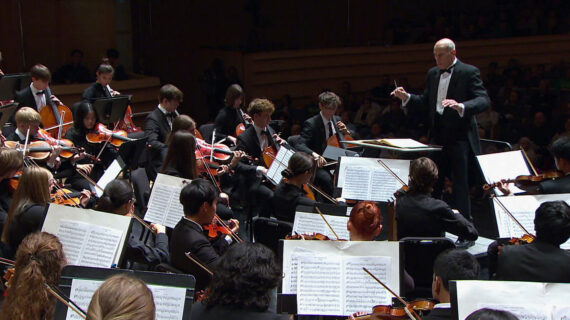
-Next, "Great Performances" goes Hollywood. Join the stars on the red carpet... Itzhak Perlman, Gustavo Dudamel, the Los Angeles Philharmonic, and me, Natalie Portman, as we pay tribute to one of the greatest film composers of all time -- John Williams. Tonight, the Los Angeles Philharmonic and Gustavo Dudamel pay tribute to the amazing versatility of the celebrated composer. "Great Performances" is brought to you by... And by contributions to your PBS station from viewers like you. Thank you.
Cheers and applause
-Who doesn't know that Olympic fanfare, originally written for the 1984 L.A. games? But I'll bet you didn't realize that that memorable tune was written by none other than John Williams, the same incredible composer who has given us so many beloved movie scores. Tonight, the Los Angeles Philharmonic and Gustavo Dudamel pay tribute to the amazing versatility of the celebrated composer. Hello, I'm Natalie Portman, and I'm so happy to be able to play a role in this celebration, especially since John Williams wrote such an amazing love theme for my "Star Wars" character, Padme Amidala, to accompany her romance with Anakin Skywalker, "Across the Stars." Director George Lucas described their love as "complicated, pure yet forbidden, personal but with profound ramifications for an entire galaxy. Somehow," he said, "John has managed to convey all of that complexity in a simple, hauntingly beautiful theme." Or, as the composer's collaborator for more than 40 years, Steven Spielberg, said, "John Williams reinterprets our films with a musical narrative that makes our hearts pound during action cliffhanger sequences, gets the audiences to scream when we were hoping they would do so, and pushes that same audience from the brink to breaking out into applause. It's not Hollywood he writes for. He writes for all of you." -My father was a professional musician. He worked in the CBS Orchestra in New York City in the 1930s and '40s. His friends were all musicians in the orchestra, so I thought when you grew up, you became a musician. That's the only kind of adult that I knew. So my life is probably in many ways very similar to yours, Gustavo, because I grew up in the ambience of music. -John Williams attended high school in Southern California. He started his own dance band and even tried his hand at conducting. After piano studies at Juilliard, he returned to Hollywood and worked for the great movie composers of the day, played in the studio orchestras, and even conducted. -I was studying music and playing here, and I was employed by Alfred Newman in his studio to play in his orchestra. Can you imagine? -Wow. Amazing. -So it was like a dream for me. And also Bernard Herrmann, who conducted, and I played in his orchestra. By osmosis, so to say, I have imbibed or digested this kind of sound of the orchestra. Others -- I mean, Franz Waxman, I worked for him, also Dimitri Tiomkin, who is remembered for scores -- and I would begin to do orchestration for some of them. Mr. Tiomkin said -- his famous old film, "Guns of Navarone," very many years ago. Well, I -- me -- I play orchestra. "Will you orchestra some sections?" So I would -- sections for him. So that was another step closer from the piano to the orchestra to eventually opportunity to conduct a little bit. I like to think, Gustavo, that every film has its own noise, its own sound, the voices of the actors, the sound effects, and so on, whatever the music is, orchestra, chamber, solo, vocal, whatever it can be, and it would be wonderful if we hear some music and we say, "It can only belong to that film." -Usually people ask for certain things for me to play, and I think the only thing that they ask me to play, no matter where I am, whether I am in South America, whether I'm in the United States or in the Far East and so on, they ask me to play the theme from "Schindler's List." -Knowing I was writing these notes for Itzhak Perlman, knowing his sound, it really led me, I think -- or I hoped -- where I needed to go. -The whole experience of actually looking at what was going on, on the film, and then hearing what John did with the music was quite amazing to me, how John was able to really take the flavor of what was going on on the film, you know, 'cause it's all black and white, and the music was, in a sense, in color.
Cheers and applause
-John Williams won his first Oscar for his adaptation of Jerry Bock's music of "Fiddler on the Roof." -Sounds crazy, no? But here in our little village of Anatevka, you might say every one of us is a fiddler on the roof, trying to scratch out a pleasant, simple tune without breaking his neck. -"Fiddler on the Roof," we all remember now, was a filmed version of the Broadway show. My opportunity and responsibility was to create music for the opening of the film, where there were contractual requirements to put the director's name, the photographer's name, the actor's name, all of this, five, six, seven minutes of screen time, which of course doesn't exist in the Broadway show. Norman Jewison said, "Well, we have the idea -- we will have a fiddler on the roof, like the Chagall painting." So I made a cadenza and a series of little variations, which we do, and some elaborations and so on, another little mini cadenza at the end of this thing, to accompany this stretch of film. -I've actually never played that cadenza before. You know, I've heard it before, but I never had the opportunity, so this is gonna be a first for me, so I'm looking forward to it.
Cheers and applause
-John Williams has been a part of the Los Angeles Philharmonic family for many years. His Film Night concerts at the Hollywood Bowl are always highly anticipated events, and the world premier of his concert piece, "Soundings," occurred right in this very hall, as a part of its inaugural celebrations in 2003. -The Disney Hall is such an inspiring place, but I want to know, what was your inspiration about this piece? -The first impression that you have, at least mine is, that Frank Gehry, who has made this building, created these shapes that look like sails, you know, in a ship. My idea for writing some music to celebrate the hall was to try to excite the sound of the sails. If you can imagine a big piece of metal like that and you just touch it and it goes "boom" like this and makes a beautiful sound and speaks to you. So the experience, I hope, for the audience, is that they will feel that the whole -- the entire ambiance of the building, the orchestra, and all of that is one element. -I always think about halls, they are instruments. It's like on a Stradivari or a Guarneri. It's kind of the instrument of the orchestra, the instrument of the music, to become alive. -I love what you say about halls, Gustavo, because a hall is a partner. You put the orchestra in one room, it has a character. You put it another room, another hall, it has another character. The hall is like what's inside the violin that we excite and bring out, so it is a partner with us in making a sound.
Cheers and applause
-As a young man in New York, John Williams spent his days as a student at Juilliard, but come nighttime, he'd be hard at work in the city's jazz clubs. -It is true when I was very young, I used to play in jazz groups and so on, nothing, I mean -- I would put it this way, not a major-league jazz player, but I played with some great, good, and very talented people in the '50s and 60's, way back, and the spirit of "Catch Me If You Can" was in the 1960s, the story was there. And I looked at the film and I thought, "Ah, that would be a perfect vehicle for this kind of 1960s style, particularly for saxophone." In writing that music, it was natural and happy for me to try to recreate some of the memories I have had with this, and also the graphics in the film had a kind of suspicious, mysterious style that was created by a man named Saul Bass. People may not remember the name, but all these wonderful geometrics that he did in the '60s. Now it looks very in that whole style. -Yeah. -It seemed like that music. Charlie Parker saxophone music and the visual art of Saul Bass put together would make sense. -The music created is kind of mysterious-feeling, you know? -It's a little fun. -This kind of personality that you don't know and you don't know if they will catch, you know, this person, and these first bars, you know, Ba, ba-da Ba-da da-dee You know, one, two, three, and then "shh," this kind of mysterious -- anxious, also, because it's sometimes the anxious feeling is not coming with an accelerando or with a fast tempo, no. Sometimes it's... the silence. -That's right. -And this creation from the silence, Ba, ba-da Then three and then it gets, you know, to the aspect. -Dramatically -- musically and dramatically, something quiet can be very threatening, -Very. Completely. -You know, very, very frightening, so we don't always have to be loud and big. We can suggest and insinuate something that is a threat... -Yeah. -By just a word or a note.
Cheers and applause
-So we could have a little sound of windy thing before the cut which would lead the cut. -If I don't read a script, I'm very happy, because I look at this director's cut, I don't know what's happening next, and I'm bored or I'm excited, and I need to have that memory when I write the -- I think, "This is maybe a boring moment. Maybe I can do something in the sound of this thing and improve the situation," so for me, the first thing is the rhythm of the film and then character and texture and style and all the other endless elements that go into it, but a director's cut is an invaluable thing for me. If it would be convenient to go into the call... - Da-da-da-da-da-da, dun-dun Yeah.
Whistling
I like that. As a matter of fact, that seems like a very natural transition into the loneliness and out of the tenderness. -Yeah. Yep. Let's see if we can do it. -Okay. Let me go back a little bit. -The thing is, where do we shift from the call to the theme? Is it on the smile? Is it when he touches the face? It could be any one of those things. -That's a wonderful question, and your choices are as many frames long as the sequence. -We could grow up together, E.T. -That's certainly the call, isn't it? -Yes, that's the call. That's the call. And this is the loneliness. This is Elliott's love. This is his heart breaking. -Does he look up again? -He looks up a second time. -But the call has to be there, doesn't it? -Oh, yeah, I think you're right, absolutely. -Let's get that. -Absolutely. -The best piece is the end of "E.T." -Oh, "E.T." -It's something like, perfectly, every point, you know, where the bicycle goes, and it's just, like, the chase. It's amazing. It's unique. -I did have an experience with Steven Spielberg at the end of "E.T." where -- the music was about ten minutes for the last reel. The children are chasing or escaping from police and so on very quickly, and I made several takes and I could not make it fit the film. The orchestra is playing away and I tried to do timing, and you know how difficult that can be. -Ah, yes. -So finally Steven said, "We'll turn the film off. Just play the music the way you want to play it, and I will re-edit the film to it," which he did. I wish I could do it all the time. -
Laugh
-It would make life a lot easier. But I also -- when I look at that scene now, I think there's something sort of operatic about the way the orchestra was playing it, that they were let free to go. They weren't watching me to, "What's coming, the next cue?" They would just play the, you know, and I think it gave some lift to the final scene. -Not so high! Not so high! -And the "boom" should be when the body falls. -When the body falls, right. -
Grunt
-Ugh! The performance of the orchestra animates the film in a way that -- film cannot live without music. It's true. It really cannot. We try. You take the film away and it looks dead. But I still have my love affair with the orchestra, which comes to us from 200 or 300 years of evolution. -Exactly. -It's a precious gift to us that we have inherited. And we have learned to manipulate strings, winds, brass, percussion all together, you know, from earlier masters, and we do our own -- make our own efforts. All a composer can do, put a few notes on paper, finished. Now we need a conductor and some fantastic players. That's all the life, and that's what we love.
Applause
-I think what a wonderful evening, you know?
Cheers and applause
Sometimes us musicians, we try to imagine to have next Beethoven, Mozart, Bach, Mahler, Shostakovich, all of these composers. But in this opportunity, we have the chance to be so close to this one that is John Williams.
Cheers and applause
We are here tonight to pay homage to your genius and to your heart, because you are one of the best composers in our times. But --
Applause
But the most important thing, you are a great human being, so thank you very much, John, for all you give to all of us.
Cheers and applause
Cheers and applause
Children singing in Mende
Cheers and applause
Laughter
Screaming
Applause
-Aah!
Laughter
Cheers and applause
Cheers and applause
Cheers and applause
Cheers and applause
-"Great Performances" is brought to you by... And by contributions to your PBS station from viewers like you. Thank you.
Cheers and applause
-To find out more about this and other "Great Performances" programs, visit pbs.org/greatperformances. Find us on Facebook and follow us on Twitter. "L.A. Philharmonic -- A John Williams Celebration" is available on Blu-ray and DVD. To order, visit shoppbs.org or call 1-800-PLAY-PBS.


 Passport















Follow Us