





PBS Wisconsin Passport
Watch this video with
PBS Wisconsin Passport
Become a member of PBS Wisconsin, support your local community, and get extended access to PBS shows, films, and specials, like this one.
Life is a Highway: Chicago to Joplin, Missouri
07/05/22 | 52m 25s | Rating: TV-PG
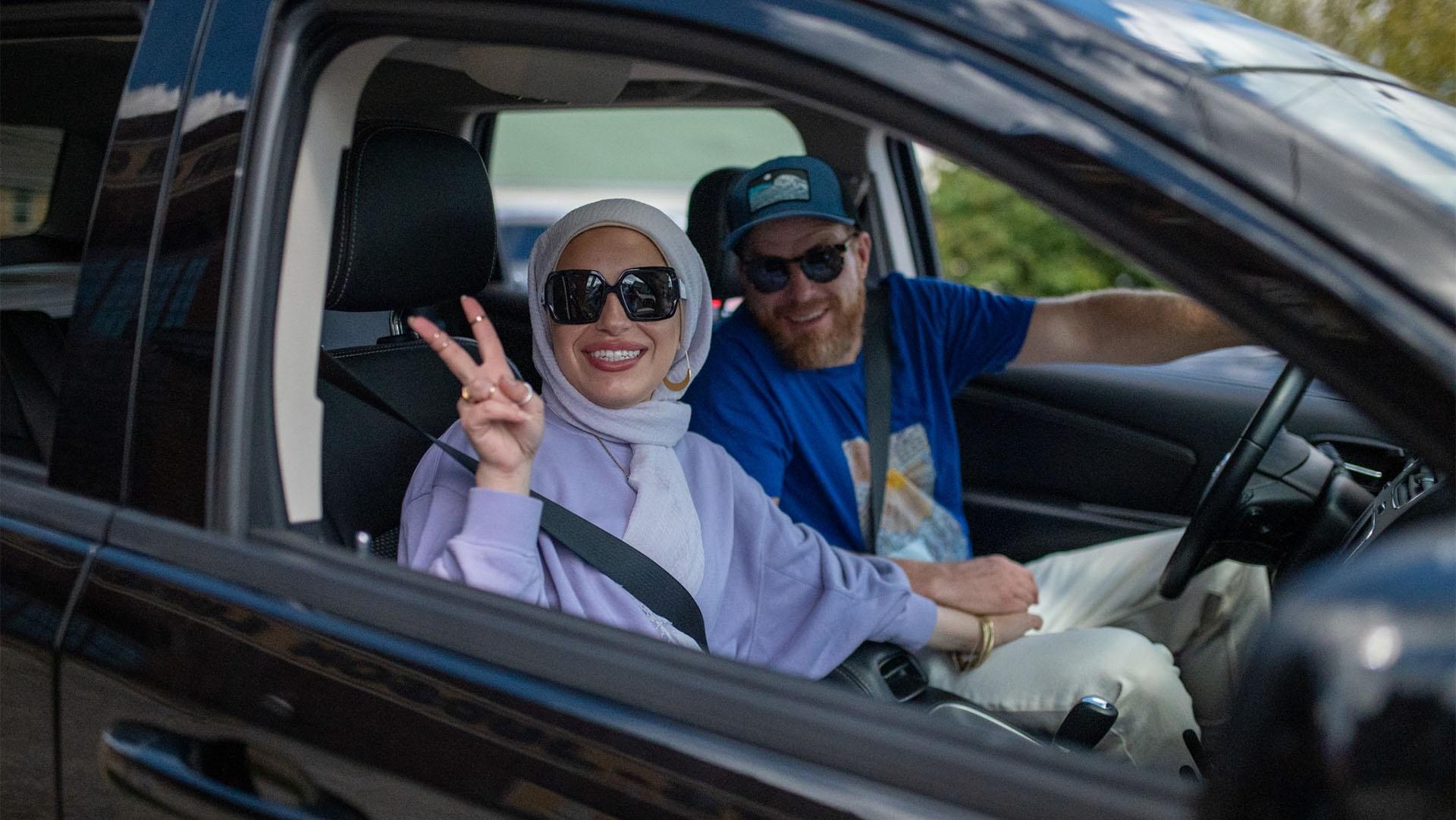
Join Mona Haydar and husband Sebastian Robins as they drive the first leg of Route 66 and discover America's Muslim roots, a history that goes back to the 1800s. Along the way, the young couple experience some tests in their relationship.


Copy and Paste the Following Code to Embed this Video:
Life is a Highway: Chicago to Joplin, Missouri
MONA: "All he needed was a wheel in his hand and four on the road."
SEBASTIAN: I dont know, it sounds pretty good to me.
[Mona laughing] I mean, I also need you.
MONA: Aww.
SEBASTIAN: Yeah.
MONA: Im Mona Haydar.
SEBASTIAN: Woo, Mona, where you going?
MONA: And this is my husband, Sebastian Robins.
Hey Babe.
SEBASTIAN: Hey, here we come.
MONA: Were on the road for three weeks.
Hey, you think of Route 66 you think heartland.
Taking time out of our busy lives as parents, educators... Were taking back the narrative... And managing my music career.
JOURNALIST: Bonjour Mona Haydar!
To follow the Muslim thread woven through the fabric of our country.
EDWARD: Muslims have always been part of America since the colonial era.
MONA: And were reconnecting with each other along the way.
SEBASTIAN: What a miracle it was to meet you and to start our life together.
What should I do?
Kiss you and hug you?
[Mona laughing] MONA: Youre so awkward.
[Sebastian laughing] MONA: Were taking The Great Muslim American Road Trip.
You just put a little fire in my belly.
On this episode... EDWARD: The American story is the Muslim story.
SANIA: That made me like giddy.
[Mona laughing] YUNUS: If you save one persons life its like youve saved all of humanity.
SAHAR: She said, "Go take shelter, take shelter now!"
[lightning crashing] My, my oh my I know it MONA: Theres this person named Muhammad Ali... MARYUM: Yes MONA: Who is a worldwide phenomenon.
No matter what it takes Im gonna keep on going [car door opens] [car door closes] [engine starts] SEBASTIAN: Day one.
Day one of our trip.
MONA: Road trip!
SEBASTIAN: I didnt even know Route 66 started in Chicago.
Did you?
MONA: No.
[road noise] What are you looking forward to?
SEBASTIAN: To go back to Lama where we met.
[road noise] How are you feeling about the next three weeks?
MONA: Im excited to spend time with you.
SEBASTIAN: Aw, me too.
Are you fearing anything?
MONA: Mm, I dont feel that fearful.
SEBASTIAN: Oh okay, good, me neither.
[Mona laughs] MONA: [sighs] Bismillah!
[recites Arabic prayer] [road noise] [whooshing sounds] [clicking sounds] Day one, outfit one.
Hey!
What?
So today were kicking off our trip by exploring the jewel of the Midwest and thats where Route 66 technically begins.
Theres Chicago!
SEBASTIAN: Dang.
Big city!
MONA: What is it, Gotham City?
SEBASTIAN: Gotham City is New York!
MONA: I thought Gotham was supposed to be Chicago.
SEBASTIAN: No!
Batman!
Gotham.
New York City!
MONA: I know!
I thought it was supposed to be Chicago!
SEBASTIAN: No way, dude!
I dont know anything about comics and I know that.
Chicago is- MONA: What is Gotham City supposed to be?
SEBASTIAN: Its not even worth asking.
MONA: Okay, fine.
New Jersey!
[both laughing] SEBASTIAN: I still think Im right!
[laughs] So who are you meeting today?
MONA: Her name is Maaria Mozaffar.
SEBASTIAN: Tell me more.
MONA: Civil rights attorney.
A few notable projects include the Illinois Civil Liberties Coalition, the Healthcare in Prisons Resolution, and the Illinois Women and Girls Council Act.
She also drove efforts to pass the Food Desert Resolution.
Dang!
Dude, this is like, all the things we care about.
SEBASTIAN: Yeah.
MAARIA: Yeahhh!
As-Salaam-Alaikum!
MONA: Wa-alaykom-assalam Its such a pleasure to meet you!
MONA: So nice to meet you.
MAARIA: Oh, my goodness, I love your music.
[Mona laughs] I love everything about you.
MONA: Thank you, thank you, and Im a fan of your work.
MashaAllah, you do it all.
You know, thats one of the things Im so excited about taking this trip with my husband is, like, meeting someone like you, you know?
Just the beautiful work youre doing, and... MAARIA: Oh thank you!
We all need to be people that stand for something, versus stand against something.
MONA: Yeah.
MAARIA: Im sure you felt this way when you were creating your music.
MONA: Yeah, its true.
MAARIA: So have you always wanted to do music for a long time?
MONA: For a really long time.
MAARIA: So how did you kind of first make your first- you called somebody up and you just said, like, "Make a video?"
MONA: No, I went to a studio in Detroit and I met up with a bunch of people who were already doing music, and I was like, "Hey, like-" MAARIA: Thats so nice.
MONA: Ive never done this before.
I still wrap my hijab, wrap my hijab Wrap my hijab, wrap, wrap my hijab MAARIA: So Mona, what made you think about doing this road trip?
MONA: Yeah, I feel like my husband and I, we just got so busy with our kids, and I was in graduate school, and my music kind of changed my life and everything got so full and busy, and we kind of forgot about us for a little bit.
And so, our anniversary is coming up and were... MAARIA: Oh, awesome.
MONA: Just trying to take a little trip to, I dont know, hang out with each other?
[laughs] MAARIA: Thats awesome, so where are you gonna be going, exactly?
MONA: So were taking Route 66... MAARIA: Okay.
MONA: Which starts here in Chicago.
[road and scribbling noises] MAARIA: You know where you should go, is the Skydeck, on Willis Tower.
And you will be able to see Route 66 and 100 miles away.
And so youll be really able to see where youre headed.
Im so excited for you!
I wish I could go on this road trip for you, right?
[Mona laughs] Youre gonna meet a lot of Muslims on your road trip.
MONA: Okay!
MAARIA: Yeah!
[road noises] Ive written legislations for the last decade, right?
One of the legislations we wrote was the, um, Contributions of Muslims in US History.
MONA: Oh wow.
MAARIA: Weve had social service centers, we have domestic shelters.
Weve had free clinics, first responders and COVID, right?
How many Muslim physicians do we know?
I think youre going to meet on this road trip all of these individuals, Muslims who have contributed to so many parts of this country.
MONA: Yeah.
MAARIA: And who have been notable, that people will realize that this type of contribution is so, um, so consistent, with who we are as Americans.
MONA: You just, like, put a little fire in my belly.
MAARIA: In Illinois... MONA: Mm-hmm MAARIA: Really exciting, what we did was create a commemorative holiday for Muhammad Ali Day.
MONA: Wow.
MAARIA: I mean Im super, super, super excited because, we are going to meet somebody MONA: Yeah?
MAARIA: Connected to that legislation, and that is Maryum Ali, who is Muhammad Alis daughter.
MONA: Ahhh!
MAARIA: Yes!
MONA: Oh my God!
MAARIA: Oh my goodness.
MARYUM: Nice meeting you!
MONA: Ahhh!
Im such a fan!
MAARIA: Oh!
Oh!
My goodness.
Its such an honor to meet you.
MARYUM: How are you two?
Yes!
Yes!
MAARIA: I was just telling Mona, that in Illinois we have Muhammad Ali Day now as a commemorative holiday.
MARYUM: Now what is the actual day?
MAARIA: January 17th.
MARYUM: Oh his birthday!
MAARIA: Yes.
MARYUM: Oh thats wonderful!
Perfect!
MAARIA: Yes!
MONA: My mom just told me this story.
In 1967, she was a young girl in Damascus, Syria.
And there was a Muhammad Ali fight.
And she had a TV.
And so all of these people then came to their house to watch... MARYUM: To watch the fight.
MONA: This fight because it was Muhammad Ali.
[bell rings] [crowd noises] [crowd gasps] [hits the floor] [bell rings] CROWD: Ali, Ali, Ali, Ali, Ali, Ali, Ali, Ali, Ali!
MONA: And I just have always felt so close to you and your family.
My father actually had Parkinsons disease.
MARYUM: Mmmm!
How old was he when he got that?
MONA: He was young, he was in his forties.
MARYUM: Oh that is young.
MONA: He had early onset.
MARYUM: My father got it young too.
Mm-hmm.
MONA: Yeah.
MONA: I know what that is.
MARYUM: Yes.
MONA: You know, to like, slowly watch someone you love, MARYUM: Yes.
MONA: Someone so strong, so beautiful.
MARYUM: Yeah.
MONA: Slowly fade you know, MARYUM: Yep.
MONA: So I was... MARYUM: Aww MONA: Just felt- MARYUM: Yeah, its- its- its rough.
You know.
MONA: But he was always this figure that we just like, so looked up to!
Like, theres this person named Muhammad Ali, MARYUM: Yes.
MONA: Who is a worldwide phenomenon!
MARYUM: You know, I asked my dad what he felt like with the disease, you know, and spiritually.
And he said something that made my knees buckle.
He said, "Id rather suffer now than in the hereafter."
I was like, oh my gosh!
MONA: Hoo!
MARYUM: Is that deep?!
MONA: Wow.
MARYUM: Yeah, religion was not something he felt should be private, its a way of life.
MONA: Mm.
MARYUM: Islam really freed him up, which is why he was able to take the stands that he took.
MONA: Yeah.
MARYUM: Make the sacrifices that he took.
And he said they werent sacrifices, cause he wanted to... MONA: Yeah.
MARYUM: Stand up for his faith.
MUHAMMAD: My name is Muhammad, yall keep calling me Cassius.
Im tired of telling you, you know, youre intelligent.
My name is Muhammad Ali, not Cassius.
REPORTER: Champ, Liston hopes you dont have another hernia operation.
MUHAMMAD: See, now youd rather say champ than Muhammad, see?
[crowd laughs] MARYUM: He always saw the glass half full, even with Parkinsons!
But he was a little, you know, self-conscious about it.
[crowd cheering] But when he lit the torch at the 1996 Olympics?
MONA: I remember that.
MARYUM: That kind of just opened him up and- and made him feel okay.
Cause he- he actually said, "Wow, they still care about me."
And I was like, ugh, he was just so, you know, so sad.
Ive watched him be so kind and loving and empathetic with all types of people.
MONA: Yeah.
MARYUM: Whether its a homeless person, or a dignitary in a country.
And I do believe just that daily manner that he had with people, that empathy that he had, that understanding, I think it helped Allah subhana wa taala guide him in the right way.
MONA: Yeah.
MARYUM: And a lot of times we look for spirituality out here, but its just your daily interactions with people.
MONA: In the mundane.
I wanna see your cute poses, you guys, show me, show me- MARYUM: High angle.
MONA: Yeah.
[all laughing] Im dead!
SEBASTIAN: Theres the- thats the Skydeck.
MONA: Oh, thats the Skydeck?
SEBASTIAN: Yeah.
MONA: Supposedly you can see a hundred miles away!
SEBASTIAN: Huh, a hundred miles away.
MONA: Down Route 66.
[clicking noises] MONA: Illinois is home to about 300 miles of the Mother Road.
Well see how much of that we can cover today.
SEBASTIAN: I swapped out your coffee that you got, and got you a cold one.
MONA: Aww, thats so sweet.
Thanks, baby.
SEBASTIAN: Oh, youre welcome.
I was also hoping youd share it with me.
MONA: [laughs] I see.
[Sebastian laughs] SEBASTIAN: You know what southern Illinois is famous for?
MONA: Cornfields?
SEBASTIAN: Yes.
My grandfather actually had a farm- MONA: Mm?
SEBASTIAN: In rural Illinois near the town of?
Did I tell you?
MONA: Mm-mm.
SEBASTIAN: Mohamet.
MONA: Wow!
SEBASTIAN: Mohamet, Illinois.
[road noise] SEBASTIAN: I thought itd be cool to get some like, classic Americana books for our trip.
MONA: Let me see!
Alright, you got, ooh, Steinbeck!
SEBASTIAN: And?
MONA: And, oh, "On the Road," Jack Kerouac.
Thats fun.
"The only people for me are the mad ones.
"The ones who are mad to live, "mad to talk, mad to be saved, "desirous of everything at the same time, "the ones who never yawn or say a commonplace thing, "but burn, burn, "burn like fabulous yellow Roman candles "exploding, like spiders across the stars.
"And in the middle, you see the blue center light pop, and everybody goes, Ahhhh." SEBASTIAN: Hm.
[laughs] Thats awesome.
[road noise] [engine revs] MONA: It looks like theres a mosque in Springfield.
SEBASTIAN: Really?
MONA: Yeah we might be able to get there in time for prayer.
SEBASTIAN: Okay, lets try it.
[speaking in foreign language] [speaking in foreign language] [speaking in foreign language] IMAM: So please spread out just a little bit.
Allahu akbar!
[speaking in foreign language] [speaking in foreign language] CONGREGATION: Amin.
[speaking in foreign language] [speaking in foreign language] MAN: Thats Dr. Siddique, Baker Siddique, professor of economics.
So please, please.
SEBASTIAN: Yeah!
Thank you.
Remind me of your name.
JUAN: Juan.
SEBASTIAN: Juan?
Yeah, and?
SAYYED: Sayyed.
SEBASTIAN: Sayyed, nice to meet you.
Sebastian.
Yeah.
CORY: My name is Cory.
MONA: Cory?
Nice to meet you.
And your name?
VALERIE: Valerie.
MONA: Valerie?
BAKER: I joined University of Illinois at Springfield in 1987.
SEBASTIAN: Wow.
BAKER: So Ive spent 34 years in Springfield.
My childrens, all of them grew up here.
ARCHITECT: When I came to America what was interesting is to meet so many different Muslims from different countries- MONA: Yeah.
ARCHITECT: With different cultural backgrounds... MONA: Yeah.
ARCHITECT: With their own diversity.
MONA: I know!
SEBASTIAN: And where are you originally from?
MAN: Bangladesh.
Im in the Army Reserve, in the Corps of Engineers.
I was deployed two times in Iraq- SEBASTIAN: Wow.
MAN: And two times in Kuwait.
SEBASTIAN: Wow.
ARCHITECT: Springfield has something like 25-plus ethnicities.
MONA: Wow.
ARCHITECT: Muslim ethnicities... MONA: Wow.
ARCHITECT: And thats how many different kind of people pray in this mosque.
MONA: Wow.
SOHAIL: Im Pakistani, by birth.
I grew up here.
I was five years old when my family came.
SEBASTIAN: Okay.
SOHAIL: But I was in the Navy, 15 years active duty.
Um, one tour on a ship to the Middle East, one tour in Afghanistan.
MAN: Did- did the Taliban target you in any way?
SOHAIL: I was the second in command of a reconstruction team.
I went out, and about, and they dont want educated Muslims meeting people, so as a Muslim, I was on a target list.
[indistinct chatter] I woke up every day and I didnt know if Id be alive the next day.
And I was actually told by one of our interpreters, "Look, Dr. Siddique, you should not go out on- on patrol anymore."
And- and I said, I have to go out.
We all- we all have to.
[indistinct chatter] MONA: I was in Albuquerque one time, and it was really funny.
Sebastian and I were walking down the street, [laughs] and this guy, um, pulled over his car and started yelling at me out of the car.
Im in hijab, of course, hes saying some crazy stuff.
And- and he says something like, "Do you accept Jesus?"
You know, like, "Do you accept Jesus?!"
You know, he was really, like, aggravated and upset.
And I said, "And Mary, too."
And he did the sign of the cross, and he said, "Im so sorry, sister."
And I think at that point he thought I was a nun.
[laughs] [all laugh] ARCHITECT: Because most people do not realize that for us, Jesus has the same sense of respect as a prophet as Christians do!
MONA 2: The miracles of they are walking on water, the leprosy- WOMAN: Mm-hmm MONA: Yeah.
MONA 2: The curing the blind.
MONA: For me, thats whats so beautiful!
MONA 2: Islam recognizes virgin birth!
Theres a whole chapter about Mary in the Quran.
MONA: And in the Quran, literally Jesus is referred to as Jesus, son of Mary.
Like, the woman in this conversation is so important that she has to be a part of Jesuss name.
CORY: When you start learning more, you realize, oh, she- she was somebody really special!
She had a purpose herself.
MONA 2: Yeah, my daughters name is Maryum.
CORY: Mine too!
[laughs] MONA 2: Yeah, its really.
[all laugh] [all laugh] IMAM: And so, we are supposed to connect the created world to the creator of the world.
SEBASTIAN: Mm-mm IMAM: So consider how many times the Quran implores us to study the sky.
SEBASTIAN: Hmm IMAM: And its splendor.
SEBASTIAN: Yeah.
IMAM: The alternation of night and day, for example.
Or the perfect balance and equilibrium that exists between the Moon and the Sun.
We are taught to connect the design that we see in the universe with the designer.
VALERIE: I love your music.
Its absolutely wonderful.
Its empowering, which Muslim women need.
MONA: Mm.
VALERIE: Yeah.
I was like, I gotta meet Mona Haydar!
Like Im just!
[Mona laughs] ARCHITECT: I am so happy when I see Muslim women breaking out of the regular molds of profession.
MONA: Im so glad to hear you say that!
[laughs] ARCHITECT: Oh yes!
[indistinct chatter] SEBASTIAN: The other thing I also appreciate that my wife taught me, that, you know, that mosques are beautiful and they bring us together, IMAM: Mm.
SEBASTIAN: But that you can pray anywhere, you know, And I love that idea that like, when its time, this patch of grass, you know, praying in an airport, praying in a bus if you need to.
MONA: You know, for me I- my mother was amazing, because she really understood Islam.
She really studied, and its her whole heart.
And so she raised me to question and to say like, if theres a basis for something, I will follow with my whole everything.
And if theres not then, you know, we can- we can do what we like.
[whooshing sounds] [clicking sounds] MONA: The backgrounds of everyone we met at the mosque were so diverse, but early in our countrys history, American Muslims were almost all enslaved Africans.
SEBASTIAN: Nice to meet you, Sebastian.
KAMAU: Hey Sebastian, Im Kamau.
SEBASTIAN: Oh yeah.
We were at the Islamic Center last night, and your colleague, Ali, told us about you.
KAMAU: Well, Im glad he did.
Im very happy to be here.
SEBASTIAN: Yeah.
KAMAU: I teach African American history among other things, and its- its a great experience and, of course, its kind of relevant to this- MONA: Yeah.
KAMAU: Because so many people who were brought from Africa were Muslims.
MONA: I love this new language that I just recently learned about, of talking about folks who were enslaved as enslaved, and not slavery as this like, this nebulous, passive thing.
SEBASTIAN: Mm-hmm KAMAU: Well, "slave" is- is not an identity.
MONA: Right.
SEBASTIAN: Hmm KAMAU: It- its something that happened to them.
MONA: Right.
SEBASTIAN: Would it be fair to say the first Muslims in America were enslaved Africans who came here in the early 17th century?
KAMAU: Probably so.
And it may have even actually been earlier than the 17th century.
SEBASTIAN: Okay.
KAMAU: There couldve been some who were traders.
SEBASTIAN: I think thats something most people dont know or believe, [laughs] if they hear it.
KAMAU: Thats kind of how Islam is.
Its around, but a lotta people dont pay attention to it.
SEBASTIAN: Right, right.
KAMAU: Or when they do, they attach something negative to it.
SEBASTIAN: Right, right.
[footsteps] MONA: One of my teachers, um, said this beautiful thing that these people came over and they werent permitted to practice their true religion.
And that a lot of Black folks became Muslim, for instance, in the 60s and 70s, and he said that is an articulation of those ancestors prayers.
That their- KAMAU: Definitely.
MONA: That their children be able to be free someday to practice their ancestral religion.
SEBASTIAN: Hm.
KAMAU: Yes.
And when you say ancestral religion, it- it existed for centuries there, in w- in West Africa and Central and Saharan Africa.
SEBASTIAN: Hey, thank you so much for your time and expertise- MONA: We know youre busy!
KAMAU: Its a- its a pleasure, I w- I was happy to do it.
MONA: Yeah.
Thank you so much.
KAMAU: It was a pleasure to meet both of you.
Woo I found a place in a little ol town Just off of Highway 19 My pride and joy is parked in the yard Living the American dream Yeah Ive worked real hard since I was 17 And this is where the good times start Living the American Living the American Living the American dream Ooh yeah!
The American dream Oh yeah!
[whooshing sounds] [clicking sounds] MONA: We are so excited for our personalized tour through St. Louiss 150 years of Muslim history.
[indistinct chatter] EDWARD: Muslims began to voluntarily emigrate to the United States in larger numbers, you know, after the Civil War.
M- most of them who came at that time would have been from what many people know as the Middle East.
The countries of Palestine, Jordan, but especially Syria and Lebanon.
The majority of Syrians who came were actually, um, Christian, but there were a number of Muslims.
SEBASTIAN: Mm-mm.
EDWARD: And then the- the- there were also people coming from- Muslims coming from Bengal, from central Asia, Afghanistan, right?
From- from Turkey itself, from Bosnia, from the southeastern Europe.
SEBASTIAN: And so what was the motivation?
What was the driving force that drove this immigration?
EDWARD: Well, they came for the reason why millions of immigrants came after the Civil War up until World War I, you know.
That was mostly for economic opportunity.
There was push and there was pull.
In most of the places from which they came, there was, um, some kind of economic displacement.
There just werent enough jobs.
And the United States was in need of cheap labor.
So, in- in one sense, what happened then is still happening today, right?
Theres push and pull.
People are displaced for one- for one reason or another.
People sometimes become refugees, and they need a place to land.
For example, in the 1990s, thousands of Bosnian refugees came to St. Louis, you know, looking for refuge, looking for a place to establish a community and raise their kids in relative safety and with some degree of economic opportunity.
But, if you wanna know when Muslims first came to St. Louis, the largest population of Muslims before World War II probably came to the 1904 St. Louis Worlds Fair, to work here.
SEBASTIAN: Hm.
EDWARD: So heres a- a map of the fair.
SEBASTIAN: Huh.
EDWARD: And one of the things that sometimes people forget about the fair is Jerusalem was reproduced at a 1:1 scale, the old City of Jerusalem, Al-Quds.
SEBASTIAN: What?!
What?!
EDWARD: So you see it right in the center there.
SEBASTIAN: Huh.
EDWARD: The Mosque of Omar, the Dome of the Rock, it was 1:1 Scale.
And they had the Church of the Holy Sepulcher and the Kotel or the Wailing Wall.
It was all right there.
MONA: Wow.
EDWARD: And then you look, Moroccos right next door.
[Mona and Sebastian laugh] My relatives came because of that, because of these fairs, right?
And maybe a long-lost relative of yours came!
Some long-lost cousin.
MONA: Yeah.
EDWARD: But I wanna show you where actually most of the Muslims, um, from the fair came from.
SEBASTIAN: Okay.
EDWARD: For the 1904 Worlds Fair, the organizers imported 11 hundred people from the Philippines.
It was the largest single foreign population.
And among their number were hundreds of people from, um, fr- from southern Philippines or the island of Mindanao.
And this was where Muslims lived.
These were called Moros or Moors, Muslims.
SEBASTIAN: Huh.
EDWARD: They were wildly popular in the fair.
They called the Moros "semi-civilized."
They displayed savages like pygmies at the fair.
MONA: Mm.
EDWARD: And then they- they contrasted them with all of the, you know, white culture which was seen as- as civilized and industrial and modern.
SEBASTIAN: Right.
Right.
EDWARD: But- but the Moros and the Muslims in general stood right in between.
They were right in the middle.
[Mona laughs] They were semi- SEBASTIAN: Wow.
They got an upgrade.
MONA: Right.
Right.
EDWARD: Civilized.
MONA: Right.
I dont know if you know, but I have a song called Barbarian [laughs] about that exact topic.
[Edward laughs] So thats a very sore spot for me.
If theyre civilized, Id rather stay savage Yo yo yo yo yo yo We them barbarians Beautiful and scarin them Earth-shakin rattlin Be wild out loud again This nose-decolonize This hair-decolonize This skin-decolonize This body-decolonize This mind-decolonize EDWARD: Immigration is cut off in the 1920s.
SEBASTIAN: Right.
MONA: Wow.
EDWARD: The National Origins Act basically cuts off immigration from anywhere where people of color are from.
[indistinct chatter] MONA: What was the driving force behind that cutoff?
EDWARD: The Ku Klux Klan got its wish.
One of their main goals was to cut off immigration from non-white people.
From non-Nordic people.
And it was a very powerful organization at that time!
And that law stayed on the books until 1965.
MONA: Wow.
EDWARD: So, it was part of xenophobia and racism, that- that really reduced the number of Muslims c- coming into the country via immigration until after 1965.
MONA: Mm.
SEBASTIAN: Wow.
EDWARD: So, in some ways in the 1920s, things got worse for Muslims.
I mean there was more racism.
There was more xenophobia.
And whats remarkable to me is, this is the time when Islam is established as an American religion in the sense that the religious congregation becomes the center of the community, thats a very American thing.
MONA and SEBASTIAN: Right.
EDWARD: The community prospered in spite of the odds against them.
These immigrants almost always brought their food.
I mean, they deeply enriched the culinary culture of the United States.
That woman is holding an ice cream cone.
[Mona and Sebastian laugh] Thats what my- the brother of my great-great-grandfather was supposed to have invented here.
MONA: The- the inventor of the ice cream cone?
[Mona laughs] EDWARD: Well, thats the- thats the story I grew up with.
MONA: Yeah!
SEBASTIAN: Go with it man.
MONA: No, I grew up knowing that a Syrian person in America invented the ice cream cone.
EDWARD: You did?!
MONA: So I knew that story growing up.
[Edward laughs] But I did, Im meeting you!
And thats your family, thats hilarious.
EDWARD: Whether it was my relatives or your relatives, you know, or the Bosnians who came here, um in the 1990s, they established restaurants and they enriched our food culture.
MONA: All I want now is some pistachio ice cream.
[Sebastian laughs] Its like, can we go get some right now?
SEBASTIAN: Right.
Totally.
MONA: Well, I am- I am actually hungry [Sebastian laughs] so whats a good restaurant?
Alright, so after that history lesson with Dr. Curtis, hes taking us on a field trip to an amazing Bosnian restaurant.
Bosnians are a big part of todays vibrant Muslim community in St. Louis.
ERMINA: Ready!
[indistinct chatter] MONA: You want some of that?
EDWARD: Yes, yes, please.
MONA: That looks really good, EDWARD: Yes.
MONA: I like that!
EDWARD: Mm-hmm.
Im really glad, um, that we could see that exhibit together.
Um, I dont think most people know SEBASTIAN: Mm.
EDWARD: That Muslims have been in St. Louis, and, you know... MONA: Mm.
SEBASTIAN: Right.
EDWARD: In this part of America for as long as they have.
MONA: Yeah you shared so much like, I had no idea.
EDWARD: Most Muslim immigrants traced their roots to after 1965.
So they didnt- you know, there was no one there to pass on that old history, and so some of it was forgotten.
But Muslims have always been part of America.
Muslims are not somehow new or foreign to America.
SEBASTIAN: Right.
Right.
EDWARD: But, I mean, youve got to take your time, SEBASTIAN: Mm.
EDWARD: And do it right, and see Route 66 and youll discover that the American story is the Muslim story.
And the Muslim story is the American story.
SEBASTIAN: And youre Christian.
EDWARD: Thats right.
SEBASTIAN: So I just have to ask, w- why are you interested in this topic?
EDWARD: I think because of my Arab background.
You know whether youre M- Muslim or not, if youre Arab, Islam is extremely important to your identity.
SEBASTIAN: Right, right.
EDWARD: And so I- SEBASTIAN: Im ashum- Im assuming people might assume youre Muslim, right?
EDWARD: With a name like Edward Curtis, it wasnt- but you know after 9/11, I became a lot browner and a lot more Muslim.
SEBASTIAN: Right.
MONA: Mm.
EDWARD: Yeah.
Just like we saw, um, at the exhibit on the 1904 St. Louis Worlds Fair, anti-Muslim prejudice has been part of America since the colonial era, and in order to overcome them, we all have to do a lot of work.
And in my view, that work shouldnt have to be mostly on Muslim shoulders.
SEBASTIAN: Mm-hmm EDWARD: It should be on people like my shoulders who dont say, Im Muslim, even if Im often mistaken for a Muslim!
SEBASTIAN: Right, right.
EDWARD: I mean, in America, race and religion have always been tied.
MONA: Yeah.
SEBASTIAN: Right.
EDWARD: So, I mean obviously you didnt grow up Arab or Muslim, right?
SEBASTIAN: I did not.
I did not.
EDWARD: So, okay, but you are Muslim now.
SEBASTIAN: Mm-hmm.
EDWARD: Yeah.
SEBASTIAN: I am.
EDWARD: So, how did that happen?
SEBASTIAN: Mm, um, my dad is Jewish and my mom is Christian.
Um, and, you know I just- I didnt, for various reasons, like find a home in either of those religions.
You know, um, yeah, I just Ive always been kind of a seeker and kind of looking for God in various places.
I was living in this intentional community in New Mexico, which is an ecumenical, lay-led, um, spiritual community, and this woman showed up, probably the first person to show up in hijab at this community in 40 years or so.
And it was Mona.
MONA: Yeah I mean, I had just experienced a personal tragedy, and that sent me on my own sort of journey up the mountain to New Mexico, and I was definitely not interested in meeting a man, [laughs] or getting married or anything.
And when I met Sebastian he just became a- a dear friend.
SEBASTIAN: You know, she was not looking to have me become Muslim and I wasnt looking to have her teach me, but just by virtue of our friendship, EDWARD: Mm-hmm.
SEBASTIAN: Um it was like, the door opened.
I think it was the way you practiced, the way you prayed and the way you held your faith, like, beautifully.
But it was sort of this invitation, and our life started unfolding and my spiritual life started unfolding.
And I sort of felt like I was being carried down this river.
And its just energizing and its beautiful.
MONA: The community shuts down for the- the winter, and we sort of focus on personal development, EDWARD: Mm-hmm.
MONA: You know, as a community and also as individuals.
And so I invited a sheikh up.
And, um, he did a sweet little intensive for the community.
SEBASTIAN: A very jolly kind of goofy guy.
MONA: Yeah.
And the community really learned a little bit about Islam.
SEBASTIAN: The next day was gonna be his last day.
So I woke up, and the first words that came to my lips when I woke up in the morning was, "Its time."
I just had this, c- again it came to me, "Its time."
So I- I asked him, I said, hey, I- I- I think I wanna become a Muslim with you.
And he- he acted as if you know, I had asked him for a piece of gum.
[Mona laughs] SEBASTIAN: Just like, okay, no big deal.
You know?
Lets go.
You know, I was so nervous, I had been rehearsing, he was like, okay come on, we need one witness.
Come on.
And I was like, really?
This is it?
And he said, you know, repeat after me.
And it was all over in about, you know 15 seconds, and I was like, thats it?
MONA: And Sebastian wanted some like, big ritual.
SEBASTIAN: Yeah right, like, bring out the cake and the- EDWARD: Wheres my certificate?
SEBASTIAN: Yeah exactly!
[all laughing] MONA: When do I blow out the candles?
SEBASTIAN: A few weeks later, Mona said, why dont you come and visit my parents, you know?
And I was like, I dont think Im, you know, Im not ready for that.
But I did, and I flew to Michigan and... MONA: And by that point you had already kind of spoken your wish for us to get closer and... SEBASTIAN: Right.
I met her parents and, both her mom and I are teachers, so we really connected on that level, and... EDWARD: And then, father?
MONA: Hes such a, a- a big kind of quiet.
He had this very, very, very deep voice, you know, and he was always kind of intimidating, because he was like the- the, you know, dark quiet type and, he was a little moody and broody.
He always gave guys a little bit of a hard time, you know, just to, like, see what- what theyre like under pressure.
[Mona and Edward laugh] SEBASTIAN: But I was very nervous!
MONA: Sebastian and my dad were sitting on the couch.
SEBASTIAN: And somehow we just chit-chatted and the moment came and the moment went- MONA: No, what did my dad say to you?
He said, [laughs] "A-plus personality."
[laughs] SEBASTIAN: Which is still the best compliment Ive ever gotten in my life.
MONA: I knew things were gonna be okay!
[laughs] EDWARD: Mm-hmm.
SEBASTIAN: I mean Im just gonna like, wear that around my neck till I die.
EDWARD: Thats great!
MONA: And, you know, right after that we got married and... ...that is so good...
So, Dr. Curtis kept talking about immigrant stories, and its funny because right after he left, one of those immigrant stories walked right up to us and introduced herself.
SENADA: Hi!
How are you?
SEBASTIAN: Good how are you doing?
SENADA: Good!
Im Senada Grbic.
And you are?
MONA: Mona.
SENADA: Mona SEBASTIAN: Sebastian.
SENADA: Its nice to meet you.
Thank you so much... SEBASTIAN: So this is your- SENADA: For coming today.
Yeah.
SEBASTIAN: This is your place?
SENADA: This is my restaurant, Grbic Restaurant.
SEBASTIAN: Oh my gosh, we had the best meal ever.
MONA: Oh my gosh.
SENADA: Good, Im so glad to hear that.
SEBASTIAN: So amazing.
SENADA: Good.
MONA: How long have you guys been here?
SENADA: We have actually been here for 20 years almost.
Yeah!
SEBASTIAN: Wow.
MONA: Do you wanna sit?
SENADA: Yeah Id love to!
SEBASTIAN: Please, please.
[Senada laughs] SENADA: So in 1998 is when we bought the restaurant.
MONA: It was already a restaurant?
SENADA: It wasnt a restaurant.
So it was this old, abandoned building.
It looked like a haunted house.
There was hardly any floors, the ceilings were collapsing.
SEBASTIAN: Wow.
SENADA: There was no electricity, no plumbing.
Just a square brick wall.
MONA: So how did you guys get it to this point, I mean- SENADA: At that time there was a lot of refugees coming over from Bosnia, and my parents were very involved in helping out the refugees, helping them get jobs and housing.
So a lot of the men from Bosnia, they had backgrounds in construction, in bricklaying, um all of that stuff.
So he decided that that would be a great opportunity to help them get started.
Since my parents came to America so early, they were already very well established.
Um, so when the war started, they decided to make sure that they wanted to be like, almost like first responders to the community.
At our house there was 50 people at any given time, any day, just everywhere.
MONA: Wow.
SENADA: I remember as kids we would drive to the airport and see if there was any families that needed help and we would just put them in the car.
MONA: Oh, my God.
SEBASTIAN: No way.
SENADA: Theyd just come to our house and youd just help them.
REPORTER: Tens of thousands of people have already abandoned their homes, terrorized by fighting around them, or the fear that it would spread.
[alarms blaring] SENADA: Here she is!
This is Mama Grbic!
ERMINA: Hello, nice to meet you!
Im Ermina!
SENADA: And here is my dad!
SEBASTIAN: Hey how are you?
MONA: Hello!
[all talking at once] [indistinct chatter] [whooshing sounds] [clicking sounds] MONA: Good morning!
So, I woke up today feeling pretty, pretty tired and beat down.
Weve been on the road for just a week now.
And, you know, my autoimmune stuff is just kicking my butt a little bit right now.
[road noise] SEBASTIAN: On days like today, she has what- what she calls flares.
Her body just kind of, just stops on her.
[road noise] And everything hurts.
[road noise] Shes proud, you know?
So its hard to know how to navigate that.
[road noise] MONA: But, its gonna be a good day.
I can just feel it.
[car drives by] We met some Muslims, and they were just like, "Hey, theres actually a picnic happening in the park, and wed love you guys to come."
Apparently its like a doctors picnic, so this should be interesting, um, since were not doctors.
[Mona laughs] But were invited.
ALI: Im a cardiologist in this area.
Ive been here about 20 years, and, I... SANIA: He was only supposed to be here for a year!
ALI [laughs]: Supposed to be!
SANIA: 20 years later, still here.
ALI: 20 years later, were still here.
[laughs] IFTIKHAR: I have a private practice, internal medicine.
SEBASTIAN: Okay.
IFTIKHAR: And we have a staff somewhere 16 to 20?
SAHAR: Im a doctor but Im kind of early- retired doctor.
You know, like I sacrificed being a physician for being a mom and a teacher.
My husband, by the way, is a pulmonologist, a critical care doctor.
SEBASTIAN: Pulmonologist?
SAHAR: He is, you know, like a front-liner.
Thats why hes not here today, SEBASTIAN: Okay SAHAR: Because hes taking care of the people in the hospital.
SEBASTIAN: Wow.
YUNUS: Before coming to med school, I did one year of Islamic studies.
And I learned a lot about Islam, and I learned if you save one persons life, its like you saved all of humanity.
Its an opportunity to potentially save all of humanity with just one person, you know?
Even just one person.
MOHAMMED: I was working in a whole bunch of clinical research studies and so you have to go in one, and you introduce yourself to the patient.
So, my first name is Mohammed.
One of the patients just started asking me about my, like, the faith about Islam.
And I remember her, at the end of that interaction, she just said, this is what we see on TV, or hear on the radio, versus now Im actually speaking to you in person.
And she just said, "God bless you."
Because the way that you approached me as a patient.
And she asked me, what was your inspiration?
I just said, you know, this is just the upbringing of my parents.
Like, we- youre not just a patient, youre a human being.
You know, having that appreciation from a patients perspective also, its a very big motivating factor.
SEBASTIAN: Everybody Ive met here are doctors.
DR. AHMED: Yes.
SEBASTIAN: Whats the, whats- ANISSA: More than 90% of the community.
SEBASTIAN: More than 90%, come on!
ANISSA: Yes, yes.
SEBASTIAN: More than 90% are doctors, whats the secret?
ANISSA: I think the doctors who come to United States need to serve the underdeveloped community, and that way they are able to get their immigration.
And so that attracts them, but the community keeps them.
I am a hematologist oncologist.
Hes a nephrologist, a kidney doctor.
SEBASTIAN: Youre a- nephrologist.
Mashaallah!
ANISSA: My daughter is a cardiothoracic surgeon.
So everybody is in medical field basically, yeah.
[laughs] SEBASTIAN: Wow, wow.
HAMID: Last year, when they gave us our white coats, they wanted us to think about what the white coat meant to us.
And I was remembering the Prophet and his advice, which goes along the lines of, "If you sit with the sick, you will find Allah with the sick."
I thought that was beautiful.
Thats who I want to be.
MONA: Yeah.
[shutter clicks] MONA: You know how my dad always used to say?
SEBASTIAN: What?
MONA: "Nice food, nice people."
SEBASTIAN: With the thumb?
[cars drive by] SEBASTIAN: So who were the girls you were talking to?
MONA: Um, they were so cute.
One was 16, one was a ninth-grader.
And yeah, they were just talking about how, as they were growing up, you know, they didnt feel represented in media.
And that burden of not feeling understood or seen in the world.
You imagine that maybe youre unloved, SEBASTIAIN: Mm.
MONA: Or maybe that youre unlovable, or invisible, or maybe even youre despised.
SANIA: Like I am the epitome of like [laughs] Midwestern.
But people still s- look at me and they see terrorist.
Just because I have family in Pakistan, they want me to go back to Pakistan.
Go back to Pakistan.
MONA: Right.
SANIA: Like, I was- Im- I was born in Kansas.
[laughs] When I saw your video [laughs], I- it made me feel like I had somebody there.
Like, I felt seen?
MONA: Mm.
SANIA: Like Im not, Im obviously not a hijabi, but I do understand like, some of the- and I also am like... MONA: Covered up or not?
dont ever take- SANIA: Yeah!
Thats my, that was my fav- I was about to pull that up!
That was my favorite line!
[Mona laughs] I loved that!
That was the covered up or not, we all, That was my- MONA: Dont ever take us for granted.
SANIA: Dont ever, yeah!
I loved that line!
That made me like, giddy!
[laughs] I loved that line!
Covered up or not, dont ever take us for granted MONA: Our choices dont separate us, you know.
We have a shared connection just by virtue of our faith.
SANIA: Yeah.
And it made me feel- like I felt bonded to every woman in that video.
MONA: You know, whether or not she- she chooses to wear hijab, like, I wanted to say that, like, whether you cover or not, I still love you.
SEBASTIAN: Mm-mm.
MONA: And, were sisters, and the struggle and the burden, and the difficulty, and the joy, and the celebration, and the devotion is still felt and shared.
Afghanis, Yazidis, Hadijis, Indonesians Egyptians, Canadians, Algerians, Nigerians Americans, Libyans, Tunisians, Palestinians Hidden beyond the Mekong in Laos Senegalese and Burkina Faso [cars drive by] SEBASTIAN: Did you hear the story about that tornado?
MONA: Yeah.
[indistinct chatter] SAHAR: On the day of the tornado actually, this was the day we have our Sunday school graduation.
And it was our first bakesale.
So we were all gathered in the mosque.
SEBASTIAN: Okay.
SAHAR: And we were having a picnic outside.
The weather was so good!
And everybody was playing, everybody was having fun.
SANIA: We had like, bouncy houses.
And I was playing with my friend, and then it started raining.
SAHAR: And then we had a phone call from one of our friends.
She said, "You are all at the mosque?"
I said, "Yes."
She said, "Go take shelter, take shelter now!"
NEWSCASTER 1: There is severe weather in the area!
NEWSCASTER 2: Well tell you all again, a tornado has touched down in southern Joplin.
everybody if you are in southern Jasper or northern Newton, take cover.
NEWSCASTER 1: Yes, try to find a safe place!
NEWSCASTER 2: Right now, go take cover right now!
[thunder strikes] SANIA: And then, like, the adults kept like, dragging the kids inside.
MAN: There it is, its on the ground!
WOMAN: I see it!
I see it!
SANIA: It actually, like, just passed the masjid.
So, after a while, like, everything died down and we all came out.
MAN: Okay caller, show him where those people need help!
WOMAN: I heard him screaming!
Chris!
MAN: Kathy!
Bring the stuff!
WOMAN: These people!
Theres somebody in here!"
IFTIKHAR: So all our Muslim community are busy treating people.
In the emergency room it was like a war zone.
You know everybodys laying on the- in the hallway bleeding and gushing of blood.
SEBASTIAN: I read 158 people died and over 1,000 injuries, is that... IFTIKHAR: 158 people died, yup, yup, yup.
DR. NIGARIA: That is true.
IFTIKHAR: We were in the ER, taking care of the patients.
Forgot about everything, actually I forgot about my properties!
SAHAR: You know like, 15 families were affected by that tornado from our community.
SEBASTIAN: Yeah.
SAHAR: Were kinda like 22 families, so when Im saying 15, its like, everybody was affected.
SEBASTIAN: Right.
Right.
THEODORA: I want to tell you something about the mosque.
SEBASTIAN: Please.
THEODORA: So when this happened, everybody from the community donate food and donate clothes.
SEBASTIAN: So you were sort of like a distribution center- THEODORA: Exactly!
Yes, its not just Muslim, its for everybody.
SEBASTIAN: Of course.
THEODORA: Whatever the people in field while theyre working there, they needed, the mosque helped them.
Sanitizer, drinks, water, whatever.
Because they cannot leave.
[dogs barking] HAMID: Being here in Joplin after, like, the tornado, its also kind of a responsibility for us, to give back from that level, from a medical point of view, but as Muslims too.
You know, thats the example of the Prophet.
MONA: Every single person we met was more beautiful and had an even more beautiful story than the next.
SEBASTIAN: Mm-mm.
MONA: You know, every single person.
Like, just such a- such an inspiring story of survival and... SEBASTIAN: Yeah.
MONA: Community... SEBASTIAN: Yeah.
MONA: And collaboration.
Working together to build a- a more beautiful, a more beautiful world!
[fountain splashing] SEBASTIAN: How you doing today?
MONA: Um, feeling a little better.
SEBASTIAN: Yeah?
MONA: Yeah, its a beautiful day!
SEBASTIAN: Good day to be alive.
I think theres something about the uprootedness of traveling, of getting shaken up, getting out of your own comfort zone that feels, like, really refreshing.
But also, Ive heard these different stories of tragedy and rebirth, and I just feel this sort of renewed sense of courage!
And if I can use that somehow to make the world a better place, like, I wanna do that!
MONA: Do you ever worry that Im just gonna like, mess up your life because of my- my challenges?
My health challenges?
SEBASTIAN: No.
MONA: You dont ever feel like, hey, like, I wish you would just take a more active role in X, Y or Z.
[laughs] SEBASTIAN: No.
Not at all.
I mean you could get ready a little quicker in the morning, but thats about it.
[Mona laughs] SEBASTIAN: Thats all I- Thats pretty much all I can think of.
MONA: Hey man, you take just as long as I do with your workout and your shower!
SEBASTIAN: Bring a few less bags, but other than that, MONA: Whatever!
SEBASTIAN: Youre not messing up anything.
Well I left my happy home To see what I could find out I left my folk and friends With the aim to clear my mind out Well I hit the rowdy road And many kinds Ive met there Many stories told me of the way to get there Ooh Nah nah nah, nah nah nah Nah nah nah, nah nah nah MONA: To order The Great Muslim American Road Trip on DVD, visit shopPBS.org or call 1-800-PLAY-PBS.
This program is also available on Amazon Prime Video.
Search Episodes

Donate to sign up. Activate and sign in to Passport. It's that easy to help PBS Wisconsin serve your community through media that educates, inspires, and entertains.
Make your membership gift today
Only for new users: Activate Passport using your code or email address
Already a member?
Look up my account
Need some help? Go to FAQ or visit PBS Passport Help
Need help accessing PBS Wisconsin anywhere?

Online Access | Platform & Device Access | Cable or Satellite Access | Over-The-Air Access
Visit Access Guide
Need help accessing PBS Wisconsin anywhere?
Visit Our
Live TV Access Guide
Online AccessPlatform & Device Access
Cable or Satellite Access
Over-The-Air Access
Visit Access Guide




Follow Us