








PBS Wisconsin Passport
Watch this video with
PBS Wisconsin Passport
Become a member of PBS Wisconsin, support your local community, and get extended access to PBS shows, films, and specials, like this one.
Our Favorite Stories
06/07/16 | 39m 51s | Rating: TV-PG
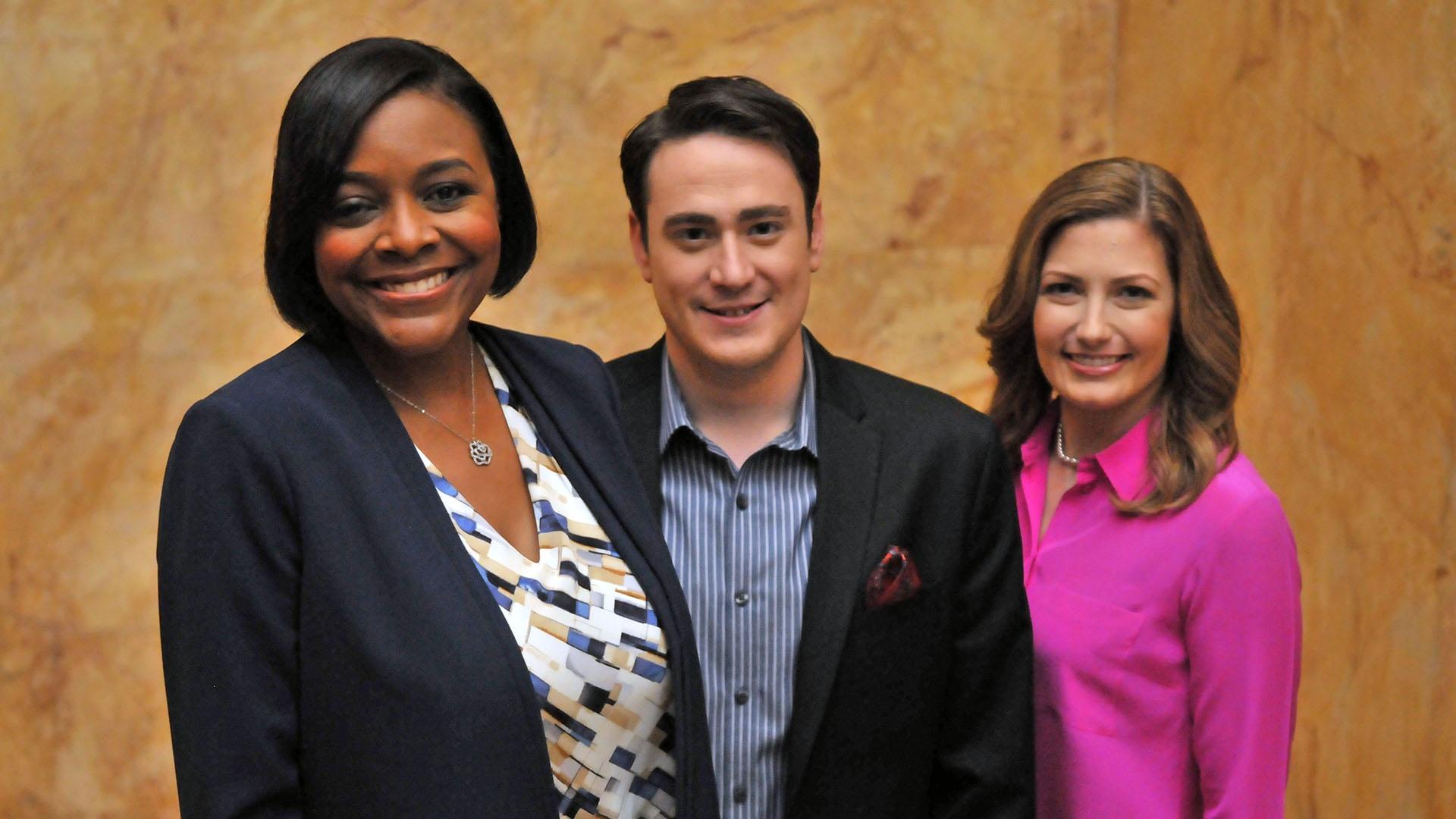
Genealogists Joshua Taylor, Kenyatta Berry and Mary Tedesco revisit their favorite stories from previous seasons, and three memorable guests return to share what has happened since their appearances.


Copy and Paste the Following Code to Embed this Video:
Our Favorite Stories
(announcer) Coming up... And then, she said, "We have the same grandfather. Welcome to the family." This show saved my life. It's completely changed my life and my future, and hopefully, it changed my children's future. (announcer) We're in the City of Angels at historic Union Station. Today, we're taking you for the ride of a lifetime. Oh, wow! That's amazing. I'm so excited. (announcer) On a very special episode of "Genealogy Roadshow." Josh Taylor. Hi, I'm Kenyatta D. Berry. And I'm Mary Tedesco. Over the last three years, "Genealogy Roadshow" has pulled back the curtain on the world of genealogy. Our show has paved the way for viewers like you to unlock the mysteries of their family histories. It's been great meeting people from all over the United States and answering the burning questions that have stumped them for years. So, over the next hour, we'll highlight some of the most compelling stories we've told. We'll also catch up with a few of our most memorable guests. (Mary) A story that I'll never forget is Tim Dasenbrock. Tim wanted to give a gift to his mother-- the gift of her family history. So, let's jump ahead for a moment, to 1900. We have Phillip's son Edward Kunkle, who's your grandfather. Oh! By 1900, Edward Kunkel is actually living as a widower. His wife has passed on, leaving him as a single father with two children. Oh, wow! Barbara, age 14... your mom. Oh! Barbara. And Phillip, age 4. You had an uncle! Yeah! I'll be darned. Oh, my God! How cool is that? Oh! By 1904, Barbara, she's had enough of living under her father's roof. So, she decides to tie the knot with someone named John Wallheimer. (gasps) That's what Wallheimer is. We found a picture of my grandmother, Barbara. Okay. But it had Wallheimer on the back. But on the back is written "Wallheimer". Really? We had no idea what that meant. Well, in 1904, at 18, your mother married John Wallheimer. Ohhh. So, she was very young. Yes, it was. Yes, it was. Well, I don't know, you were 18 when you got married. Really? Well... that's all right, I wasn't 14. (laughter) Touch. Now, in 1909, tragedy unfortunately befell the family again. Oi. Oh, no. Edward Kunkel, your grandfather, passes away in a mining accident. Oh, I didn't know that either. Following this accident, Barbara, your mother, takes care of her younger brother Phillip who's ten years younger, remember. Right. He's only just a boy when this happens. She took responsibility for her brother... Good for her to step up....who was much younger. Isn't that great? To think that your mom was such a-- you know, the upkeep of that family, really. Exactly. And then, in 1924, after 19 years of marriage, your mom Barbara and John divorce. She was married all those years. This divorce record shows us that, in about 1921, your mom Barbara took up with another man called Rufus Eldrige Musgrave. That was-- that was my father. She was stepping out on her husband with your father! Yeah! That's all right with me. Okay! That's all right with me, I... I wouldn't have been here otherwise. (laughter) So, we can assume that perhaps the Wallheimer marriage was not the happiest. It must have been. Aw. But it appears that she did find love with Rufus. Oh, I'm so glad. I am so glad for her. Which is wonderful. And for me! Yes! Oh, boy! So, later in 1924, shortly after the divorce, the two marry. And we know that on February 20th, 1927-- Me! Me! Ha-ha, yeah! There was a wonderful event. Emma Belle Musgrave... Right....came into this world. You made my day. You made my day. Thank you. It's my pleasure, ma'am. That was great. Tim, welcome back to "Genealogy Roadshow". Oh, it's a pleasure being here, Mary. Thank you. Thank you. So, I understand you have an update for us on your mom. Oh, yeah. I'm sorry to say that Mom never got to meet her family in person, she passed away. I'm so sorry. Thank you. I wanna let you know that really there's no reason to be sorrowful. Uh... it was one of the most beautiful transitions that one could wish for. I-- I fed her dinner that night, and she looked at me, and she told me that... she told me that my father needed to come, to hurry and get her. Yeah. And I... you know, Mom's mind wasn't quite always there. And I-- I said, "Mom, Dad's dead. You know Dad's dead." And she said, "I know." Right. "I want him to hurry and come get me." And I-- really, I just... I'm sorry-- I just passed it off. And I put her to bed, and I kissed her goodnight and said "I love you." And she told me she loved me. And, uh... that was it. She did not wake up in the morning, and, uh... Very peaceful. It was very peaceful. Sounds like. It was beautiful. And it sounds like, you know, her husband, your Dad, was... Yeah, I don't know if I believe those things. But... But obviously, there's-- Makes you wonder. Oh, my God, do I wonder now. Absolutely. You know, it's funny. We have a tradition in our family that when someone dies, a bell rings in our house three days later. Really? We have no bell in the house. Yeah. There is... And there was a bell. I s... ooh, I got goose flesh. There was a bell! Wow. And I-- I take it to mean that I made it okay. I wanted to just tell you why this story was so special for me, for so many reasons. My grandmother had dementia. Aw, I'm sorry. And while we were filming this episode, it was at the end of-- of her life, and she actually passed away two months after we filmed with your mom. And when I was talking to your mom, it was like a piece of my grandmother with the disease, like, a little less advanced. So, when I was sitting there with her, I could just-- I understood. Oh, that is so beautiful. And I understood. Thank you. I... she was a great woman. I'm so sorry you-- your grandmother passed, and I hope it was as peaceful as with my mother. It was extremely peaceful. Oh, great. And, um, it was one of the reasons why your story, your mom's story struck me so much, and I was able to connect so much with the two of you, because I just felt like I was already there, like I already understood, like she was my grandmother. Oh, that's great. Tim, tell me a little bit about the impact of genealogy has had on you, on your life since the show. Oh! I was on television, of course, and everyone saw me. And... because I'm of a certain age... Uh-huh? I did not wear my glasses. Okay? Now, I wear glasses in... Sure....in regular life, because I'm not that vain. But you know, I'm on television, I'm a little vain. (chuckling) We'll excuse it. (laughter) I received a call from my doctor personally the next day. Really? And he said, "Tim, I want you to come to my office." Uh-huh? So, I went to the office, and he said, "That mole on your face looks a little odd." What? "And I've never--" he said, "I've never seen it before, you always have glasses on." Sure. And it turned out it was cancer. Oh, my God! Yeah. And two surgeries later, I am cancer-free. Oh, my goodness! And... this show saved my life. (gasps) I have this show to thank for that. Not only did this show, and you, and everyone here give my mother an entire lifetime of memories, but you have given me the rest of my life. Well... I'm speechless. (laughing) Thank you for sharing that with us. My pleasure. Thank you very much, Tim, for being here. I appreciate that. It was an honor, thank you. As a child, I remember completing a class assignment to create and fill in my family tree. I'm sure a lot of you had that same project when you were in school. But imagine not being able to fill in one-half of the tree because you didn't know anything about one side of the family. That was the case for one young woman who I met in Nashville, Sarah Jones. Sarah always felt out of place and had a strong desire to have a connection with her father. So, let's pick up the family. Right, we were at 1940, and we know that your grandmother was Catherine. We know that Catherine met a man named John Kubik. John was a dancer, and he actually built a dance hall. Really? He was a carpenter. Wow. After, you know, John and Catherine had gotten together, they moved to California. Mm-hmm. While in California, they gave birth to a baby boy whose name was David, and that's your father. Wow. Is this the first look you've had? It is, yeah. I haven't ever seen any photos or anything really to speak of, so... Some time in his 20s, your father took a trip to Hawaii. Those are some awesome jorts. (laughter) That's your father. (laughing) Wow. You might like this one. That's amazing. From my time in Hawaii, like, I have pictures similar to this with the surfboards. Looking at your family history, you have a bit more in common with your father. I 100% feel that. My whole entire life, I've felt this huge void. I just didn't fit in, didn't belong, and the only thing I could ever come up with is that there's this whole other side of me that maybe that's who I am, that's where I fit in, that's where my characteristics come from, my personality comes from. Now, are you wondering at all how we got these pictures? Yeah. We actually were able to find someone who lived in California who had these pictures... Really?...in her possession. Now, her name is Sharon. Mm-hmm? And she is your cousin. Would you like to meet your cousin? Yeah, I would love to. All right, Sharon? (gasps) (applause) Sarah, welcome back to "Genealogy Roadshow". Yeah, thank you so much for having me. I'm excited to see you guys. It's great to have you back. I remember when we last saw you, you just sort of made a connection with your father's side of the family. Mm-hmm. You met a cousin for the first time. It was a big surprise. So, what has happened since you came to the show? I've been able to fill out the whole other side of my tree. I wish I had you guys back when I was in third grade. Um, I have a whole new side of my family. I have a new cousin and an aunt, and I've come to California and visited for a week. And I have pictures with, you know, new people, and postcards being sent and birthday cards and care packages, they're just fabulous. How are you different than you were sort of a couple years ago? I feel more confident in myself. You know, 'cause for so long, I felt like a little bit out of place. Um, as much as I, you know, have loved my mom's side of my family, there's definitely parts of me that I do relate to. There was this huge aspect of, like, why didn't I fit in? I felt a little bit like a black sheep. I was like, why is my life not playing out like everyone else's? Who, you know... am I that different? Am I weird? Mm-hmm. And then, you know, once getting to know them and talking to my aunt and, you know, different stories that I could relate to, and lifestyles and belief systems and different things like that, that I just am now-- I feel so much more confident in who I am. So, what's next for you? What's next? You know, I... I'm in a place in my life now where I've been seriously looking at moving out here to California and being closer to them. I never knew my dad, I never got to have a relationship with him. Meeting my cousin and my aunt was a first step of... of kind of getting that part of me back. But I don't wanna miss out on that relationship. You know, we have 30 years to catch up on. So, you know, maybe the next 30 years will be here with them... Yeah....is what I think. So, thank you, guys. That's fantastic. Hey, you're very welcome. Thank you so much for coming back and sharing what's happened. It's great that you keep in touch and you keep those relationships going very strong. Absolutely, couldn't have done it without you guys. (Kenyatta) One of my favorite guests was mystery writer Gail Lukasik. Little did she know, she had the mystery of a lifetime living in her own family. I know you have unsolved mystery in your family. Is that what brings you here today? That is exactly what brings me here today. You know? Okay. And it concerns my mom. I found her birth certificate. Okay. Under "race", she was listed as "colored", C-O-L. So, yeah, I'd be curious to know if that's true. Okay, well, it seems like your mom wanted to do something that we call "taking this to the grave," right? Yes. Yes. This family secret? And I think that happens a lot. And since you already know that she's listed as colored on her birth certificate, let's see if that was an error, or if these records support that. Now, I actually have a 1940 census record. And you see your mother, Alvira Frederic, and you see Shirley Frederic listed below. We see that they are cousins living in a household in New Orleans in 1940. Yeah. But that is your mother. Wow. I mean, this is her at 18 in 1940, and she's working as a maid in a tea shop in New Orleans. I didn't know that. Do you see their designation "N-E-G"? That designation is for "negro". So, here, your mom was identified as black. And this is in New Orleans in 1940 for-- You're kidding. your-- yeah. So, what we uncovered so far lends credence to your mom's birth certificate. So, you know that your mom's parents were Azemar and Camille Frederic. Right. Azemar, on his birth certificate, is listed as "colored". Oh. Like your mother, his daughter. Now, we know also in 1918 that he is working as a pipe fitter for a company called Inland Steel. Wow. Okay? And that was in East Chicago, Indiana. Now, Azemar does find true love, and he gets married, and here is the marriage certificate. And on that, it has Azemar Frederic and "C-O-L". And what do you think that stands for? "Colored". Yeah. Also, in the 1910 census, we can see Camille's race at the age of five listed as "M-U" for mulatto. So, your grandmother Camille is listed as mulatto as well. Oh, my goodness. That's a surprise. That's why I say you never know what you're gonna find when we start looking into genealogy. Wow. Yeah. Are you okay? Yeah, that's really... something else. Mm-hmm. I'm okay. Okay. Yeah. It's a lot of information to take in at once, you know? It is. It's huge. It's huge. (laughing) It's huge. Hi, Gail, welcome back to "Genealogy Roadshow". Thank you, Kenyatta, it's so great to be back here. I'm glad to have you back because I really enjoyed telling your story on "Genealogy Roadshow", because I felt you were so brave to come on national television after your mom had recently passed, and talk about her history and discovering more about your African American heritage. So, tell me a little bit more about what's been going on since you've been on the show. Well, I have to tell you this, that when I was on this show, there's no way I could have imagined what was gonna happen next. Literally three days after the show aired, I got up on Friday morning, opened my email, and I had an email from a woman by the name of Stephanie Frederic. Okay? Now, you remember my grandfather's last name was Frederic. Right, right. Started reading the email, and she said, "I saw the show, and I want to tell you that my father is Azemar Frederic, Jr." Wow. "He is your mother's half-brother." Wow, so one of those four siblings we discussed on the show. That's right. Yeah. And then she said, "We have the same grandfather. Welcome to the family." Wow. It blew me away. I was sobbing, literally. There were tears just running down my face. So, I emailed her back and told her, "Oh, you know, we have to talk, this is so great." So, two hours after I get the email from my new cousin Stephanie... Uh-huh? I get an email from a woman who identifies herself as Aunt Alma. Mmm, okay. I have no idea who Aunt Alma is. She says in her email that, "I am your mother's half-sister." And she said to me, "I've been looking for family probably as long as you have." Wow. And she says, "We have to talk." So, we arranged to have a conversation-- Cousin Stephanie, me, and Aunt Alma, at that afternoon. Okay. So, we get on the phone, and we talk for over two hours. Wow. And they said to me, "We gotta-- we have to meet you. We have to meet you, we have to have a party!" You know, there's something behind this. I don't wanna get too, like, spiritual about this thing, but-- Go ahead. That party took place in April, exactly a year after my mother passed, almost to the day. And what was great about this, which I didn't know because I don't know the Frederics yet, right? Right, yeah. I haven't met them. Some of them hadn't seen each other in 30 years. So, your kind of finding this extended family brought them all together. Yes. Wow. The show, being on the show, and then Stephanie seeing it and Alma seeing it, that brought this family back together after 30 years. You know, your story is honestly one of my favorites. So, I am so excited you were able to reconnect with family and that you're on this new journey and new discovery in your life. After the show aired, besides finding my lost family... Yeah. I'm calling 'em that-- I received a number of emails from mixed race people across the United States. Oh, really? And they were quite moving. Mmm. They were quite moving in that this story hit them because... they're sort of caught in a limbo position, is what they were telling me, racially. Mmm. And that's why they really appreciated my mother's story. They understood it. And so, you said it moved you, but how did it move you? Describe that to me, like, in a way. I felt like I had done something good. Mmm. You know? Yeah. I had done something good. I think knowledge is power, and we need to talk. Mm-hmm. We need to start these dialogues. You have so much more to discover... Yes, yes....as you continue on this journey. But again, I wanna thank you so much for coming back to "Genealogy Roadshow"... Thank you, Kenyatta....and letting us know. Thank you so much. We Welcome back to "Genealogy Roadshow". I'm Josh Taylor. Now, one of the questions we get asked a lot is why genealogy is so important to us. Family history truly changes lives. My favorite moments are when a story or a connection helps someone understand more about themselves. Every family has a story, and I found when I can connect people to their ancestors, it brings them to life. They are no longer just names and dates on a page. Genealogy gives you a sense of self and empowerment. For me, visiting my grandfather's home town in Italy inspired me to pursue genealogy as a fulltime profession. Walking in the footsteps of my Italian ancestor literally changed the course of my life. After that trip, I decided that genealogy was the only thing I wanted to do. (Josh) One story that has left a huge impact on me is the one told by Gail Mullen from Philadelphia. Her question about a mysterious inheritance led her to the heartbreaking story of her cousin Serafine. To really tell the story though, you really need to understand the Jewish experience in Vienna during World War II. When Austria was annexed to Germany, within days, Adolf Eichmann, who was the Second Lieutenant in the SS, came to Austria, and he planned to solve what he called "the Jewish problem." They were forcing the Jewish community from their homes and from their homelands at their own expense. We don't know why Serafine didn't leave. This is a 1942 travel report of a train transport. And it gives us details that on October 5th, 1942, 549 Jewish citizens are transported from Vienna to an extermination camp just outside of Minsk. We know that among those 549... was Serafine Kriwer. (sobbing) I know, it's-- it's tough. (sniffling, sighing) Do you wanna know more about the trip? Yes. Okay. We know the trip took four days. The train arrived the night of October 9th, 1942. Upon arrival, Serafine was immediately executed. (sniffling) Yeah. So, one of the questions is, is your Kriwer family related to these Kriwer siblings? Mm-hmm. Or were they simply being good friends and good people and helping out? We looked into the Kriwer family to see what we could find. We see a record of Edith Kriwer, and it says that her father is Wolf Kriwer. And then looking at your Kriwer line, your grandfather Robert, his father was a Josef Kriwer. Okay. Josef Kriwer had a brother, Wolf Kriwer. Aha. What we learn is that the individuals your grandparents were helping were actually your grandfather's cousins. Wow. Sometimes, the things we uncover in our past are not pleasant. They reflect a horrific moment in our history. Does that help clear up some of the confusion? It does, it does, thank you. You're very welcome, thank you for stopping by today and sharing your story with us. Thank you so much for having me. My life is forever changed, thank you. (Mary) Penelope McCarthy and her diverse family wanted to know more about a slave woman named Henriette Walker, and how Henriette brought these two families together. We wanna find out what the story is, whether good or bad, but we're hoping it's-- it's a good story. She's the-- basically the matriarch of this family. She's the one that brought us all together. So, let's take a look at Henriette. Could be "On-ri-et" in French. Correct. We know that Henriette had at least two children, that we're aware of, by Gustav Gremillion, a slave owner. One Joseph, born in 1857, and the next, Aristide, born in 1864. Is that right? My great-great- great-grandfather. So, on the 1850 census, we find that Gustav Gremillion was married to somebody named Maria Malvina Guerit. So, like a large number of female slaves during this time period, it appears that Henriette may have had two sets of children-- one with Gustav Gremillion, and the other with her husband, Pierre Walker. Oh! Did you know Henriette was married? (all) No! Okay. Oh, boy. Oh! Let's take a look at the 1870 U.S. Census. This was the first census she would have been enumerated as a free woman. (man) Oh! Okay, great. Oh! Oh, cool! So, this is the 1870 U.S. Census. Now, this particular census does not detail the exact family relationship. Doesn't say, like, mother, brother, wife, et cetera. So, we can assume that the children listed as "black" were Henriette's and her husband's, Pierre Walker. Two sets of twins? (laughing) Oh, my gosh! So, that's why I had twins. Oh, really? She has twins! Wow. Thank you, grandmother. But it is interesting because, according to the census, close by are the two boys. Oh... Joseph and Aristide, her sons with Gustav Gremillion. And Keva, Aristide is your third-great-grandfather. They really were not that far away-- just within the same post office district. So, let's recap the children. From the records, we were able to find out that Henriette had two children with Gustav Gremillion-- Joseph and Aristide. Right, okay? And with her husband, Pierre, we were able to discover that she had at least another 13 for a total of 15 children. Oh, my word! We have so many more cousins to find! Oh, we gotta find them! You might wanna get more people in Point Coupee to take a DNA test. Yes, that's so awesome. I'm guessing. And then, we see by this 1925 record from Point Coupee... Wow. That's her death record. Oh, my gosh. Oh, my goodness. I have been trying to track that down for years. Mercy. So, on May 1st, 1925, your Henriette passes away at the age of almost 90. So, she definitely lived more of her life as a free woman than a slave. It's heartwarming to know that she lived as a free woman for quite a few years, and she was able to-- I'm assuming-- find happiness. I wanna thank each of you for coming on "Genealogy Roadshow". And thank you so much for bringing the whole family, because you guys are really fantastic. Thank you. And we love each other so much. (applause) (Josh) Many people don't realize that Filipinos are the fourth largest group to immigrate to the United States. I met U.S. Army veteran John Owen in Miami. He wanted to find out more about his mother's Filipino heritage. But what we were able to piece together gave him a complete picture of who he is. Now, we actually know that your mother comes from the island of Panay-- there in red. And in that island, there are different provinces, and she comes from the province of Iloilo. And we were actually able to identify the exact town that she was born in as Dueas. See, I never knew that. We always thought that she came from Santa Barbara. Well, we know this because we actually were able to uncover the baptismal record of your mother. That's amazing. I've been looking for so long for something like that. I mean, that's-- that's a piece of my mother you have. So, you can see her there in the middle. You can see that she's baptized 25th of August, 1943. That really is amazing. It brings me much closer to her, it really does. Yeah-- the incredible thing about genealogy is that you never know what you'll find, who will be connected. So, you hinted already that your mother grew up during the second World War. Yes. And she did, it was literally in her backyard. The Japanese actually arrived at the island where your mother was born in April of 1942. The Japanese conquered the city and the Eastern side of the island, but the local residents did not give up. So, the Filipino troops became part of what's known as that Philippine resistance movement. Okay. Or the guerrillas. We know that there were more than 200,000 individuals that were organized into guerrilla groups, and they literally kept fighting the Japanese until the Allies came in and retook the island of Panay in March of 1945. You might have seen images like this. Yeah, actually had a copy of that put on my wall in Iraq. Did you really? Yeah. That's amazing that you've seen this before, and that it became something that encouraged you because this was the life that your mother and her family would have been living. Wow. You know, you look at someone's family tree, and we always like to poke around a little bit and see what else we can find. And so, we looked into something on your father's side of the tree. Okay. So, I actually want to introduce you to your grandfather, Walter Owen. That's a... 'cause I've never seen him or know anything about him, it's just amazing. So, you don't know anything about your grandfather? No. Nothing at all. Does it feel a bit emotional to look at a picture like that? It is, it's emotional to hear all of this. It's just amazing to-- to be able to see my grandfather, because I never had a chance to. (Kenyatta) Singer Evelyn Johnson came to the roadshow hoping to find a connection to St. Louis jazz musician Buggs Roberts, who wrote and composed songs for legendary artists like Benny Goodman and Louis Jordan. When doing genealogy research, we tend to look for, obviously, someone's given birth name and surname. Now, as you know, with musicians, they use nicknames and pseudonyms. Okay. And so, when looking for Buggs Roberts, came up short. There was nothing with the name Buggs Roberts on it. So, then, I thought, Buggs was famous in St. Louis as a musician, let's go to some newspapers. Okay. We were able to find an article that was published in January 1951. Now, this article gives us a name, and it's truly sort of the start of an obit for Buggs. And if you take a look here, and it says Leroy Buggs Roberts. Oh, okay! So, now we go from just Buggs Roberts to Leroy Buggs Roberts. And we searched for Leroy and names similar to Leroy with the last name Roberts. We were able to find a death certificate for a LaVelle Roberts. Hey! (laughing) That's where your middle name comes from! Yeah. So, your middle name is LaVelle? Yeah. (woman) Okay. Well, now, don't get too excited. We still don't have proof that they're the same person. Okay. Now, he was born on May 11th, 1915 in a little town called Anniston, Alabama. Wow. In 1934, while they're living in Zanesville, Ohio, Buggs joins his first band-- the Al Sears Band... Okay....in Cincinnati. Okay. Okay, Al Sears. Oh! Al Sears Band. All right! So, now that we have an idea of who he is, we need to see if we can answer that question for you. Yes, yes. Is this famous Buggs Roberts of St. Louis the same as your great-grandfather, Daddy Buggs Roberts? So, let's look at the second part of that article we had. Okay. One of the big things it mentions is who his surviving family is. Oh! Tell me if you recognize a name. Delores, your grand-- great-grandmother. Oh! And actually, all of these names are familiar to you as your ancestors. Yes. And just to confirm what we've seen on the obituary, that Daddy Buggs Roberts... Yes....is indeed the famous St. Louis arranger and composer... I'm so excited....Buggs Roberts. I'm just tingling all over. Now, if you turn around, we were able to find an article with a photo of Buggs Roberts over there. (gasps) It's kinda grainy. But if you can see it right there in the corner, that's him. Right here. Talking a little bit about his accomplishments and who he played with as well. Look at him. Oh, wow! That's amazing! It's just overwhelming to me, it really is. This is the very first time I've ever seen a picture of him. Oh, wow. Yes. Daddy Buggs died when I was just a year old. (sighs) So, why are you so-- your mom is getting really emotional. It's just overwhelming, really. It is? And why is it overwhelming? Just to see? Well, just to know, you know? Just to know. Just to know. (Josh) I met Lila Luster and her daughter Kayla in New Orleans. They were curious about the history of their family home, bought over a century ago. And what I revealed to them proves the true meaning of "Home Sweet Home". What is your first memory of the house? When I look at it, the first thing I just think was spending time with my grandmother. My great-great-grandmother Mama Jean would stand in the doorway there. It's so many-- so many memories. So many memories in that house. So, the question is, how long has your family resided at that house? You provided the name of your third-great-grandmother Adele. Mm-hmm. Did you know her husband's name? No, we haven't been able to find a name to connect with her. Well, looking through the documents, we know the name of your third-great-grandfather. Wow. He was Jean Baptiste Eugene. We actually looked at the 1867 city directory. Jean Baptiste. So, here we see your third-great-grandfather Baptiste Eugene listed in the 1867 city directory. He is living on 176 Villere Street, and he was a drayman, which meant that he drove flat-bed wagons to transport goods back and forth. Wow! The next document we took a look at was Union Civil War veterans. Wow. And it's in this schedule that we actually find your third-great-grandfather Jean Baptiste Eugene. That's amazing. We know from the record that he enlists on the Union side, and he was in the 73rd Regiment, Company A of the Colored Troops. Wow, that is... remarkable to find that out. You know, to know that your family was involved in the Civil War. Very involved in the Civil War. Very much so. Now, we know from death records and other documents that, very sadly, your third-great-grandfather died the very next year after the 1890 schedule. He left behind his wife Adele, your third-great-grandmother. Right. And six children. Right. She applies for widow's pension. Now, the pension files have survived. There is millions of pages, they're in one place. Where is that? They're in Washington D.C. at the National Archives. We were able to uncover... Oh!...the words of your third-great-grandmother. Oh, you're kidding me! This is what she had to give to prove she was the wife of Jean Baptiste in order to receive his pension from the military. Yeah. Did she-- and she did get it. She got it, she got it. The question is, what did she do with it once she had it? Let's look at Adele. Oh, Josh, what did she do? What did she do? Here she is in 1890, so she gets the pension-- I know what she did with it. She bought the house! Exactly what she did. Here she is in 1900. Wow. Living very clearly at 1315. Adele Eugene, 1315... Wait, where do you see it?...and it's a double. So, 1313 and 1315 is on-- it's the same house. And look at the family. Now, you said at one time there was 29 people living in the house? 29 people living in that house at one time. Look at people, I mean, that I think is a family tradition. A single mother of six bought that house. Yes. Had it not been for your third-great-grandfather... Right, in the military....serving in the Civil War, which made her eligible for the widow's pension... For the pension....you might not have that house in your family today. Wow. The very conflict that affirmed the emancipation of the slaves... Of slavery....also changed the destiny of your family. Of my family. Thank you so much for... Thank you. Oh, you are welcome. It's amazing. We hope you've enjoyed these stories as much as we've enjoyed bringing them to you. Thank you so much for supporting "Genealogy Roadshow". Stay tuned this season for many more amazing and compelling stories. And please remember, "Genealogy Roadshow" is made possible because of viewers like you. (announcer) Next time on "Genealogy Roadshow"... Could this man be related to the founding fathers of Boston? That's quite a family legacy. I'm floored. (announcer) One woman's quest reveals her ancestor's unexpected journey to America. Your family was at the right place at the right time. Did you hear about this? (whistling) (announcer) And... what's got this man whistling? How amazing is that? Absolutely blows my mind. (announcer) Join us in Boston, Massachusetts, on "Genealogy Roadshow."
Search Episodes

Donate to sign up. Activate and sign in to Passport. It's that easy to help PBS Wisconsin serve your community through media that educates, inspires, and entertains.
Make your membership gift today
Only for new users: Activate Passport using your code or email address
Already a member?
Look up my account
Need some help? Go to FAQ or visit PBS Passport Help
Need help accessing PBS Wisconsin anywhere?

Online Access | Platform & Device Access | Cable or Satellite Access | Over-The-Air Access
Visit Access Guide
Need help accessing PBS Wisconsin anywhere?
Visit Our
Live TV Access Guide
Online AccessPlatform & Device Access
Cable or Satellite Access
Over-The-Air Access
Visit Access Guide




Follow Us