








PBS Wisconsin Passport
Watch this video with
PBS Wisconsin Passport
Become a member of PBS Wisconsin, support your local community, and get extended access to PBS shows, films, and specials, like this one.
Albuquerque
05/17/16 | 54m 11s | Rating: TV-PG
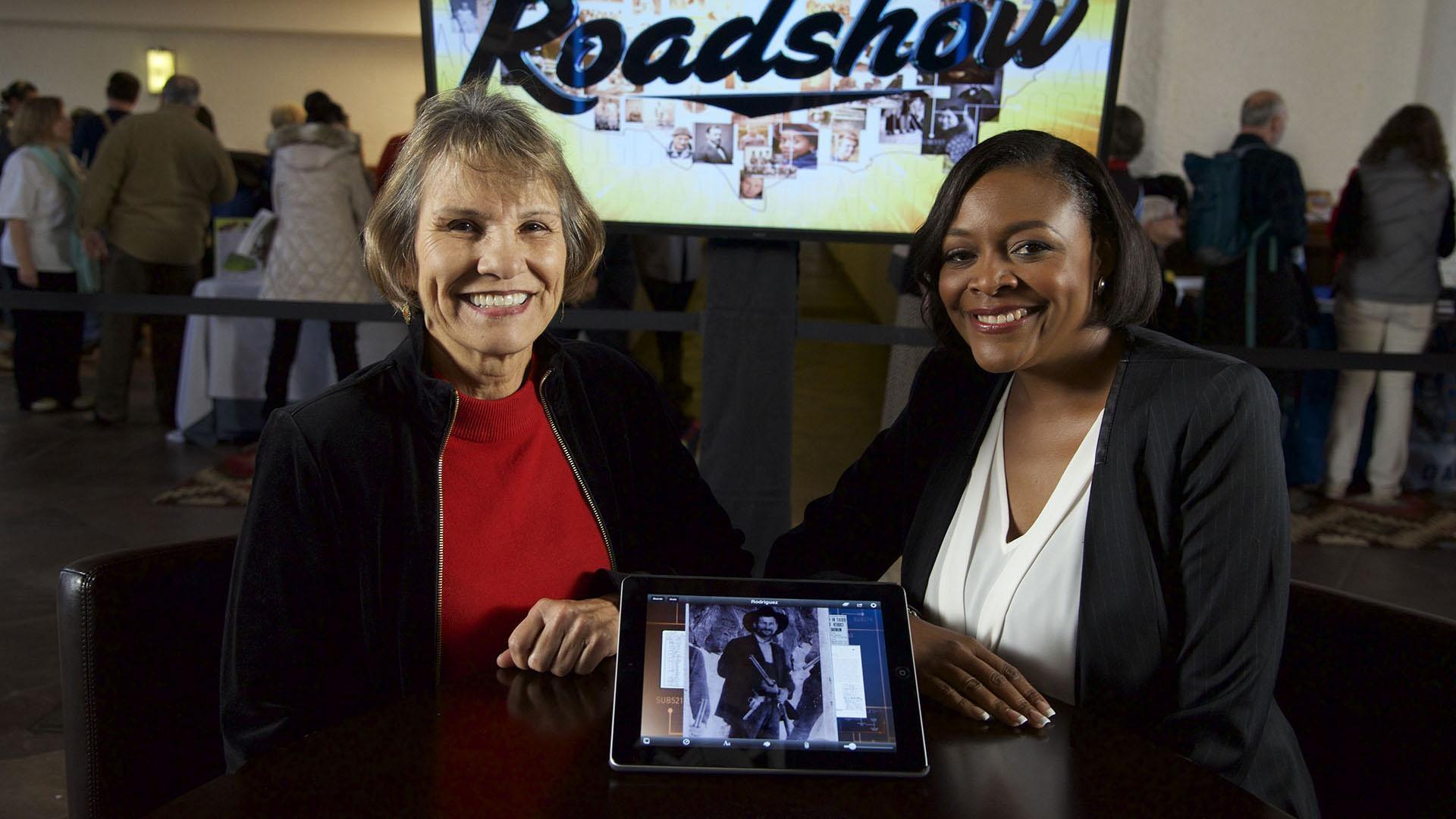
Trace a woman’s connection to a Native-American code talker; a man’s deep New Mexican roots; an ancestor whose life resembles a Wild West tale; queries about a tie to the explosive Trinity Test; and a man’s link to a famous comic book heroine.


Copy and Paste the Following Code to Embed this Video:
Albuquerque
(announcer) Coming up on "Genealogy Roadshow"... Are you serious with me? Yes. Was this woman's long-lost relative a war hero? So his family didn't even know what he actually did? He was classified for many, many years. Plus, does this man have a connection to a comic book heroine? Oh, my goodness. That's amazing. And, is her grandfather responsible for the takedown of an infamous outlaw? Oh, my gosh. I never heard this before. The search for these answers begins right now, on "Genealogy Roadshow." We've crisscrossed the country helping everyday Americans unlock family secrets... I have goosebumps. I know. And discover the truths of their past. That's amazing. Helping uncover these fascinating stories is our expert team of genealogists. Join us as we take everyday people on an emotional journey of self-discovery. Today, we're in New Mexico's largest city, historic Albuquerque. Settled by the Spanish in 1706 and named for the eighth Duke of Albuquerque of Spain, the city sits along two famous landmarks-- the Rio Grande and Route 66. Since its founding, Albuquerque has blended its Spanish and Native American roots. Located in the heart of Indian Pueblo country, Albuquerque is steeped in Native American culture. Ancient artifacts permeate the city, and Old Town Albuquerque is filled with adobe Pueblo/Spanish architecture that mirrors its Southwestern landscape. Today, we're at the Old Albuquerque Airport Terminal. Funded by the Works Progress Administration, the airport opened in 1939, with only two runways. The building's Pueblo revival architecture makes it one of the few airports designed in the style of its region. We're here today to help our guests take the trip of a lifetime through their family histories. Well, these are some documented papers signed by two different presidents for the Homestead Act. So, we wanted to find out, you know, a little bit more about our history out here. This is my grandfather. He won the Silver Star in Korea, and I would like to know more about my military heritage. Our first guest wants to know if her grandfather was involved in capturing one of the Wild West's most notorious outlaws. My name is Gerri Rodriguez, and I'm from Albuquerque, New Mexico. I'm a fourth generation native New Mexican. I am now retired. And the main thing that I do in my life is to care for my mom and my dad. It's a challenge sometimes and kind of hard, but it really is an opportunity to get to spend time with them and know them. My mom's father, my grandfather, sounds like he was a very interesting man. He was a deputy marshal for a short period of his life. That must have been, first of all, a very dangerous profession. I think it was a pretty wild west town at the time, and they did have a lot of outlaws. One of the things that I heard about is that perhaps he helped Sheriff Pat Garrett capture Billy the Kid. So, that's speculation, but I'm hoping to find out. I just think it was probably kind of exciting. But it makes me wonder how that kind of life was. I'd love to know more about it. Hi, Gerri, welcome to "Genealogy Roadshow." Thank you, it's great to be here. So I understand you're here today to learn more about this man here. Yes, that's my grandfather, John Francis Barnum. Well, I must say from looking at this photo... and being in New Mexico, he looks like quite the character. Definitely. So, Gerri, to answer your question about Billy the Kid, we first need to see if your grandfather and Billy the Kid were at the same place at the same time. Okay. So to do that, let's take a look at the obituary for your grandfather, John F. Barnum. (Gerri) Okay. And in looking at this obituary, we can see here in 1908 Mr. Barnum served as city marshal in Raton, New Mexico. Right. Now, we've established him being a city marshal... 1908, oh. In 1908, okay? Okay. Now, Gerri, it is well documented that Billy the Kid was actually killed in a shootout in 1881. (laughing) Okay. So we can definitively say that your grandfather was not... (laughter) involved in the capture or death of Billy the Kid. So that family story is not true. We're-- we're putting that to rest. We're putting that to rest today. However though, in doing the research to cover more about your grandfather, we looked at his life as a city marshal. And what we discovered was a true Wild West story. Oh. Now, your grandfather was a city marshal in a place called East Raton. And as a city marshal, his duties were very similar to that of a police officer. Okay. Of what we think of today. Now, New Mexico in 1908, and New Mexico and what it is today, obviously is very, very different. And many people think that the Wild West ended at the turn of the century. But, it took places like New Mexico a lot longer. And, in fact, New Mexico was one of the last places to be granted statehood, and that actually happened in 1912. Oh. Right. Now, your grandfather was a city marshal in the Wild West. Right. The Wild West had good guys and bad guys. And your grandfather was a good guy. But I wanted to tell you what happened when he encountered one of the bad guys. Okay. Okay? And this guy's name is Napoleon Cantou. Now, Napoleon was a notorious troublemaker. He was a convicted forger. He actually attempted to break out of jail and failed to do so. And, he threatened to kill a local sheriff. So, he was definitely one of those bad guys. In May of 1909, your grandfather attempted to arrest Napoleon's brother Steve. Now, he went to the house to arrest him for fighting and breaking the peace. Now, a violent confrontation occurred, and it led to Napoleon actually getting shot... in the chest. Oh, my gosh. By my grandfather? Yes. Okay. Okay? What I'm gonna pull up is a document known as an affidavit where Napoleon is going to give his version of the events. Okay. I'm gonna scroll down. And we're gonna start with the sentence, "I was inside the house when he shot me. I gave John Barnum no occasion to shoot me." Oh, my goodness. "I had no gun either in my hands or about my person." Napoleon is saying that he is completely innocent in this. Of course. He was doing nothing. You know, it's all John Barnum's fault. Now, one of the things about this affidavit is, Napoleon died shortly thereafter. From-- From his injuries... Injuries. From the shootout. So, Napoleon is giving his version of the events sort of on his deathbed. And this affidavit actually led to an indictment for your grandfather, John Barnum, for the murder of Napoleon Cantou. Oh, my gosh. I never heard this before. Before? Yeah. And in your grandfather's version of the story, your grandfather alleged that Napoleon actually had a gun and shot at him. Yeah. So he shot back in self-defense. I believe it. (laughter) Now, that's quite a different version than what we heard in Napoleon's affidavit earlier where he had no gun on his person... Right. he never threatened anyone-- Right. Why would he even think to shot him? Now, in October of 1909... Mm-hmm. Your grandfather, John Barnum, was put on trial. Yes? Now, since Napoleon dies before the trial... Oh. There is no way for your grandfather's attorneys to cross-examine him. It essentially kind of came down to one man's word versus the other. Mm-hmm. So, Gerri, let's take a look at what the jury decided. And this is an article from the "Albuquerque Journal". And here we can see... murder in the third degree for Barnum. (gasps) Oh, my gosh. Maybe this is why I never heard about it. Yes, that could be. (laughing) I mean, when you think about family stories, yeah. Oh, my gosh. Oh, my gosh. And, look! The jury decided in just two hours? In two hours, they deliberated. However, the local community rallied around your grandfather. And the citizens of Raton petitioned the governor of the Territory of New Mexico to pardon your grandfather. I'll be. Oh. Now, let's take a look at that petition. Here it states... "The end of justice will be best subserved "by the pardon of Barnum and his restoration to liberty and citizenship. Respectfully submitted." These are the words of his community. That's great. So, then, what happened? Right. We need to figure out was this petition actually successful? Was it effective? Here's the governor's response to the petition, and if you can just read a bit of it for me starting with, "Now, therefore." "Now, therefore, I, William J. Mills, "Governor of the Territory of New Mexico, "do hereby grant to the said John Barnum "a full and complete pardon "from the sentence above referred to. "This pardon will take effect on Thanksgiving Day, November 24th, A.D., 1910." Hallelujah. (laughter) Yeah, so he was pardoned, and he was told... And on Thanksgiving Day! On Thanksgiving Day. To spend it with his family. Wow, that's very-- something to be thankful for, isn't it? Yeah! My parents are in their 90's, so to be able to have information for them that they never knew before while they're still living. Yeah. Just to be able to share that with them. To share this story with them. Yeah. Thank you. Thank you so much for coming to "Genealogy Roadshow." (Gerri) I was able to find out something that no one in our family, to my knowledge, knew. And to be able to carry that information on and share it with my mom and dad who... who probably don't have that many years to live, so it's exciting to be able to give it to them. (announcer) Did this woman's Native American ancestor help turn the tide of World War II? When I was a baby, my mom and dad got divorced, and then we lost contact with his family. But, my mom had heard that one of my grandfather's brothers was in World War II, and he might have been one of the Navajo code talkers. And that's pretty much all I know. I would like to find out who else is out there. You know, I would like to find out who else is out there like... that would embrace me like I want to embrace them. Charlotte, welcome to "Genealogy Roadshow." Thank you! I'm so excited to be here. Well, I'm very, very excited to share what we found. So, before we start, let's actually learn a little bit about the Navajos and the Navajo code talkers. Okay. One thing that's very well known about the Navajos is their extremely complex language. You know, in genealogy, we often have to trace a language that isn't necessarily familiar to us, but the Navajo language is something completely different. It's widely unwritten. Because of the complexity of the Navajo language, the Navajo people played an incredibly important role during the second world war. The U.S. military was incredibly unsuccessful at the start of the war against the Japanese. The Japanese kept cracking the coded communications of the U.S. military, and this was devastating to the U.S. forces. Every time the U.S. would change their code, the Japanese would immediately crack it. Mm-hmm. Luckily, Philip Johnston, who was a retired U.S. Marine, he had actually been raised on a Navajo reservation with his missionary parents. Oh! And, because he understood the language, he said maybe the fact that it is so complex, that might be a great, great resource for the U.S. military to use. So, Johnston and other members of the military actually wt to Native American boarding schools to recruit Navajos who spoke both English and Navajo. Uh-huh. And, they actually enlisted, in 1942, 29 recruits, known as "the original 29." And those recruits worked to create a very, very intricate code the military would use. The Japanese were never able to break the code. The Navajo code talkers were instrumental in winning the war for us, including key battles such as Iwo Jima and others. Oh. So, a pretty-- pretty important moment in history. Now that we know about the Navajo and the code talkers, let's talk about how to trace Navajo family history. And here's where it gets really difficult. Oh! (laughter) The Navajo are known to use multiple given names for different occasions. Oh. So, whereas your name might have been Charlotte for your entire life, for someone who is Navajo, that might not always be the case. Oh, I see. So, let's start off with your grandfather, Coolidge Nez. Okay. Now, looking through vital records, we know that your grandfather was actually born right here in Albuquerque. Okay. About 1914. And here, we turn to a very specific set of census rolls that are collectively known as the Indian Census Rolls. Oh. Now, some of the Native American census rolls actually assign an ID number to an individual. Okay. We're-- We're lucky for that because, remember that the Navajos don't always keep the same sort of first name, that could change, and so one of the easiest ways they could think of is, well, let's have a sort of common way to identify from year to year to year who these individuals are... Yeah. within the census document. When we go to the 1930 Native American census rolls for the Navajo, we find a Do Kee Nez who is-- is about 16 years old. Your grandfather Coolidge would have been about 15 or 16 in 1930. So, it's very possible that this Do Kee Nez is your grandfather. And, there is an ID number given here, on the side of the census, of 62323. Going forward ten years to the 1940 census, we find a Nez family, and sure enough, you see there at... Oh, yeah. You see a Coolidge Nez, and look at the number right by his name. Mm-hmm. 62323. It's the same ID number. So, there's your grandfather Coolidge in the 1940 census. And the nice thing about the census records are, of course, it gives us an entire family. Yes, I see that it says there's lots of siblings. You see a lot of siblings. You see siblings of Leonard and Charlie and Francis and Dora and Chester. Now, Chester's a name that you knew as possibly being a Navajo code talker. Yes. But the question is, is this Chester on the census, who we know is-- is the brother of your grandfather... Mm-hmm. Is he a code talker? Yes. Now, I can tell you that there is a Chester Nez that is known as a Navajo code talker. In fact, he is known as one of the original 29 code talkers. Oh. We know this because his life was chronicled by a writer named Judith Avila who actually worked with Chester to document and publish his memoirs. Oh. And the nice thing about the memoir is, it gives information about his family. We learn that his Navajo name was Betoli. And, it mentions his family members-- a sister, Dora, and a brother, Coolidge. Oh! The same family found on the census rolls. So, Charlotte, Chester Nez the code talker is your granduncle. The family stories are true. (laughter) You always wonder, you know, you just... wonder. I do. So, we know that Chester was sworn in as a recruit in 1942. And there is your-- your granduncle Chester. A very, very distinguished photo. His service to our country was classified by the U.S. government for 20 years. Oh, so his family didn't even know what he actually did? Yes. In 2001, the original 29 code talkers were actually awarded with the Congressional Gold Medal by President Bush. And we actually have a photograph of Chester saluting the president, receiving his medal. That's amazing. It's more than I'd hoped for. (laughter) Chester was the last living of those original 29, and he died only a few years ago, in 2014. Our researchers also came across some family photos. Oh. Let's take a look at-- at a couple of-- of the family photos. The first one, this is actually the original 29 code talkers, and Chester is right down there in front and in dead center. Oh, wow. We also came across a photograph of your grandfather, Coolidge. Oh, yeah. (chuckling) Have you ever seen a photo of him before? I have not, no. I just wish that I could have known him, you know? I just-- It would have been so nice to have that connection. We also came across another photo. This one might surprise you, but you might recognize the person. (laughing) Oh! Yeah. I have more hair now, though. (laughter) So-- So, this is your baby photo? Yes. (laughing) Now, you might ask yourself, how-- how did we find these? Exactly. Right? How do you find photos of yourself as a baby? We're good... (laughter) In that sense, but we found the best type of document a genealogist could ever, ever find. We found a living relative. Oh, really? Yes. And it's that living relative that provided us with the photos. I wasn't even sure that they were still... living. I just have had no-- no contact with... any of my dad's side of the family at all, so it's-- that's nice to know, you know? I just-- it would be nice to have that connection with somebody that's my family. Well, I was hoping you would say that... (laughing) Because your aunt Nancy is actually here to meet you. Oh! Really? I'd like you to meet Nancy. Hi. Hi, Charlotte, I'm your aunt Nancy. Hi. How are you? I am so glad to meet you. All except for me. You're beautiful, baby. It's so good to meet somebody just-- Oh, you're-- you're mine. You're mine now. Nancy, thank you so much for coming. You're welcome. And Charlotte, thank you so much. Oh, thank you. This is-- This is one of the best moments in genealogy, when you can connect people together. So, I hope this is the beginning of a very, very long journey of reconnecting and discovering more about your Navajo heritage. Thank you so much. Thank you very much. You are amazing. You're very welcome. Thank you so much Thank you both for coming. Thank you. (Charlotte) What my mom thought was true was actually true, you know? We have other relations out there, other living family that we didn't know, and we actually got to meet one, my-- my aunt. I will definitely keep in contact with Nancy, and I'm hoping that she can put me in contact with other members of the family that I don't know, and I'm just excited to meet. Tracing Native American history can be a challenging task. To research Charlotte's family, Josh traveled to the University of New Mexico and the Center for Southwest Research, which houses the American Indian Oral History Collection. So much of Native American history comes wrapped up in oral tradition. This collection was collected in the 1960s from the elders of multiple Native American tribes, so it's including their memories of many, many generations. So, it's possible that I'm gonna find information about three or four generations at once just from a single interview. When visiting an oral history collection, you really want to ensure that you're consulting with the staff on site, because they're going to be very well aware of what's in their collection. When you gain access to the collection, you're normally given a CD or an audio cassette, and you can actually listen to the words of the relative or the person being interviewed. I want to hear the words and the tonality of the person that I'm researching. They're speaking now in the Navajo language which, of course, I can't understand. Luckily, there's been a full transcription made and a translation, so I can understand what they're saying. Oral history archives aren't just confined to universities or libraries. It's very possible that you could create your own personal family history archive. In fact, as a genealogist, you should. You should start interviewing older relatives to make sure that your stories aren't lost. So go, interview, talk, listen. That will help give you a more complete picture of your relatives' lives. How does a postcard from the past connect this woman to a top secret experiment that changed the world? My name is Janet Mansfield. I live in Corrales, New Mexico. My maternal grandfather is a mystery to me. I was five years old when he died, so I have these very vague memories of him, and this vague story that I've never been able to really prove-- how he was one of the scientists who witnessed the Trinity Test. All I know about the Trinity Test is that it was the first place they tested the atom bomb. I'd love to find out more about what he was doing here. If I knew more about it, I'd feel a little more connected to him. He'd be more of a real person, as opposed to just some abstract memory. Janet, welcome to "Genealogy Roadshow." Thank you, it's so great to be here. So, you came to us with a very fascinating story. You think that your grandfather, Archibald Stuart Hunter, may have witnessed the Trinity Test? Uh, these were vague stories that I grew up on. We didn't hear much, I think probably because he wasn't allowed to talk about it. So, I understand you brought us a postcard. I did. This was from my grandfather written to my grandmother in 1947 from Albuquerque. And, it's the only paper trail I have of him actually being in New Mexico. And that's what's brought you here today? Yes. Well, let's set aside this postcard for a moment, Janet, and look into the history of Trinity. So, when Hitler gained power in Europe, our allies were worried that Nazi Germany could come up with an atomic bomb. This fear was real. In response, the United States government developed a top secret program that we now know as the Manhattan Project. Mm-hmm. That work created an atomic bomb, as we know, and this work took place all over the United States. But the project's lead laboratory was right here in New Mexico at Los Alamos. Mm-hmm. More than 130,000 men and women took part in this research project, the Manhattan Project. That's a massive amount of people. It was an enormous project. On July 16th, 1945,
at 5
30 in the morning, the first atomic bomb was detonated at the Trinity Test. And thus began the Atomic Age. Our researchers were able to locate an eyewitness account of this blast from Italian physicist Enrico Fermi. Now, remember, this information was classified until 1965, which is 20 years after the test. Let's take a look at video of the very first nuclear blast while I read the eyewitness account. "On the morning of the 16th of July, "I was stationed at the base camp at Trinity "about ten miles from the site of the explosion.
The explosion took place at about 5
30 a.m." (explosion) "My first impression of the explosion was "a very intense flash of light and a sensation of heat "on the parts of my body that were exposed. "I subsequently looked in the direction of the explosion "through the dark glass, and could see "a conglomeration of flames that promptly started rising. "After a few seconds, "the rising flames lost their brightness "and appeared as a huge pillar of smoke, with an expanded head like a giant mushroom." I have goosebumps! I know. I can't imagine being there and just... It's just mind-blowing. And back to your question, Janet. Was your grandfather Stuart at Trinity? Was he? (laughing) Janet, I love this picture. This is the picture that you provided to us. Your grandfather, Archibald Stuart Hunter, was born in 1897 in Massachusetts. According to his obituary, your grandfather earned his PhD from Johns Hopkins University in Maryland. Science was his field. From 1927 through World War II, your grandfather Stuart worked for DuPont. Yes. During the war, DuPont played a major role in the Manhattan Project. DuPont worked with the University of Chicago on plutonium production and the design of the world's first nuclear reactor plant. I had no idea. They're right in the middle of all this. Wow. However, where did your grandfather fit into this puzzle? We pored through boxes of unclassified information at the National Archives. Wow. Eventually, our research turned up a declassified page. This is a transcript from a congressional hearing in which your grandfather testified. So, this is the cover page. Oh, my gosh! Oh, this is great! So, what was this? Your grandfather was trying to get a bill passed that would fund a brand-new research and development laboratory for the War Department. In this transcript, your grandfather states what he was doing during the war. Shall we take a peek? Yes, yes, yes! (laughing) Toward the bottom of the transcript, your grandfather states, "I remained as a civilian during the war. "After the war broke out, the Quartermaster General "persuaded the DuPont organization to loan me to their organization." Oh, wow. Wow! So, he was definitely involved with the War Department during the war. Wow. I didn't know that. The next thing I want to bring your attention to is another declassified page related to your grandfather, which we located, again, at the National Archives. At the top, it reads, "Clothing-- Radioactivity." And down toward the bottom, "Effect of the Bikini Island Crossroads Operation." I have no idea what that is. Crossroads was a 1946 atomic bomb detonation in the Pacific. It was the fourth-ever detonation. We have Trinity, Hiroshima, Nagasaki, and then Crossroads. Wow. This document indicates that your grandfather was studying the effects of radioactivity on clothing. In fact, what we think is, your grandfather may have directed the research. This piece of the puzzle may tie your grandfather to at least one atomic detonation. What about Trinity? I know, I know! Was he at Trinity? Was he at Trinity? We found one remaining clue, and it proves that your grandfather was at the forefront of the research in the Atomic Age. Wow, this is exciting. (chuckling) In 1961, long after Trinity, this patent was made public. Just take a look at this, Janet. (Janet) "Atomic Burst Locators." Yes. I have no idea what that is. Well, the atomic burst locator could pinpoint the active center of an atomic explosion. Wow. (Mary) This is an article from 1961 about the declassified patent. And take a look at the names of the inventors at the bottom. Who do we see? Archibald Stuart Hunter. Wow. Could this have given your grandfather a reason to be in New Mexico during the Trinity Test, and afterward? It would make sense. Let's look at what we have so far. Your grandfather being loaned by DuPont to the War Department during the war. We have him directing radioactive tests on clothing for the Crossroads nuclear test. And we see that he was an inventor of the atomic burst locator. And of course, we have your postcard from New Mexico. Your grandfather's scientific work was far more complicated and extensive than meets the eye. Was your grandfather Stuart at Trinity? We may never know for sure, Janet, but what we do know for sure is that your grandfather Stuart was a brilliant man. A brilliant scientist. Wow. And he went to the grave with many secrets. This is amazing. I want to personally thank you for sharing this special story. It was fantastic. He was a very special man. Thank you so much. I just-- I really feel like I got to know him a little bit better today. This is fantastic. (announcer) Searching through this young man's past uncovers an American heroine immortalized on coins and comic books. (Ken) My name's Ken Parker. I currently live in Camp Verde. I've been living in Arizona the last 20 years, and I'm a back country wilderness guide at Grand Canyon. I have lived most of my life outside, and I wonder how far back that goes. How many generations Parkers been dealing with this desire to get out? My grandfather died five years ago, And with him a lot of the family history also went. And now that I'm recently married, being able to have these stories to share with my future children, to have a complete family history to pass forward is very meaningful. My main question is where else my family has been across the United States because there are so many Parkers. And when did they come to this country? My history goes back a long ways. I want to know more about it, and I want to be able to share that with my hikers, with my future children, with my wife, to have a more complete connection to my past. It'd be very special. Ken, welcome to "Genealogy Roadshow". Thank you. It's wonderful to meet you. I'm very excited to be here. So what makes you excited about tracing your family history? Well, my family history is known pretty well about four generations back in Arizona, and when we came to Arizona, when we came to the United States, they're all kind of question marks. Okay, okay, well, we're gonna hope to fill in some of those question marks. You have a really, really amazing story. You have a connection to a legendary American colonist. The story of your ancestors' arrival to America is full of drama and intrigue. And literally-- you excited? I'm very excited. All right, all right. It is literally one for the history books. Oh, my goodness. Before we get to that story-- Yes. Let's actually trace back your line to get beyond those four generations where you were at. Okay. So let's take a look at your tree. Now, you were able to trace back to your fourth great-grandparents, Abraham Blackshear and Milinda Lord. Yes. Now, we were able to extend that line back a bit further through a variety of wills and other documents. So we were able to go back to your fifth great-grandparents, Alexander Blackshear and Agnes Stout. And Agnes Stout is the daughter of Benjamin and Agnes Stout. So we're almost back to their first arrival in America, almost there. 1669... wow. 1669. That's where it gets really exciting for me because I've researched the Stout family before. Oh, really? For others. And there is a particular interesting character in the Stout family tree. Now, remember how we used wills and land transactions before? Right. We can use the same documents to link back to another generation. So this is a 1695 land transaction between a Richard Stout of New Jersey, a wife Penelope, and a son Benjamin, your sixth great-grandfather. So your seventh great-grandparents are Richard and Penelope Stout. Really? That's amazing. 1695, it's pretty far. Well done. A bit more than four generations, right? It is. Now, Penelope is that interesting Stout character I was hoping to find. Yeah? Penelope's story starts with her arrival in America about 1640. 1640. 1640. We've been here awhile. You've been here a long time. A long time. According to legend, Penelope, your seventh great-grandmother-- around 1640, she and her first husband joined some other colonists from the Netherlands and headed to New Amsterdam, today known as New York City. Right. The ship never made it there. It was likely wrecked in an area that's now part of New Jersey, on the shoreline. They think they wrecked around an area that was known as Sandy Hook, sorta near that New Amsterdam colony. How do we know this? I told you your ancestors made it in the history books. Mm-hmm. Right, they made one of the earliest histories of New Jersey that was ever written. In 1765... an early history of New Jersey actually accounts the story of a woman who was shipwrecked off of the coast. And it connects that to... the woman who married someone with the surname of Stout. Huh. This is a legend about your seventh great-grandmother. Right, the woman. That's amazing. The passengers of the ship arrived on the shore where they were wrecked. Um, and there was a young Dutchman who was Penelope's first husband, and he was too sick to travel. So the other passengers left Penelope and her husband behind and headed for New Amsterdam. So they just left her? They just left her. You're a guide, I mean, you would never do that-- Never. Never, never, never. That's rule number one I'm sure, right? That's right. Never leave people alone. That's right. Well, the Indians attacked. They killed Penelope's husband, and they mangled her, leaving her for dead. Wow. Penelope survived, living in a hollow log for several days until she was rescued by an old Indian and a young one. Eventually, according to legend, the Dutch of New Amsterdam heard of a white woman among the Indians. They figured that it had to be Penelope, and they came to her relief. And Penelope then joined her fellow colonists. Once there, of course, she meets her second husband, Richard Stout, who we believe is your seventh great-grandfather. What a story of survival. Absolutely. Penelope and her family actually become part of a group of settlers that move to the northern part of what is now New Jersey. This is actually the same place where Penelope was taken during her earlier capture. So she and her husband are blazing trails to go to-- sort of uncharted, brand-new area... Amazing....to see if they can settle there. I have a regular need to go into uncharted territory as well. Maybe it comes from Penelope. I think I can understand that feeling. Now, it's such a story, it's actually been immortalized on coins. So here is Penelope Stout. And here she is, being rescued. The area today is known as Middletown, New Jersey. And your seventh great-grandmother is known by the nickname of "The Mother of Middletown". Really? Yes. So if you go to Middletown, New Jersey, you can walk in and say, "Hey, you wouldn't be here without my seventh great-grandmother." I think I'll try that. There's one more legend in the life of Penelope that I want to share. Go on. The next document I'm gonna show you is something that I-- I never thought I'd be showing someone as a genealogist. Penelope made the comic books. Did she? Have you ever heard of something called "Ripley's Believe It Or Not"? Absolutely. Well, in the 1960s, your seventh great-grandmother made "Ripley's Believe It Or Not" with the legend of her escape. And it notes that, when she died, she was 110 years old, and she had 502 descendants. By the age of 110, I suppose it's possible. It's possible, and now there are Stout descendants all over the world. I bet. Penelope has very active pages on social media of her descendants trying to figure out the truth to this legend. There are blogs. There are books. There are all sorts of people that are your distant cousins who are all trying to figure out the truth behind the Penelope story. And now I can join in. Absolutely. Finding a story of an immigrant ancestor is one thing, but finding this story... were you expecting something like this? Not at all, this was totally unexpected. Well, thank you so much for coming by. Thank you for letting us tell Penelope Stout's story. Thank you for sharing it with me. Hey, you're welcome. This will definitely be something for the trail. (announcer) The old Albuquerque airport terminal is filled with excitement as guests pack the historic building with questions about their ancestries. I have a great-grandmother that I've always been fascinated by. This is my two times great-grandfather. And I'm curious about his parents because we do not know our ethnicity. (announcer) An in-depth analysis of guest Carlos Villarreal's DNA reveals Sephardic ancestry. Growing up, we've always been told that we were Spanish, nothing but Spanish. And it's interesting to see the mixture that we have. (announcer) And Mary encourages Roberta Brito to use New Mexico's early church records to trace her roots. So, Roberta, what I would recommend in your case is to travel directly to this parish where your ancestors were baptized and married, etc. Not only can you hold the record in your hand, but you can find the marriage record of the parents and work your way very efficiently back, basically, into the 1700s. That's amazing. (announcer) Researching this young man's family tree uncovers roots that predate the state of New Mexico itself. Uh, I'm Mark Vigil, I'm 30 years old, and I'm from Albuquerque, New Mexico. I'm coming here to find out more about my father's side of the family. I know that we've been in the state of New Mexico for a very long time. Uh, I've heard some stories here and there, but I really want some better detail of what really happened in our history. Mark, welcome to "Genealogy Roadshow". Thanks for having me. Thanks so much for being here. What makes you family such a treasure trove for genealogists is that your family seems to have remained in one place, New Mexico, for many generations. Wow. Church records tell us that your second great-grandparents link you to one of the oldest families... Really?...in New Mexico. Wow. I want to take a look at your pedigree chart, Mark. Okay. So there you are, there are you parents, your grandparents, your great-grandparents, and your great- great-grandparents. Oh, wow. I want to focus your attention on the lady called Teodora Ortiz. Okay. She is your link to one of the oldest families in New Mexico. Let's check with your second great-grandmother in this census document from 1870. Can you find Teodora? All right, yeah. Line one, Teodora Ortiz. I want to scroll up to the top right for a moment and bring your attention to something. Do you see that, where state is crossed out? Yeah. Territory. Territory of New Mexico. That's amazing. So we found roots this deep in New Mexico, this is pre-state. Can we trace your family back even further? I hope so. That's the question. So we found your family in the 1700s. Oh, wow. When New Mexico was still a Spanish colony. No way. As if the territory wasn't enough. Wow. That's pretty amazing. The next ancestor that I wanna talk about is your sixth great-grandfather. Wow, that's going back now. It is-- now, his name was also Antonio, but he was Antonio Jose Ortiz. Okay. So let me tell you a little bit more about him-- he was a very wealthy man. Was he? Very wealthy. He was a rancher, a merchant, and a money-lender. So this is a pretty big deal. If that wasn't enough, he was also the mayor of Santa Fe. Whoa! What? Santa Fe? Yes. How 'bout that? So you want to know if you had deep roots in Santa Fe. Yeah, right? There it is. That's amazing. It's pretty cool stuff. In addition, he was responsible for funding the construction of several churches and chapels in and around Santa Fe. Really? This is one of them. And guess what, Mark? You can visit this today. This is still standing. Really. This is the Chapel of Rasario. That's too amazing. So talk about having deep roots in Santa Fe. Yeah. Well, we located your Ortiz's ancestors, as you've seen, in the 1700s. Right. We talked about your very deep roots in Santa Fe. Mark, not every family in this country can trace their ancestry back to the 1600s, but you can. Oh, get out of town. Because your family was involved in another rich part of New Mexico history called the Reconquista of New Mexico. So in 1680... No, really?...the northern Pueblos banded together to drive Spain and its colonists out of the country. They were almost successful. A dozen years later, Spain and its colonists staged a comeback. Soldiers and about 70 civilian families living near Mexico City joined the other settlers to reclaim lost Spanish territory. Mark, your family was part of this-- Oh, wow. --reconquest. That's monumental right there. It really-- it really is. Your family was one of the families from Mexico that were known as the Espaoles Mexicanos. Oh, wow. That's what they were called. The Spanish Mexicans. Exactly. You're a direct descendant of one of those families who risked their lives to travel from Mexico City to the New Mexico frontier. So they were the civilians that the military-- Exactly. Wow. They were amongst the civilians. So they volunteered to go up-- wow. You got some pretty amazing ancestors, I have to tell you. That's amazing, yeah. We have one more surprise for you. Oh, my goodness. One more surprise. Remember your sixth great-grandfather, Antonio Jose Ortiz? Yes. The man who was the mayor of Santa Fe. Right. Well, the King of Spain issued a decree requesting voluntary donations from his subjects to support the American Revolution. Your sixth great-grandfather, Antonio Jose Ortiz, took part in collecting the donations. The best part is, we have proof. Mark, this is an incredibly special document. This is not only a New Mexico link, this is an American link. And this document that your sixth great-grandfather, Antonio Jose Ortiz, appears on, he is one of the donors. Oh, wow. The Daughters of the American Revolution recognizes your sixth great-grandfather, Antonio Jose Ortiz, as a Revolutionary War Patriot. That's amazing. This is such a big deal, Mark. I can't-- this is such a big deal. And not many people are aware that there are Spanish Americans who made contributions to the Revolutionary War. I wasn't-- yeah, I was totally-- this is news to me. And your family was a part of this. Yeah, yeah. At the middle of it. Mark, you came here wanting to know how deep your roots run, specifically in Santa Fe, New Mexico. We were able to trace your family all the way back to 1693. Right, yeah. Mind-blowing. It's mind-blowing. Yeah, I didn't think it would go that far. Right in Santa Fe. Right in Santa Fe. The story of your family, Mark, is the story of New Mexico. Yes, it is. Mark, thank you so much for coming. Oh, it's been a great pleasure of mine. Great pleasure of mine. Yeah, it's been great. (announcer) And finally, this woman's attempt to find a connection to a Mexican legend leads to an emotional discovery. My name is Adria Gonzalez. I am 33 years old. I was born and raised in El Paso, Texas. Ever since I was a kid, my family would get together and talk about lots and lots of stories. But there's one particular one that really got to me. The one about Pancho Villa, that he was maybe related to us. I want to know-- did it happen? Did we really have a connection with Pancho Villa? Some people know their ancestors, know where they come from. But I feel like I'm lost. We are the people that we are because of our past. I want to know truly where I come from Why am I the person that I am? Hey, Adria, welcome to "Genealogy Roadshow". Hello. How are you today? Fine, great, great. Very excited to be here, actually. Well, great-- well, hopefully today, we can help you learn more about your family. Thank you. and whether or not you have that connection that you've heard about to Pancho Villa. Mmm. So, when you're doing genealogy research, and you're looking at someone who might have been famous or infamous, there's two things you need to do. First, you need to learn more about that person. And then, we also need to see if your family was in the same place... Okay....at the same time. So let's learn a little bit more about Pancho Villa. Okay. Pancho Villa was a Mexican revolutionary-- Robin Hood of sorts. He stole from the rich and gave to the poor. But he was also a killer and a bandit. And because of his Robin Hood status, that made him somewhat of a folk hero. Sure. Now, in 1910, the Mexican Revolution started. Mm-hmm. And he joined that. And he was the first revolutionary leader to occupy a major city, and that city was Parral. Yes. Okay? He retired in Durango, and then he was actually assassinated three years later by seven gunmen. Okay? Okay. So, now that we know a little bit about Pancho Villa, did your family and Pancho Villa actually cross paths? Yes. So let's start by taking a look at your family tree. Right. Here, we have your great-grandfather, Jacinto Torres. Yes. And he was born and baptized in Parral in 1883. Oh, wow. Yeah. And you've heard that name before? Yes, I've heard it because of my grandmother Ramona. Ramona? Okay. Now, your great-grandparents, Jacinto and Maria, were the parents of ten children. They had four boys and six girls. Oh, wow. What I'm gonna bring up is the birth record for their first daughter Aurora, who was born in 1908. 19... And she is... born actually in Parral. So, we have Jacinto born in 1883 in Parral, Jacinto and Maria getting married in Parral, and their first daughter Aurora is born in Parral. Oh, wow. And then, we have a document that shows Aurora's sister, your grandmother, Ramona. And this is her birth certificate. Oh, that's... That's my grandma, Ramona. Born in 1911 in Parral. This is her birth record. Wow. I think if she was here, she would be very happy. Mm-hmm. Very emotional. I wanna share with you what we call in genealogy a descendancy chart. These are all the children of Maria and Jacinto Torres, your great-grandparents. Oh, wow. This is your family. The Torres. Yes. Oh, wow. So, all ten of those children were born in Parral. So, this puts your family there between 1908 and 1929. Wow. Now, why is this important to you? We know that Pancho Villa captured Parral. We know the Mexican Revolution took place between 1910 and 1920. Yes. And this puts Pancho Villa and the Mexican Revolution literally at your family's doorstep in Parral. Yes. But Adria, although we were able to place your relatives in the same town as Pancho Villa, unfortunately, we were unable to find a blood connection to him. Okay. Wow. But in doing research to find out if your family was connected to Pancho Villa, I was able to find out a lot more information about your family. And what I want to share with you right now is a record related to your great-grandfather, Jacinto Torres and his parents. This is the baptismal record of Jacinto Torres, born in 1883 in Parral. Mm-hmm. This document is great because it lists his parents, your second great-grandparents, and that's Cresencio Torres and Apolonia Hernandez. Oh, wow. These are your second great-grandparents. Oh, I always wanted to know their names. When you find documents like this when doing genealogical research-- Right. --it gives you that additional nugget of information, that, for us-- Mm-hmm. is two additional names we can search. So, we searched more documents. Really? More documents? More documents, yes. Are you excited? Yes, I am very excited, I'm like, whoo! I can tell. And we were able to actually find a marriage record for your second great-grandparents. Are you serious with me? Yes. Wow. So, this is Cresencio Torres and Apolonia Hernandez. Now, what we love about this record is it lists their parents as well, your third great-grandparents, Jose Maria Torres and Maria Remedios Gutierrez. Oh, my God, I... I can't believe this. So, we were able to go back two additional generations beyond your great-grandparents. Wow, that's amazing. Now, one of the things I think resonated with me when you kind of talked in the beginning... Mmm, right....was how much you felt a connection to your ancestors, how important this was to you. Yes. What I'm about to show you is really gonna bring it home for you, because when you're doing genealogy research... Okay?...this is the point you want to get to. We were able to actually extend... your family tree... Oh, wow....to your fourth great-grandparents on both sides of your family. Not just one side, but both sides of the family. Wow, I... I'm in shock. I'm in shock. Wow. This is amazing. This is four generations that you can walk away with. And with all of these additional names, you can definitely continue your genealogical journey, and maybe that journey can include a visit to Parral. Yes, thank you so much. This really means a lot to me, and our family's gonna get closer than before. Thank you so much for coming to "Genealogy Roadshow". Oh, thank you so much. Thank you for being here. Well, we didn't have anything about Pancho Villa, but I did find out about my ancestors. It's very inspirational, even though they're not physically with me, I know that, spiritually, they're here with me actually. (electronic blasts) (announcer) This episode of "Genealogy Roadshow"nnouncer) Next time on "Genealogy Roadshow"... One man is given the gift of a lifetime when we connect him to his Filipino roots. That's awesome. I really-- I really want to find out. (announcer) Does this woman have a hero or villain in her family tree? Oh, my gosh, you're kidding. I know. (announcer) And the truth about a government cover-up brings everyone to tears. I can truly say he is a hero. He is a hero. (announcer) Join us in Miami, Florida, on "Genealogy Roadshow."
Search Episodes

Donate to sign up. Activate and sign in to Passport. It's that easy to help PBS Wisconsin serve your community through media that educates, inspires, and entertains.
Make your membership gift today
Only for new users: Activate Passport using your code or email address
Already a member?
Look up my account
Need some help? Go to FAQ or visit PBS Passport Help
Need help accessing PBS Wisconsin anywhere?

Online Access | Platform & Device Access | Cable or Satellite Access | Over-The-Air Access
Visit Access Guide
Need help accessing PBS Wisconsin anywhere?
Visit Our
Live TV Access Guide
Online AccessPlatform & Device Access
Cable or Satellite Access
Over-The-Air Access
Visit Access Guide




Follow Us